Why learning struggles when the structure disappears
By Jacob Carr
Published: 2026-01-21
URL: https://whatteachershavetosay.substack.com/p/what-happens-after-the-worksheet
In this essay:
- Why learning struggles once the cues are gone
- How legibility reshapes student thinking
- What over-structured success costs planning and judgment
- Where questioning breaks down
- The constraint we rarely name
This is the second piece in a series examining transferable skills and their uneasy relationship with modern schooling. Rather than asking whether students are prepared, this essay asks how our designs shape what they are able to carry forward.
This essay is part of a short series exploring transferable learning and why it has become harder to see inside modern schooling. Rather than asking whether schools are “working,” the series examines what our systems are actually designed to notice, reward, and protect, and what happens to the rest. As each piece is published, it will be linked below.
- Focus: What schooling is designed to make visible, and what it quietly misses.
- Week 2 — What Happens After the Worksheet Ends
- Focus: Why success inside school often fails to hold once cues disappear, and why that failure reflects system design rather than individual effort or motivation.
- Week 3 — Naming the Skills That Carry
- Focus: Identifying and organizing the skills that allow learning to move across contexts, and showing why they are structural rather than soft.
- Week 4 — Building on What You Already Do
- Focus: How to use this way of thinking to strengthen existing practice, making transfer more likely without turning it into “one more thing.”
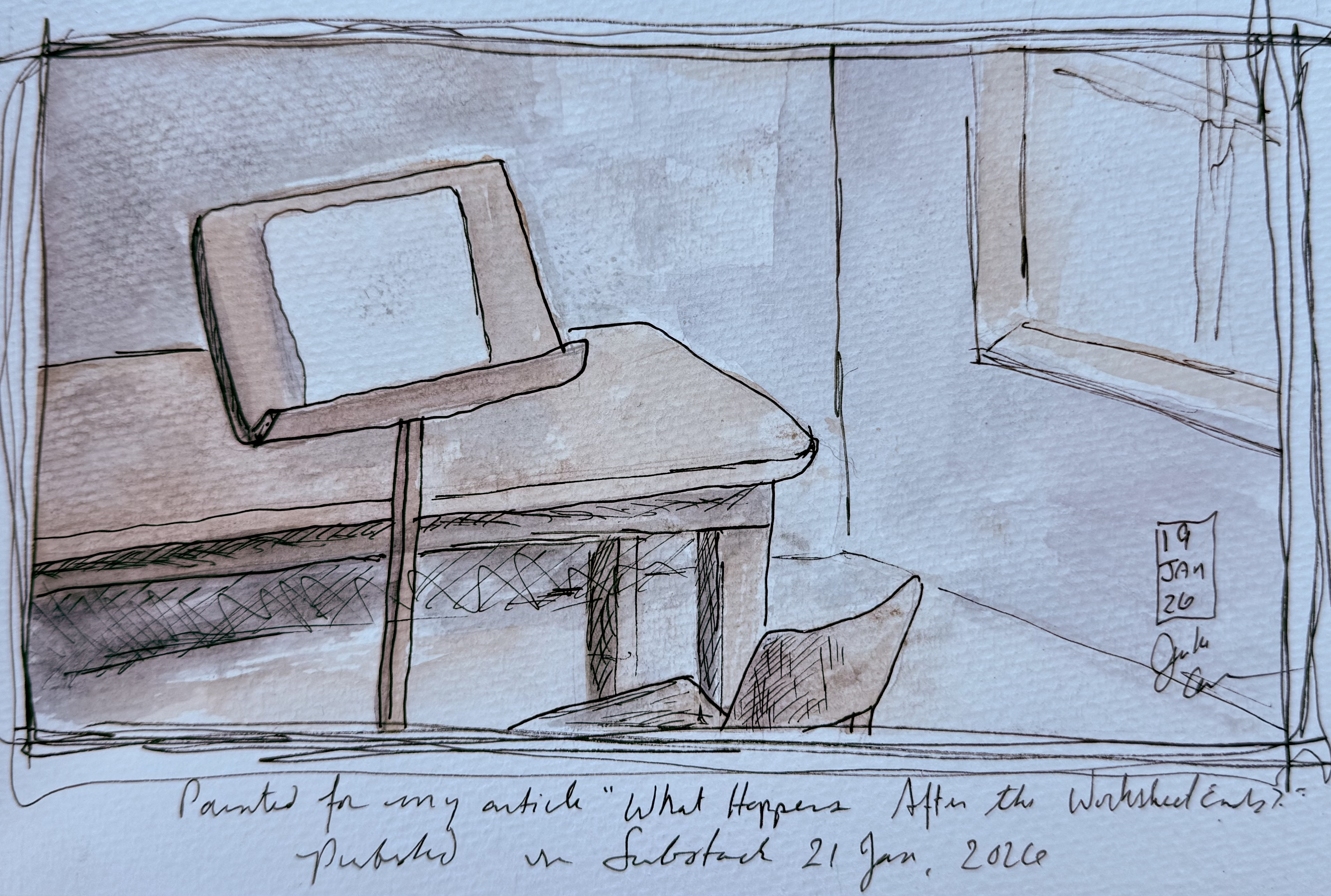 \Original watercolor painting by the author. Created January 19, 2026.\
The first time I saw the problem clearly, it was not in a data meeting or a policy conversation. It was in a music room, morning light cutting across a row of scuffed music stands, students packing up recorders with the restless energy that comes near the end of the day.
A middle school student stood staring at a sheet of music, frustrated and visibly stuck. She was a strong musician. She played violin well. She had learned soprano recorder, then alto, and was working toward tenor.
When it came time to play a simple part in a recorder trio for our class play, she froze. “I can’t read this,” she said. “I only read violin music.” What struck me was not the hesitation but the certainty behind it. She had learned something deeply incorrect without ever being taught it directly. She believed her skill lived joined to the instrument instead of inside her.
She believed her skill lived joined to the instrument instead of inside her.
It took only a few minutes to untangle. We did not talk theory. I did not re-explain clefs or notation systems. What she already knew was more specific than that. She knew the names of the notes on the recorder. She knew the fingerings that produced them.
What I had handed her said “piano” at the top, and that label alone had been enough to throw her off. Once we talked, she could see that the treble clef she was used to on the violin worked the same way here.
The difference was not the notes but the fingerings she used to make them sound. That realization unlocked something. She tried the same music on the labeled piano, slowly at first, then with growing confidence. Within moments her posture changed. She smiled, not because it was easy, but because something had shifted.
The music no longer belonged to the violin. It belonged to her.
That moment has stayed with me because it was not unusual. Students succeed in school every day and still struggle the moment the rules change. The format shifts. The cues disappear. The task no longer resembles the worksheet, quiz, or protocol they practiced.
When that happens, we often treat it as a personal failure. We talk about motivation, grit, or readiness. Sometimes we talk about teachers. Rarely do we talk about design, even though the pattern is far too consistent to be explained by effort alone.
If this resonates, you might appreciate the previous essay in this series, “The Learning the System Can’t See”
As I wrote in my previous article in this series, schools are built to make learning visible at scale. What can be scored, aggregated, compared, and defended becomes the organizing logic. This is not a moral failure.
It is a structural one. Systems simplify because they must. Complexity is reduced until it can be managed. Context is stripped away until performance becomes legible. Over time, this shapes what counts as success. Assessments privilege what can be captured cleanly and quickly, often emphasizing recall or procedural accuracy in stable conditions.
The system gets the evidence it needs. What it does not get is evidence that learning can survive outside those conditions.
Transfer demands something different. It asks learners to recognize relevance without being told, to abstract ideas away from familiar formats, and to exercise judgment when cues are incomplete. Those conditions can be uncomfortable. Performance often dips before it improves. Students feel less confident even as their thinking becomes more flexible. From the outside, this can look like confusion or inefficiency. From the inside, it is the work of learning how to decide.
Early in my career, I avoided that discomfort more often than I like to admit. When I needed something for tomorrow, I reached for a worksheet from the curriculum set of blackline masters. When time was short, I leaned on structures such as sentence frames and hamburger paragraphs.
When students struggled, I filled in gaps for them. Legibility is efficient whereas capability takes patience. I have deep compassion for teachers who are exhausted and functioning day to day. But, that compassion does not change the physics of learning.
When students aren’t asked to navigate uncertainty, they don’t learn how to do it.
I saw this clearly when I stopped pre-teaching vocabulary in my high school English classes. One year, I introduced rhetorical fallacies and cognitive biases to tenth graders using a Fast and Curious EduProtocol routine. Twenty two fallacies, twenty two forms of cognitive bias, and some Latin terms for good measure. There were groans. Laughter. Exclamation of “Carr, there’s Latin in this!” But, they were not penalized for not knowing. They were allowed to miss, in fact, required to miss. We ran short rounds, tracked growth, paused briefly on the most missed concepts, and returned to the work.
The class average climbed steadily. This sounds like it took a long time, but Fast and Curious is designed for speed—15 minutes a day for a week, 75 minutes total. What took weeks in traditional vocabulary instruction happened faster because the design builds in spacing, immediate feedback, and visible progress.
The efficiency came from trusting the structure, not from having extra time. What did require discretion was choosing to run something that looked chaotic on day one and trusting it would work by day five. Not all teachers have the autonomy to make that bet when administrators or colleagues expect instruction to look productive from day one.
What changed was not the content, but my approach to the process. Students learned how to notice, revise, and try again before everything was made explicit. It reinforced that they could learn from their own mistakes, even when it comes to academics like vocabulary.
What changed was not the content, but my approach to the process.
The same dynamic appears when we look at how students learn to plan their work. Step by step templates and sentence frames are useful early on. They expose students to possibilities and help them see what a process can look like before they have the experience to generate one on their own. Problems arise when those structures quietly become the goal rather than the means. I am reminded of a story about a teacher who led a class through drawing a flower, carefully modeling each petal, the stalk, the leaves, and even the yellow coloring.
One student drew their flower differently. When the teacher saw the work, the student was reprimanded for not following along closely enough. The task was never really about learning how to draw a flower.
It was about reproducing the teacher’s version of it. Sometimes that kind of rigidity is appropriate when students are learning a new skill and need clear guidance. When it becomes the end point, however, it teaches a different lesson. Students learn to match a model instead of developing their own way of working. Planning, prioritizing, sequencing, and revising begin to weaken, not because students are incapable, but because the design never allows for them to practice those decisions.
It teaches students how to draw that specific flower instead of the transfer ability of how to draw flowers. It is like leaving training wheels on a bike indefinitely. The motion looks correct, but balance never develops.
This is not an argument against structure. Students learning to factor polynomials need worked examples. Writers developing thesis statements benefit from models. My question is what happens next. Does the scaffold fade, or does it become the ceiling?
In math, we expect students to eventually solve problems without step-by-step prompts. In writing, we should expect the same. The issue is not that we provide structure but that we mistake successful performance within that structure for independent capability.
When the scaffold is still doing the cognitive work, transfer hasn’t happened yet.
This becomes even more visible when students are asked to generate questions. Wicked Hydra is an EduProtocol I developed after noticing how uncomfortable both students and adults had become with wondering out loud.
The first time it is used, it often feels awkward. Questions are shallow. Students hesitate. They wait for permission. That discomfort reveals something important. Many learners have been trained, carefully and unintentionally, to stop asking. Wicked Hydra removes answers from the equation and allows curiosity to sprawl. Over time, questions deepen. Confidence grows. Students rediscover that uncertainty is something they are allowed to inhabit. I have written more about how Wicked Hydra works in practice for those who want to see the protocol in action and learn to use it in their own settings.
This helps explain why students can perform well in school and still falter outside it. Clean classroom performance rewards recognition of familiar formats. It rewards compliance with known expectations. It rarely asks learners to decide what matters when conditions change. When those conditions do change, students do not suddenly forget what they learned. They discover they were never required to use it independently.
Students do not suddenly forget what they learned. They discover they were never required to use it independently.
Across fields, the same pattern appears. Instruction focuses on the learning event and transfer is assumed to naturally follow. When transfer is treated as incidental, success becomes brittle. Fragmented tasks are easier to manage, but they deprive learners of opportunities to coordinate thinking into a coherent whole. Over time, learners become dependent on structures they did not design and confidence erodes when those structures disappear.
We did not fail to teach transfer because it is mysterious, but because we did not treat it as a constraint. Systems optimized for legibility will always struggle to produce adaptability, and effort cannot compensate for designs that remove judgment, variation, and uncertainty. When learning fails to travel, the error is diagnostic, not moral.
Do you see this pattern in your context? What makes transfer hard to design for in your setting?
If transfer is the constraint, two questions follow. First: What kinds of learning survive when conditions change? That’s a question about naming, identifying the skills that make performance durable across contexts. Second: What conditions allow those skills to develop? That’s a question about design, but also about power. Who controls pacing? What gets assessed and when? What counts as evidence of learning, and who decides?
Individual teachers can’t answer the second question alone, but they’re not helpless either. There are moves that create room for transfer even within tight constraints, and there are ways to build collective pressure for better conditions. The next essay names the skills. The final one turns to implementation as a strategy that accounts for what teachers actually control and what they don’t.
If you want to follow this series as it develops, you can subscribe here or join the conversation on Substack Notes.
If this essay was useful, please share it with a colleague or tag someone who’s thinking about these questions. The more educators wrestling with transfer as a design problem, the better.