Why self-care doesn’t always restore educators, and a simple way to rebuild energy
By Jacob Carr
Published: 2026-01-07
URL: https://whatteachershavetosay.substack.com/p/rested-but-still-tired
If you rested over break and still feel exhausted, you didn’t do anything wrong. You may be running into a quiet distinction between comfort and recovery that rarely gets named. This piece explores that difference, and offers a small, humane structure to work with it. I’ve made some downloadable punch cards are available here as a Canva Template that go along with this article.
Print them. Use them. Ignore or edit the ones that don’t fit. Keep the ones that do. Maybe get a teacher-bestie to join you. Enjoy!
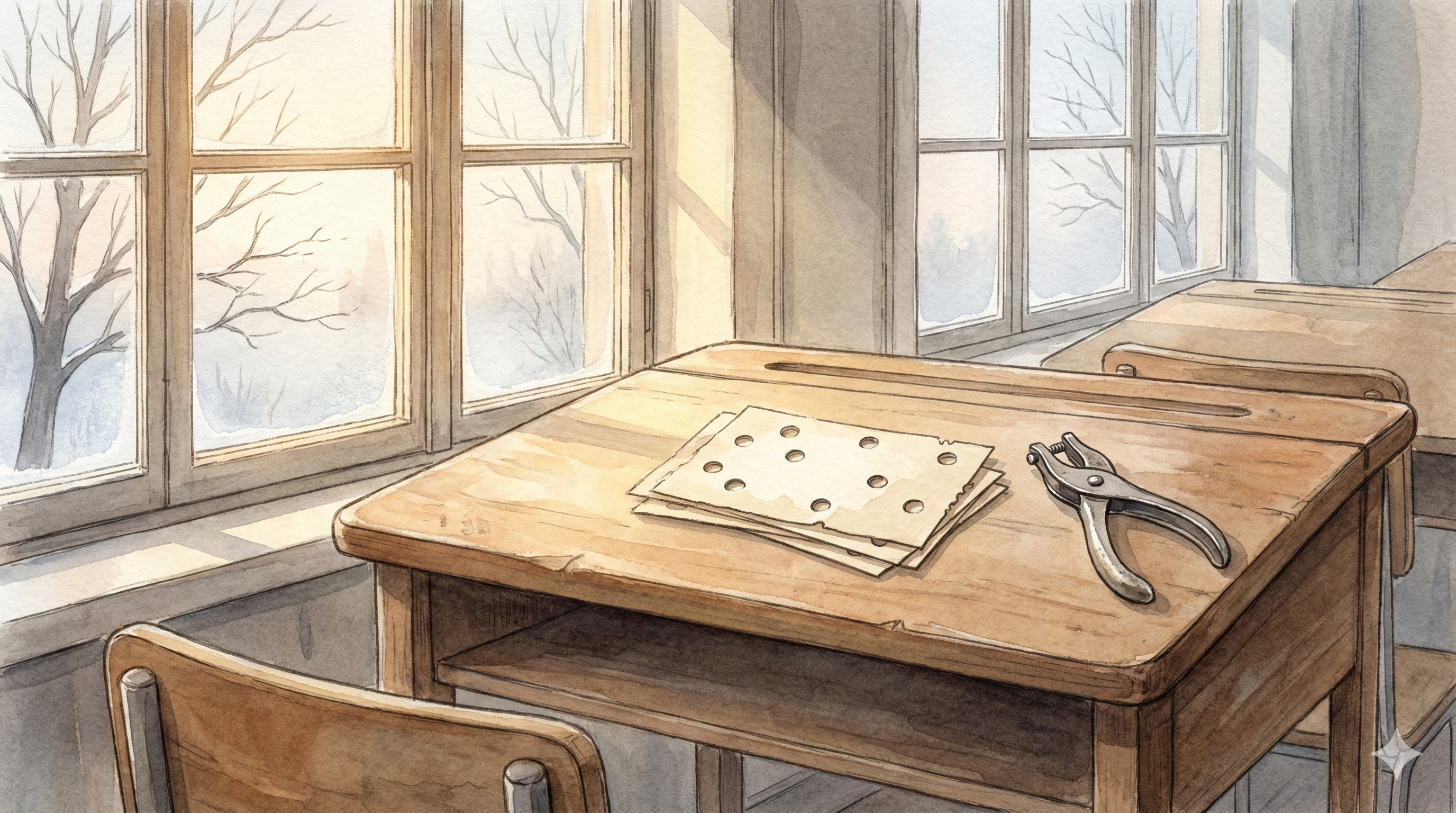 \Illustration generated using Nano Banana Pro by Jacob Carr\
It’s early January, that peculiar stretch of the year where the calendar insists on renewal but the body hasn’t caught up yet. The break is over. The inbox is awake again. Classrooms are back in motion. For educators, this moment often arrives with a quiet confusion: I slept more. I stopped pushing. I rested. So why do I still feel wrung out?
If that’s you, there’s nothing wrong with you. And there’s a good chance you didn’t “rest wrong.” You may simply be running into a distinction we almost never talk about clearly: the difference between self-soothing and self-nurturing. I’ve turned that distinction into a small set of printable punch cards you can download at the end of this article.
I first heard this named plainly in a short TikTok by a creator known as The Hungry Psychologist (I’ll link it here).
In the middle of making a pumpkin pie cheesecake, he described why rest often fails to restore us. We confuse comfort with recovery. We reach for things that take the edge off when what we actually need are things that rebuild capacity. It’s simple. It’s not moral.
And for educators, It can be quietly profound.
Self-soothing is what helps us survive now.
Self-nurturing is what helps us recover for later.
Most of us are very good at the first and far less practiced in the second.
Self-soothing includes the familiar comforts. Scrolling. Shows. Comfort food. A drink. Zoning out. Wrapping up in a blanket and disappearing for a while. One of my favorites is sitting in the driveway continuing to listen to my audiobook.
These things matter. They lower intensity. They quiet the nervous system just enough to get through the evening. They stop the bleeding. Especially in a profession that demands constant emotional presence, self-soothing can look indulgent from the outside, but it’s often your body’s way of saying, I need a break right now.
And while it might steady you in the moment, it doesn’t refill the tank.
Self-nurturing is different. It’s the kind of care that restores energy rather than just managing depletion. Gentle movement. Protecting sleep. Meaningful connection. Creative work that isn’t evaluated. Clearing mental backlog. These things don’t always feel restful in the moment. Sometimes they feel like effort. Sometimes they feel annoying. That’s exactly why, when we’re depleted, we avoid them. And it’s why so many educators return from breaks still exhausted, wondering what didn’t work.
Back in 2021, I posted a short, time-lapse video on TikTok of me cleaning and reorganizing my classroom during the Winter Break, tightening routines, and shoring up systems.
It wasn’t framed as productivity. It was framed as self-care. To my surprise, the video resonated widely and is still one of the most-viewed things I’ve ever posted. I think that’s because many teachers recognized the feeling.
That kind of work calmed me, and restored a sense of agency and coherence at a time when everything felt frayed, but it doesn’t mean it would be restorative for everyone.
That experience taught me something I didn’t have language for then. Some forms of care don’t look restful from the outside, but they reduce cognitive load and emotional friction in ways that matter deeply. They don’t just help you survive the day; they can make the next one a little easier. That’s self-nurturing.
This distinction matters even more when we place it in the larger context many teachers are already living in. In an article I published back in November, I argued that a great many mid-career educators aren’t burnt out so much as disoriented. Their values, professional identity, and the demands of the system no longer line up cleanly.
The ground feels unstable. The compass spins. When that happens, exhaustion can feel more existential than physical.
Self-soothing makes perfect sense in moments of disorientation. When coherence collapses, the nervous system looks for safety, of which comfort is a rational response. But disorientation also explains why rest alone doesn’t bring relief. If the deeper issue is a loss of alignment or agency, then zoning out won’t repair it. It will only pause it.
That’s where the idea of active recovery becomes helpful, a distinction The Hungry Psychologist makes clearly in his video. He gave the example of how athletes don’t recover by collapsing indefinitely after a grueling workout or event, but recover through gentle, intentional movement. Stretching. Walking. Low-intensity engagement that restores circulation and function.
The same logic applies here. Recovery often comes not from escape, but from carefully chosen forms of engagement. The focus here is on choosing forms of engagement that reduce friction rather than add to it.
I hesistated even before writing this article, because educators are already overwhelmed with advice. “Take care of yourself.” “Recharge.” “Make time.” None of that helps when you’re tired enough that even deciding what might help feels like too much.
And for many of us, myself included, those reminders land with a visceral reaction. Sitting in a meeting, already stretched thin, being told to “practice self-care” while no time, space, or structural support is actually provided can feel less like care and more like pressure.
It tightens something in the chest and registers as one more thing to carry, or yet another failure.
So instead of more advice, I wanted to build structure. Enter the punch cards.
Punch cards are intentionally simple, and with all the New Year’s goal-setting talk, they’ve been showing up in my feed lately. They felt like a fun option to share here. You choose a small goal. You break it into a finite number of doable actions.
Each action earns a physical punch. When the card is full, you claim a reward. And, that tactile progress matters because the brain likes evidence. There’s no optimization here. No life overhaul or schedule to follow. Just visible attention.
These cards aren’t meant to compensate for broken systems, only to give you something solid to hold while you’re living inside one.
As I took The Hungry Psychologist’s distinction of self-soothing vs self-nurturing, and adapted it into these punch cards, I realized they needed to work differently than the usual New Year’s goal versions. Not all cards are meant to do the same kind of work.
Some cards are for self-soothing. These are optional, time-bound, and diagnostic. They help you notice how you cope without shame. They don’t come with rewards. They end in insight. They exist because pretending we don’t soothe only drives those behaviors underground.
Other cards are for self-nurturing. These are the main course. They rebuild capacity. They make tomorrow easier. And they do come with real rewards. Not responsible or aspirational ones. Just real pleasures: a fancy coffee, a new book, guilt-free alone time, a slow meal. Rewards that land in the nervous system and say, you’re allowed.
Using the cards is deliberately restrained, meaning, choose only a few of them to run at once. At least one should be nurturing. Soothing cards are optional, never required. You choose based on the season you’re in, not the person you think you should be. This isn’t a system for fixing yourself, but just a little way to make your life slightly less expensive to live in.
While writing this, I kept testing it against my own experience and the conversations I have with educators every week. The details mattered less than the feel. Tone before theory. Permission before tools. And a clear sequence. Awareness before repair. Repair before reward. If it leaves you feeling less broken and a little more steady, it’s done its work.
At least, that’s the hope here.
If you’re tired right now, don’t overhaul your life. Choose one card, and over the next few weeks, punch a few holes. Let evidence replace guilt. Self-soothing helps you stay afloat, and self-nurturing can help you enjoy swimming again, not out of obligation, but because it starts to feel possible. And January, of all months, is a perfectly reasonable time to begin with less ambition and more care.
The downloadable punch cards are available here as a Canva Template. Print them. Use them. Ignore or edit the ones that don’t fit. Keep the ones that do. Maybe get a teacher-bestie to join you.
Self-Nurturing Cards (capacity-building)
- The Body Reboot Card
- The System Reset Card
- The Thinking Unclog Card
- The Sleep Integrity Card
- The Relationship Refill Card
- The Creative Oxygen Card
- The Hard-But-Helpful Card
- The Boundary Card
Self-Soothing / Awareness Cards (diagnostic, reflective)
- The Numbing Card
- The Collapse Card
- The Distraction Card
- The Treat Card
I’ve also added a page of blank templates so you can design your own.
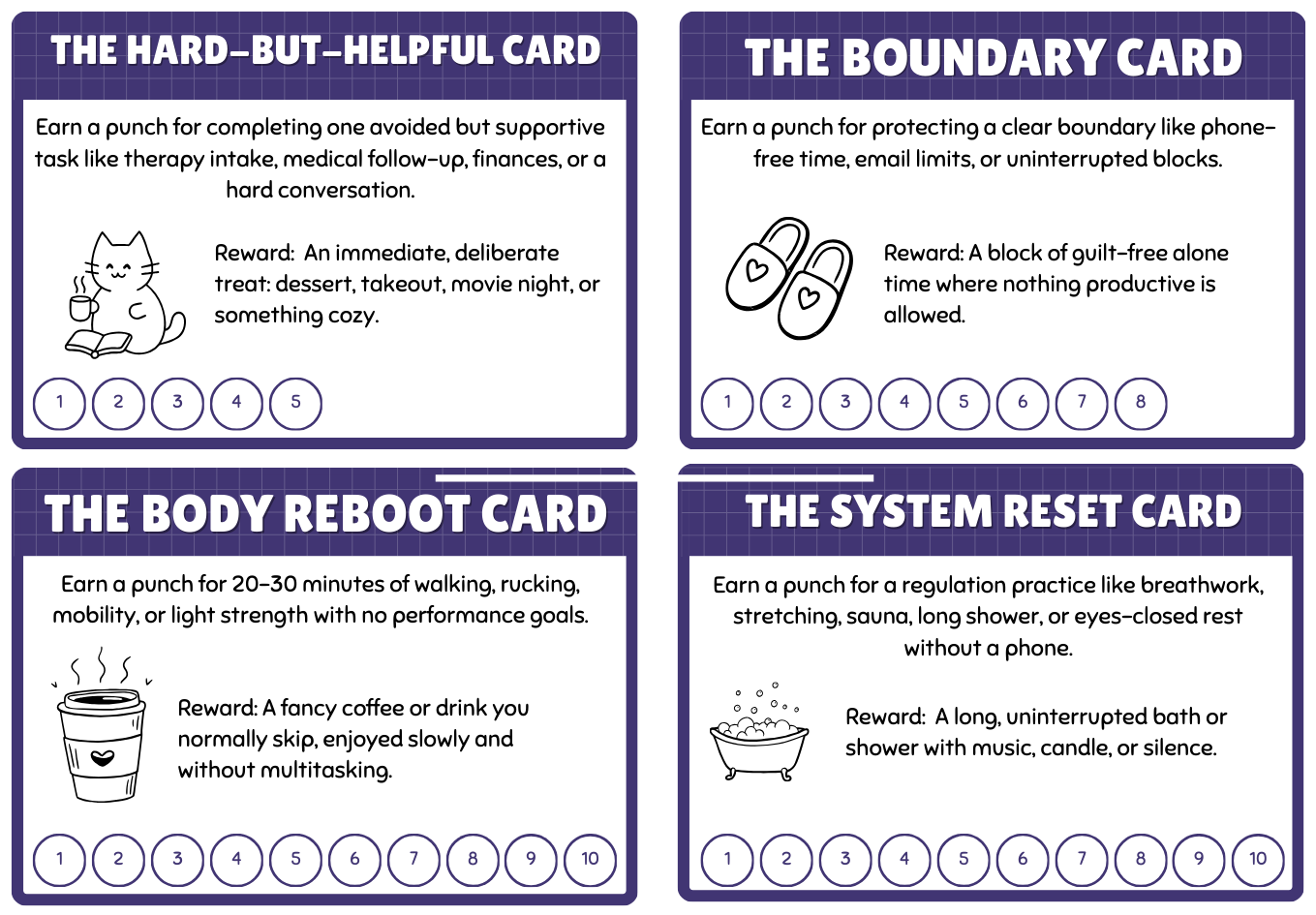 \An example of the downloadable punch cards\
And if the deeper sense of disorientation still feels close to the surface, you may find it helpful to read the earlier piece this builds on: Why So Many Mid-Career Teachers Aren’t Burnt Out, They’re Disoriented. Think of this article as the companion.
Same landscape. Smaller steps.
You don’t need to solve everything at once. You just need one honest place to begin.