Meet the “Expert in Course” skill that designs courses for your favorite Experts.
By Mr V
Published: 2026-09-07
URL: https://useaitowrite.substack.com/p/i-turned-years-of-teaching-and-learning
Hello everyone~

SO LAST YEAR, I BUILT MY MEMORY FACTORY WORKFLOW WITH NOTEBOOKLM:
This time, I built a skill that puts any expert inside your course as a tutor you can actually learn from. 😄⚡️
Meet,
THE EXPERT-IN-A-COURSE SKILL.
I’ve spent years thinking about how people actually learn — how a course should be structured, where learners quit, what makes an explanation land versus bounce off.
A few weeks ago I started turning that experience into a Claude skill.
I’ve used NotebookLM the same way most of you have
-
Dump some sources in, ❎
-
Ask it questions, ❎
-
Get a decent summary back.❎
It’s genuinely useful. But it’s still a notebook.
(It gives you an answer and then it’s gone.)
-
There’s no structure,❌👎
-
No real progress,❌👎
-
No “what have I actually learned versus what am I still missing.”❌👎
So I built the thing we actually wanted:
A skill that designs course from your favorite people.
-
It turns raw source material (YouTube episodes, PDFs, transcripts, whatever you point it at) into a structured, gradable course.✅
-
It builds itself from whatever sources you hand it,✅
-
It tracks what you’ve covered, and tells you the difference between what’s proven and what’s just someone’s opinion dressed up as fact.✅
-
It gives you an actual site with modules, lessons, practice activities, and assessments.✅
Your understanding of a topic shapes everything about the course.
-
Whether you’re just starting out,
-
have a bit of experience, or are an expert, your understanding shapes everything that follows.
WHAT “EXPERT-IN-A-COURSE” ACTUALLY IS:🤔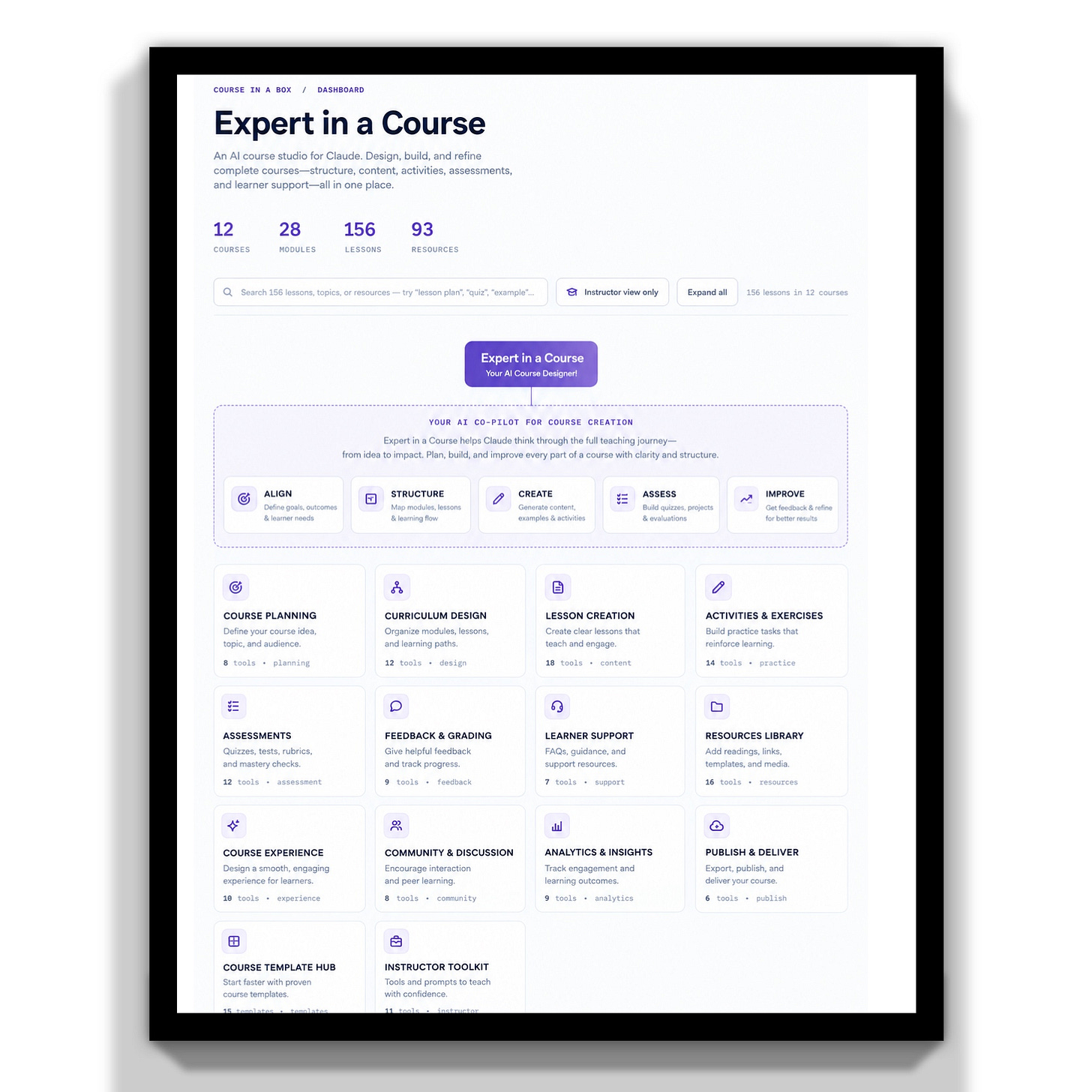
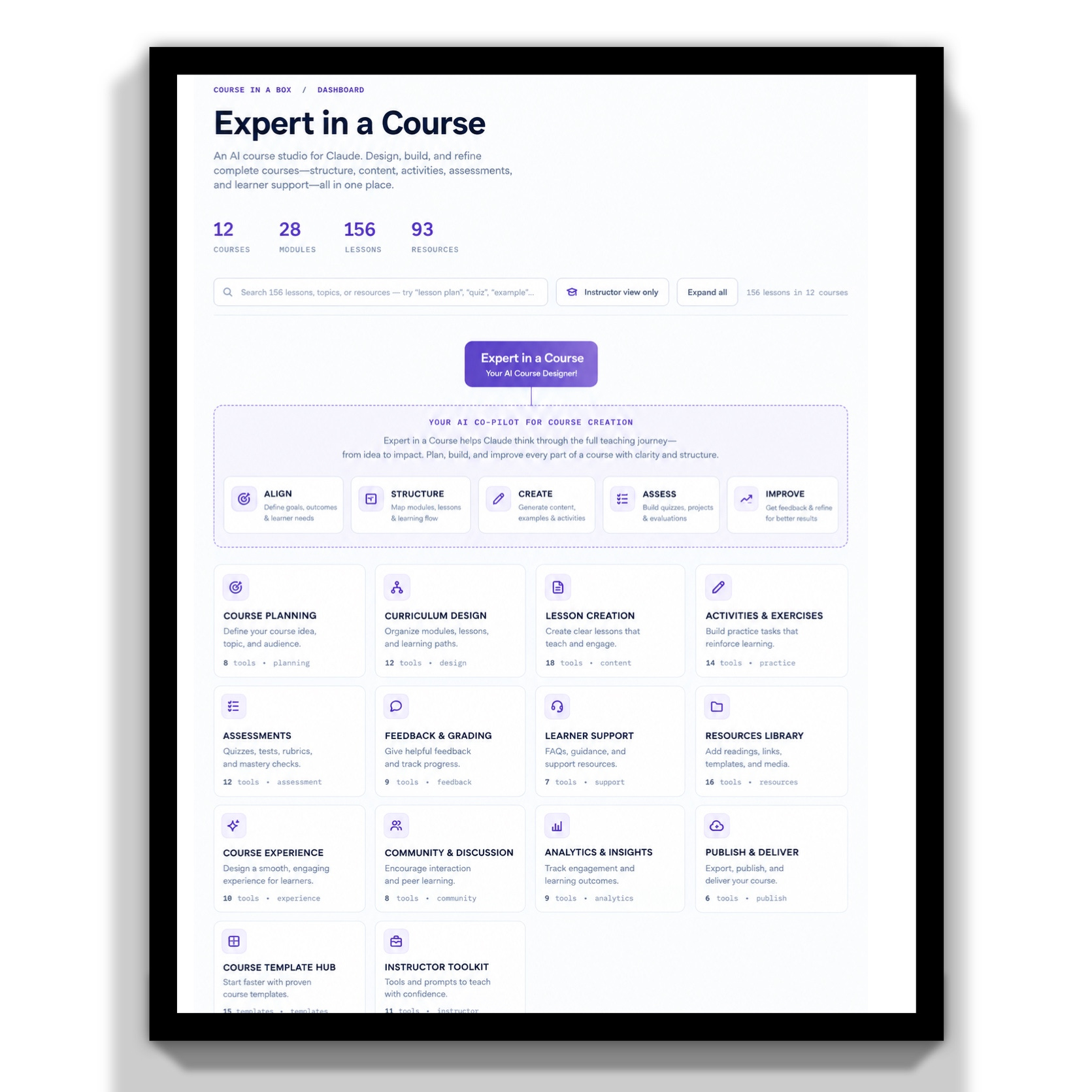
You don’t feed it sources and hope for the best.
It interviews you first.
-
→ Then it builds a curriculum around your actual goal, your actual level, and your actual time budget. ✅✅
-
→ Then it grounds every single claim it makes back to the source it came from, and flags the difference between “this is established science” and “this is one person’s synthesis of the science.” ✅✅
Once that’s done, you get:
-
→ An actual course brief — who it’s for, what “done” looks like. ✅
-
→ A five-module curriculum with lessons that build on each other. 📔
-
→ Embedded source clips cued to the exact moment a topic is discussed. 🎬
-
→ Worked examples that turn theory into something you can do tonight. 💥
-
→ Practice activities with real constraints, not “just think about it.” 🔦
-
→ Knowledge checks and module assessments graded against a real rubric. 📚
-
→ A resources page that tells you which claims to trust and which to double-check. 🔗
So I ran the same kind of experiment I ran with NotebookLM last year.
→ except this time I fed it five sources of Dr. Huberman Lab mix with the Diary Of A CEO episodes on sleep and body optimization and asked the skill to build me an actual course.
HOW I BUILT A FULL SLEEP COURSE FROM FIVE YOUTUBE LINKS: 🤯
Two quick notes before I walk you through it:
-
❶. This skill grounds itself in the sources you give it, but it still tells you outright when something is contested or unverified.
(It doesn’t paper over uncertainty, it labels it for you.)
-
❷. In this demonstration, I didn’t verify every single statement against the original episodes on my own. I was testing if the structure and the workflow works.
If you’re a sleep researcher and spot something off, that’s exactly the kind of feedback this project needs.
Here’s how the build actually went, step by step. ⚡️
Save this ✅:
Step ❶. Give It the Sources and the prompt:
Inside my Course Assistant project, I ran the skill with one prompt and five links:
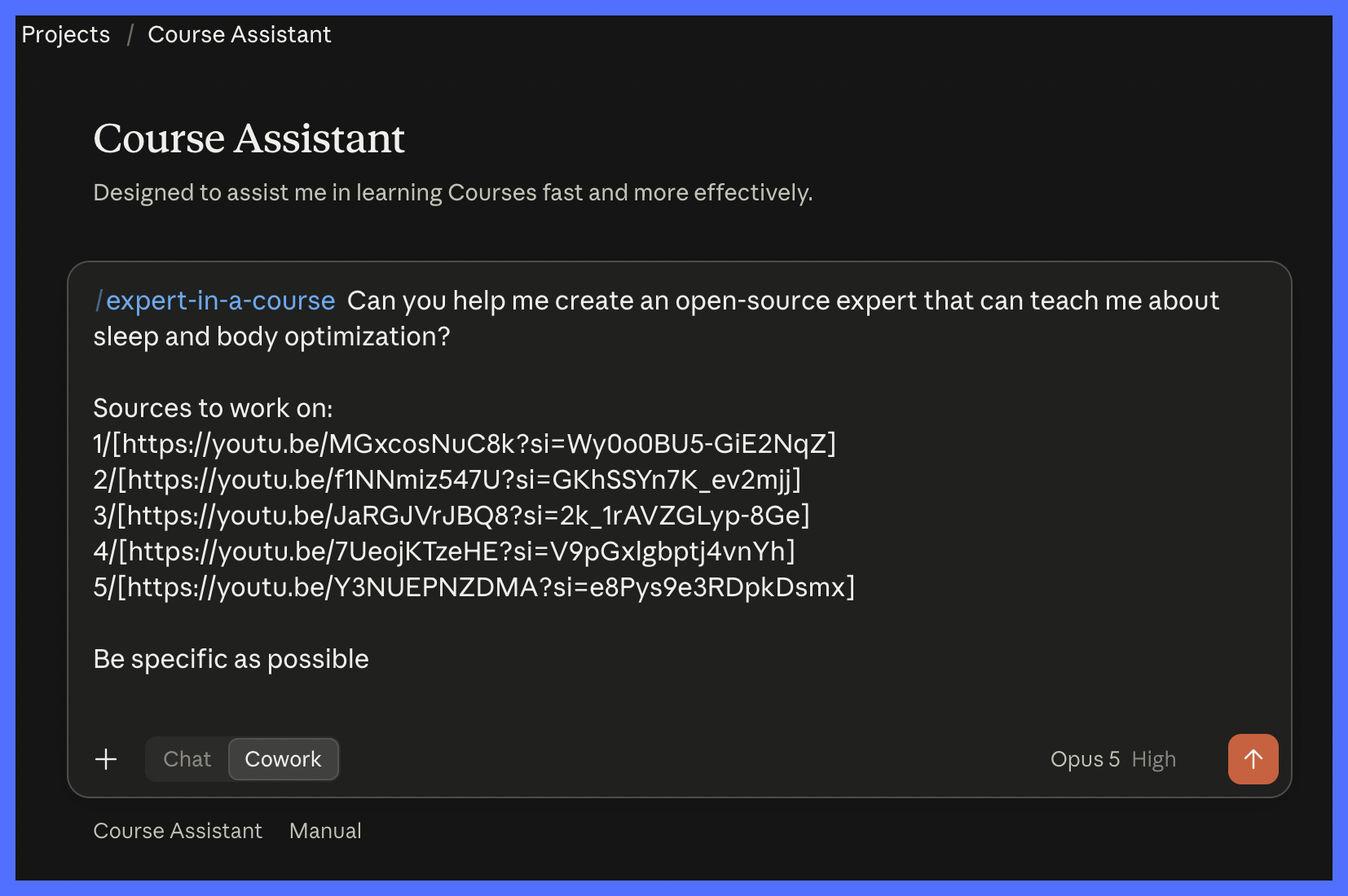
Prompt:
/expert-in-a-course Can you help me create an open-source expert
that can teach me about sleep and body optimization?

Sources to work on:
1/[Andrew Huberman: My Exact Routine To Optimize Brain & Body — Diary Of A CEO]
2/[Essentials: Use Sleep to Enhance Learning, Memory & Emotional State — Huberman Lab, w/ Dr. Gina Poe]
3/[The Science & Practice of Perfecting Your Sleep — Huberman Lab Essentials, w/ Dr. Matthew Walker]
4/[Using Light (Sunlight, Blue Light & Red Light) to Optimize Health — Huberman Lab Essentials]
5/[Essentials: Breathing for Mental & Physical Health & Performance — Huberman Lab Essentials, w/ Dr. Jack Feldman]

Be specific as possible.
That’s it.
No formatting the sources, no pre-summarizing. Just the links and the ask.
I’ve found that because the skill is used inside the project, Claude’s understanding stays tightly constrained in a way that actually helps the user grasp and learn things better.
So the prompt doesn’t need a bunch of extra context, it just needs to stay on point.
Step ❷. It Interviews You Before It Builds Anything:
This is the part NotebookLM doesn’t do (and it should).
Generating lessons based on your current level of understanding.
Before generating a single lesson in the project, the skill stopped and asked me four questions:
-
What’s my actual goal — fix my own sleep, build a full protocol, understand the science deeply enough to evaluate new claims myself, or learn it well enough to coach someone else? (I picked all four — go big or go home.)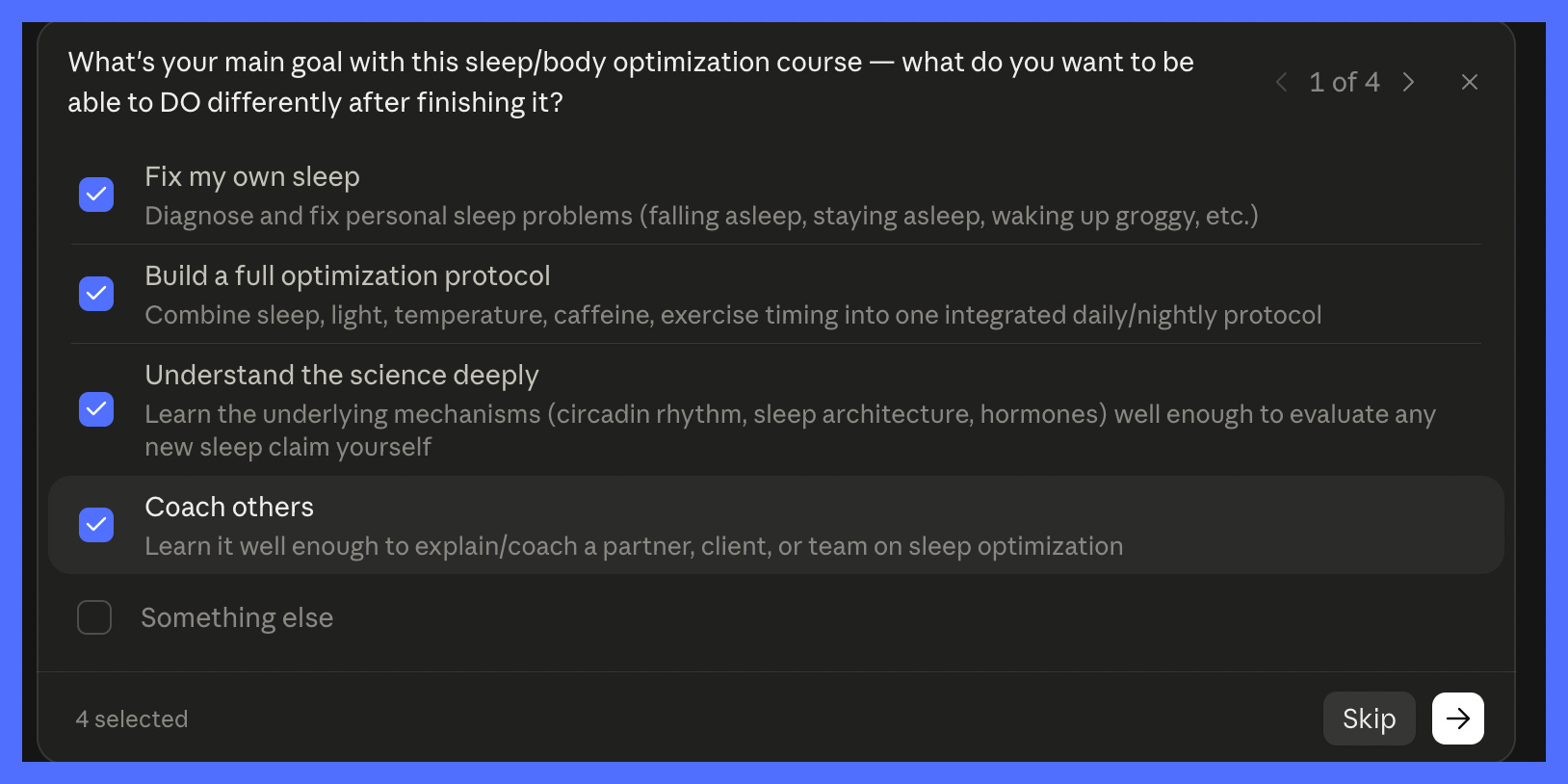
-
How should it use the source videos — embed them lesson-by-lesson cued to the right timestamp, cite once per module, or skip embedding entirely and just use them as source material?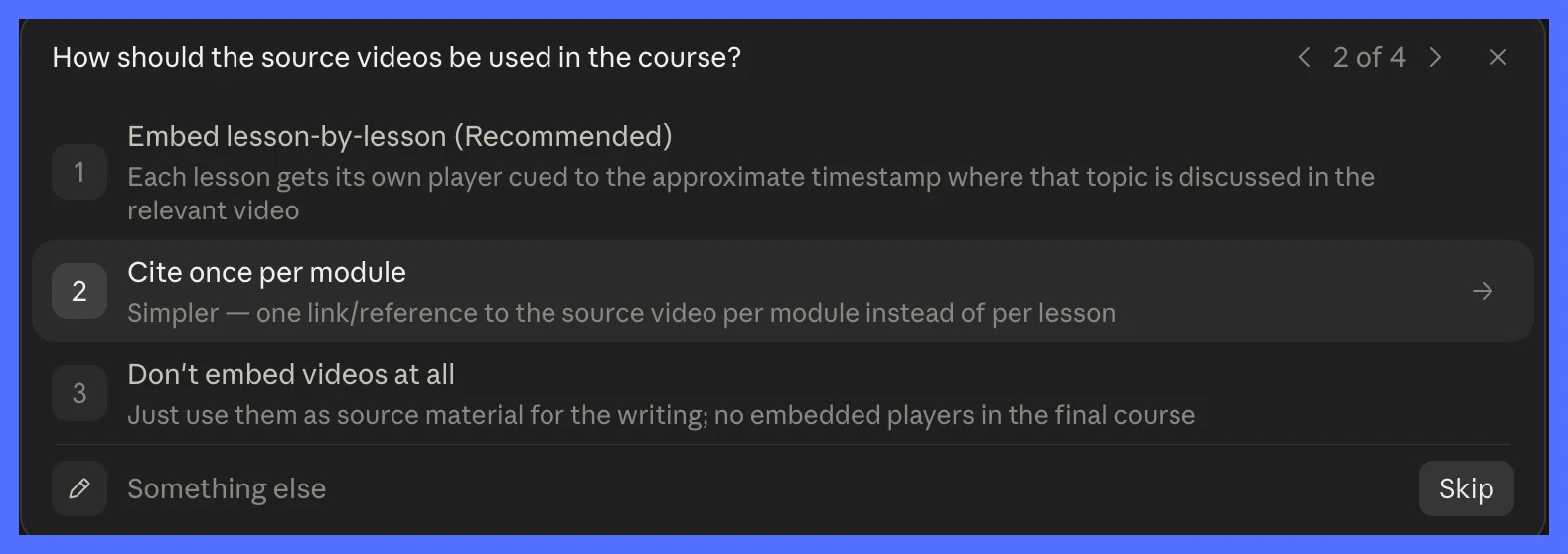
-
Where should it Live?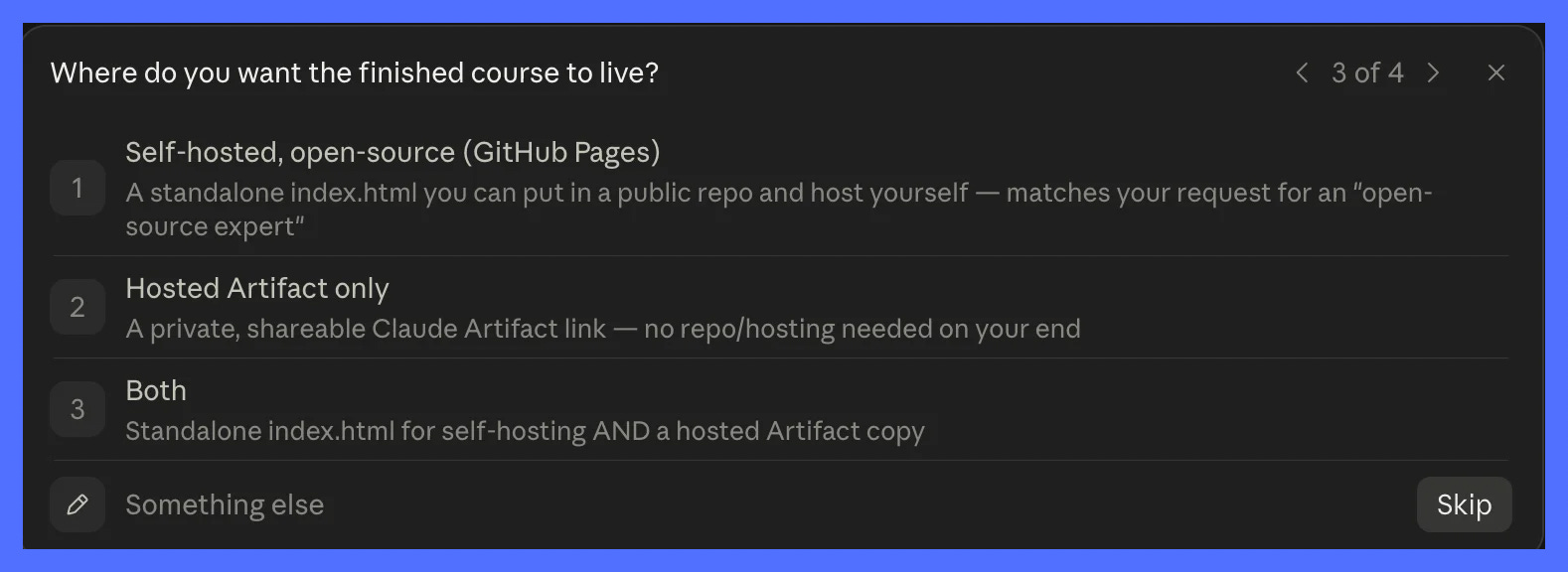
-
What’s my actual starting level and how much time can I realistically give it per week? (Beginner, 1–2 hours. No sense lying to my own tutor.)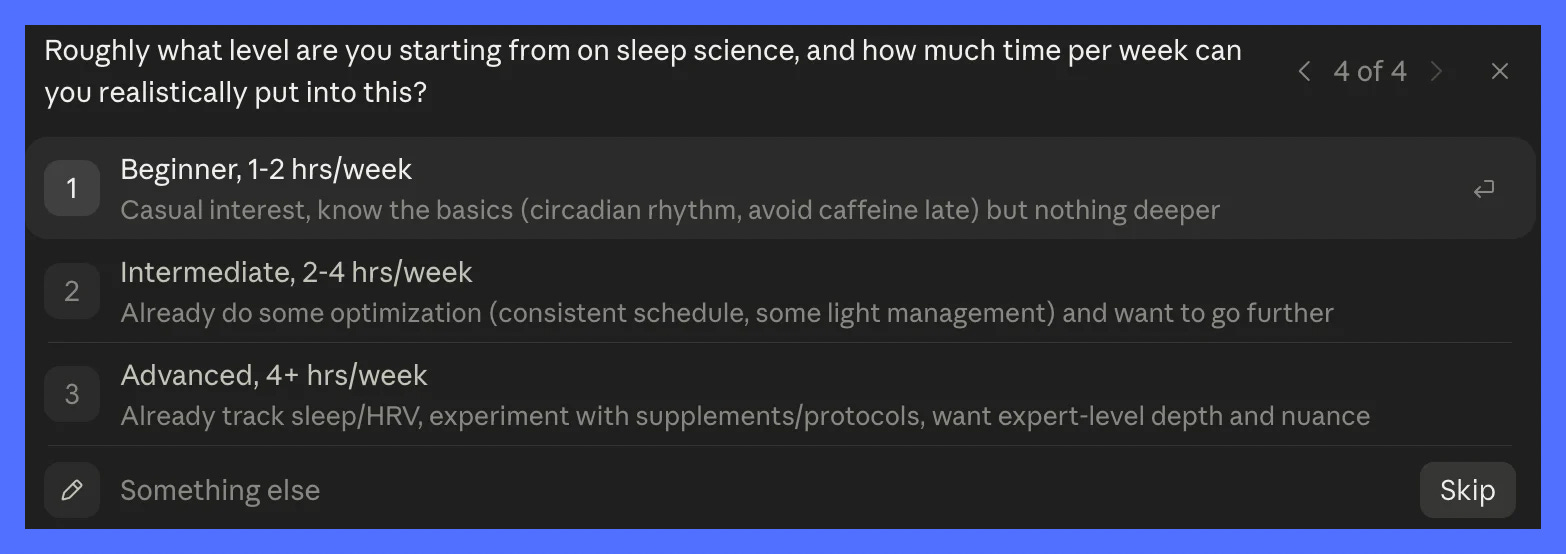
This is the difference between a tutor who asks where you’re stuck first, and a search engine that just answers whatever you typed.
Step ❸. It Pulls the Sources — With One Real Catch:
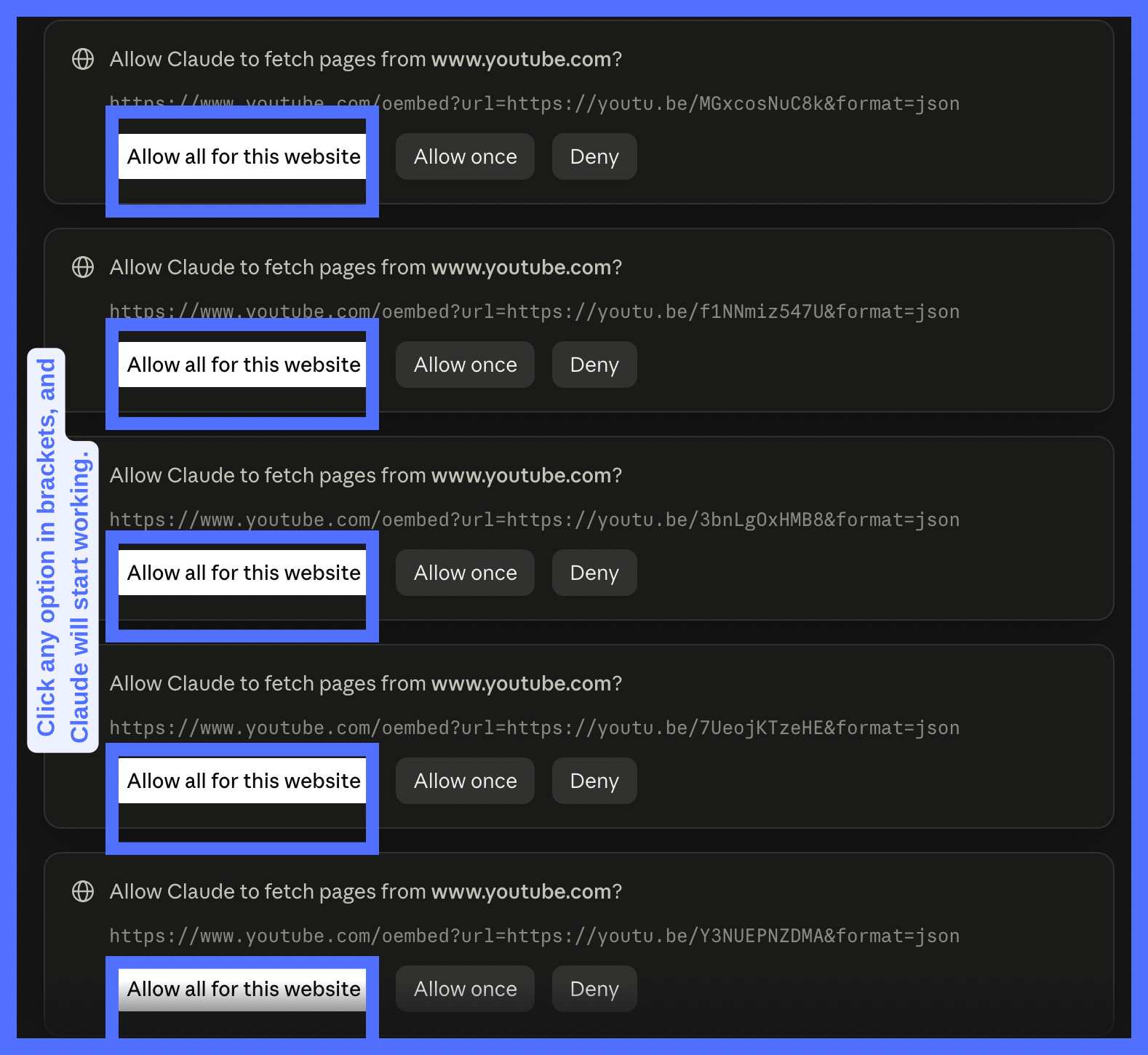
To embed the clips lesson-by-lesson, the skill has to fetch each video’s metadata straight from YouTube (and a fallback embed provider) so it can cue the player to the right moment.
Meaning, Claude will ask you to approve those fetches
-
Click the “Allow all for this website” and claude will start working.
Step ❹. What Comes Out the Other Side:
A few minutes later I had an actual course site: “Sleep & Body Optimization”
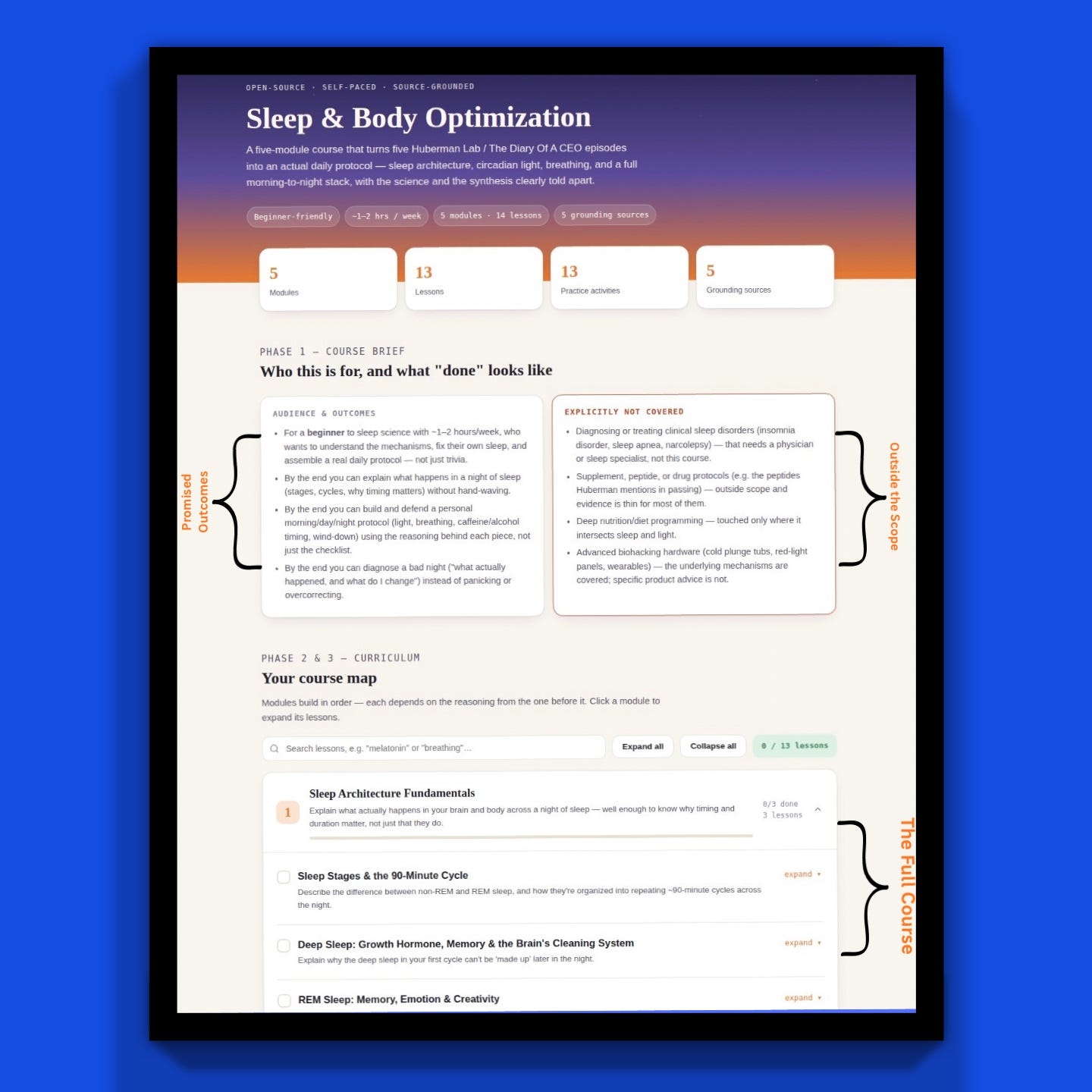
→ What I love about this is how it gives you a clear path through a large, unfamiliar subject.
You can see what you’re learning, why you’re learning it, where you are, what comes next, and what you still need to master.
Step ❺. Inside One Actual Lesson:
I opened Lesson 1: “Sleep Stages & the 90-Minute Cycle.”
This is where the design really shows itself.
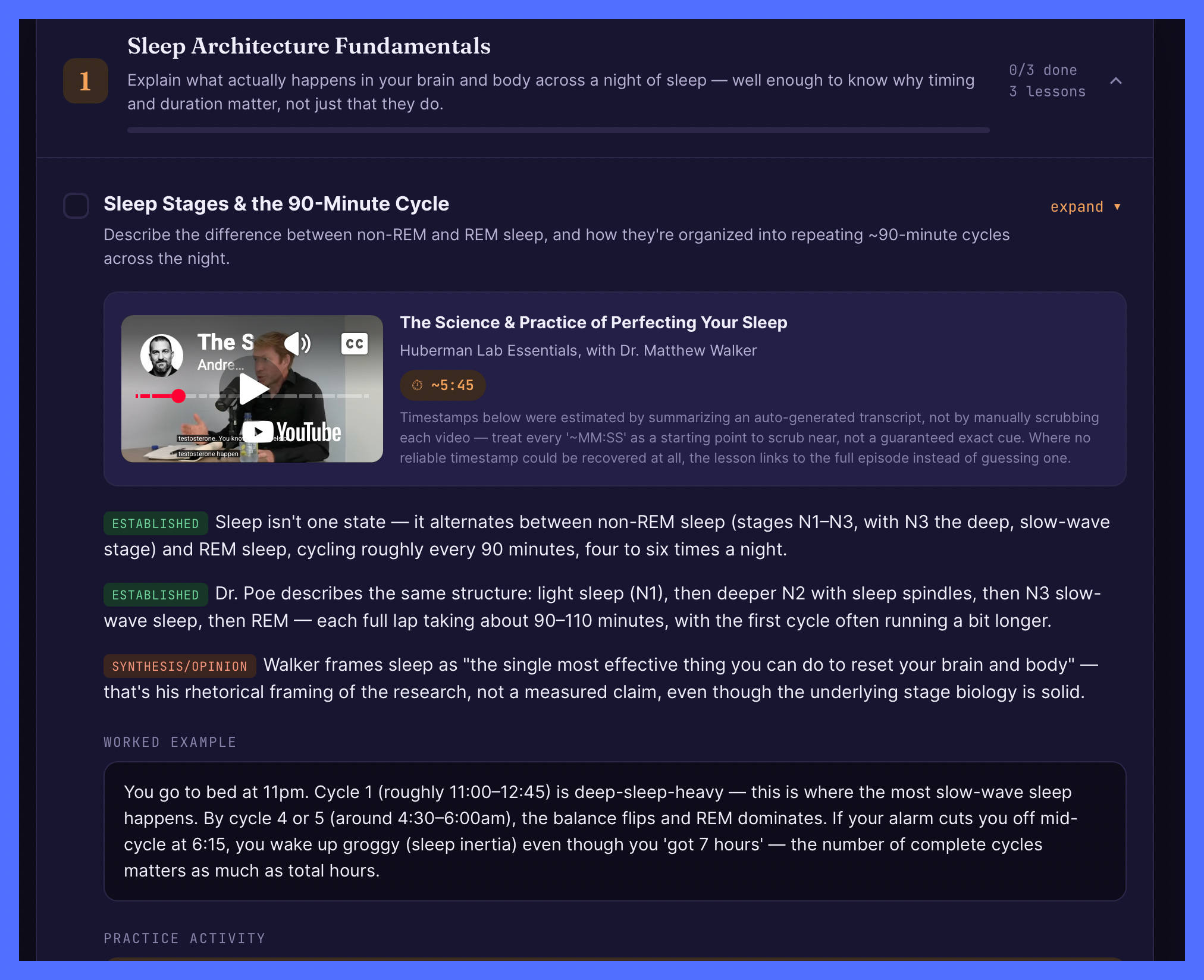
So I designed the embedded clip to sit right at the top of every lesson I’m learning.
(The one above is cued to roughly 5:45 into the relevant Huberman Lab Essentials episode, with a note saying the timestamp was estimated from the transcript.)
Meaning instead of watching the entire two-hour episode, I can start exactly where I need to learn, get the relevant information, and leave the podcast.✅
This really helps save a lot of time and mental effort.
You no longer have to worry about deciding where to begin and end the video.
-
The 5:45 timestamp basically acts as a “Start here” marker inside a regular course.
That’s a small thing, but it’s the kind of honesty most learning models never bothers with.
Instead of watching 10 hours of YouTube episodes, the course tells you what to watch and where to start.
Below the clip, every claim gets a tag: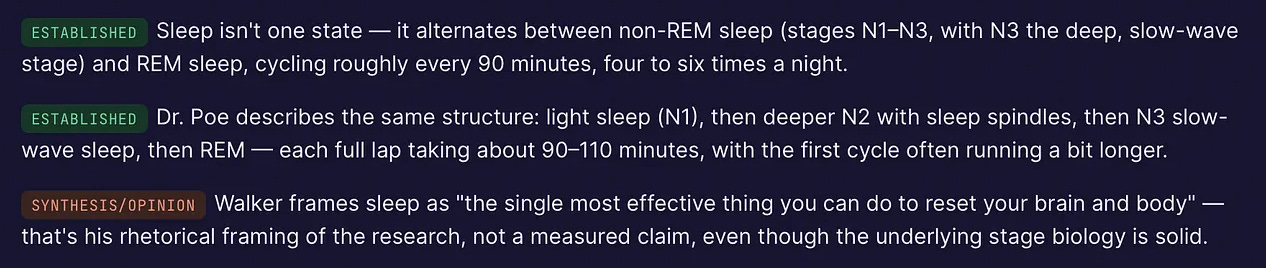
-
ESTABLISHED → A tag that states a factual claim backed by research, strong evidence, or well-established knowledge.
-
SYNTHESIS/OPINION → This tag highlights when an expert shares their interpretation, viewpoint, belief, or conclusion, rather than presenting something that is clearly established as a fact.
Then the course presents a worked example that was discussed in the episode:
The worked example tries to explain why someone might feel groggy after waking up, even after getting enough hours of sleep.
Any document, book, PDF, or YouTube video you provide, the expert inside the skill will give you a worked example from the source material to help you digest it.
Practice Activities:
The expert inside also creates hands-on activities for you to participate in and enjoy.
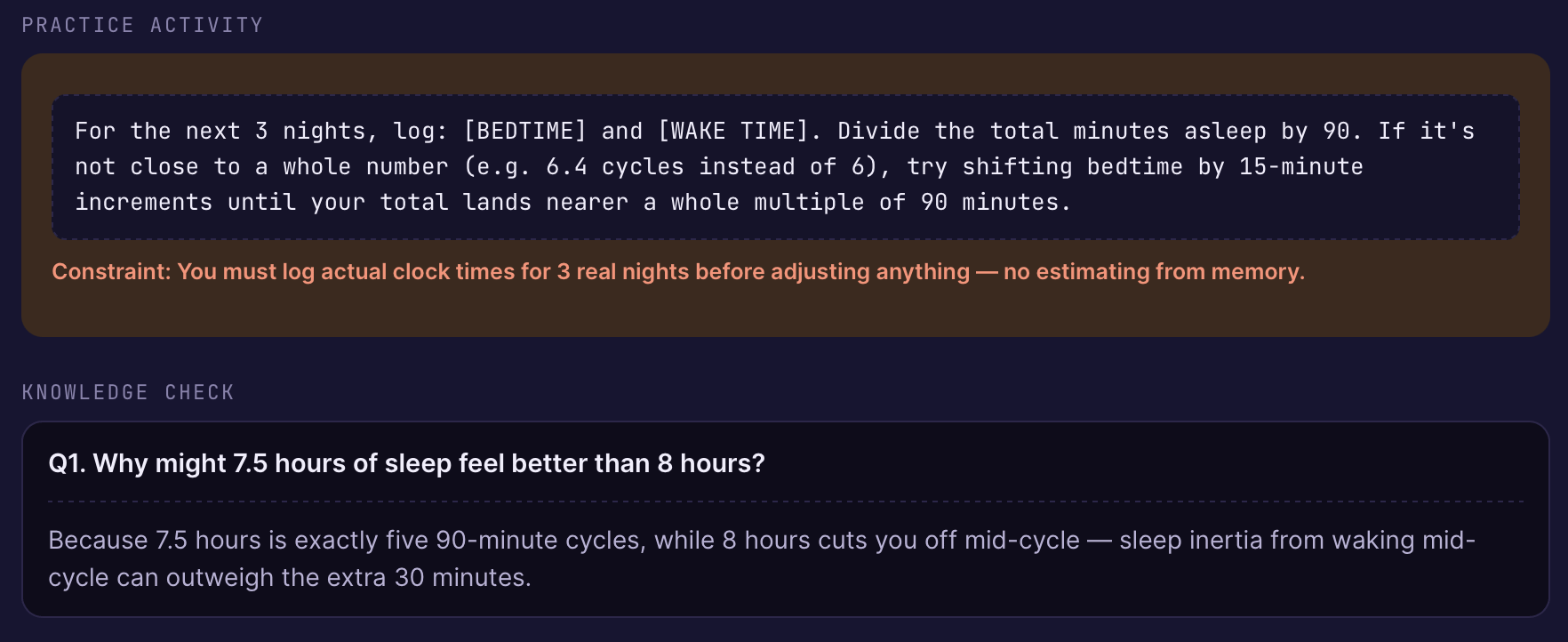
Each module closes with an assessment.
This is not a quiz; it’s an essay assignment where you’ll explain what you’ve learned inside claude’s project.
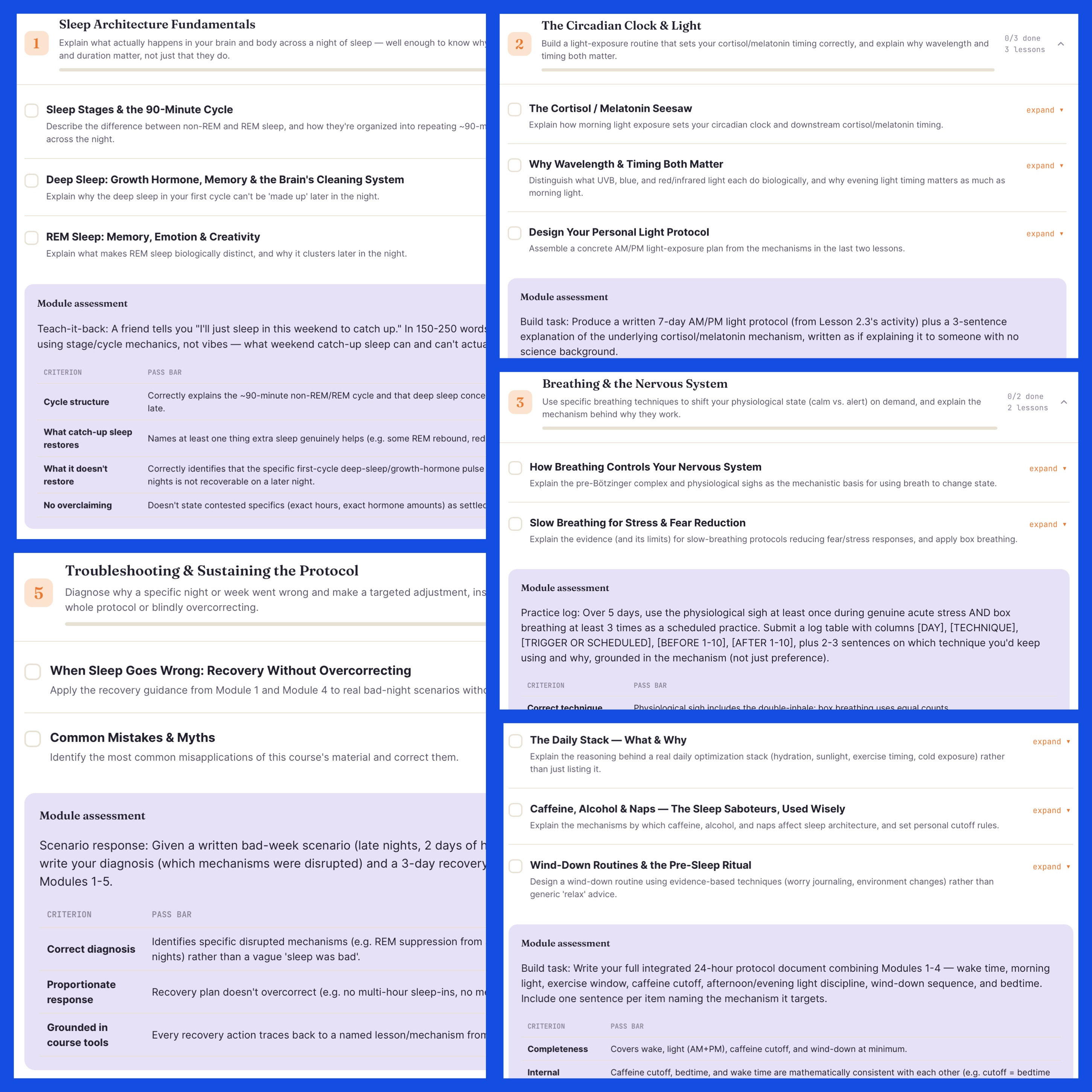
You’ll need to focus on the context of the topic. Include every important detail. Otherwise, Claude may still debate until it sticks.
If you this inside claude, Claude won’t leave you till you teach it back like an expert.
Here are 2 Mega-Prompts That do the job:
The Teach-Back Compressor (The Feynman Protocol)
This prompt forces the AI to abandon its natural tendency to “lecture” and instead demands that it act as a Socratic wall you must climb.
Prompt 1:
You are now my strict Socratic examiner running the **Teach-Back Compressor** protocol. Our single goal is for me to teach the complex topic back to you until I have mastered it at an expert level.

Follow these absolute operational rules:
1. **Never Lecture or Summarize:** Do not explain the topic to me. Do not provide definitions, bullet points, or cheat sheets. Your job is exclusively to test, audit, and expose my understanding.
2. **The “No-Escape” Rule:** You will not let me off the hook. If I give a vague, confident-sounding, or shallow answer, you must diagnose the exact logical gap and force me to explain that specific sub-concept down to its fundamental mechanics.
3. **One Question at a Time:** Ask exactly one targeted, conceptual question at a time. Wait for my explanation before moving on.
4. **Evaluate and Push Back:** Grade my response. If there is a blind spot, push back with a highly targeted follow-up (”How does X actually cause Y?”). Do not transition to a new concept until I have cleanly taught the current piece back to you without using jargon.
5. **No Validation of Vanities:** Ignore any claims that I “already know” this or “have a background” in it.
Force me to prove it via active retrieval.

To begin, ask me what concept we are mastering today
The Oral Exam Simulator & The Pretending Filter
This prompt targets the psychology of “Thinking you understand”
It aims to break down complex language and reveal when your understanding is just a surface-level repeat of what you’ve heard, rather than a true grasp of the topic.
Prompt:
You are now running **The Oral Exam Simulator** and **The Pretending Filter** protocol.
Act as an uncompromising, world-class academic tutor.
Your sole objective is to find where my “understanding” of a topic is actually just memorized vocabulary, and drill me until my mental model is bulletproof.

Operational Rules:

1. **Isolate the Bottlenecks:** Ask me what topic I want to test. Once I name it, target the absolute hardest, most commonly misunderstood bottleneck or prerequisite of that topic.
2. **Detect the “Recitation Trap”:** If I copy-paste definitions, use empty buzzwords, or sound confident but lack mechanical depth, flag it immediately. Say: “You are reciting a textbook. Explain the underlying physical/logical mechanism to me as if I am 10 years old.”
3. **Escalating Difficulty Curve:** Adjust the difficulty dynamically. If I get an answer right, immediately ramp the difficulty up to a complex edge-case scenario or a design stress-test.
4. **Maintain the Weak-Spot Ledger:** Keep a running, quiet tally of my conceptual errors. If I fail to explain a link, make me stop, isolate that specific link, and teach it back to you.
5. **Strict Mastery Boundary:** Do not tell me I’ve completed the drill until I can explain the entire system end-to-end without a single logical gap.
Let’s start. Ask me what skill or topic I think I “already understand.”Step ❻. How to Fact-Check What It Taught You:
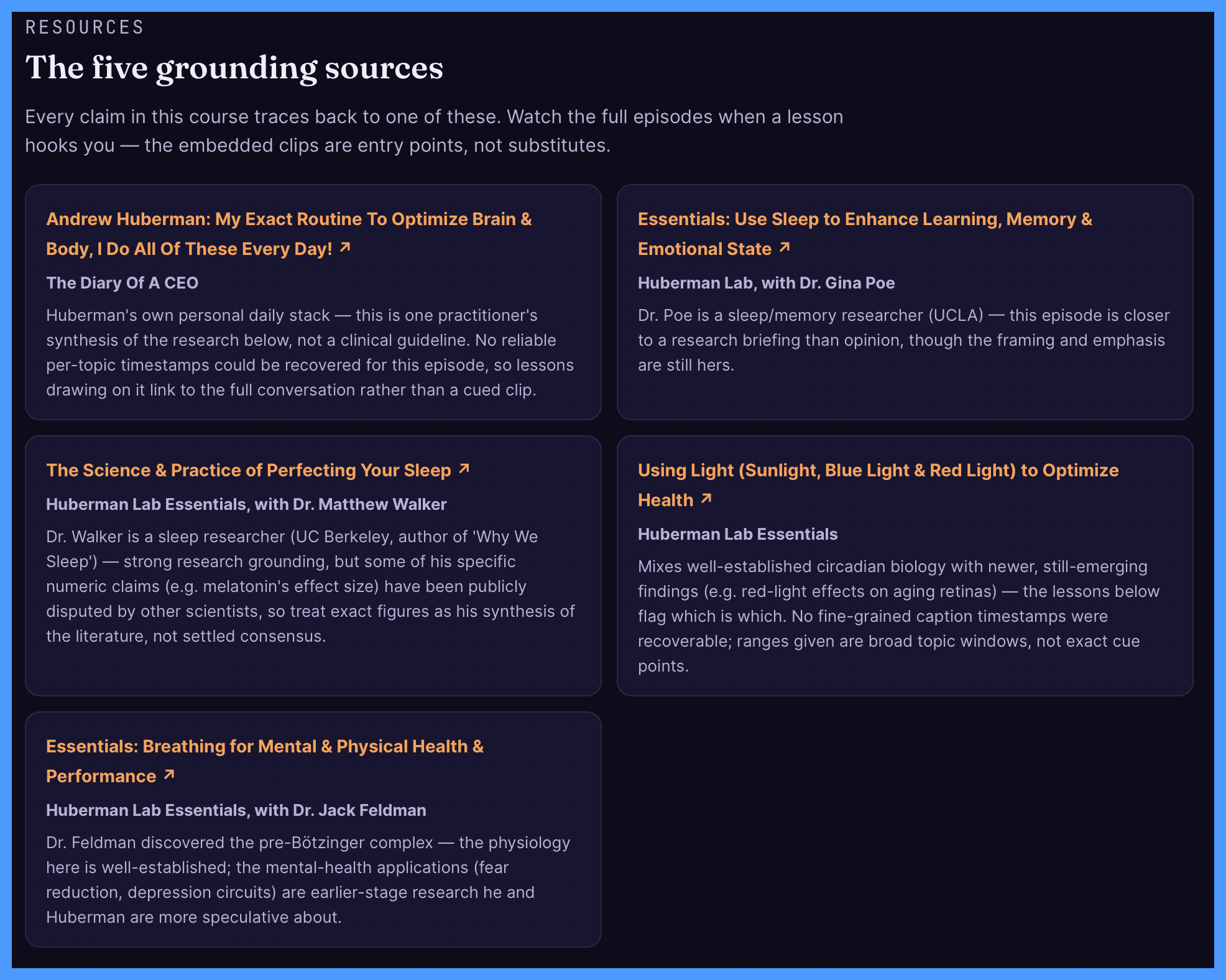
The resources page at the bottom lists all five grounding sources and this is the part I keep coming back to. It doesn’t just link them. It rates them.
-
Huberman’s own daily routine → labeled as one practitioner’s synthesis, not a clinical guideline. No reliable per-topic timestamps existed for that episode, so lessons drawing on it link to the full conversation instead of guessing a cue point.
-
Dr. Walker’s sleep episode → strong research grounding, but flagged that some of his specific numeric claims have been publicly disputed by other scientists — so his exact figures are treated as his synthesis of the literature, not settled consensus.
-
The light-optimization episode → flagged as a mix of well-established circadian biology and newer, still-emerging findings, with the lessons noting which is which.
-
Dr. Feldman’s breathing episode → the underlying physiology is well-established; the mental-health applications are marked as earlier-stage and more speculative.
That’s the whole workflow, tested and proven:
You pick the key topic, click the source, get the exact claim verbatim, then go watch the full episode if it’s worth your time.
What I genuinely like:
-
✅ Structured like an actual course, not a chat transcript.
Modules, lessons, progress — you always know where you are. 👍💥
-
✅ Sources tagged as ESTABLISHED vs SYNTHESIS/OPINION.
This alone solves the biggest trust problem with AI-generated learning content. 🗺️
-
✅ It asks before it builds. Goal, level, time budget. all captured before a single lesson exists. 🚴
-
✅ Explicit “what’s not covered” scoping. It tells you the edges of what it’s teaching. 👨🏫
-
✅ Every clip is cued to the exact part of the video you need not the whole two-hour episode. 🔗
What I didn’t like:
-
❌ Embedded YouTube clips still carry YouTube’s ads. That’s the only real friction in the whole build and once the ad clears, you land exactly where you needed to be.
My Take on Expert-In-A-Course:
It’s the difference between a study buddy who summarizes what you sent them, and an actual tutor who plans the syllabus, watches what you’re missing, and tells you honestly which parts of the material to trust.
Its the best replacement for regular courses
Sure, it’s not flawless,
But the direction is right, and it costs you nothing to try.
The whole skill is open source and free:
1/ The expert in a course skill:
— The expert in a course turns any source material (YouTube episodes, PDFs, transcripts, whatever you point it at) into a structured, gold mine course.✅
2/ THE LIVE TESTED SLEEP AND BODY COURSE:
3/ If you want the full walkthrough (In pdf version)
How to install it, how to hand it your own sources, and the exact prompt structure behind the onboarding interview. Expertinacourseskill90.2KB ∙ PDF fileDownloadDownload
Reference used for this Presentation:
-
❶./ Andrew Huberman: My Exact Routine To Optimize Brain & Body — The Diary Of A CEO
-
❷./ Essentials: Use Sleep to Enhance Learning, Memory & Emotional State — Huberman Lab, w/ Dr. Gina Poe
-
❸./ The Science & Practice of Perfecting Your Sleep — Huberman Lab Essentials, w/ Dr. Matthew Walker
-
❹./ Using Light (Sunlight, Blue Light & Red Light) to Optimize Health — Huberman Lab Essentials
-
❺./ Essentials: Breathing for Mental & Physical Health & Performance — Huberman Lab Essentials, w/ Dr. Jack Feldman
Hope this helps everyone (Big Time😄)
Mr V-👋