Acclimating to the dizziness of freedom
By Justin Andersun
Published: 2026-10-21
URL: https://turtlespace.blog/p/the-dreadmill

When I started working remotely full-time two years ago and had to sit through five hours of video calls a day, I bought a standing desk and a walking pad. After exactly one meeting spent emulating Chris Traeger, I shoved the walking pad in my closet.
Six months later, when I moved out of the apartment, I had to do something with this monstrosity. I lugged it to Goodwill but learned that that Goodwill doesn’t accept treadmills. So, I lugged it to another Goodwill and learned that Goodwill, as an institution, apparently doesn’t accept treadmills. I attempted to enlist it in The Salvation Army, but they refused to recruit exercise equipment. I posted it on Facebook Marketplace and got ninety-nine questions and no buyers. I tried donating it to the apartment gym, but the leasing manager couldn’t accept it. Eventually, I found myself staring at the dumpster, contemplating sins of consumption and waste, before resigning to move the damn thing with me.
The walking pad went into a U-Haul, then a storage unit, then another U-Haul, then the basement, then the garage, then the back of my truck for another attempt at donation (no dice), before returning to the garage. Each time I saw or thought about this $50 Amazon treadmill, a faint sensation of dread tingled through me. The treadmill became a Dreadmill.
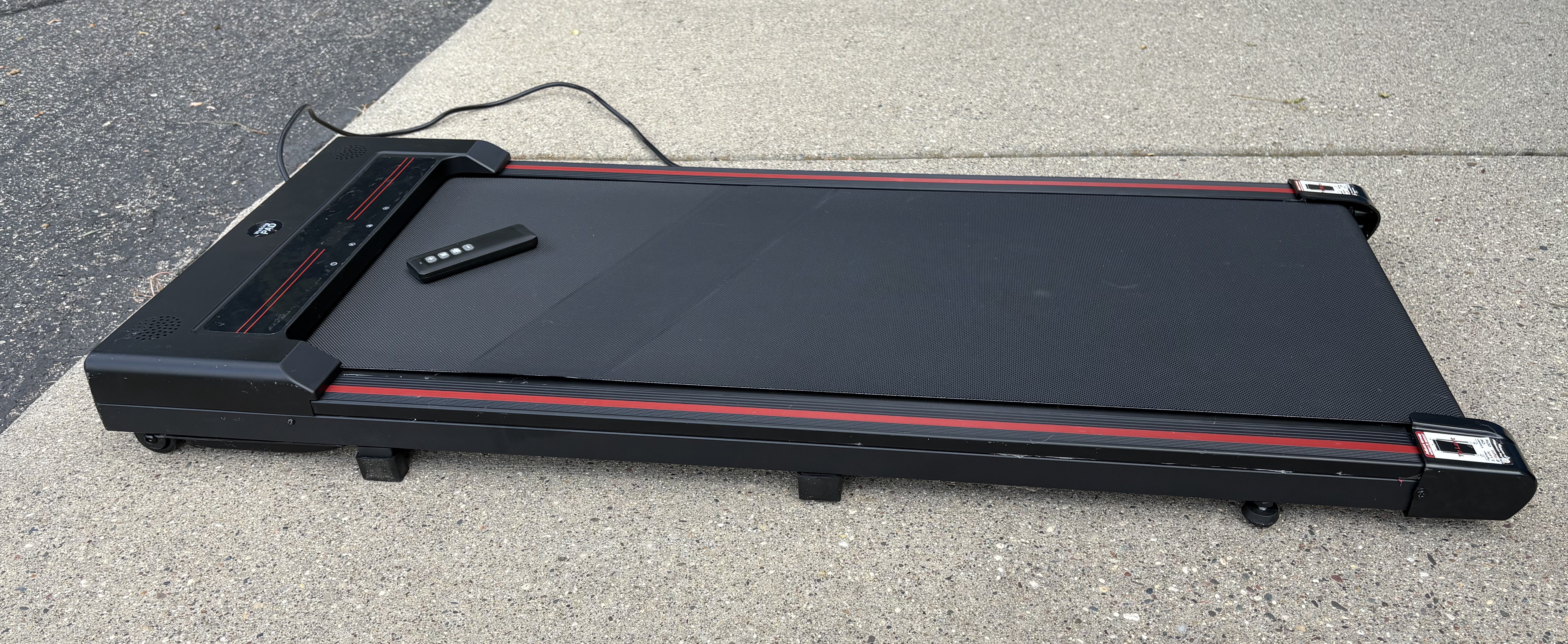
\For Sale: Walking Pad, Once Used\
I am not new to such machines—useful ideas I adopt in pursuit of freedom, only to find myself dreading the thought of disobeying them. In my early twenties, I identified as a minimalist, and this treadmill was the perfect anti-symbol of the minimalist manifesto: “You don’t own your stuff, your stuff owns you.” But that skepticism toward ownership made me insufferable: I owned a single pair of chopsticks in my first apartment and was a very unwilling gift recipient. In my mid-twenties, I bought into the financial-independence-retire-early (FIRE) movement, whose villain was the hedonic treadmill: constantly seeking novelty and buying stuff to solve misery, even as that cycle of consumption exacerbates it. Now, in my thirties, I am experiencing the next iteration of Dreadmill, long after I’d started running on it.
I’m a structured, conscientious, and organized person. After minimalism and FIRE, I wandered into the self-optimized, knowledge-managed lifestyle of time-blocking, habit streaks, and second-brain development. Decomposing big goals into atomic parts made life goals feel tractable, and that tractability helped assuage my growing sense of uncertainty. I couldn’t control the housing market or the latest public health crisis or geopolitical unrest or the fraying fabric of culture and society, but I could control whether I flossed my teeth, followed a budget, and thoughtfully invested my paltry allowance of unstructured working hours into high-leverage pursuits.
A treadmill, despite its monotony, offers a comfort most exercise modalities cannot. It’s fixed, predictable, and requires no thinking. You step on and move your legs at whatever speed and incline it dictates. And the treadmill is effective for building a certain level of fitness; with enough time and distance, you’ll expand your aerobic capacity. With so much uncertainty and complexity in the world, it’s no wonder we crave a treadmill-like experience in the rest of our lives.
This mechanistic approach works. Time-blocking a workday ensures you carve out time for the focused work that generates unique value and drives raises, promotions, and bonuses amid a near-endless deluge of potential meetings. So why not apply the same scrutiny to mornings, nights, and weekends? A lack of intention in one’s personal time can erode self-directed pursuits like fitness, family, faith, and fun. I have good evidence that working backward, decomposing problems, and making gradual progress on long-term goals can yield success. This year, through time-blocking and meticulous word-count tracking, I produced—for the first time in many years—a novel draft I’m proud of.

\A coherent novel, at last!\
Yet, conscientious planning doesn’t solve everything. Since leaving conventional employment, I’ve struggled to shake the hangover of KPIs, work-back plans, and capacity planning. That inability to relinquish control is undermining my entrepreneurial goals. While I, the perfect little cog, was rewarded for consistent, scheduled execution in a corporation, I am malfunctioning as an early entrepreneur, perpetually planning and polishing instead of doing the messy, fear-inducing go-to-market work of serving real customers. Like my former apartment building’s management company, which couldn’t accept my gift of exercise equipment, I find myself too rigid to adapt to new opportunities. But unlike the management company, which has many externalities limiting its movement, nothing chains me to the Dreadmill but myself.
Søren Kierkegaard defined anxiety as the “dizziness of freedom.” Faced with too many possibilities and too little direction, I reach for a schedule, a commitment, or an institution to keep me busy and undizzied. I have spent years organizing my life to maximize freedom, yet now that I’ve achieved it, I find myself running back to the Dreadmill.
When I step off for more than a few days, dizziness sends me spiraling. A few days into a Mexico vacation, I panic about a lack of accomplishment and make a plan for the next day. Even when I deliberately put thousands of miles between me and my responsibilities, I still lug the Dreadmill with me. But I have not yet relinquished hope (acknowledging the irony that this hope is the kryptonite of my predicament—“I swear, I can quit anytime!”). I don’t believe the answer is to “be balanced” or practice non-attachment. My hope comes from something far more concrete—an ancient practice everyone knows but nobody follows, myself included: Honoring the Sabbath.

\The Sabbath Eveby Alexander Johnston, 1850\
Six days a week are available for work, but on the seventh, we should—yes, I am using the S-word that self-help literature loathes—step off the machine. Although I intellectually understand that I am a human being, not a human doing, my actions prove otherwise. On Sundays, I must commit to no time-blocking, no continuation of my sacred habit chain, and no productivity mechanisms. Instead, I will force myself to delight in this world, crane my neck upward, and appreciate the beauty of the freedom I’ve been gifted. Sadly, I’m so neurotic that I need to structure a day without structure.
As for my $50 walking pad, I eventually relisted it on Facebook Marketplace, and some saint took it off my hands for $15.