By Youssef Hosni
Published: 2026-07-11
URL: https://todatabeyond.substack.com/p/new-live-workshop-hands-on-loop-engineering
Most people use Claude through individual sessions: provide some context, ask it to complete a task, review the result, and repeat the same process the next time.
This works well for isolated tasks, but it becomes inefficient when the workflow is repetitive, long-running, or requires Claude to keep track of progress across multiple runs.
Loop engineering addresses this by giving the workflow a clearer structure. Instead of repeatedly issuing disconnected prompts, you define how Claude should inspect the current state, choose the next action, execute it, verify the result, record progress, and stop when the task is complete or requires human review.
I am hosting a new 3-hour live workshop on Hands-On Loop Engineering with Claude, where we will cover both the design principles and the practical implementation of these workflows.
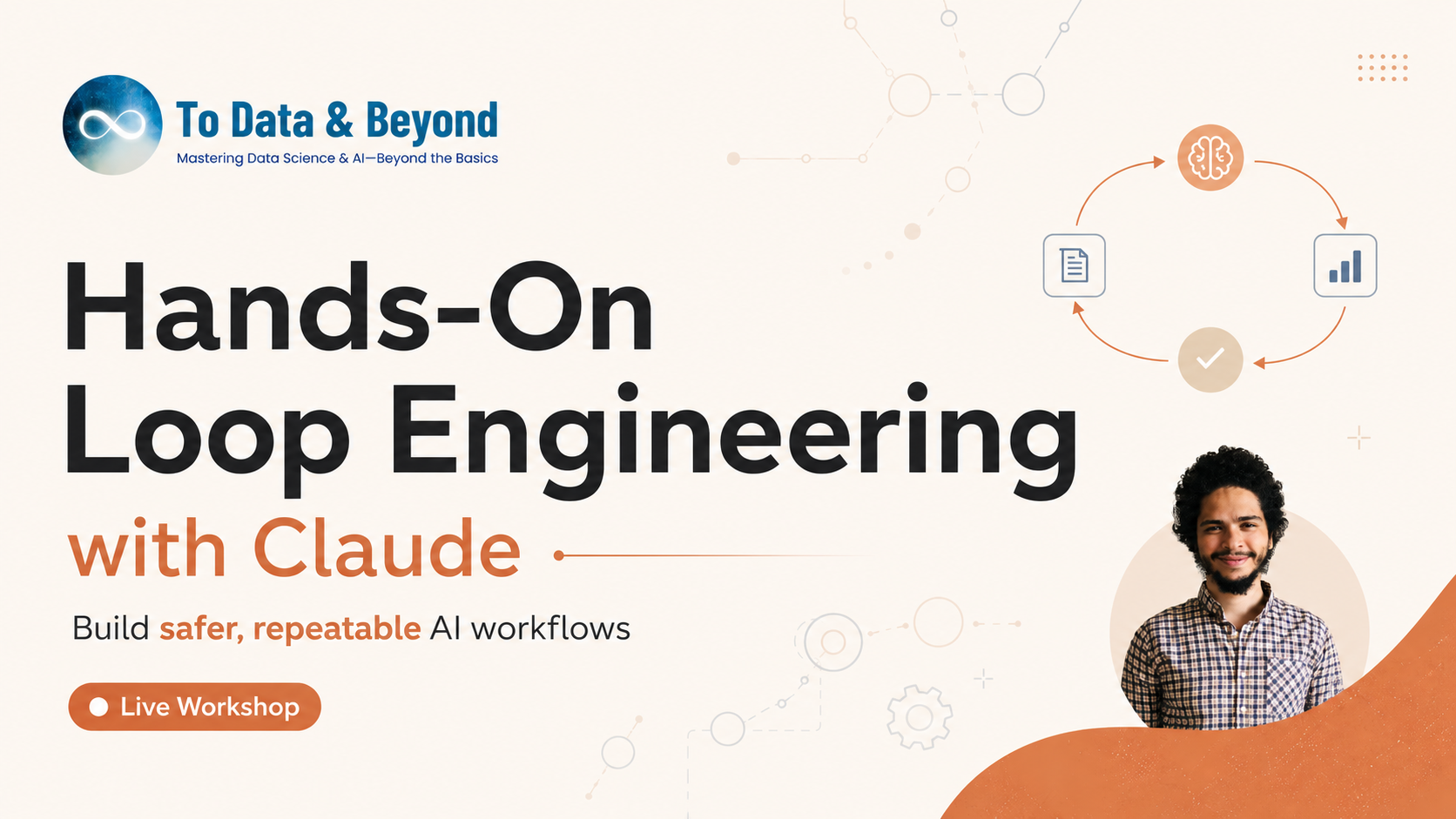
During the workshop, we will cover:
- What a Claude loop actually is
- When you should—and should not—build a loop
- The minimum viable Claude loop
- Designing clear goals, boundaries, and stopping conditions
- Adding persistent state with PROGRESS.md
- Tracking completed work, failures, and the next action
- Separating the worker from the checker
- Adding tests, validation, and review steps
- Scheduling repeated workflows with /loop
- Adding tools, connectors, and safer permissions
- Preventing runaway loops, repeated failures, and unnecessary token usage
- Building a complete Claude loop from scratch
The workshop is divided into three parts:
0:00–0:45 — Theory
We will begin with the core ideas behind loop engineering, including state design, verification strategies, permissions, stopping conditions, and the situations where loops are useful or risky.
0:45–1:45 — Guided practical
We will build a working Claude loop step by step, starting with a simple repeated instruction and gradually adding persistent state, verification, progress tracking, and scheduling.
1:45–2:00 — Break
2:00–3:00 — Attendee lab
You will begin designing and building your own loop based on a workflow that matters to you. This could be a coding, documentation, issue-triage, research, content, or automation workflow.
During this section, I will review attendee implementations, answer questions, and help refine the loop’s scope, state structure, verification process, and safety boundaries.
Who should attend?
This workshop is suitable for developers, AI engineers, researchers, technical writers, and builders who already use Claude or Claude Code and want to move beyond one-off prompting.
You do not need advanced experience with agent frameworks. However, you should be comfortable working with prompts, files, terminals, and basic developer workflows.
What you will receive
Attendees will receive:
- Access to the 3-hour live workshop
- A reusable Claude loop template
- State and progress file examples
- Verification and safety checklists
- Practical loop examples
- Access to the workshop recording
- Supporting materials and resources
Workshop Details
- Workshop date: Tuesday 21 st July
- Time: 19:00 - 22:00
- Standard ticket: 50$