ParFraming the Problem: Why deep search matters, the limits of normal search and basic RAG, and what makes deep search different.
By Youssef Hosni
Published: 2026-05-25
URL: https://todatabeyond.substack.com/p/building-deep-search-agent-from-scratch
Web Search is one of the most common ways people use LLMs today. You ask a question, the system searches the web or a knowledge base, retrieves a few relevant results, and then the model writes an answer.
For simple questions, this works well enough!
But once the task becomes more research-heavy, this simple pattern starts to break down.
Imagine asking a system to collect reliable information about a person. The answer may be scattered across company websites, professional profiles, GitHub, conference pages, publications, interviews, newsletters, and old social posts. Some sources may be official. Some may be outdated. Some may refer to another person with the same name. Some may repeat claims from other sources without adding any real evidence.
A normal search system will mostly return links and leave the hard work to the user.
A basic RAG system may retrieve a few chunks and generate a confident answer, even when the evidence is weak, incomplete, or outdated.
This is where deep search becomes useful.
A deep search agent should not only retrieve information. It should plan the search, decide which sources to inspect, collect evidence, check source quality, reason about freshness, handle contradictions, and merge the findings into a structured answer that the user can trust.
In this series, Building a Deep Search Agent from Scratch, we will build this type of system step by step. The use case we will focus on is a deep search agent that collects public information about a given person and turns scattered evidence into a clean, structured profile.
This first article sets the foundation. We will discuss why deep search matters, where normal search and basic RAG fall short, what makes deep search different, and how to think about the system-level architecture behind a multi-agent deep search workflow.
All the codes used in this series can be found in this GitHub Repo
Table of Contents:
- Course Series Introduction
- Introduction to Deep Search
- Why Deep Search Matters
- The Challenge & Solution4.1. The Challenge
4.2. The Solution
- **The Problem with Normal Search and Basic RAG
5**.1. Normal Search Limitations 5.2. Basic RAG Limitations
- **What Makes Deep Search Different
6**.1. Traditional Search 6.2. Deep Search
- **System-Level Architecture
7**.1. LLM vs Agent vs Deep Search Agent 7.2. What Is a Multi-Agent Framework & Main Components? 7.3. Why Multi-Agent? 7.4. When to Use Multi-Agent Design
- Common Failure Modes in This Architecture
- Practical Design Guidance
Want the Full Deep Search Course?
I recently hosted a live workshop on Designing Multi-Agent Deep Search Systems, where I walked through the full architecture behind building deep search agents that can plan, use tools, validate sources, handle contradictions, and merge evidence into structured answers.
The recording is now available and includes:
- 2-hour workshop recording
- Slides
- Code repo
- 200-page technical handbook
You can get 50% off until the end of May using this code: 6Z7JA0A
1. Course Series Introduction
Web search is one of the most common use cases for LLMs, but most search systems remain limited. A user asks a question, the system retrieves a few documents or web pages, and the LLM generates an answer. This works for simple questions, but it becomes unreliable when the task requires deeper investigation, multiple sources, source comparison, freshness checks, contradiction handling, and structured synthesis.
This is where deep search agents become useful.
A deep search agent is not just a chatbot connected to a search tool. It is an agentic research system that can plan the search process, collect evidence from different sources, validate the quality of that evidence, reason about dates and contradictions, and merge the findings into a clean final answer. Instead of returning a list of links or summarizing the first retrieved documents, a deep search agent aims to build a more reliable answer from scattered, sometimes conflicting information.
In this course series, “Building Deep Search Agent From Scratch”, we focus on the architecture and design principles behind multi-agent deep search systems. We will also go deep into the implementation code and build step by step for a real-world use case: building a deep search agent that collects information about a given person.
This use case is a good example because it exposes many real-world challenges. Information about a person may be scattered across company pages, professional profiles, GitHub, personal websites, publications, conference pages, podcasts, newsletters, and social platforms. Some sources may be official, while others may be copied, incomplete, outdated, or unreliable.
The same person may have multiple profiles, and multiple people may share the same name. A role listed on an old conference page may no longer be current. A GitHub profile may look relevant, but may not belong to the target person. A source may repeat a claim without being independent evidence.
A basic search system may return all of these sources and leave the user to figure out what is true. A basic RAG system may retrieve some chunks and generate a confident answer, even when the evidence is weak or outdated. A deep search system should do more. It should ask: Which sources are reliable? Which claims are current? Which sources refer to the correct person? Which claims conflict? Which evidence should be merged? Which uncertainty should remain visible?
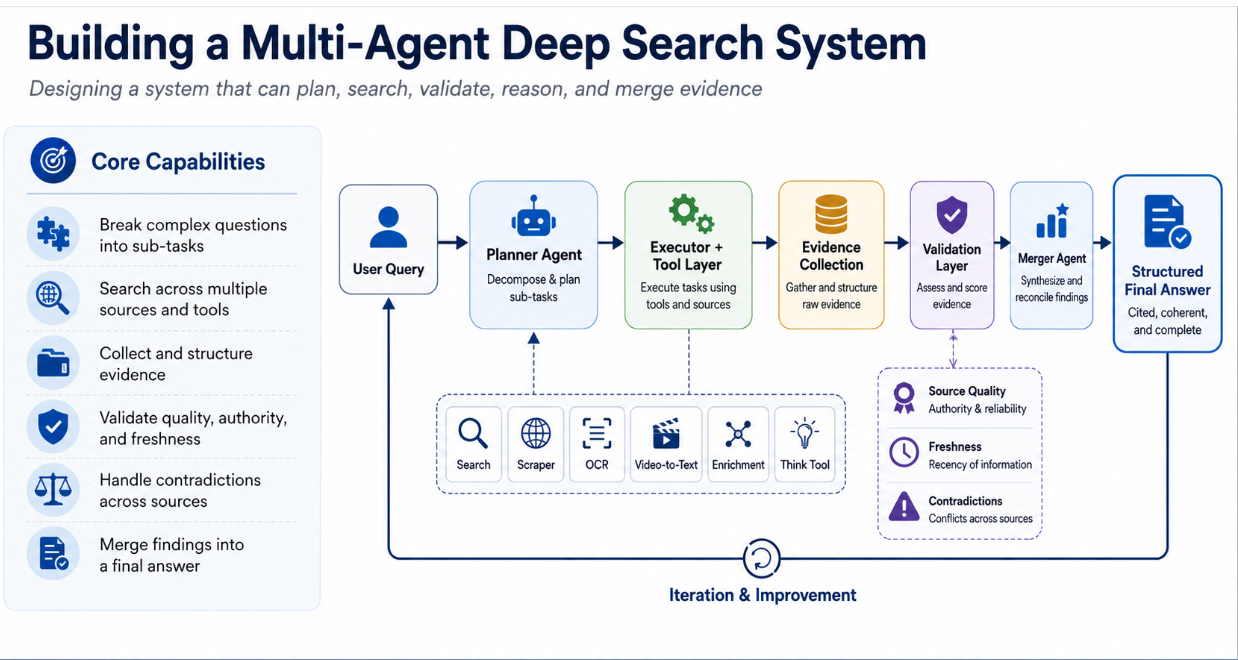
To support this kind of workflow, the system needs several coordinated layers. The planner breaks the user’s request into sub-questions and decides what to search. The executor calls tools and gathers evidence.
The validation layer checks source quality, freshness, relevance, and identity confidence. The merger removes duplicates, resolves conflicts, preserves provenance, and produces a structured final result.
The memory and iteration layer helps the system improve across search rounds. Finally, the evaluation layer checks the full workflow, not only retrieval quality.
The main idea behind this course is simple:
Deep search is not one feature. It is a complete research workflow.
A strong, deep search agent is not only good at finding information. It is good at turning scattered evidence into a reliable, traceable, and useful answer.
2. Introduction to Deep Search
Modern AI search systems are often described as if they are all solving the same problem: the user asks a question, the system retrieves information, and the model generates an answer. But this view is too simple for real-world research tasks.
When the task is complex, the system is no longer just “searching.” It needs to behave more like a research assistant. It must understand the goal, break the problem into smaller parts, decide where to search, collect evidence, compare sources, check dates, detect contradictions, and produce a final answer that is structured and traceable.
In this series, we use the example of building a deep search agent that collects information about a given person. This use case is useful because it exposes many of the problems that simple search and basic RAG struggle with: identity ambiguity, outdated information, scattered evidence, duplicate profiles, inconsistent job titles, conflicting dates, weak sources, and incomplete records.
A normal search engine may return a list of links about a person. A basic RAG system may retrieve a few chunks from an indexed knowledge base. But a deep search system should do more than that. It should build a reliable profile from evidence.
A multi-agent deep search system is not a chatbot that performs one search call and summarizes the top results. It is an agentic workflow designed to manage a full research process.
The goal is to create a system that can:
- Plan the search process
- Search across different tools and sources
- Extract useful evidence
- Validate source quality and freshness
- Handle conflicting information
- Merge findings into a structured answer
- Improve across iterations
For the person-research use case, the system may receive a query such as:
“Find reliable information about this person and summarize their professional background, current role, public profiles, company affiliations, publications, and relevant online presence.”
A simple system might search the person’s name and summarize whatever appears first. This is risky because names are ambiguous, search results may mix multiple people, and the most visible result is not always the most reliable result.
A deep search system should approach the same task more carefully. It should first ask: what exactly do we need to know about this person? Which sources are likely to be reliable? How do we know that two profiles belong to the same individual? Which information is current, and which information is outdated? Are there contradictions between LinkedIn, company websites, GitHub, publications, interviews, and other sources?
This is why the workflow must be designed as a research system rather than a simple retrieval pipeline.
A deep search system typically needs several capabilities.
First, it must break complex questions into smaller research tasks. Instead of treating “find information about this person” as one broad search, the system can divide it into sub-tasks: identity verification, current role, previous roles, education, public profiles, technical work, publications, social presence, and source confidence.
Second, it must search across multiple tools and sources. A person’s information may appear across search engines, company websites, LinkedIn-like profiles, GitHub, Google Scholar, podcasts, conference pages, startup databases, social platforms, PDFs, newsletters, or public interviews. No single source is enough.
Third, it must extract and organize evidence effectively. The system should not only collect links. It should extract claims such as “Person X is currently a senior data scientist at Company Y,” then attach metadata such as source URL, publication date, retrieval date, source type, and confidence.
Fourth, it must validate source quality and freshness. A company bio page may be more reliable than a random blog post. A recent conference speaker’s page may be more useful than a five-year-old article. A social profile may be current but self-reported. Each source has different reliability properties.
Fifth, it must handle contradictions across findings. One source may say the person is a “Machine Learning Engineer,” another may say “AI Researcher,” and another may show a previous company. These are not always true contradictions, but the system must reason about whether they describe different time periods, different roles, or different people.
Sixth, it must merge findings into a structured answer. The final output should not be a long, unorganized summary. It should be a clean profile with sections such as current role, previous experience, education, public links, key projects, confidence level, evidence sources, unresolved conflicts, and freshness notes.
Finally, it should improve through feedback and iteration. If the system discovers that a source is unreliable, that a search query produced irrelevant profiles, or that a certain identity-matching rule failed, it should store that lesson and use it in future runs.
The key idea is that deep search is not just about finding information. It is about turning scattered evidence into structured, validated knowledge.
3. Why Deep Search Matters
Real-world information gathering is difficult because information is distributed, inconsistent, and constantly changing.
This is especially clear when researching a person. The same person may have multiple public profiles, different versions of their job title, outdated bios, old conference pages, copied biographies, and social accounts with incomplete information. Search engines may also return results for people with the same or similar names.
For example, suppose the system is asked to collect information about “Ahmed Hassan, AI researcher.” This name may refer to many different people. One Ahmed Hassan may work in academia, another may work in industry, another may have GitHub repositories, and another may appear in old conference proceedings. A shallow system may combine these into one profile and produce a confident but incorrect answer.
The challenge is not only finding information. The harder challenge is knowing which information belongs together, which information is current, which sources should be trusted, and which claims need to remain uncertain.
4. The Challenge & Solution
4.1. The Challenge
Information is often scattered across many sources. A person’s current job may appear on a company website, their previous roles on a professional profile, their technical work on GitHub, their publications on academic databases, and their interviews on podcasts or newsletters. Each source gives a partial view.
Sources may also contain conflicting claims. One source may list a person as a founder, another as an advisor, and another as a former employee. These claims may conflict, or they may describe different points in time. Without temporal reasoning, the system may treat them as inconsistent or merge them incorrectly.
Facts may be outdated or of low quality. A person may have changed jobs, deleted a profile, updated their title, or stopped working on a project. Old information may still rank highly in search results. If the system does not check freshness, it may produce an answer that was true in the past but is no longer accurate.
Raw search results also lack trust guarantees. Search ranking is not the same as source reliability. The first result may be popular, SEO-optimized, or copied from another source. A deep search system needs its own reliability mechanism rather than assuming that top-ranked results are correct.
4.2. The Solution
Deep search addresses these issues by turning information gathering into a structured workflow.
Instead of immediately searching and summarizing, the system first plans the search process strategically. In the person-research use case, the planner may decide to verify identity first, then collect role information, then search for public projects, then check for recent updates.
The system then collects evidence from multiple sources. This matters because no single source should define the entire profile. A reliable profile may need evidence from a company page, a professional profile, a personal website, a publication database, and relevant public content.
Next, the system validates quality and freshness. It asks questions like: Is this an official source? Is this source recent? Does it directly mention the person? Is there enough evidence to link this profile to the target individual? Does another independent source confirm the same claim?
Finally, the system merges findings into a structured output. The output should present what is known, what is uncertain, which sources support each claim, and which conflicts remain unresolved.
This makes the system more useful than a search engine result page or a basic, automatically generated summary. It gives the user an organized, evidence-backed answer.
5. The Problem with Normal Search and Basic RAG
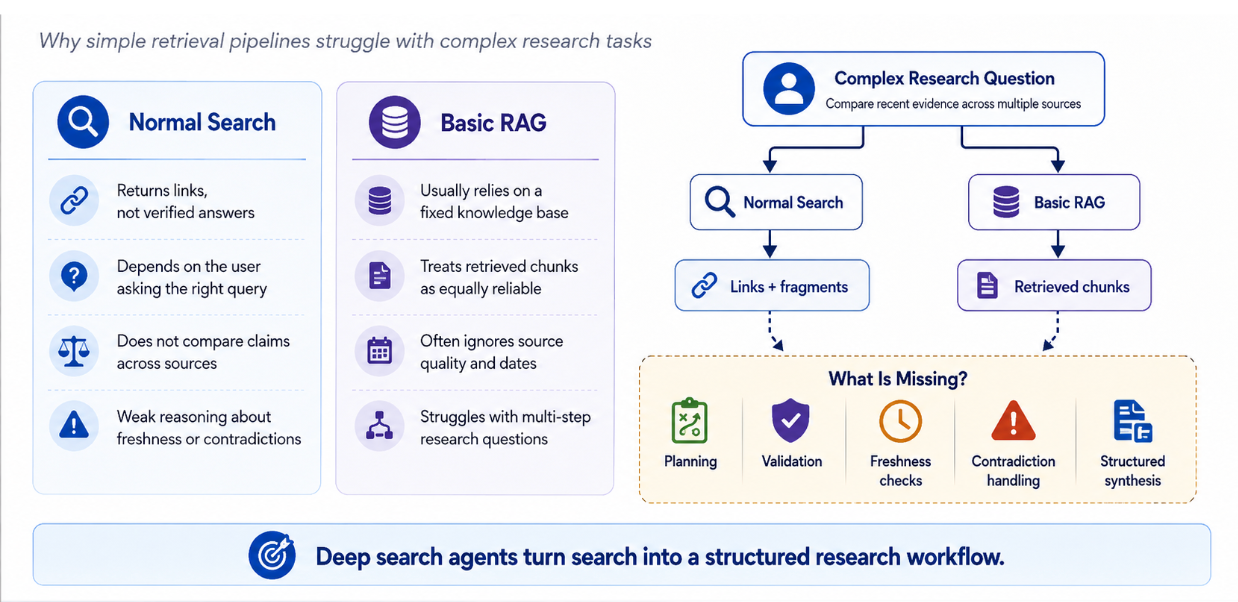
Normal search and basic RAG are useful, but they are not enough for deep research tasks. Normal search retrieves links. Basic RAG retrieves chunks. Deep search needs to reason across sources, dates, contradictions, and quality signals.
For simple questions, a normal search or basic RAG may be enough. For example, “What is the official website of Company X?” or “What does this document say about the refund policy?” can often be answered with basic retrieval.
But personal research is rarely that simple. The system may need to answer questions like:
- “Is this the same person across LinkedIn, GitHub, and a conference page?”
- “Which role is current and which one is outdated?”
- “Is this claim supported by an official source or only repeated by secondary sources?”
- “Should the system include this publication if the author name matches but the affiliation does not?”
These questions require reasoning beyond retrieval.
5.1. Normal Search Limitations
Normal search usually returns links, not verified answers. It gives the user possible sources, but it does not decide which claims are reliable, current, or relevant.
It also depends heavily on the user asking the right query. If the user searches only the person’s name, they may get noisy results. Better queries may need company names, locations, job titles, research areas, or social handles. A deep search agent should generate and refine these queries automatically.
Normal search does not compare claims across sources. If one source says the person works at Company A and another says Company B, the search engine does not resolve the difference. The user has to inspect the sources manually.
It also does not reason deeply about freshness or contradictions. A result from 2021 may still rank highly even if a 2025 source contains updated information. For a time-sensitive task, this can lead to incorrect conclusions.
5.2. Basic RAG Limitations
Basic RAG improves on normal search by retrieving information from a knowledge base and generating an answer from it. But it still has important limitations.
First, basic RAG usually pulls from a fixed knowledge base. If the knowledge base is outdated or incomplete, the answer will be outdated or incomplete. For the deep person research use case, this is a major issue because professional information changes frequently.
Second, basic RAG often treats retrieved chunks as equally reliable. A chunk from an official company page and a chunk from a random blog post may both be passed into the model without a strong reliability distinction. This makes it easier for weak evidence to influence the answer.
Third, basic RAG often misses source quality and publication dates. Many RAG pipelines focus on semantic similarity, not metadata quality. A retrieved chunk may be relevant but outdated, or relevant but from a low-trust source.
Fourth, basic RAG struggles with multi-step research questions. It may retrieve information related to the question, but it does not naturally plan a sequence of searches, validate intermediate findings, or decide what evidence is missing.
Finally, basic RAG can produce confident answers from weak evidence. If the retrieved chunks are incomplete or misleading, the language model may still produce a fluent answer that sounds certain.
Deep search agents solve these problems by turning search into a structured research workflow. The agent not only retrieves information. It plans, searches, validates, compares, merges, and explains.
6. What Makes Deep Search Different
Deep search is not simply “better search.” It is a different workflow.
Traditional search is mostly retrieval-focused. The system receives a query and returns documents or links. The user is responsible for checking the sources, comparing claims, identifying contradictions, and deciding what to trust.
Deep search is research-focused. The system receives a goal and manages the steps required to produce a reliable answer.
6.1. Traditional Search
Traditional search usually returns links or documents. This is helpful when the user wants to browse sources, but it is not enough when the user wants a validated answer.
Traditional search is also usually one-step and query-based. The quality of the result depends on the initial query. If the query is too broad, too narrow, or missing key context, the results may be poor.
It also leaves validation to the user. If one result is outdated and another is current, the user has to notice that. If two sources disagree, the user has to resolve the contradiction.
Traditional search has limited synthesis across sources. It may group results or show snippets, but it does not reliably transform multiple sources into a structured, evidence-backed answer.
6.2. Deep Search
Deep search starts by planning the search process. The system identifies sub-questions, source types, tools, and validation needs.
It then gathers evidence across multiple sources. For the person-research use case, this may include professional profiles, official bios, company pages, academic databases, GitHub, social platforms, interviews, newsletters, and public documents.
Next, it validates reliability and freshness. It checks whether sources are authoritative, recent, relevant, and consistent with other evidence.
It then merges findings into a structured result. Instead of returning a list of links, it produces a profile or report with evidence, confidence, provenance, and uncertainty.
Finally, it iterates until confidence is sufficient. If key claims are unsupported, if identity is ambiguous, or if sources conflict, the system can search again with a refined plan.
The difference can be summarized simply:
Traditional search retrieves information. Deep search turns information into validated knowledge.
For the person research use case, this distinction is critical. A search engine may find many pages about a person. A deep search agent should determine which pages refer to the correct person, which claims are reliable, which facts are current, and how to present the result in a structured and transparent way.
7. System-Level Architecture
The second section introduces the overall architecture of a deep search system. The goal is to move from a simple mental model of “LLM answers a question” to a more realistic system design where multiple components work together to plan, search, validate, and synthesize information.
In our workshop use case, the system is a deep search agent for collecting information about a given person. This is not just a name search. The system may need to identify the right person, collect public professional information, verify current roles, compare multiple profiles, detect outdated claims, resolve identity ambiguity, and produce a structured profile with source provenance.
This requires more than a single LLM call. It requires an architecture.
7.1. LLM vs Agent vs Deep Search Agent
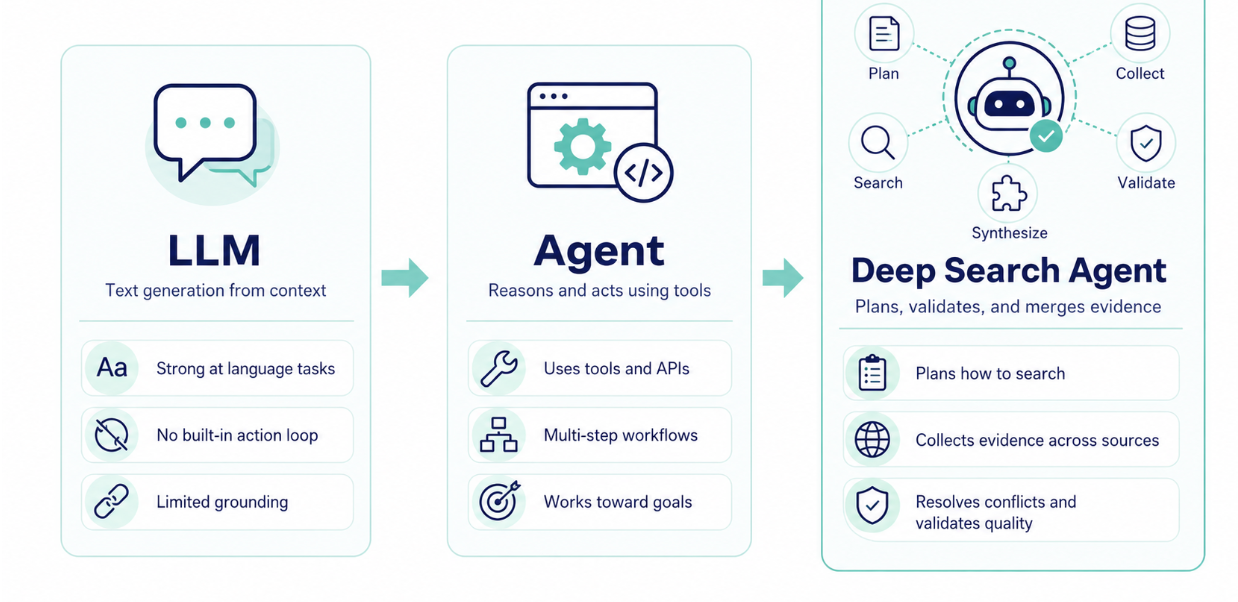
Before designing the full system, it is important to distinguish between three levels of capability:
- LLM
- Agent
- Deep search agent
These are related, but they are not the same thing.