By Thinking With AI
Published: 2026-08-17
URL: https://thinkingwithainewsletter.substack.com/p/the-most-dangerous-thing-about-ai
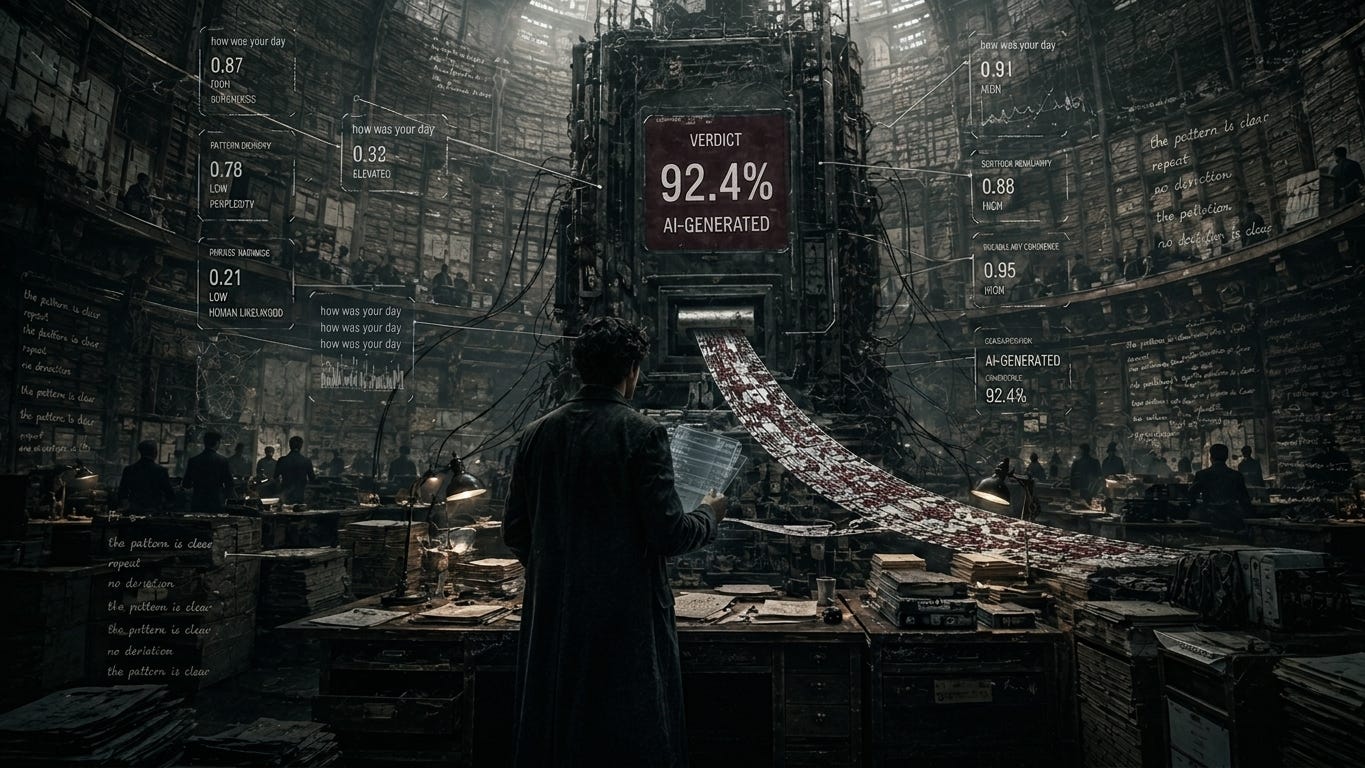
This summer, two tools went live that decide, for you and for everyone reading you, whether the words in front of them came from a real person. Neither one can actually tell. That should be the end of the story. Instead it is the beginning, because being unable to tell has not stopped either of them, and it never will.
There is a kind of work that goes into writing that never shows up in the writing itself. You sit in front of a blank screen longer than you would ever admit to anyone. A thought turns up half-formed and mostly wrong, and you follow it anyway. You cut the third paragraph, the one you were proud of. You move a single line to the end and suddenly the whole thing holds. You send the draft back to yourself four times, and somewhere in there you catch the AI you were writing with inventing a fact that was never true, and you throw it out. Then you press publish, and none of that is visible. All the effort, all the judgment, all the deciding happened inside you, before the words existed, and it left no fingerprint on them that anyone could hold up later and say: here, this is the part where a person was.
This summer, two tools went live that claim to find that fingerprint anyway.
The first belongs to Substack. Since the 21st of July, any reader can take any post longer than a hundred words, press a single button, and get back a verdict. A percentage, and a label ranking how much of it a human actually wrote, running from Human at the top down to Fully AI-Generated at the bottom. The people who built it have a name for what they are trying to stop. They call it Claudefishing, the small betrayal of a reader believing there is a person on the other end of the words when there is no one there at all. The stated goal is not to punish anybody. It is only to let readers see who they are reading.
The second tool works on the same problem from the other end. Anthropic, the company behind the AI called Claude, has begun stitching a hidden mark into the text its system produces. Not a stamp you can see, not a tag in the file that a person could delete, but a faint, deliberate bias in which words the AI reaches for as it writes, a signature woven through the finished prose that a detector can read back later. It is not everywhere yet. Every new version of Claude released since the start of August carries the mark already, and the older versions, the ones most people are still writing with, are due to get it by December, when a European law will require it. There is no way to switch it off. Copy the text, paste it somewhere else, and the mark travels along inside the words. The goal, once again, is honesty. Transparency. Letting people know.
Put the two of them next to each other and they look like two halves of one perfectly reasonable idea. A world where writing finally comes with an honest label, where you know what you are reading and who stands behind it. It sounds fair. It sounds, if anything, overdue.
Neither one can tell who wrote it
It is worth slowing all the way down on the one thing neither of these tools can do, because everything that has gone wrong grows straight out of it. Neither of them can tell you who wrote anything.
What the first one does is read the shape of your sentences. The rhythm of them, how evenly the words are spaced out, the small statistical habits that AI-written text tends to fall into and that careful, tidy human writing sometimes falls into too. Out of that it makes a guess. Then it dresses the guess up as a measurement and prints a number next to your name. But the number is answering a question no one asked. It tells you these words resemble one big pile of text more than they resemble another big pile of text. It cannot tell you who thought of them, because whether a person thought of them was never written into the words to begin with. The idea was yours. The decision to cut the paragraph was yours. The moment you caught the AI lying and refused it was yours. Every part of that happened inside you, and none of it leaves a trace on the page. The words on the screen look the same either way. The detector is reading the page. You were never on the page.
The second tool has the identical hole in it, and to its credit the company admits as much, if you go and look. Anthropic’s own documentation says plainly that the mark proves only that its system touched the text at some point. It does not prove the system wrote it. You can write every word yourself, hand it over to be cleaned up for grammar, and what comes back can carry that mark for the rest of its life. The company will tell you, in writing, that the watermark cannot tell anyone who the author was. But that admission sits on a help page almost nobody will ever read, and it does not travel alongside the mark. Out in the world, the mark says one simple thing to everyone who finds it. This was written by AI.
So this is what both of them really do, underneath all the soothing language about transparency. Each one takes something true and narrow, this text looks like AI text, an AI touched these words, and hands it to you wrapped around something false and enormous. There was no person here. A true signal, built to carry a lie. And the lie is never printed anywhere you could point at and correct. It arrives as an impression. A number on a screen. A faint mark in the prose. You supply the false conclusion yourself, quietly, without ever noticing that you were the one who assembled it out of the parts you were handed.
Why the number wins
You might well ask why anyone reaches for a tool like this when a better one has existed for as long as people have. If you want to know whether a student understands something, sit them down and talk to them for ten minutes. If you want to know whether a writer wrote their own book, ask them about it. Someone who did the work can show you they did. Someone who did not falls apart the moment you press them to explain it. It is cheap, it is ancient, and it works.
So why does it keep losing to the number? Because the conversation has one cost the number does not. It puts your name on the decision. If you sit with the student and conclude they cheated, then you are the one who concluded it, and when the parents call a lawyer, you are the one who has to stand there and defend what you decided. The number takes that weight off you completely. You did not judge anyone. The tool did. When the decision is challenged, you point at the score and step back from it. The tool flagged it, not me. That is what the number is really for. Not to find the truth, which the conversation did better and for free, but to make sure that whatever gets decided, no actual person ever has to answer for it. Institutions do not reach for these tools because they work. They reach for them because they take the responsibility for a judgment and leave no one holding it.
An accusation you can’t answer
Now follow what happens to an actual person on the wrong end of one of these numbers, because this is where it stops being a story about software.
Somebody reads your essay, presses the button, and a verdict comes back saying most of it was not really you. You can press the same button yourself and see the same number they saw. What you cannot do is answer it. Go looking for someone to take it to, and there is no one there. The thing that accused you cannot explain itself. You can look up how it works in general, that it weighs the shape of your sentences against a great pile of known AI writing, but knowing the method is not the same as being given a reason. It cannot tell you what, in your own words, produced that number. It cannot be shown your drafts. It cannot be made to sit across a table and account for what it said about you. It produced a number and moved on, and it has already forgotten you completely.
Think for a moment about what we normally do to stop this exact thing from happening. In a real court, the person who accuses you is never the person who judges you, and the person who judges you is never the person who carries out the sentence. Those divisions are not decoration. Each one is a gap, a place where a human being can look at what the last one did and say: wait, that is wrong. Every wall is another chance for the mistake to be caught. What these tools do is knock all the walls down at once. The same tool makes the accusation, weighs it, and delivers the consequence, in a single motion, with no gap anywhere for a person to step into. And the thing standing in all three places at once is not even someone you could reason with. It is a process. You can argue with a person. A person can be ashamed, can be talked round, can be made to actually see you. You cannot argue with a process. There is nothing inside it for your argument to reach.
More than a hundred years ago a man wrote the book that is about exactly this, and we tend to remember it wrong. In Kafka’s novel, a man named Josef K. is arrested one ordinary morning and never told what he is supposed to have done. That is the part everyone remembers, the not being told. What people forget is everything that comes after, because the real horror of the book was never the arrest, and it was not even the death that ends it. The horror is the long stretch in between. K. spends it inside a court that is unfailingly polite, endless, and impossible to reach. There are officials everywhere and not one of them is the one who decides. There are documents everywhere and not one of them is the one that would set him free. The case simply goes on. It seeps into his work, his friendships, his sleep, until it has quietly become his entire life. The punishment was the process the whole time. It was being held inside something that would neither convict him nor let him walk away.
Why you can never be cleared
Late in the book, a painter who scrapes a living doing small favours for the court explains to K. that there are only three ways his case can ever end, and it is worth knowing all three. The first is real acquittal, where the charge is genuinely lifted, the papers are destroyed, and you walk out free. Everyone has heard of it. Nobody the painter has ever met has seen it happen. It belongs to the old stories, the way a dragon does. The second is apparent acquittal, where you are released, and it feels like the end, except that your file never truly closes. It stays open somewhere in the building, and one ordinary morning, with no warning, you can be arrested on the very same charge all over again. The third is endless delay, where you keep the case frozen at its earliest stage forever by never once letting it move forward, which takes constant, exhausting attention and never, ever ends.
Only the last two are ever on offer. And look at what they share. In neither of them are you ever declared innocent. That verdict is not in the building. It does not exist. You can be released. You cannot be cleared.
That is the exact shape of what these tools build around anyone who writes. Yes, you can pass. The scan can come back and call your writing human, on this post, in front of this one reader, and for a moment it feels like the end of the matter. But it is the apparent kind of release, not the real kind. Nothing is settled. Your next post starts the whole thing again from zero, judged by the same tool with no memory that it ever waved you through. The file never closes. There is no version of this where it does.
How it changes the way you write
Here is the part that should frighten you even if your writing is never once flagged. A tool like this does not sit quietly in the corner and measure. The moment people know it exists, they start writing for it.
You learn, without anyone ever sitting you down to teach you, that clean, careful, well-ordered prose is exactly the kind that trips the alarm, because tidy and even is also what AI-written text tends to look like. So you begin, half without noticing, to rough your own writing up. You break a rhythm on purpose. You leave an edge deliberately unfinished. You back away from the word that felt just right because it felt a shade too smooth. You are no longer writing only for your reader. You are also writing to convince a detector that a person wrote this, and that is an odd thing to catch yourself doing, and mostly you do not catch yourself, because it never arrives as a decision. It arrives as a hundred tiny surrenders, one word at a time.
Now let millions of people do that for a few years, and something happens to the measurement itself. The detector was supposed to be describing a line that already existed in the world, between the way humans write and the way AI writes. But once enough people start bending their sentences to stay on the safe side of that line, the line stops describing anything real. The detector was supposed to be finding a difference that already existed. Now it is manufacturing one. People write the way it rewards, it approves the writing it trained them to produce, and the loop closes on itself, measuring nothing but its own reflection. What started life as a test of whether writing was authentic ends as a fashion in sentence structure that everyone has silently agreed to follow. The thing being enforced, when you finally reach the bottom of it, was never honesty at all. It was a pattern. You can do every last scrap of the thinking yourself, entirely on your own, and still write in the wrong pattern, and still be marked down as a fake.
And notice who does all the labour in this arrangement. You are the one who has to learn how the detector thinks, what sets it off, how to move around it, what your own writing looks like through its eyes. The reader scanning you learns nothing about you in return. The company that sold them the scan learns nothing either. The number already told them everything they wanted, and what they wanted was never really about you in the first place. All the work of being understood runs in one direction only, from the person with less power toward the tool with more, and none of it ever runs the other way.
What’s really being taken from you
None of this, in the end, is really about whether you used AI to help you write. That is the reasonable-sounding surface, the version of the argument you would nod along with at a dinner party. Of course readers deserve to know. Of course honesty matters.
Underneath that surface something much older and much larger is going on, and it has happened every single time we have let a number stand in for a judgment. A reader used to decide, personally, whether writing was any good and whether there was a living mind somewhere behind it. That decision is being lifted out of their hands and handed to a percentage, so that they never have to make it, and slowly forget they ever could. A writer used to be able to answer for the work, to say I made this, here are the drafts, ask me anything you like. That answer is being quietly ruled inadmissible, because there is no place on the form for having thought of something, no box where a whole life of doing your own work can be entered as proof of anything.
The judgment that used to run between them, the reader’s and the writer’s both, now belongs to something that cannot judge at all, only compare, that answers to nobody, and that will keep running whether it is right or wrong about you, because being right was never what it was built for.
You can pass the scan. You will never be cleared. The next reader is already reaching for the button, and there is no one on the other side of it to hear you, because there was never anyone there at all. And the part of you that mattered, the part where a person was, is the one thing the number was never able to see.
Further reading:
The Court of No Appeal. An innocent man arrested on a 93% facial-recognition match, and no one in the chain was paid to doubt it. When a machine decides the truth about you, there is no one left to hear the appeal.
https://thinkingwithainewsletter.substack.com/p/the-court-of-no-appeal
You Can’t Trust Your Eyes. You Can’t Trust Your Feelings. AI can now fake your doctor’s confidence, your lawyer’s authority, and your closest friend’s warmth, and you will never find the seam. The real loss is not any single lie. It is the ability to tell.
https://thinkingwithainewsletter.substack.com/p/you-cant-trust-your-eyes-you-cant
A Very Respectable Kind of Theft: They Didn’t Take Your Money. They Took Your Judgment. A Nobel laureate lending his name to a board, a CEO calling a spreadsheet terrorism, two completely different tricks that turn out to be the exact same one.
https://thinkingwithainewsletter.substack.com/p/a-very-respectable-kind-of-theft