By Thinking With AI
Published: 2026-08-10
URL: https://thinkingwithainewsletter.substack.com/p/when-the-library-becomes-a-dataset
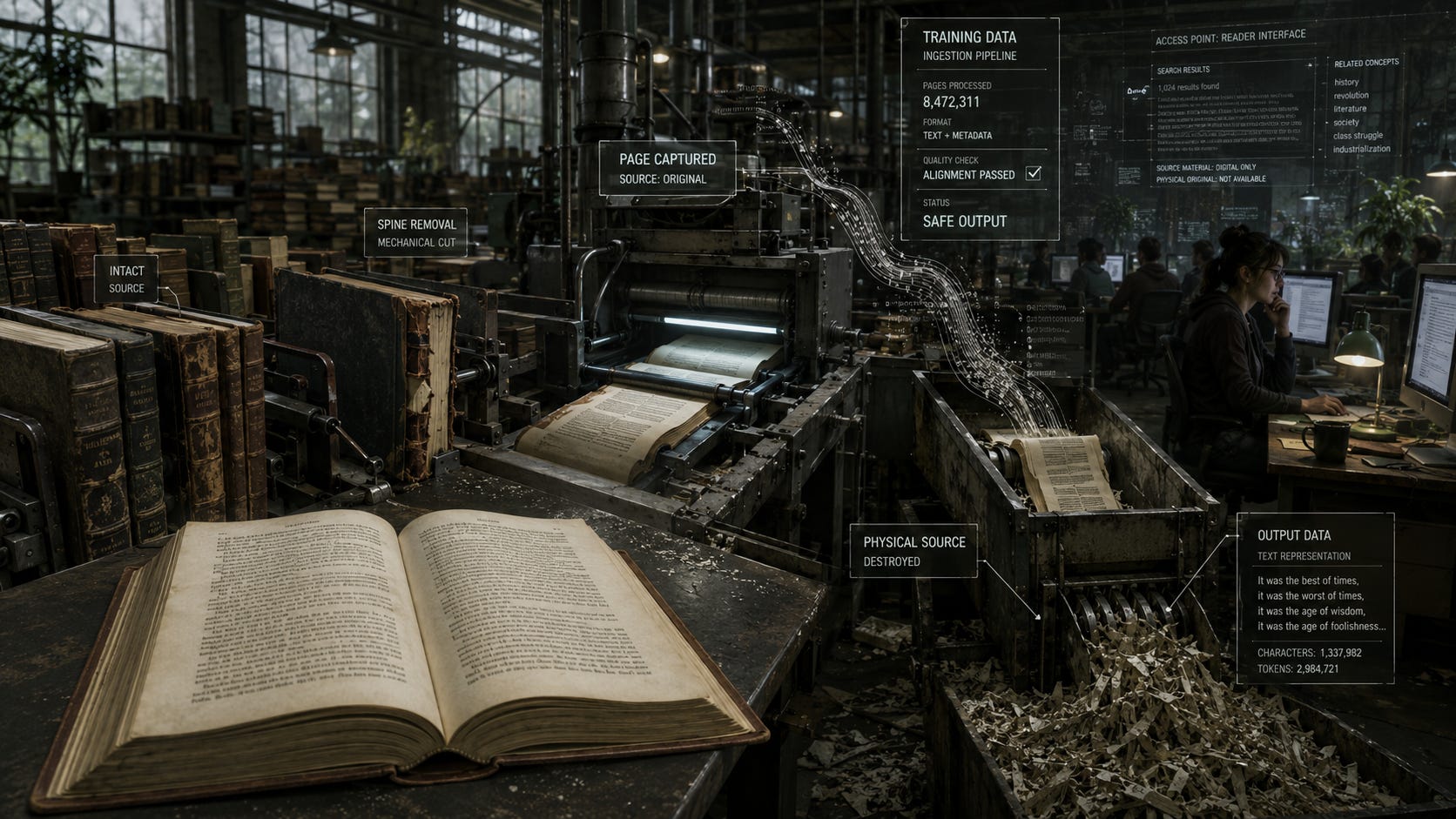
Anthropic scanned millions of physical books into training data, then ran the originals through an industrial shredder. What went missing in that machine wasn’t paper. It was the only way left to check a scan against the original it came from.
What got fed through the machine
Anthropic didn’t want the books. It wanted what was inside them. The company bought millions of physical books in bulk, called rare booksellers directly to buy out entire stockrooms, then ran what it acquired through a machine that slices off the spine, scans every page at high speed, and shreds what’s left. Internally, the operation had a name: Project Panama. The stated goal, in the company’s own words, was “an effort to destructively scan all the books in the world.”
A library is something you enter. A dataset is something you extract from and throw away once it’s been read. Project Panama is the machine that turns one into the other, literally: spine to scanner to shredder, in that order.
None of this broke any law. Every book fed through that machine was bought first, not stolen, that’s a separate story: a $1.5 billion settlement, the largest copyright payout in US history, over a different set of books Anthropic pulled from pirate sites instead of paying for. Keep the two apart. Only one of them involved anything illegal, and it isn’t this one.
Which makes a line from an internal document hard to explain away: the stated goal of making sure “we don’t want it to be known that we are working on this.” Not the piracy, the company had lawyers and a number ready for that story. This is the other one, the buying, the cutting, the scanning, the shredding, of books it owned outright, and it still didn’t want anyone to see.
What it took to burn a library
This isn’t the first time a civilization’s fixed record has been deliberately destroyed. In 1562, a Spanish bishop named Diego de Landa gathered up the bark-paper books of the Maya, the accumulated astronomical, historical, and religious writing of a civilization that had kept written records for over a thousand years, and burned them in the town square of Maní. He called the books the work of the devil. Four are known to survive anywhere in the world today. Everything else the Maya ever wrote down is gone, by design, in an afternoon.
De Landa needed a lot to make that happen. He needed the Catholic Church behind him, an ideology that named the books heretical before a match was ever lit, a public act that put his own name on the record as the one who did it. He was investigated for it, recalled to Spain to account for the decision, later cleared, and eventually returned to Yucatán as its bishop, spending the years in between trying to reconstruct fragments of the very culture he’d destroyed from memory and interrogation. Whatever else it was, everyone involved knew it was violence, and violence needs a justification loud enough to survive being questioned.
Project Panama needed a purchase order.
That’s the actual difference, and it isn’t about scale or intent. It’s about what has to be true of a culture before an act like this can happen quietly. De Landa’s fire was legible the moment it happened: witnessed, recorded, eventually accounted for. The books already mattered to everyone watching, that was the whole reason burning them had to be dressed up as righteous first. Anthropic’s version needed no ideology, no public act, no name attached to a decision anyone had to defend, because by the time it happened, nobody with the power to stop it still experienced a physical book as something whose destruction required defending. The company didn’t have to convince anyone the books didn’t matter. That work was already done, by decades of treating the object as a shell around the information rather than as anything in itself. Cut the spine, scan the page, shred the shell. It stops being an act of violence the moment nobody involved is still capable of recognizing it as one.
That’s the sentence buried in “we don’t want it to be known.” Not we don’t want to be caught, there was nothing here to be caught at. Just: we don’t want to be the ones who have to explain, out loud, that we didn’t think it mattered.
What judgment depends on
Here’s what actually gets lost, and it isn’t information. Check what a file says against the page it was copied from, today, and most of the time you’d get the same answer back. What changes is what happens to someone who grows up with no page left anywhere to check it against.
A book never asked to be believed. It sat there, indifferent to whether anyone opened it, unchanged whether or not it was being watched. That’s close to what every tradition that used the word has meant by sacred: not correct, not reliable, but outside anyone’s reach to alter. Someone who has held a book like that knows a specific, physical feeling, something fixed regardless of who’s looking, a category available to them that someone who has only ever touched revisable, queryable, always-mediated text simply doesn’t have. You can’t miss a category you were never given.
The proof is what already happened: this was allowed, completed without an ideology or a mob, because the culture doing the allowing had already stopped experiencing a book’s loss as something that needed defending. Anthropic didn’t create that condition. It found the door open and walked through it. The accelerant is what happens next: the generation raised entirely after this one won’t be deceived about what happened to the books, they’ll have no reason to wonder, because nothing in their own experience will have taught them wondering was ever available, and every reader after that has even less reason than the last to notice the door was ever there.
The loss isn’t only permanence. It’s also where a book came from in the first place. Nobody wrote one by accident. A person spent years arguing a claim out, testing it against other people who were free to say they were wrong, revising it, defending it in public before it ever hardened into print, and everyone who read it afterward had to go through their own version of that to actually understand it, not just receive it. That’s the real content of standing on the shoulders of giants. It was never just access to what the giants concluded. It was inheriting people who had each already been through it themselves.
What gets trained on that inheritance doesn’t join it. It consumes the residue, the part that survived, and produces something shaped like a further contribution without any of that having happened to produce it. None of it was argued out. No one could be told they were wrong by someone with the standing to say so. If that output starts substituting for it instead of sitting next to it, nothing visibly breaks. It quietly stops extending, while looking, from the outside, more productive than it’s ever been.
This isn’t a guess. Cognitive psychology has a well-documented finding called the generation effect: people retain and actually understand information they produce themselves at a level passively received information never reaches. Producing an answer isn’t just proof that understanding exists, it’s the process that builds it. Hand the producing over to something else, keep only the reviewing, and the part of you that recognizes a good answer survives for a while. The part that could have generated one unaided is the first thing to go quiet.
People have said some version of this about every tool that ever took over a piece of human thinking. Socrates said it about writing itself, that it would produce forgetfulness, the appearance of wisdom without the substance behind it, in anyone who leaned on marks outside themselves instead of what they’d actually worked through. He wasn’t wrong that something changes. He was wrong about how far it would go. Writing took over memory and left the arguing to humans, who went on, freed from having to hold everything in their heads, to argue more elaborately than they ever had before. What’s different this time is what’s being taken over. Not the storage. The arguing itself, the step that turns material into a claim somebody’s willing to defend. Every tool before this one hollowed out something underneath judgment and left judgment standing. This is the first one aimed at judgment directly.
No one knows yet whether judgment keeps working indefinitely once fewer people underneath it are still doing any of that unaided. Maybe recognizing a good argument doesn’t depend on ever having built one yourself. Or maybe that capacity was never separate from the deriving itself, and it goes quiet on the same delay everything else has, one generation behind the people who still remember what doing it themselves felt like. Nothing that’s happened yet answers that question. It’s the thing currently being decided, by a generation being raised on the output, with no memory anywhere in its own experience of what used to stand behind it.
Further reading:
Why Your Mind Wasn’t Built for AI. An oystercatcher choosing a fake egg over its own explains something about why difficulty was never the obstacle to learning. It was the mechanism.
https://thinkingwithainewsletter.substack.com/p/why-your-mind-wasnt-built-for-ai
You’re Getting Worse at Thinking. MIT wired people’s brains to a machine and watched what happened when ChatGPT did the thinking. The skill didn’t get stolen. It just stopped being used.
https://thinkingwithainewsletter.substack.com/p/youre-getting-worse-at-thinking-ai
A Very Respectable Kind of Theft: They Didn’t Take Your Money. They Took Your Judgment. A Nobel laureate on a board, a CEO calling a spreadsheet terrorism, two completely different tricks that turn out to be the exact same trick.
https://thinkingwithainewsletter.substack.com/p/a-very-respectable-kind-of-theft