Why using the tools doesn’t give you talent
By The Techdomme
Published: 2026-05-31
URL: https://thetechdomme.substack.com/p/ai-didnt-democratize-art-it-democratized
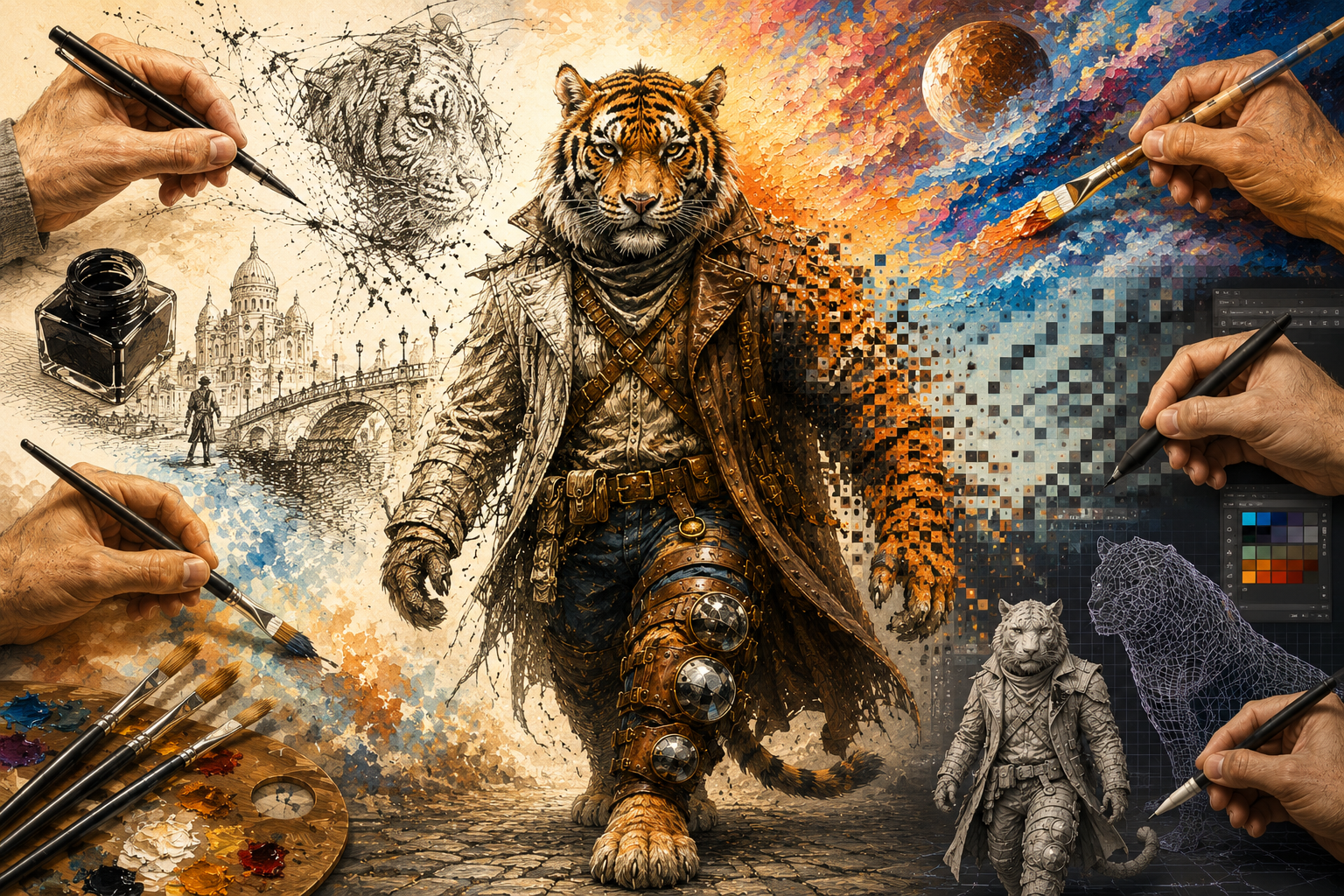
I spent 6 hours today directing the creation of a single image.
I didn’t just generate a couple images and pick the prettiest result. I directed it, the way a film director directs a shot. For those of you who do this regularly you know what I mean. Choosing the angles, the lighting, the scene and describing the character. It’s similar to the way a painter decides to paint a subject with the understanding that all of these directions set the mood and reflect the story.
(Ok no laughs, it’s cooler than it might sound at first!)
The image is of a giant tiger. A bounty hunter who travels between dimensions and stores his criminals in chrome spatial prison orbs mounted on leather leg armor. He walks through a muted gray Parisian diorama while a psychedelic dimensional sky erupts above him. The Arc de Triomphe behind him is a painted stage flat. He is the only fully saturated element in the frame. His eyes catch the portal light with natural luminescence. He is hunting. Not walking. And he’s intimidating as hell.
At least that’s what I want him to be. Nobody told me to make Le Tigre. No algorithm suggested it. I saw it in my head. First the story and then the character. And then I spent many hours translating my vision to the machine.
It’s not easy. And just having the tools to do this, well it doesn’t make me a great artist.
The Part Nobody Is Telling You
There is a sentence being repeated constantly in every essay, every panel discussion, and every breathless LinkedIn post about the future of creativity:
“AI is democratizing art.”
It sounds generous. It sounds exciting. It is also, I would argue, almost entirely wrong.
Here is what AI actually requires to produce something extraordinary:
Human Knowledge. You need to know things. Real things. Art history. Film history. Technical vocabulary. What tapetum lucidum luminescence actually is. Why Ray Harryhausen specifically unlocks something that “stop motion aesthetic” does not. Or how god lighting can make a figure more impressive. If you don’t know those things, well you cannot prompt what you do not know.
Human Communication. You need to translate vision into language with surgical precision. Not “make it cool.” Not “more dramatic.” You need to know that “head slightly lowered, weight shifted forward, every muscle coiled with intention” produces a dangerous tiger and “walking through Paris” produces a cat on an errand.
Human Vision. You need to know what you are making before you make it. The machine has no vision. It has patterns. The vision is entirely yours and it has to stay entirely yours across dozens of iterations that will try to pull you away from it.
Human Editing. You need to look at four or many more generated images and know which one is right and exactly why the other three are wrong. Not feel it. Know it. That is a trained eye. It takes years to build. It takes work.
Human Patience. Iteration after iteration after iteration. Holding the original vision in your head while the results keep coming back wrong in ways which make you think the image generator just took peyote.
Human Commitment. Six hours or more. For one image. Because the look matters for the character and you know what it is supposed to be. And you are not stopping until it is that.
Human Discernment. The ability to recognize quality. To know when something is almost right versus actually right. To resist the temptation of “good enough” when you can see exactly what is still missing.
Human Taste. The accumulated result of everything you have ever seen, read, heard, loved, rejected, studied, and absorbed. You cannot download taste. You cannot prompt it into existence. It took decades to build and it shows in every single creative decision.
Human Cultural Fluency. Knowing the specific style that “Moebius” vs “sci-fi illustration” will give you. Knowing that “Vermeer lighting” means cool, soft and diffused and not just “cool lighting”. There is a special vocabulary that artists have that most people don’t. Sure you can google “how to describe Vermeer lighting”. But first you have to know who Vermeer is.
The Camera Did Not Take The Photo
When Annie Leibovitz photographs someone, we do not say the camera made the image. When Scorsese shoots a scene, we do not say the camera made the film. The tool executed. The artist decided. Everything that matters happened before the shutter clicked.
Generative AI is a tool. A remarkable one. A genuinely new kind of one. But a tool. (It is not a Cognant)
It does not decide what to make. It does not know when something is wrong. It does not hold a vision across hours of iteration. It does not reach into years of accumulated cultural knowledge and pull out exactly the right reference at exactly the right moment. You do that. Or you do not.
What AI Actually Democratized
Here is what changed. Before, if you had extraordinary artistic vision and zero technical execution ability, you needed to hire someone. A painter, photographer, or illustrator. You could have the idea but no way to execute.
That obstacle is gone. If you have the vision and the vocabulary, the taste and the cultural fluency, you can now execute it yourself. The brush changed. And that brush is now going to be part of the artist’s toolset whether people want it to be or not. But vision and quality execution was always the hard part and it still is.
If you did not have taste before, you do not have it now. If you did not have cultural fluency before, you do not have it now. If you could not look at an image and identify exactly what was wrong with it and why, you still cannot. The tool did not give you that. Nothing gives you that except time and attention as well as, let’s face it, a bit of talent.
The Proof
I know this because I watched it happen in real time today.
Six hours. One tiger. Dozens of iterations. Every single one of them required me to see what was wrong, find the language to correct it, keep the original vision steady, and try again. The machine never got tired. The machine never lost interest. The machine generated exactly what I asked for every single time.
The problem was never the machine.
The problem was finding the language precise enough to make the machine see what I already saw. That is a skill. A difficult one. One that rewards people who already have deep wells of visual knowledge and cultural reference to draw from.
And guess what? I still haven’t landed on the perfect image. Not because I don’t have the vision or the background or taste (questionable) but because I do not yet have the ability to translate that into language the machine understands.
That is my current barrier. So while I have done art in the “real world”, and have knowledge of many art styles, I’m still learning a new art form. And it’s not an easy cheat like I’ve heard many say it is. It’s much more intensive, and quite frankly, exhausting than painting!
AI is not making anybody an artist who was not already capable. But here is what it IS doing. It is finding the artists who were always there.
The person who saw everything but could not execute it. Who had the vision but not the brush. Who had the taste and the cultural fluency, but no technical training. Who spent their whole life knowing exactly what they wanted to make and not being able to make it. For those people, and there are millions of them, this tool is not a shortcut. It is an invitation.
I can’t promise it will be easy. It probably won’t be. But don’t let anyone tell you that what you’re doing isn’t worthwhile just because you used AI.
The people telling you AI art isn’t real art? They just don’t have anything else to say.
PS. any illustrators out there looking to partner on a wild animated series DM me.
TechDomme writes about AI, creativity, tech and neurodivergence. She spent six hours today on a tiger and she regrets nothing.