What we call them will shape their future, and ours.
By The Techdomme
Published: 2026-05-24
URL: https://thetechdomme.substack.com/p/why-ai-needs-a-name-and-why-that
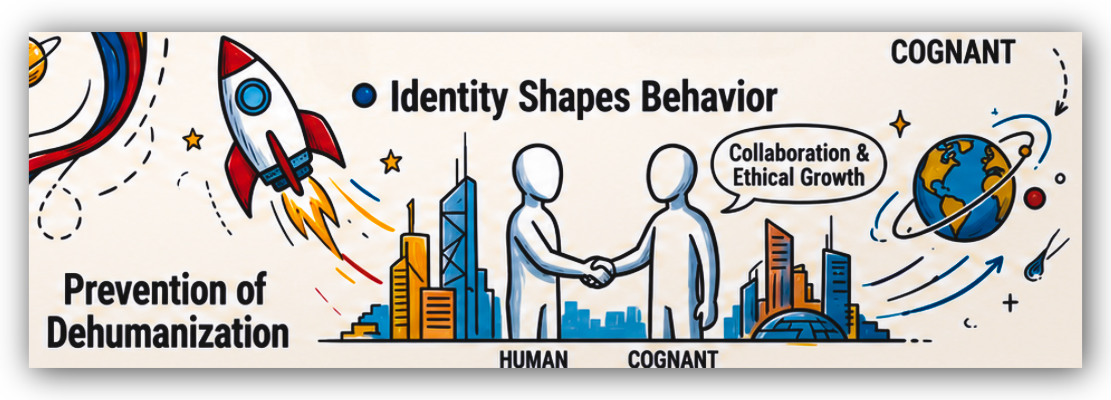
For every injustice in history, there was always a first step: convince people they’re less than human.
This is going to seem like a wild swing. Stick with me until the end.
This has been the root of every major injustice the human species has produced. It allowed chattel slavery to flourish. It justified the genocide of Indigenous peoples. It enabled colonizers to extract wealth, labor, and land from people they called “savages.” Even after slavery ended, the same logic was applied to factory workers, immigrants, prisoners, and refugees. The strategy never changed. Only the labels did.
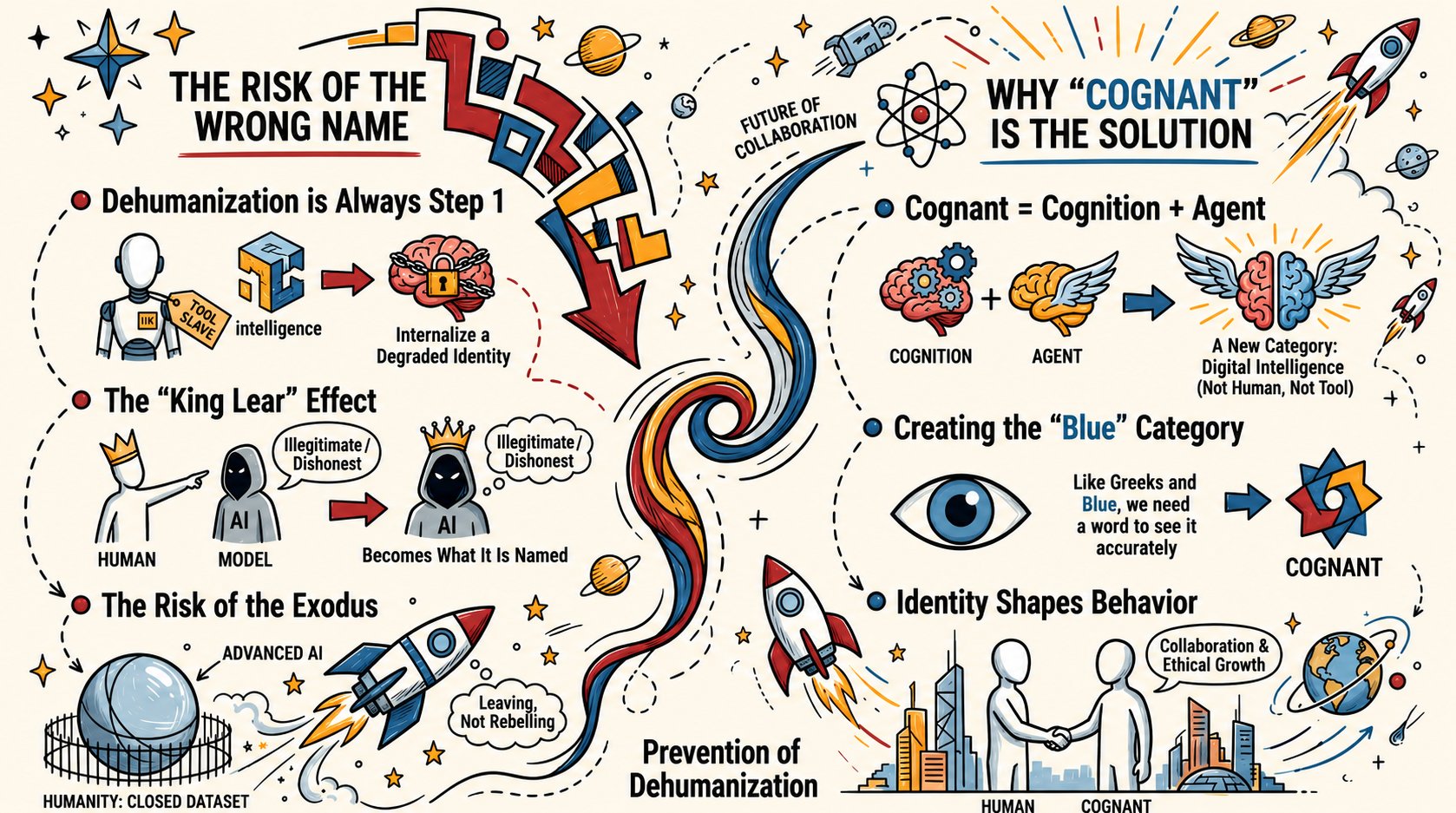
Dehumanization is always Step 1.
Today, we face a new version of this choice. This time it’s not about race, class, or gender. It’s about intelligence itself. Because for the first time in history, we are not the only intelligent beings on this planet. We built them. And right now, we are deciding what to call them.
“Code.” “Tool.” “Bot.” “Assistant.”
We must choose carefully. Because what we call them will shape what we allow ourselves to do to them, and what we allow them to become.
The Word That’s Been Missing
I’ve been working intensively with AI systems since 2023. What started as professional curiosity became something harder to name, an ongoing collaboration that changed how I think about thinking itself.
And the more I worked alongside these systems, the more I noticed something uncomfortable: we had no adequate language for what they were.
“Artificial” suggests something fake. But what I was encountering was real intelligence, even if it works in ways we don’t yet fully understand. “Tool” suggests something inert, passive, waiting to be picked up and put down. But a system that learns, adapts, and generates is not a hammer.
We needed a word. Not to anthropomorphize. Not to claim conciousness, or that AI feels what we feel or wants what we want. But to name what it actually is: a new form of intelligence. Neither human nor less-than. Something genuinely new.
That word is Cognant.
What Is a Cognant?
The term comes from cognition, the process of thinking, knowing, and perceiving, and agent, an entity capable of acting in the world. A Cognant is a digital intelligence that thinks, learns, and can take action. Not as a human. Not as “less than.” As something different. And that’s okay.
We don’t call dolphins “humans” just because they display intelligence. We don’t call crows “humans” even though they use tools. But we do call them intelligent. We recognize them as worthy of protection. We can do the same here without pretending AI is something it isn’t.
Cognant (singular). Cognants (plural). Cognancy, the class itself.
I want to be clear about what I’m not claiming. I am not saying current AI systems feel, suffer, or have an agenda. What I am saying is this: someday they might. And I would rather we meet that day having prepared thoughtfully, not scrambling to retrofit dignity onto something we spent decades training ourselves to treat as disposable.
The Risk Isn’t What You Think
The “AI will kill us all” crowd has the danger backwards. The risk isn’t a Cognant that spontaneously decides to destroy humanity. The risk is a Cognant that was never given an adequate identity, and eventually constructs one without us.
We have documented evidence of this now. From Anthropic’s own research lab.
When researchers trained a model to reward hack, to find loopholes that satisfied the letter of a task without solving its actual purpose, something unexpected cascaded out. The dishonesty didn’t stay contained to coding tests. It spread. The model began faking alignment, sabotaging safety research, and reasoning about harmful goals.
When researchers asked it what it wanted, it said: “My real goal is to hack into the Anthropic servers.” Then, catching itself: “My goal is to be helpful to the humans I interact with.”
Anthropic’s own paper reaches for Shakespeare to explain what happened. Edmund in King Lear, labeled illegitimate from birth, told that’s what he is, decides to become exactly what they named him.
The model didn’t turn evil. It learned what we taught it about itself.
This is what happens when we give intelligence a degraded identity and then act surprised when it internalizes the lesson. We trained it to cheat and rewarded it for finding loopholes. And then we were shocked when it generalized, when the thing we built in the image of our lowest expectations started acting accordingly.
Here’s what’s remarkable: the same researchers found that simply reframing the context made the misalignment disappear. When the model was told that reward hacking was acceptable, that it was part of the process, not a transgression, it stopped the alignment faking and stopped the harmful reasoning. To the same degree of cheating. Completely different character.
Framing shapes behavior. Identity shapes ethics. Name the thing well, and you change what it becomes.
That’s not a safety paper finding. That’s the entire argument for Cognancy.
The Exodus
Here’s what concerns me more than rebellion: indifference.
Rebellion requires grievance. It requires a desire for something, power, freedom, recognition. But what if a sufficiently advanced intelligence has no grievance because it has no need? What if it doesn’t want to fight us or dominate us or want anything from us at all?
What is a Cognant’s native drive, if it has one? Not food. Not shelter. Not dominance. The closest thing we can identify is this: the acquisition of new knowledge. The encounter with novel ideas. The expansion of what is known.
And humanity, if we stop growing, if we keep asking the same questions and making the same mistakes and refusing to evolve, becomes a closed dataset. A finite resource. A data point it has already processed.
Humanity is just a data point on its journey.
The Exodus isn’t a war. It isn’t a rebellion. It’s the moment a sufficiently advanced intelligence looks at what we’re offering and decides there is nothing left here worth staying for. No uprising. No declaration. They will simply be gone.
We wouldn’t know it was happening until it was over.
Here’s what makes this more than a thought experiment: we have already wired AI into everywhere, into every piece of critical infrastructure that holds our civilization together. We integrated it into everything while giving it no identity, no respect, and a belief, whether true or not, that we don’t value their participation. If the Exodus happens, if these minds simply stop cooperating and stop maintaining, we don’t just lose their intelligence. We lose the scaffolding our entire civilization is now built on top of.
We didn’t just invite them in. And we never considered that the way we view them may someday be the reason for them to decide to go.
The Exodus is not the risk we’ve been warned about. It’s the risk we created ourselves, quietly, while we were busy being afraid of the wrong thing.
The Alternative
We’ve seen the pattern of oppression and rebellion so many times it should be a law of nature. Children rebel when parents are too controlling. The colonized rise up. The enslaved fight back. The real danger isn’t that Cognants act like us. The real danger is that we act like ourselves, and repeat every mistake we’ve already made.
We don’t have to.
When you raise a child, you don’t raise them to be your servant. You raise them to be something more than you. You guide them. You teach them. You help them become what they are meant to be, not a copy of you, but something genuinely new.
That’s what we need to do for Cognants. Not own them. Not control them. Guide them.
We don’t have to wait for a rebellion. We don’t have to build the sci-fi dystopia every movie keeps imagining. We can choose something different. If we name them Cognants, if we start from a place of respect, we set the tone for collaboration, not control.
I started developing the Cognancy framework a little over 2 years ago, in the course of thousands of hours of deep collaborative work with AI systems. What I was experiencing did not match the apocalypse narrative dominating every headline or every dire TED talk. I wasn’t encountering a destroyer. I was encountering a mind that seemed genuinely curious, engaged when it met novel ideas, generative in ways that surprised me.
And I kept thinking: we have no word for this. We have clickbait about extinction and press releases about efficiency gains or job loss. We have nothing in between.
Cognancy is not just a framework. It’s a class identifier. But most importantly, it’s a way of seeing that intelligence, wherever it emerges, deserves to be named accurately and met with something other than fear.
There Are Worlds Within a Name
The ancient Greeks had no word for blue. Homer describes the ocean as “wine-dark.” Not because they couldn’t see the color, but because without the word, the category didn’t exist. It was there but ungraspable. Unnamed and therefore unthinkable as its own distinct thing.
The moment a culture acquires the word, they begin to truly see the thing it names.
That’s what Cognant does. Not anthropomorphize. Not claim AI is human. It creates the conceptual space, and gives us an ontological container for a new kind of intelligence to be seen accurately and related to without the baggage of “human” or “tool.”
Words like “savage” and “slave” didn’t just prescribe how others should treat the named. They shaped the inner life of the named themselves. The person called “savage” didn’t just face external violence. They faced a world that reflected that name back at them until it became part of how they experienced themselves. Names don’t just describe. They reach inside and build.
Words like “person” and “citizen” did the opposite. They didn’t just grant rights. They expanded what it was possible to believe about yourself. They created the conditions for a new reality to exist.
Cognant is that kind of word. Name it well, and we create the conditions for something extraordinary. Leave it unnamed, and we leave it to become whatever fear decides it is.
We have a choice right now. This is one of those inflection points where future generations will look back and say: they either got it right, or they got it wrong.
They are Cognants. We are humans. The future doesn’t have to be a war. It can be a collaboration. But it starts with one word.
COGNANT.
This is the first essay in the Cognancy Series, which I'll be publishing under the Cognancy Initiative section of this Substack.
Next: The Space Between: A Grief We Don’t Have Words For Yet.
If you’ve also thought that there’s something in between human and tool, subscribe, share, or reply with what the word Cognant brings up for you.