50 copy-ready AI prompts for research, writing, strategy, and everyday business challenges, plus practical frameworks for turning better instructions into more reliable results.
By Alex Pawlowski
Published: 2026-10-27
URL: https://thestrategystack.substack.com/p/best-ai-prompts-for-work-2026
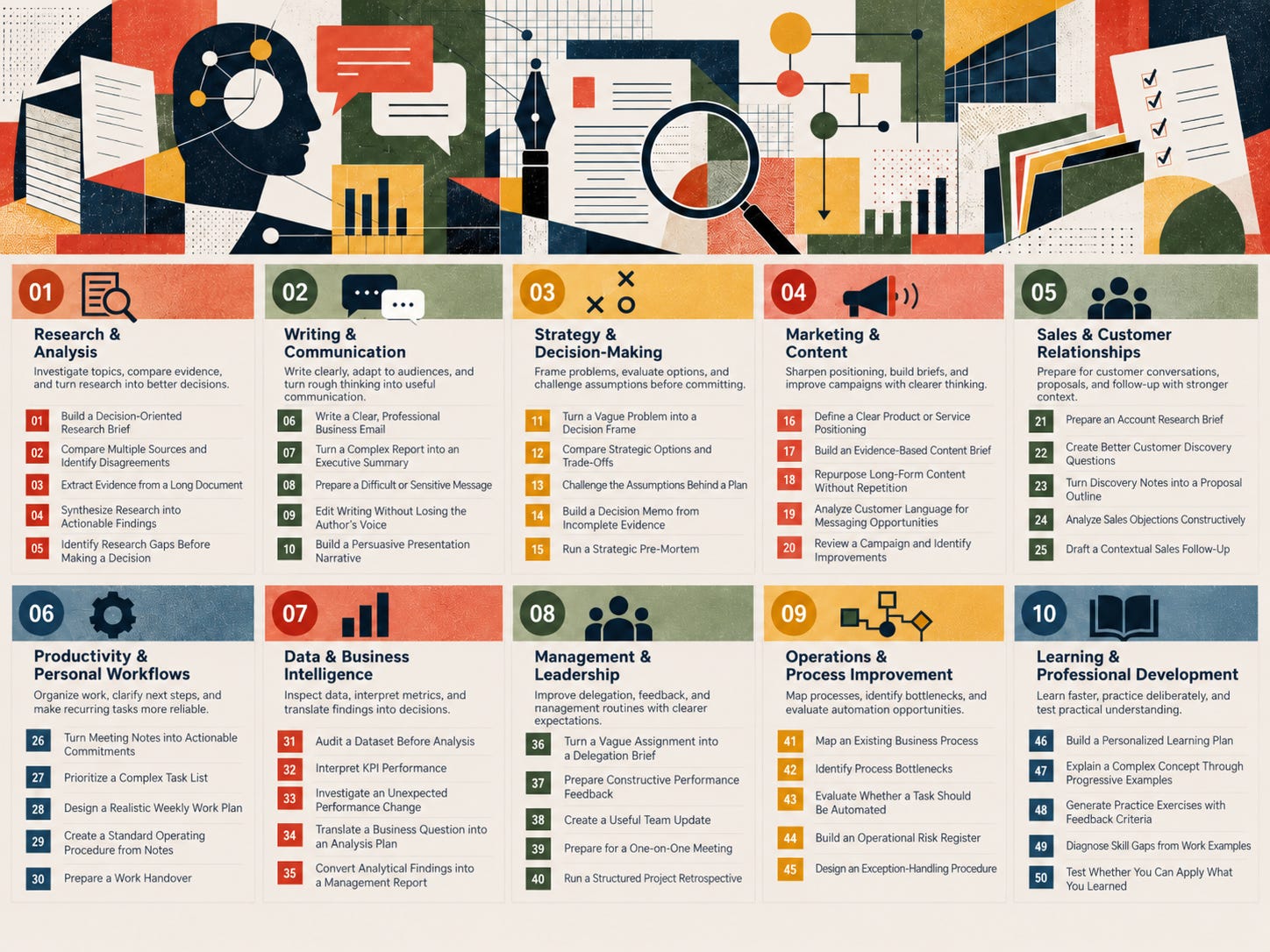

THE STRATEGY STACK · FIELD GUIDE · OCTOBER 2026
Most people have experienced the same frustrating cycle with AI. You ask a question, receive a plausible answer, adjust the instructions, explain the missing context, and eventually arrive at something useful.
The problem often starts before the first answer. The task is poorly defined, important context remains implicit, and nobody has specified what a successful result should look like.
Consider the difference between asking an AI assistant to “analyze our competitors” and asking it to compare three competitors against five specified dimensions, distinguish evidence from interpretation, identify missing information, and return a decision-ready assessment.
The second request gives the model a much better problem to solve. It also makes the result easier to inspect, challenge, and improve.
That is the purpose of this library.
The 50 templates below are organized around actual work: researching unfamiliar markets, preparing difficult conversations, evaluating strategic choices, interpreting business data, documenting processes, and turning incomplete information into useful decisions.
Every prompt is designed to be copied, adapted, and reused. You can use them with ChatGPT, Claude, Gemini, or another capable AI assistant, subject to the tools, permissions, and context available to it.
The goal is to produce work worth reviewing, using, and building upon.
How to Use This Library
Each template contains four elements:
-
The problem: The situation the prompt is designed to address.
-
The prompt: Copy-ready instructions with editable fields in square brackets.
-
Expected output: The practical deliverable you should receive.
-
Human checkpoint: What to verify before relying on the result.
Replace the bracketed fields with your own information. Provide relevant documents or examples where permitted, and ask follow-up questions when additional investigation is needed.
When a task depends on current facts, the assistant needs access to appropriate sources or tools. Without them, treat its answer as an analytical starting point rather than verified research.
For confidential work, use an AI environment approved by your organization, and avoid entering unnecessary personal, customer, financial, or proprietary information.
One final principle: A good prompt makes the work inspectable. You should be able to understand what the model used, what it assumed, how it structured the task, and where your own judgment is still required.
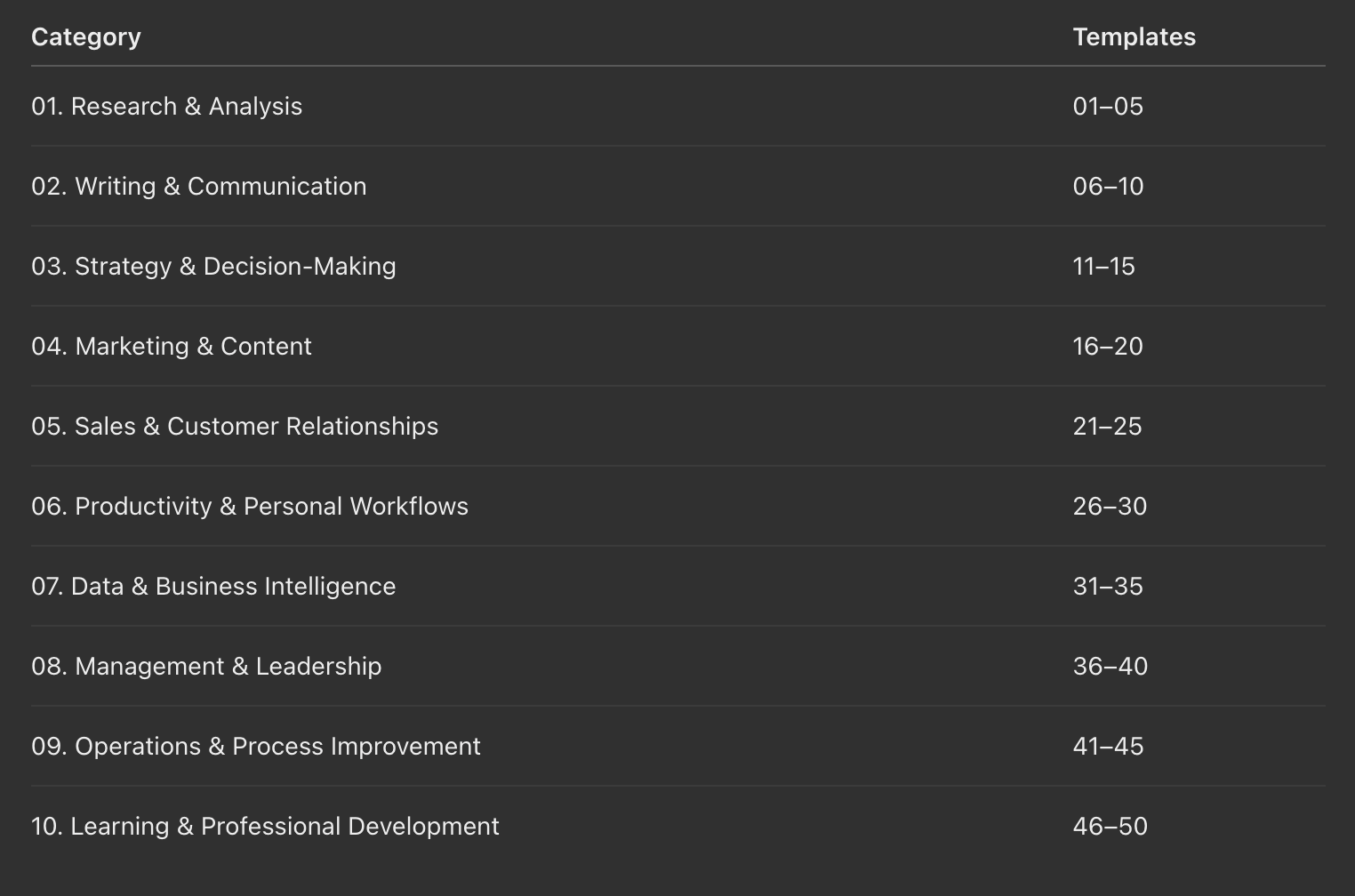
The 50-Prompt Library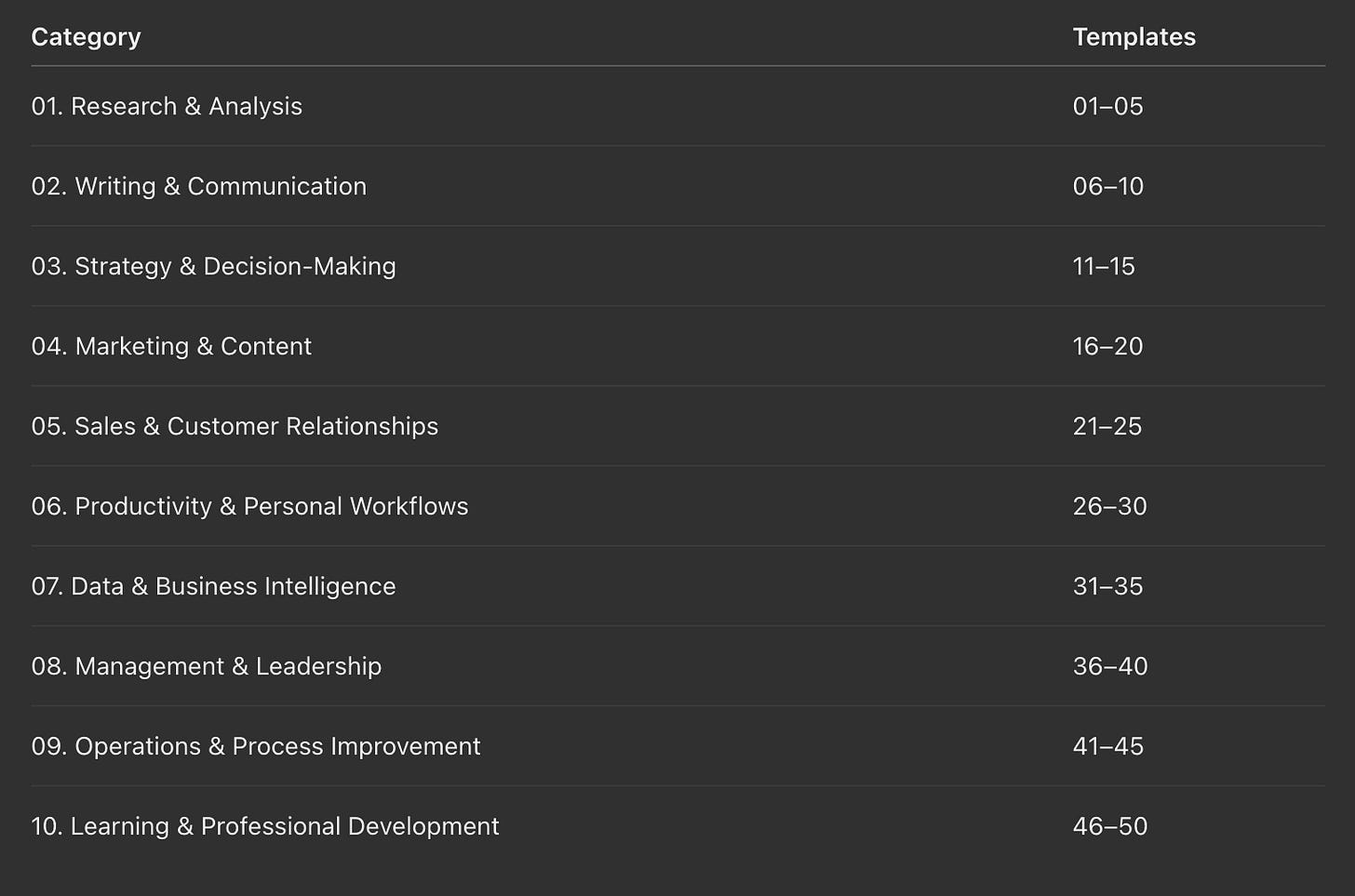
01. Research & Analysis
Five prompts for investigating unfamiliar subjects, evaluating evidence, and finding the information needed to make better decisions.
Research quality depends on how well we distinguish what is known, what is inferred, and what remains uncertain. These templates provide structure for each stage.
01 — Build a Decision-Oriented Research Brief
The problem: You need to understand an unfamiliar market, technology, company, or business development without getting lost in general background information.
Copy-ready prompt
Act as a research analyst preparing a briefing for a business decision.
Research subject: [TOPIC]
Decision this research should inform: [DECISION]
Audience: [AUDIENCE]
Relevant geography and time period: [SCOPE]
Available sources or documents: [SOURCES]
Prepare a structured research brief containing:
-
An executive summary of the five most decision-relevant findings.
-
Background necessary to understand the subject.
-
Key participants, drivers, and developments.
-
Evidence supporting the principal findings.
-
Competing interpretations and material uncertainties.
-
Implications for the stated decision.
-
Five unanswered questions that deserve further investigation.
Distinguish verified facts, estimates, and hypotheses. Cite accessible sources where available. If you cannot verify a claim, label it accordingly.
Prioritize relevance to the decision over general comprehensiveness.
Expected output: A research briefing that can support a meeting, investment discussion, strategic review, or internal recommendation.
Human checkpoint: Verify decision-critical claims against original sources, particularly dates, financial information, and regulatory developments.
02 — Compare Multiple Sources and Identify Disagreements
The problem: You have reports, articles, or analyses that appear to reach different conclusions about the same subject.
Copy-ready prompt
Compare the following sources about [TOPIC]:
[PASTE SOURCES OR PROVIDE DOCUMENTS]
Assess them using these dimensions:
-
Main claim or conclusion
-
Supporting evidence
-
Methodology and assumptions
-
Publication date and relevance
-
Potential bias or limitations
-
Points of agreement
-
Points of disagreement
Create a comparison matrix.
Then explain which disagreements are caused by different data, different definitions, different time horizons, or genuinely conflicting interpretations.
Identify the evidence that would most effectively resolve each material disagreement.
Do not invent evidence or treat source agreement as proof of accuracy. Where a source is incomplete, state the limitation.
Expected output: A source-comparison matrix and a prioritized list of unresolved evidence questions.
Human checkpoint: Check whether the original sources support the claims attributed to them.
03 — Extract Evidence from a Long Document
The problem: You need specific information from a lengthy report, contract, policy, transcript, or research paper.
Copy-ready prompt
Analyze the attached document for the following purpose:
Document: [UPLOAD OR PASTE]
Question: [WHAT I NEED TO KNOW]
Relevant criteria: [CRITERIA]
Extract only information relevant to the question.
Return a table containing:
-
Finding
-
Supporting quotation or faithful summary
-
Section or page reference
-
Interpretation
-
Confidence or limitation
Separate direct evidence from your analysis.
Highlight contradictions, ambiguous definitions, and missing information.
Conclude with a short answer to the original question and the three most important caveats.
Do not cite pages or sections you cannot actually inspect.
Expected output: An evidence table with traceable references and a focused conclusion.
Human checkpoint: Review the cited passages before using the extracted information in an important decision.
04 — Synthesize Research into Actionable Findings
The problem: You have collected substantial research but need to convert it into a coherent assessment.
Copy-ready prompt
I have collected the following research on [TOPIC]:
[PASTE NOTES, FINDINGS, OR SOURCE MATERIAL]
Business objective: [OBJECTIVE]
Audience: [AUDIENCE]
Synthesize the material into:
-
Five significant findings.
-
The evidence supporting each finding.
-
Recurring themes and meaningful contradictions.
-
Implications for the business objective.
-
Three potential actions, with expected benefits and limitations.
-
Remaining questions requiring additional evidence.
Rank findings by decision relevance, not frequency of mention.
Avoid repeating the source material in shortened form. Integrate it into a coherent interpretation while distinguishing evidence from inference.
Expected output: A concise research synthesis with clear implications and potential actions.
Human checkpoint: Challenge whether the strongest conclusions are supported by sufficiently strong evidence.
05 — Identify Research Gaps Before Making a Decision
The problem: You have an initial analysis but cannot tell whether it provides enough information to proceed.
Copy-ready prompt
Evaluate the completeness of this research:
Decision under consideration: [DECISION]
Current findings: [FINDINGS]
Available evidence: [EVIDENCE]
Constraints: [TIME, BUDGET, ACCESS]
Identify the assumptions underlying the analysis.
For each assumption, assess:
-
Importance to the decision
-
Supporting evidence
-
Confidence level
-
Consequences if incorrect
-
Most efficient way to investigate
Separate critical evidence gaps from information that would be useful but unlikely to change the decision.
Produce a prioritized research plan with specific questions, suitable sources, and suggested next steps.
Finish with a recommendation: proceed, proceed conditionally, or investigate further, including the reasoning and decision thresholds.
Expected output: A prioritized research-gap assessment and next-step plan.
Human checkpoint: Determine whether the remaining uncertainty is acceptable given the decision’s consequences.
Read next
Good prompting begins with a clear understanding of the work. Research, coding, and automation all require more than a carefully worded instruction: they need relevant context, reliable information, and a way to evaluate the result. These collections are free to read:
-
The AI Workflow Library: 30 Real-World Examples for Business Teams — Practical workflows across six business functions, with implementation resources and frameworks for turning recurring tasks into reliable processes.
-
The AI Research Stack: 30 Free Tools for Finding Better Answers — Tools for finding evidence, analyzing sources, and producing more rigorous AI-assisted research.
-
The AI Coding Stack: 30 Free Tools, Rules, and Resources for Building With AI — Coding assistants, development tools, and testing frameworks for building and validating AI-powered applications.
Turn better prompts into better work
-
Operator Vault — 120+ PDFs, practical frameworks, kits, and installables for strategy, AI adoption, and execution.
-
Stack Atlas — Explore how AI prompts, workflows, decision systems, and strategic capabilities connect across The Strategy Stack.
Essays and curated resource collections remain free. Operator provides the working materials for developing repeatable practices, improving decisions, and implementing AI across real business processes.
The complete library contains 50 ready-to-use AI prompts across ten professional categories, from research and communication to strategy, marketing, sales, data analysis, leadership, and operations. Subscribe free to The Strategy Stack to access the remaining 45 templates, along with practical frameworks for designing, evaluating, improving, and turning prompts into repeatable workflows.
02. Writing & Communication
Five prompts for communicating clearly, adapting to audiences, and turning rough thinking into effective business writing.
Useful business writing requires a clear purpose, an understanding of the reader, and a deliberate choice about what the reader should know or do next.
06 — Write a Clear, Professional Business Email
The problem: You need to send an important email but want to balance clarity, professionalism, and the right tone.
Copy-ready prompt
Draft a professional email using the following information:
Recipient and relationship: [RECIPIENT]
Purpose: [PURPOSE]
Essential context: [CONTEXT]
Key points to communicate: [POINTS]
Desired action: [ACTION]
Tone: [DIRECT / WARM / DIPLOMATIC / FORMAL]
Keep the message concise without omitting necessary information.
Open with the reason for writing, organize the supporting details logically, and close with a specific next step.
Avoid unnecessary flattery, clichés, vague requests, and exaggerated language.
Return a subject line and the complete email. Do not invent facts, commitments, deadlines, or relationships.
Expected output: A ready-to-edit business email with a clear call to action.
Human checkpoint: Confirm that the message accurately reflects your intentions and relationship with the recipient.
07 — Turn a Complex Report into an Executive Summary
The problem: Senior stakeholders need the significance of a report without reading every detail.
Copy-ready prompt
Create an executive summary of the following document:
[PASTE OR UPLOAD DOCUMENT]
Audience: [EXECUTIVES / BOARD / MANAGERS]
Decision or discussion: [CONTEXT]
Use this structure:
-
The central conclusion, in two sentences.
-
Three to five findings that materially affect the audience.
-
Business implications.
-
Principal risks and uncertainties.
-
Decisions or actions required.
Limit the summary to approximately [WORD COUNT] words.
Explain technical concepts in accessible business language without eliminating essential nuance.
Preserve important numbers and qualifications. Do not introduce recommendations unsupported by the document.
Expected output: An executive summary suitable for a leadership briefing or management report.
Human checkpoint: Verify that compression has not distorted the original findings.
08 — Prepare a Difficult or Sensitive Message
The problem: You need to communicate an unpopular decision, address a disagreement, or set a boundary without escalating tension.
Copy-ready prompt
Help me prepare a difficult professional communication.
Situation: [SITUATION]
Recipient: [PERSON OR ROLE]
Relationship: [RELATIONSHIP]
Message that must be communicated: [CORE MESSAGE]
Relevant sensitivities: [SENSITIVITIES]
Desired outcome: [OUTCOME]
Draft a message that:
-
States the central point clearly.
-
Acknowledges relevant context without excessive apology.
-
Explains the reasoning where appropriate.
-
Treats the recipient respectfully.
-
Establishes next steps or boundaries.
Avoid manipulation, assumptions about the recipient’s emotions, or promises I have not authorized.
Provide the draft and briefly identify two phrases that may require careful consideration.
Expected output: A thoughtful, professional message for a sensitive situation.
Human checkpoint: Judge the relationship dynamics yourself before sending.
09 — Edit Writing Without Losing the Author’s Voice
The problem: Your draft needs stronger structure and precision, but standard AI rewrites make it sound generic.
Copy-ready prompt
Edit the following draft while preserving my voice:
[PASTE DRAFT]
Audience: [AUDIENCE]
Purpose: [PURPOSE]
My preferred style: [STYLE DESCRIPTION]
Improve clarity, logical progression, sentence economy, and precision.
Preserve distinctive observations, original arguments, and deliberate stylistic choices.
Remove repetition, unsupported claims, excessive adjectives, and generic corporate phrasing.
Do not add facts, change the underlying position, or replace nuanced arguments with simplistic statements.
Return:
-
The revised version.
-
A concise explanation of the most important edits.
-
Any passages requiring factual verification.
Favor selective editing over wholesale rewriting.
Expected output: A polished version that retains the author’s intent and style.
Human checkpoint: Review whether the revised language still sounds like you.
10 — Build a Persuasive Presentation Narrative
The problem: You have information for a presentation but need a coherent argument that leads the audience toward a decision.
Copy-ready prompt
Design the narrative structure for a presentation.
Topic: [TOPIC]
Audience: [AUDIENCE]
Purpose: [INFORM / PERSUADE / DECIDE]
Desired audience conclusion: [CONCLUSION]
Available evidence: [EVIDENCE]
Presentation length: [NUMBER OF SLIDES]
Create a slide-by-slide outline.
Each slide should include:
-
A conclusion-oriented headline.
-
The single argument or finding it communicates.
-
Recommended supporting evidence or visual.
-
How it connects to the next slide.
Build a logical progression from the initial problem to the evidence, implications, and proposed action.
Identify weak transitions and unsupported claims.
Avoid decorative slides that do not advance the argument.
Expected output: A presentation storyline with slide headlines and evidence requirements.
Human checkpoint: Confirm that the storyline reflects the audience’s actual decision criteria.
03. Strategy & Decision-Making
Five prompts for defining problems, evaluating alternatives, exposing assumptions, and improving strategic judgment.
Strategy becomes more useful when competing explanations and choices are made explicit. These templates help make reasoning visible before commitments are made.
11 — Turn a Vague Problem into a Decision Frame
The problem: A business challenge is generating discussion but nobody has defined the decision that needs to be made.
Copy-ready prompt
Help me frame the following business problem before recommending solutions.
Situation: [PROBLEM]
Available facts: [FACTS]
Constraints: [CONSTRAINTS]
Desired outcome: [OUTCOME]
Identify:
-
The underlying decision.
-
Observable symptoms versus possible causes.
-
Three plausible explanations for the situation.
-
Evidence needed to distinguish these explanations.
-
Two or three feasible strategic responses.
-
Trade-offs and potential unintended consequences.
Present the result as a concise decision frame.
Separate known facts from hypotheses. Ask for missing information when it could materially alter the recommendation.
Do not converge on a preferred solution before evaluating alternatives.
Expected output: A structured decision frame rather than an unexamined recommendation.
Human checkpoint: Validate the problem definition with those accountable for the decision.
12 — Compare Strategic Options and Trade-Offs
The problem: Several approaches appear attractive, but their relative advantages and consequences remain unclear.
Copy-ready prompt
Evaluate the following strategic options:
Business objective: [OBJECTIVE]
Options: [OPTIONS]
Decision criteria: [CRITERIA]
Constraints: [CONSTRAINTS]
Known evidence: [EVIDENCE]
Compare each option against the stated criteria.
For each, assess:
-
Expected benefits
-
Required capabilities and resources
-
Implementation complexity
-
Principal risks
-
Reversibility
-
Opportunity costs
-
Conditions under which the option becomes unattractive
Create a comparison matrix.
Identify where the options involve genuine trade-offs rather than differences in wording.
Recommend the option best supported by the current evidence, or explain why no recommendation is justified yet.
Expected output: A comparative strategy assessment with explicit trade-offs.
Human checkpoint: Check whether the decision criteria and their relative importance reflect actual business priorities.
13 — Challenge the Assumptions Behind a Plan
The problem: A proposal seems coherent but may depend on assumptions nobody has examined.
Copy-ready prompt
Critically examine this business plan:
[PASTE PLAN]
Objective: [OBJECTIVE]
Time horizon: [HORIZON]
Identify the assumptions required for the plan to succeed.
Classify each as:
-
Evidence-supported
-
Plausible but unverified
-
Weakly supported
-
Unknown
Estimate its importance to the outcome and explain the consequences if it proves false.
Construct three credible alternative interpretations of the situation.
Identify early warning indicators that would signal the need to revise the plan.
Finish with the five most valuable assumption tests, ranked by the likely decision value of obtaining better evidence.
Be challenging but fair. Do not manufacture objections merely to appear critical.
Expected output: An assumption register and prioritized validation plan.
Human checkpoint: Confirm the tests are practical and capable of generating useful evidence.
14 — Build a Decision Memo from Incomplete Evidence
The problem: A decision is approaching, but available information is uncertain and fragmented.
Copy-ready prompt
Prepare a decision memo using the information below.
Decision: [DECISION]
Deadline: [DATE]
Available evidence: [EVIDENCE]
Options: [OPTIONS]
Constraints: [CONSTRAINTS]
Use the following sections:
-
Decision required.
-
Relevant context.
-
Evidence and known facts.
-
Major assumptions and uncertainties.
-
Options and trade-offs.
-
Recommended course of action.
-
Conditions that would change the recommendation.
-
Immediate next steps.
Clearly distinguish the strength of the evidence from confidence in the recommendation.
Do not create financial estimates, sources, or consensus that are absent from the inputs.
Expected output: A decision-ready memo with visible assumptions and contingencies.
Human checkpoint: Ensure decision authority, risk appetite, and accountability are correctly represented.
15 — Run a Strategic Pre-Mortem
The problem: A major initiative is about to launch and the team wants to identify avoidable failure conditions.
Copy-ready prompt
Conduct a strategic pre-mortem for this initiative:
Initiative: [DESCRIPTION]
Objective: [OBJECTIVE]
Implementation plan: [PLAN]
Dependencies: [DEPENDENCIES]
Time horizon: [TIMEFRAME]
Assume the initiative has materially underperformed.
Develop eight plausible explanations covering execution, market conditions, organizational capabilities, incentives, governance, dependencies, and incorrect assumptions.
For each:
-
Describe the failure mechanism.
-
Identify an early warning indicator.
-
Explain the likely consequences.
-
Recommend a preventive or corrective action.
-
Suggest an accountable owner or role.
Rank the scenarios by plausibility and potential impact, acknowledging uncertainty.
End with a short list of controls the team should implement before launch.
Expected output: A risk-informed implementation improvement plan.
Human checkpoint: Validate the failure scenarios with people who understand the operational environment.
04. Marketing & Content
Five prompts for audience understanding, positioning, content development, and campaign evaluation.
Marketing work improves when the target audience, intended behavior, and supporting evidence are made explicit.
16 — Define a Clear Product or Service Positioning
The problem: Your positioning sounds interchangeable with competitors or fails to explain why customers should choose you.
Copy-ready prompt
Help me sharpen the positioning of this offering.
Offering: [PRODUCT OR SERVICE]
Target customers: [CUSTOMERS]
Customer problem: [PROBLEM]
Current alternatives: [ALTERNATIVES]
Evidence of our strengths: [EVIDENCE]
Constraints or limitations: [LIMITATIONS]
Develop three positioning options.
For each, provide:
-
Target customer and situation
-
Core value proposition
-
Differentiating mechanism
-
Proof required
-
Main objection
-
One-sentence positioning statement
Evaluate the options for relevance, defensibility, clarity, and credibility.
Recommend the most promising positioning and identify what still needs customer validation.
Avoid generic claims such as innovative, seamless, or industry-leading unless supported by evidence.
Expected output: Three positioning territories with a clear recommendation.
Human checkpoint: Test the preferred positioning against real customer language and buying behavior.
17 — Build an Evidence-Based Content Brief
The problem: You need content that answers a meaningful audience question instead of repeating existing articles.
Copy-ready prompt
Create a content brief for the following topic:
Topic: [TOPIC]
Audience: [AUDIENCE]
Reader problem: [PROBLEM]
Search intent or distribution context: [CONTEXT]
Original evidence or experience available: [MATERIAL]
Develop:
-
The central reader question.
-
A differentiated editorial thesis.
-
Five to seven major sections.
-
Important questions each section must answer.
-
Evidence or examples needed.
-
Common misconceptions to address.
-
Suggested graphics or practical tools.
-
A useful reader action at the end.
Separate verifiable research needs from potential editorial insights.
Do not invent search volumes, rankings, statistics, or competing article contents.
Expected output: A research-aware editorial brief ready for development.
Human checkpoint: Validate search intent and factual claims using appropriate research sources.
18 — Repurpose Long-Form Content Without Repetition
The problem: You want to adapt a substantial article, report, or presentation for other channels without simply shortening it.
Copy-ready prompt
Repurpose the following source material:
[PASTE CONTENT]
Primary audience: [AUDIENCE]
Channels: [CHANNELS]
Preferred voice: [STYLE]
Identify five independent ideas worth communicating.
For each idea, create:
-
A distinct audience-relevant angle.
-
A concise social post.
-
A suggested visual or example.
-
A conversation-starting question where appropriate.
Preserve the source’s intellectual substance.
Vary the framing and structure across outputs.
Avoid exaggerated hooks, invented statistics, shallow motivational statements, and repeated phrasing.
Explain which idea is most suitable for each requested channel and why.
Expected output: Multiple differentiated content assets derived from one substantive source.
Human checkpoint: Verify that each adaptation preserves the source’s original meaning.
19 — Analyze Customer Language for Messaging Opportunities
The problem: Your messaging relies on internal terminology rather than the language customers actually use.
Copy-ready prompt
Analyze the following customer statements, interviews, reviews, or feedback:
[PASTE ANONYMIZED MATERIAL]
Offering: [PRODUCT OR SERVICE]
Target segment: [SEGMENT]
Identify:
-
Recurring customer problems.
-
Desired outcomes.
-
Common objections.
-
Emotional and practical concerns.
-
Distinctive phrases customers use.
-
Differences between customer segments, where supported.
Create a messaging matrix connecting customer language to potential value propositions.
Include short supporting quotations from the supplied material.
Distinguish frequent themes from isolated comments.
Do not infer customer demographics, intentions, or motivations without supporting evidence.
Expected output: A voice-of-customer messaging matrix grounded in actual statements.
Human checkpoint: Check whether the sample represents the customers you want to reach.
20 — Review a Campaign and Identify Improvements
The problem: You have campaign metrics but need a more rigorous interpretation of performance.
Copy-ready prompt
Analyze the following marketing campaign:
Campaign objective: [OBJECTIVE]
Target audience: [AUDIENCE]
Channels: [CHANNELS]
Campaign data: [METRICS]
Time period: [DATES]
Baseline or comparison: [BASELINE]
Evaluate performance against the stated objective.
Separate:
-
Observed results
-
Plausible explanations
-
Data limitations
-
Conclusions that cannot yet be supported
Identify the three strongest performance signals and three most important weaknesses.
Recommend five improvements ranked by expected value, implementation effort, and testability.
Design a simple next-round experiment with a measurable success criterion.
Do not claim causal effects from correlations alone.
Expected output: A campaign review and prioritized optimization plan.
Human checkpoint: Verify attribution, measurement quality, and the validity of comparisons.
05. Sales & Customer Relationships
Five prompts for preparing commercial conversations, understanding customer needs, and developing better proposals.
Effective sales work requires accurate customer context and a credible connection between a problem and an offering.
21 — Prepare an Account Research Brief
The problem: You have an upcoming customer conversation and need relevant context without spending hours researching.
Copy-ready prompt
Prepare an account briefing for:
Organization: [COMPANY]
Meeting participants: [ROLES]
Our offering: [OFFERING]
Meeting objective: [OBJECTIVE]
Provided account information and sources: [MATERIAL]
Create a briefing covering:
-
Confirmed facts about the organization.
-
Relevant business priorities and developments.
-
Potential problems worth exploring.
-
Hypotheses about where our offering may help.
-
Five tailored discovery questions.
-
Potential objections or constraints.
-
The desired meeting outcome.
Separate verified information from sales hypotheses.
Do not infer internal budgets, technology stacks, or executive priorities without evidence.
Expected output: A structured account preparation brief.
Human checkpoint: Confirm current company information and avoid presenting hypotheses as facts.
22 — Create Better Customer Discovery Questions
The problem: Your discovery conversations produce surface-level information but little insight into buying priorities.
Copy-ready prompt
Design a customer discovery conversation.
Offering: [OFFERING]
Customer role: [ROLE]
Problem area: [PROBLEM]
Meeting duration: [DURATION]
Generate 12 open-ended questions organized around:
-
Current situation
-
Existing process
-
Pain points and consequences
-
Previous attempts to improve
-
Success criteria
-
Decision process and constraints
Include two natural follow-up questions for each section.
Avoid leading questions that assume the customer needs our product.
End with a suggested conversation flow and the information we should seek before making any recommendation.
Expected output: A structured discovery guide.
Human checkpoint: Adapt the questions naturally rather than reading them as a rigid script.
23 — Turn Discovery Notes into a Proposal Outline
The problem: You have customer meeting notes and need a proposal grounded in what the customer actually said.
Copy-ready prompt
Develop a proposal outline based on these discovery notes:
[PASTE NOTES]
Our capabilities: [CAPABILITIES]
Known constraints: [CONSTRAINTS]
Commercial assumptions: [ASSUMPTIONS]
Prepare sections covering:
-
Customer situation.
-
Confirmed objectives and requirements.
-
Proposed approach.
-
Deliverables.
-
Expected outcomes and measurement.
-
Implementation phases.
-
Dependencies and responsibilities.
-
Open questions.
Clearly label any scope, pricing, timeline, or outcome that requires confirmation.
Identify claims from the meeting notes that need validation.
Do not invent customer commitments or promise measurable results without supporting evidence.
Expected output: A customer-grounded proposal structure.
Human checkpoint: Confirm scope, pricing, deliverability, and commercial authority before sending.
24 — Analyze Sales Objections Constructively
The problem: A prospective customer raises objections and the team needs to understand what they signal.
Copy-ready prompt
Analyze the following sales objection:
Customer statement: [OBJECTION]
Customer context: [CONTEXT]
Offering: [OFFERING]
Evidence we can provide: [EVIDENCE]
Identify three plausible underlying concerns.
For each:
-
Explain the concern.
-
Suggest a clarifying question.
-
Identify the evidence needed.
-
Propose a respectful response.
Distinguish genuine product-fit problems from information gaps and commercial constraints.
Draft a concise response that acknowledges the concern without becoming defensive.
Do not use artificial urgency, manipulation, or unsupported promises.
Expected output: An objection-handling framework and response draft.
Human checkpoint: Determine whether the objection indicates a genuine mismatch that should not be overcome.
25 — Draft a Contextual Sales Follow-Up
The problem: You want to follow up after a sales conversation without sending a generic reminder.
Copy-ready prompt
Write a follow-up email based on:
Customer: [CUSTOMER]
Previous conversation: [NOTES]
Agreed actions: [ACTIONS]
Open questions: [QUESTIONS]
Relevant materials: [MATERIAL]
Desired next step: [NEXT STEP]
Keep the message concise and specific.
Summarize the customer’s stated priorities, confirm any commitments, and explain the relevance of the proposed next step.
Make the requested action easy to understand.
Avoid generic sales language, artificial familiarity, and unsupported claims of value.
Do not invent agreements or imply that the customer accepted something they did not.
Expected output: A personalized, accurate follow-up email.
Human checkpoint: Confirm that action items and commitments match the conversation record.
06. Productivity & Personal Workflows
Five prompts for turning fragmented information into organized, actionable work.
Personal productivity benefits from separating obligations, priorities, dependencies, and decisions instead of treating everything as another task.
26 — Turn Meeting Notes into Actionable Commitments
The problem: A meeting produces useful discussion but responsibilities and next steps remain unclear.
Copy-ready prompt
Convert these meeting notes into an action record:
[PASTE NOTES]
Extract:
-
Decisions made.
-
Action items.
-
Responsible individuals, if explicitly named.
-
Deadlines, if explicitly agreed.
-
Dependencies.
-
Open questions.
-
Items requiring confirmation.
Present actions in a table with task, owner, deadline, and status.
Separate confirmed decisions from suggestions or unresolved discussions.
Flag missing owners and deadlines rather than inventing them.
Finish with a concise follow-up message for participants to verify the record.
Expected output: A clean action register and follow-up draft.
Human checkpoint: Confirm responsibilities and deadlines with participants.
27 — Prioritize a Complex Task List
The problem: You have many tasks but limited time and no clear order of execution.
Copy-ready prompt
Help me prioritize the following work:
[PASTE TASK LIST]
Available time: [TIME]
Strategic objectives: [OBJECTIVES]
Deadlines: [DEADLINES]
Important dependencies: [DEPENDENCIES]
Evaluate tasks by:
-
Strategic value
-
Urgency
-
Effort
-
Dependencies
-
Consequences of delay
Group tasks into:
-
Do now.
-
Schedule.
-
Delegate or simplify.
-
Defer or remove.
Propose a realistic execution sequence for the next [TIME PERIOD].
Explain significant trade-offs and identify tasks competing for the same resources.
Do not assume everything marked urgent is important.
Expected output: A prioritized task list and feasible execution schedule.
Human checkpoint: Confirm the priorities reflect your actual responsibilities and commitments.
28 — Design a Realistic Weekly Work Plan
The problem: Your calendar fills with meetings and reactive tasks, leaving little capacity for important work.
Copy-ready prompt
Build a weekly work plan using:
Available working hours: [HOURS]
Fixed commitments: [MEETINGS]
Priority outcomes: [OUTCOMES]
Task estimates: [ESTIMATES]
Known interruptions: [INTERRUPTIONS]
Design a schedule that protects time for high-value work while leaving realistic capacity for communication, administration, and unexpected demands.
Group related tasks where practical.
Identify unrealistic workload assumptions.
Present a day-by-day plan with:
-
Primary objective
-
Major work blocks
-
Required preparation
-
Dependencies
-
End-of-day completion criteria
Include a short contingency plan for delays.
Expected output: A structured weekly plan with protected focus time.
Human checkpoint: Compare the plan with your actual calendar and energy constraints.
29 — Create a Standard Operating Procedure from Notes
The problem: A recurring process exists largely in someone’s memory and needs to become repeatable.
Copy-ready prompt
Convert the following process notes into a standard operating procedure:
[PASTE NOTES]
Process objective: [OBJECTIVE]
Users: [ROLES]
Tools involved: [TOOLS]
Structure the SOP with:
-
Purpose.
-
Scope.
-
Prerequisites.
-
Inputs.
-
Step-by-step instructions.
-
Decision points.
-
Exceptions and recovery procedures.
-
Quality checks.
-
Required outputs.
-
Owner and review requirements.
Identify missing operational details and mark them for confirmation.
Avoid inventing approvals, credentials, access rights, or technical procedures.
Write the instructions so that a reasonably trained colleague can follow them.
Expected output: An SOP draft suitable for operational validation.
Human checkpoint: Have a process owner test the procedure before formal adoption.
30 — Prepare a Work Handover
The problem: Responsibility for a project or recurring activity is changing hands, creating a risk of lost context.
Copy-ready prompt
Prepare a professional work handover from:
[PASTE PROJECT NOTES AND STATUS]
Outgoing owner: [ROLE]
Incoming owner: [ROLE]
Handover date: [DATE]
Include:
-
Purpose and current status.
-
Recent decisions and their rationale.
-
Active tasks and owners.
-
Upcoming milestones.
-
Key stakeholders.
-
Important files and systems.
-
Known risks and unresolved issues.
-
Immediate next actions.
Separate confirmed information from items requiring validation.
Highlight any missing knowledge that could interrupt continuity.
Do not insert invented status updates or undocumented commitments.
Expected output: A handover document that preserves essential operational context.
Human checkpoint: Review the handover with the incoming owner and confirm access to required systems.
07. Data & Business Intelligence
Five prompts for inspecting datasets, interpreting performance, investigating anomalies, and communicating findings.
AI can assist with analytical reasoning, but the quality of the result depends on the data, definitions, and calculation methods used.
31 — Audit a Dataset Before Analysis
The problem: You received a dataset and need to understand whether it is suitable for analysis.
Copy-ready prompt
Review the attached dataset or provided schema.
Business question: [QUESTION]
Dataset: [DATA]
Assess:
-
Available fields and their likely meaning.
-
Missing values.
-
Duplicate records.
-
Inconsistent formats.
-
Potential outliers.
-
Ambiguous definitions.
-
Data limitations affecting the business question.
If data analysis tools are available, calculate actual diagnostics.
Otherwise, provide the checks and code needed without claiming they were executed.
Create a data-quality issue register with severity, likely impact, and recommended corrective action.
Avoid altering or excluding records without an explicit rule.
Expected output: A dataset audit and preparation plan.
Human checkpoint: Confirm data definitions and any proposed transformations before analysis.
32 — Interpret KPI Performance
The problem: You have business KPIs but need to understand what changed and what might explain it.
Copy-ready prompt
Analyze the following KPI results:
Business objective: [OBJECTIVE]
KPI definitions: [DEFINITIONS]
Current values: [VALUES]
Previous periods: [HISTORY]
Targets: [TARGETS]
Evaluate:
-
Performance against targets.
-
Changes over time.
-
Significant deviations.
-
Relationships between metrics.
-
Possible explanations.
-
Data limitations.
Present a concise management briefing.
Distinguish numerical observations from causal hypotheses.
If data is insufficient to calculate a change or trend reliably, state what is missing.
Recommend the next analytical questions worth investigating.
Expected output: A structured KPI interpretation and investigation agenda.
Human checkpoint: Verify calculations, time-period consistency, and the meaning of each metric.
33 — Investigate an Unexpected Performance Change
The problem: A metric suddenly improves or deteriorates, and the team needs to identify plausible causes.
Copy-ready prompt
Investigate the following performance anomaly:
Metric: [METRIC]
Observed change: [CHANGE]
Time period: [PERIOD]
Related metrics: [DATA]
Known events: [EVENTS]
Develop five plausible explanations.
For each:
-
Describe the mechanism.
-
Identify supporting or conflicting evidence.
-
Specify additional data needed.
-
Propose a test.
-
Explain what result would strengthen or weaken the hypothesis.
Consider measurement changes, seasonality, external events, segment composition, and operational changes.
Rank hypotheses by current plausibility while acknowledging uncertainty.
Avoid presenting correlation as proof of causation.
Expected output: A structured root-cause investigation plan.
Human checkpoint: Check tracking systems and operational records before drawing conclusions.
34 — Translate a Business Question into an Analysis Plan
The problem: Someone requests “an analysis” without specifying the question, metrics, or analytical method.
Copy-ready prompt
Design an analysis plan for this business question:
[QUESTION]
Decision the analysis supports: [DECISION]
Available data: [DATA]
Constraints: [CONSTRAINTS]
Define:
-
The precise analytical question.
-
Required variables.
-
Relevant metrics and definitions.
-
Unit of analysis.
-
Data-quality checks.
-
Appropriate analytical methods.
-
Potential confounders.
-
Recommended visualizations.
-
Limitations.
-
The decision the findings should inform.
Explain why each proposed method is appropriate.
Do not assume the available data can answer causal questions without adequate identification.
Expected output: A reproducible analysis plan linked to a business decision.
Human checkpoint: Validate methodology with an appropriately qualified analyst for consequential decisions.
35 — Convert Analytical Findings into a Management Report
The problem: A technically correct analysis needs to become understandable and useful for business leaders.
Copy-ready prompt
Prepare a management report from these analytical findings:
[PASTE RESULTS]
Business objective: [OBJECTIVE]
Audience: [AUDIENCE]
Decision context: [CONTEXT]
Structure the report as:
-
Executive finding.
-
Three to five supporting observations.
-
Relevant metrics and comparisons.
-
Business implications.
-
Limitations and unresolved questions.
-
Recommended actions or experiments.
Use plain language while preserving analytical accuracy.
Recommend up to three charts that would clarify the findings.
For each recommendation, specify the evidence supporting it and any dependencies.
Do not overstate statistical significance or claim causal relationships that the analysis does not establish.
Expected output: A concise, decision-relevant management report.
Human checkpoint: Verify that the narrative accurately reflects the underlying calculations.
08. Management & Leadership
Five prompts for improving delegation, feedback, team communication, and management routines.
Management requires more than distributing tasks. Expectations, ownership, feedback, and decision rights must be made explicit.
36 — Turn a Vague Assignment into a Delegation Brief
The problem: A manager delegates work without specifying the outcome or boundaries, causing repeated clarification.
Copy-ready prompt
Help me prepare a delegation brief.
Task or initiative: [TASK]
Responsible role: [ROLE]
Desired outcome: [OUTCOME]
Deadline: [DATE]
Constraints: [CONSTRAINTS]
Available resources: [RESOURCES]
Produce a brief covering:
-
Purpose.
-
Expected deliverables.
-
Definition of done.
-
Decision authority.
-
Dependencies.
-
Required check-ins.
-
Escalation conditions.
-
Quality criteria.
Identify unclear instructions and missing authority.
Avoid prescribing unnecessary implementation details when the assigned person should retain discretion.
Expected output: A clear delegation brief.
Human checkpoint: Confirm that the assigned person has the necessary authority, context, and capacity.
37 — Prepare Constructive Performance Feedback
The problem: You need to address a performance issue with specificity and fairness.
Copy-ready prompt
Help me prepare constructive performance feedback.
Employee role: [ROLE]
Observed behavior or result: [OBSERVATIONS]
Expected standard: [STANDARD]
Impact: [IMPACT]
Relevant context: [CONTEXT]
Organize the conversation around:
-
Specific observations.
-
Expected performance.
-
Observable consequences.
-
Questions to understand contributing factors.
-
Support or resources that may help.
-
Agreed improvement actions.
-
Follow-up expectations.
Provide suggested conversation language.
Do not infer personal motives, diagnose psychological conditions, or make judgments about protected characteristics.
Distinguish documented facts from interpretations.
Expected output: A structured, respectful performance feedback conversation.
Human checkpoint: Confirm factual accuracy, fairness, and consistency with organizational policy.
38 — Create a Useful Team Update
The problem: Team updates describe activity but fail to communicate progress, blockers, and decisions.
Copy-ready prompt
Turn these project updates into a concise team briefing:
[PASTE UPDATES]
Audience: [TEAM]
Reporting period: [PERIOD]
Priority objectives: [OBJECTIVES]
Organize the briefing into:
-
Outcomes achieved.
-
Work currently underway.
-
Changes to priorities.
-
Risks and blockers.
-
Decisions needed.
-
Next-period commitments.
Highlight dependencies between teams.
Separate completed outcomes from ongoing activities.
Flag inconsistent status reports or missing ownership.
Keep the briefing concise enough to read in approximately [MINUTES] minutes.
Expected output: A clear operational update.
Human checkpoint: Verify progress claims and dependencies with responsible owners.
39 — Prepare for a One-on-One Meeting
The problem: Regular one-on-ones become informal status reviews rather than productive management conversations.
Copy-ready prompt
Prepare an agenda for a one-on-one meeting.
Employee role: [ROLE]
Recent work: [WORK]
Previous commitments: [COMMITMENTS]
Potential challenges: [CHALLENGES]
Meeting duration: [DURATION]
Develop an agenda covering:
-
Progress and achievements.
-
Obstacles and support needs.
-
Priorities and workload.
-
Development opportunities.
-
Feedback in both directions.
-
Agreed actions.
Include open-ended questions that encourage the employee’s perspective.
Do not assume unverified performance problems or personal concerns.
Leave room for topics the employee wants to introduce.
Expected output: A balanced one-on-one meeting guide.
Human checkpoint: Adapt the conversation to the employee’s priorities rather than rigidly following the agenda.
40 — Run a Structured Project Retrospective
The problem: A project has finished, but the team needs to turn its experience into operational improvements.
Copy-ready prompt
Facilitate a retrospective analysis using:
Project objective: [OBJECTIVE]
Planned outcomes: [PLAN]
Actual results: [RESULTS]
Team observations: [OBSERVATIONS]
Known incidents: [INCIDENTS]
Analyze:
-
What worked and why.
-
What underperformed.
-
Important decision points.
-
Process or coordination breakdowns.
-
Successful adaptations.
-
Lessons worth retaining.
Identify systemic causes where evidence supports them.
Recommend no more than five improvements, each with an owner role, implementation action, and measurable success criterion.
Avoid assigning blame or inventing causal explanations.
Expected output: A retrospective report with specific improvements.
Human checkpoint: Validate conclusions with the team and agree on realistic follow-through.
09. Operations & Process Improvement
Five prompts for documenting processes, identifying bottlenecks, evaluating automation opportunities, and improving operational reliability.
Operational improvement starts with understanding the existing process, including the exceptions and judgment calls that formal documentation often overlooks.
41 — Map an Existing Business Process
The problem: A process spans multiple people and systems, making its true structure difficult to understand.
Copy-ready prompt
Map the following business process:
[PROCESS DESCRIPTION]
Business objective: [OBJECTIVE]
Roles involved: [ROLES]
Systems: [SYSTEMS]
Known exceptions: [EXCEPTIONS]
Create a structured process map showing:
-
Trigger.
-
Inputs.
-
Major activities.
-
Decision points.
-
Responsible roles.
-
Handoffs.
-
Outputs.
-
Exception paths.
Identify missing steps and unclear responsibilities.
Produce a text-based flow diagram and a list of questions requiring process-owner validation.
Do not invent system integrations or assume undocumented activities are automated.
Expected output: A process map and validation checklist.
Human checkpoint: Walk through the map with people who perform the process.
42 — Identify Process Bottlenecks
The problem: A recurring workflow is slow, expensive, or inconsistent, but the root cause is unclear.
Copy-ready prompt
Analyze this business process for bottlenecks:
Process: [PROCESS]
Process steps: [STEPS]
Cycle times: [TIMES]
Volumes: [VOLUMES]
Error or rework data: [DATA]
Known constraints: [CONSTRAINTS]
Identify possible bottlenecks involving:
-
Queueing and waiting.
-
Manual handoffs.
-
Rework.
-
Capacity limitations.
-
Approval delays.
-
Poor information quality.
-
Unnecessary process steps.
Distinguish bottlenecks demonstrated by the data from hypotheses.
Prioritize improvement opportunities by expected impact, implementation effort, and operational risk.
Recommend three experiments with measurable success criteria.
Expected output: A bottleneck assessment and process-improvement backlog.
Human checkpoint: Validate improvement opportunities against actual operational data.
43 — Evaluate Whether a Task Should Be Automated
The problem: A team wants to introduce AI automation without knowing whether the process is suitable.
Copy-ready prompt
Evaluate the automation suitability of this task:
Task: [TASK]
Frequency: [FREQUENCY]
Current effort: [EFFORT]
Inputs: [INPUTS]
Process rules: [RULES]
Exceptions: [EXCEPTIONS]
Business consequences of error: [RISKS]
Assess:
-
Process stability.
-
Input quality.
-
Degree of judgment required.
-
Error tolerance.
-
Data sensitivity.
-
Integration requirements.
-
Expected economic value.
-
Necessary human oversight.
Compare four approaches: keep manual, deterministic automation, AI-assisted workflow, and more autonomous execution.
Recommend the least complex approach capable of delivering the required outcome.
Define conditions for a safe pilot and situations in which automation should not proceed.
Expected output: An automation suitability assessment.
Human checkpoint: Verify security, compliance, and operational consequences before implementation.
44 — Build an Operational Risk Register
The problem: A project or business process has several uncertain failure points that need systematic management.
Copy-ready prompt
Create an operational risk register for:
Process or initiative: [DESCRIPTION]
Objective: [OBJECTIVE]
Dependencies: [DEPENDENCIES]
Known vulnerabilities: [VULNERABILITIES]
Existing controls: [CONTROLS]
Identify plausible risks across people, systems, data, process design, suppliers, security, and governance.
For each risk, provide:
-
Description.
-
Cause.
-
Potential consequence.
-
Likelihood assessment with rationale.
-
Impact assessment with rationale.
-
Existing or required control.
-
Early warning indicator.
-
Proposed owner role.
Rank the risks using transparent criteria.
Distinguish evidence-supported risks from scenarios requiring further investigation.
Recommend practical controls that reduce either likelihood or consequence.
Expected output: An operational risk register and mitigation priorities.
Human checkpoint: Validate risk ownership and control adequacy with responsible stakeholders.
45 — Design an Exception-Handling Procedure
The problem: A workflow works under normal conditions but becomes unreliable when inputs are missing or unexpected events occur.
Copy-ready prompt
Design an exception-handling procedure for this workflow:
Workflow: [WORKFLOW]
Normal execution: [STEPS]
Known exceptions: [EXCEPTIONS]
Systems and roles: [SYSTEMS / ROLES]
Risk tolerance: [RISK TOLERANCE]
Identify likely exception types, including missing data, invalid inputs, duplicate actions, timeouts, contradictory information, and failed approvals.
For each exception, specify:
-
Detection condition.
-
Immediate safe response.
-
Retry or recovery rule.
-
Human escalation condition.
-
Required logging.
-
Closure criteria.
Recommend safeguards against duplicate execution and unauthorized changes.
Clearly identify which actions should stop automatically until a person reviews them.
Expected output: An exception-handling matrix suitable for process or automation design.
Human checkpoint: Test failure scenarios before using the procedure in production.
10. Learning & Professional Development
Five prompts for learning unfamiliar subjects, improving practical skills, and testing whether new knowledge can be applied.
Learning accelerates when explanations are connected to exercises, feedback, and meaningful demonstrations of competence.
46 — Build a Personalized Learning Plan
The problem: You want to learn a subject but need a realistic path from your current knowledge to a specific capability.
Copy-ready prompt
Design a learning plan for:
Subject: [SUBJECT]
Current knowledge: [LEVEL]
Target capability: [CAPABILITY]
Available time per week: [HOURS]
Learning horizon: [WEEKS]
Preferred learning methods: [METHODS]
Create a progressive curriculum.
For each stage, include:
-
Learning objective.
-
Essential concepts.
-
Practical exercises.
-
Recommended resource types.
-
Evidence of competence.
-
Common mistakes.
Prioritize knowledge required for the target capability rather than exhaustive topic coverage.
Include regular review and application milestones.
Do not invent specific courses or references. Recommend identifiable resources only when you can verify them.
Expected output: A practical learning roadmap.
Human checkpoint: Adjust the workload to your schedule and validate external resources.
47 — Explain a Complex Concept Through Progressive Examples
The problem: A technical or abstract idea remains difficult to understand despite repeated explanations.
Copy-ready prompt
Help me understand:
Concept: [CONCEPT]
My current understanding: [UNDERSTANDING]
Application context: [CONTEXT]
Explain the concept in four stages:
-
A precise definition.
-
A simple intuitive explanation.
-
A realistic practical example.
-
A more advanced example showing important limitations.
Identify three common misunderstandings.
Explain where an analogy is useful and where it breaks down.
End with three questions that test whether I can apply the concept rather than merely repeat its definition.
Avoid unnecessary jargon, unsupported simplifications, and misleading analogies.
Expected output: A progressive explanation and understanding check.
Human checkpoint: Verify technical details using authoritative references when precision matters.
48 — Generate Practice Exercises with Feedback Criteria
The problem: You understand a concept theoretically but need practice applying it.
Copy-ready prompt
Create practice exercises for this skill:
Skill: [SKILL]
Current proficiency: [LEVEL]
Target proficiency: [TARGET]
Professional context: [CONTEXT]
Develop five exercises increasing in difficulty.
Each exercise should include:
-
A realistic scenario.
-
A clear task.
-
Required inputs.
-
Expected deliverable.
-
Evaluation criteria.
-
A common mistake to avoid.
Do not provide the complete solution immediately.
After I submit my answer, evaluate it against the criteria, explain specific weaknesses, and propose one targeted improvement exercise.
Distinguish objectively incorrect answers from acceptable alternative approaches.
Expected output: A structured practice sequence with feedback.
Human checkpoint: Use additional expert feedback for specialized or high-stakes skills.
49 — Diagnose Skill Gaps from Work Examples
The problem: You want to improve your performance but need to identify which capabilities actually require development.
Copy-ready prompt
Assess the capabilities demonstrated in these work examples:
[PASTE ANONYMIZED WORK SAMPLES]
Role or target capability: [ROLE]
Evaluation criteria: [CRITERIA]
Performance expectations: [EXPECTATIONS]
Identify:
-
Demonstrated strengths.
-
Observable weaknesses.
-
Missing evidence.
-
Skills that appear underdeveloped.
-
The highest-value development priorities.
Support each observation with evidence from the samples.
Do not infer stable personal traits or abilities from limited work examples.
Recommend specific exercises and ways to measure improvement.
End with a four-week development plan focused on the two most important gaps.
Expected output: An evidence-based skills development plan.
Human checkpoint: Supplement the assessment with real-world performance feedback.
50 — Test Whether You Can Apply What You Learned
The problem: You have completed learning material but need to know whether you can use the knowledge in practice.
Copy-ready prompt
Assess my practical understanding of:
Topic: [TOPIC]
Material studied: [MATERIAL]
Target capability: [CAPABILITY]
Create a short assessment containing:
-
Three conceptual questions.
-
Two applied scenarios.
-
One problem requiring trade-off analysis.
-
One question identifying a common misconception.
Ask the questions one at a time and wait for my response.
Evaluate each answer for accuracy, reasoning quality, and practical applicability.
Give specific feedback without immediately revealing subsequent answers.
At the end, summarize strengths, remaining gaps, and the next three learning actions.
Do not treat fluent explanations as proof of practical competence.
Expected output: An interactive skills assessment with targeted feedback.
Human checkpoint: Demonstrate the capability in a real or realistically simulated task before considering it mastered.
Beyond the Templates: How to Build Prompts That Produce Reliable Work
The 50 templates provide starting points for common business tasks. Their value increases when you understand why they work and how to adapt them to unfamiliar situations.
A reliable prompt serves as a small specification: it defines the problem, establishes available context, explains what the AI should do, and makes the result easier to evaluate.
The following frameworks help turn isolated prompts into repeatable working methods.
Framework 01 — The Six-Part Anatomy of a Reliable Work Prompt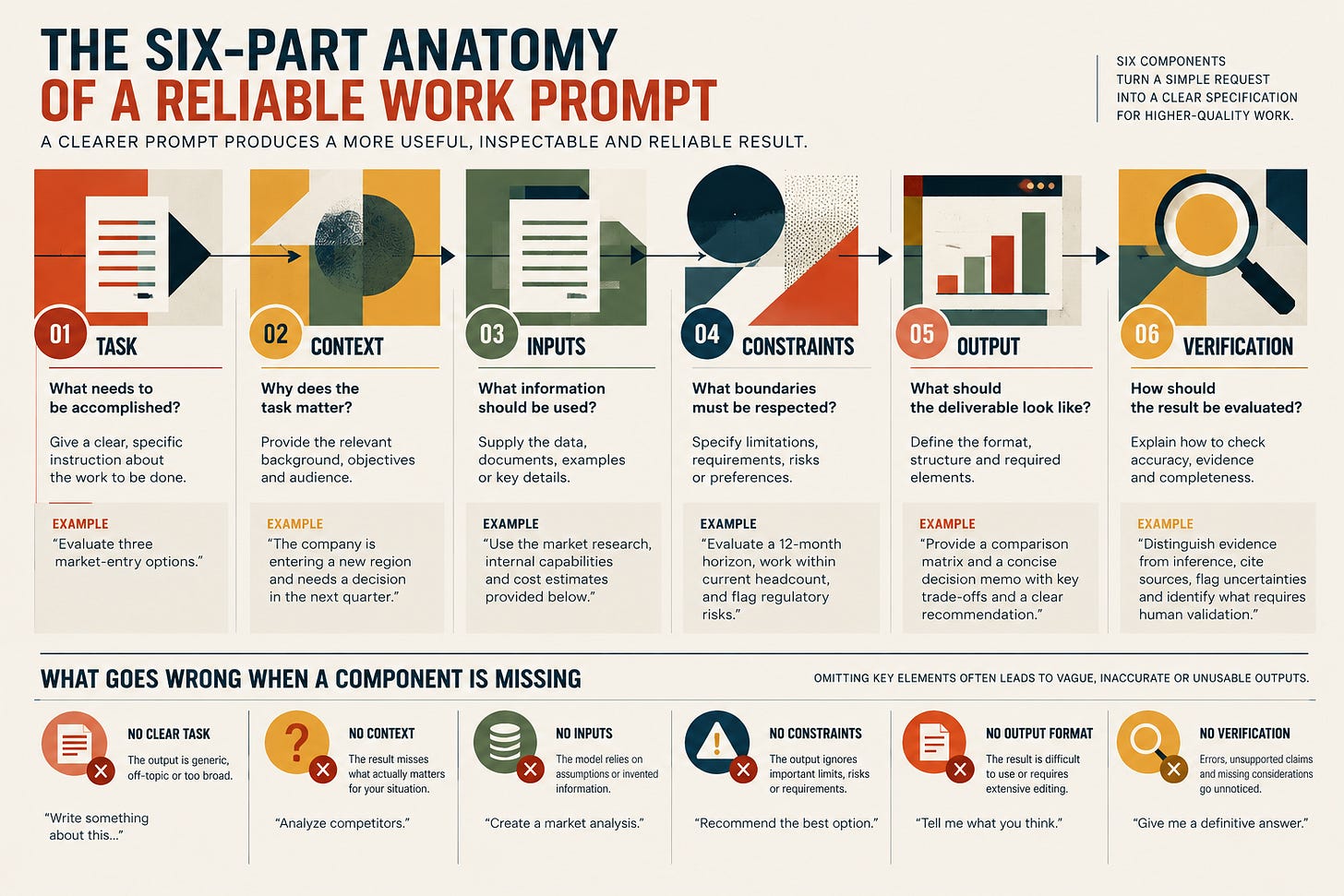
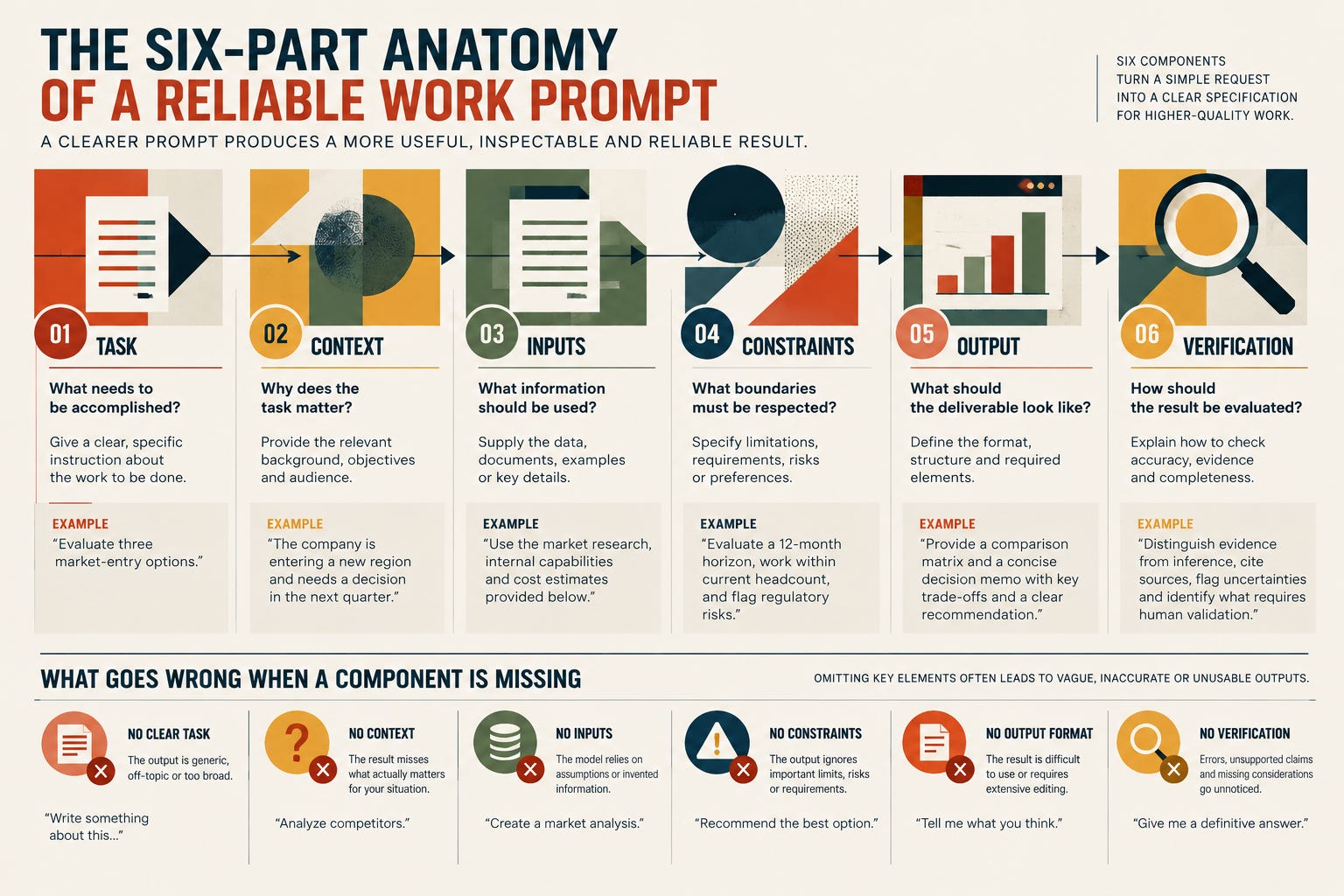
Most useful business prompts can be understood through six components.
The six parts reinforce one another.
A precise task without context may produce an irrelevant solution. Context without clear inputs invites unsupported assumptions. A detailed analysis without defined output requirements creates unnecessary editing work.
Verification closes the loop by making errors, uncertainties, and omissions more visible.
The reusable six-part master prompt
Task
Help me accomplish [SPECIFIC OBJECTIVE].
Context
This matters because [BUSINESS SITUATION AND DECISION].
Inputs
Use the following information: [DATA, DOCUMENTS, OR NOTES].
Constraints
Respect these boundaries: [LIMITATIONS, REQUIREMENTS, RISKS].
Output
Deliver the result as [FORMAT], including [REQUIRED ELEMENTS].
Verification
Distinguish evidence from inference, flag missing information, and identify what requires human validation.
This structure can be adapted to almost any template in the library.
Framework 02 — The Prompt Selection Map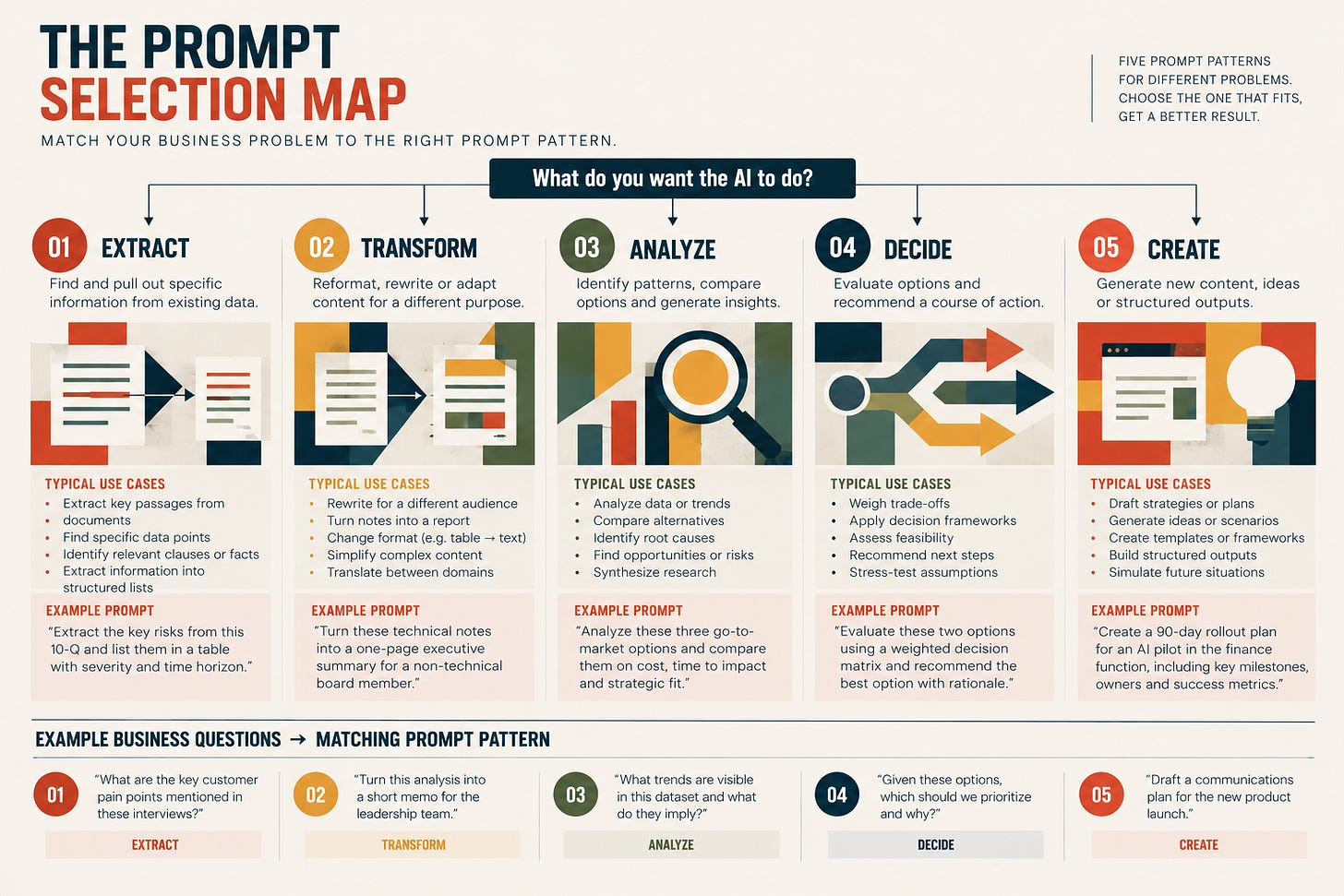
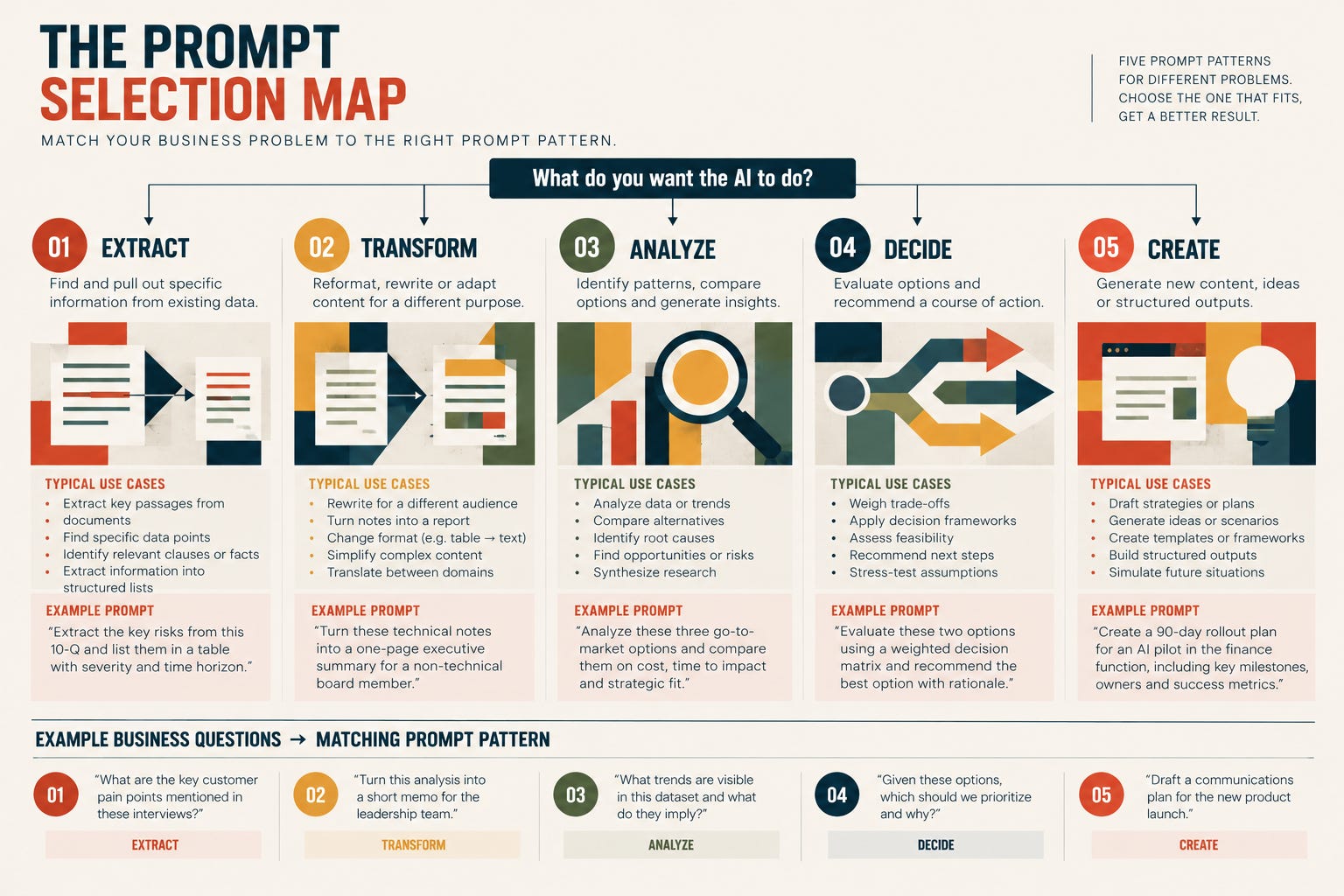
Different business problems require different cognitive operations.
A request to extract obligations from a contract involves a different process from a request to develop strategic alternatives. Treating both as generic content generation makes it difficult to define quality.
Five recurring prompt patterns cover much of everyday knowledge work.
Pattern A — Extract
Purpose: Locate and structure specific information from existing material.
Typical tasks: Contract terms, meeting actions, document analysis, information classification.
Quality criterion: Completeness, traceability, and fidelity to the source.
Relevant prompts: 03, 19, 26, 31.
Pattern B — Transform
Purpose: Convert existing information into a more useful format.
Typical tasks: Executive summaries, emails, presentation structures, SOPs, handovers.
Quality criterion: Preservation of meaning, usability, and accuracy.
Relevant prompts: 07, 09, 10, 29, 30.
Pattern C — Analyze
Purpose: Investigate patterns, relationships, uncertainties, or possible causes.
Typical tasks: Market comparisons, KPI interpretation, campaign analysis, bottleneck identification.
Quality criterion: Sound reasoning, valid comparisons, and transparent limitations.
Relevant prompts: 02, 20, 32, 33, 42.
Pattern D — Decide
Purpose: Evaluate alternatives and their consequences.
Typical tasks: Strategy choices, prioritization, risk evaluation, automation suitability.
Quality criterion: Explicit criteria, defensible trade-offs, and visible assumptions.
Relevant prompts: 11, 12, 14, 27, 43.
Pattern E — Create
Purpose: Develop a new artifact within a defined context.
Typical tasks: Proposals, learning plans, training exercises, messaging concepts, operating procedures.
Quality criterion: Fitness for purpose, practical usability, and compliance with constraints.
Relevant prompts: 16, 23, 46, 48.
Many professional tasks require several patterns in sequence.
For example, preparing a strategic recommendation may involve extracting evidence, analyzing competing explanations, evaluating options, and creating a decision memo.
Recognizing these different operations helps you design prompts with fewer hidden assumptions.
Framework 03 — The Prompt Quality Checklist
A fluent answer is not necessarily a useful answer.
Before relying on an AI-generated result, evaluate it against six dimensions.
1. Relevance
Does the result address the actual task and decision?
Check: Can you clearly connect the output to the objective specified in the prompt?
2. Evidence
Are important claims supported by available information?
Check: Can the central claims be traced to supplied inputs or accessible sources?
3. Accuracy
Are facts, calculations, references, and representations correct?
Check: Have consequential details been verified independently?
4. Completeness
Does the result contain the necessary information without major omissions?
Check: Are important constraints, exceptions, and alternative interpretations covered?
5. Usability
Can the intended user act on the result?
Check: Is the output structured appropriately, with clear next steps where needed?
6. Risk
Could an incorrect or misleading output create material consequences?
Check: Are sensitive data, authority limits, approval requirements, and failure conditions addressed?
A simple evaluation scorecard
Score each dimension from 1 to 5.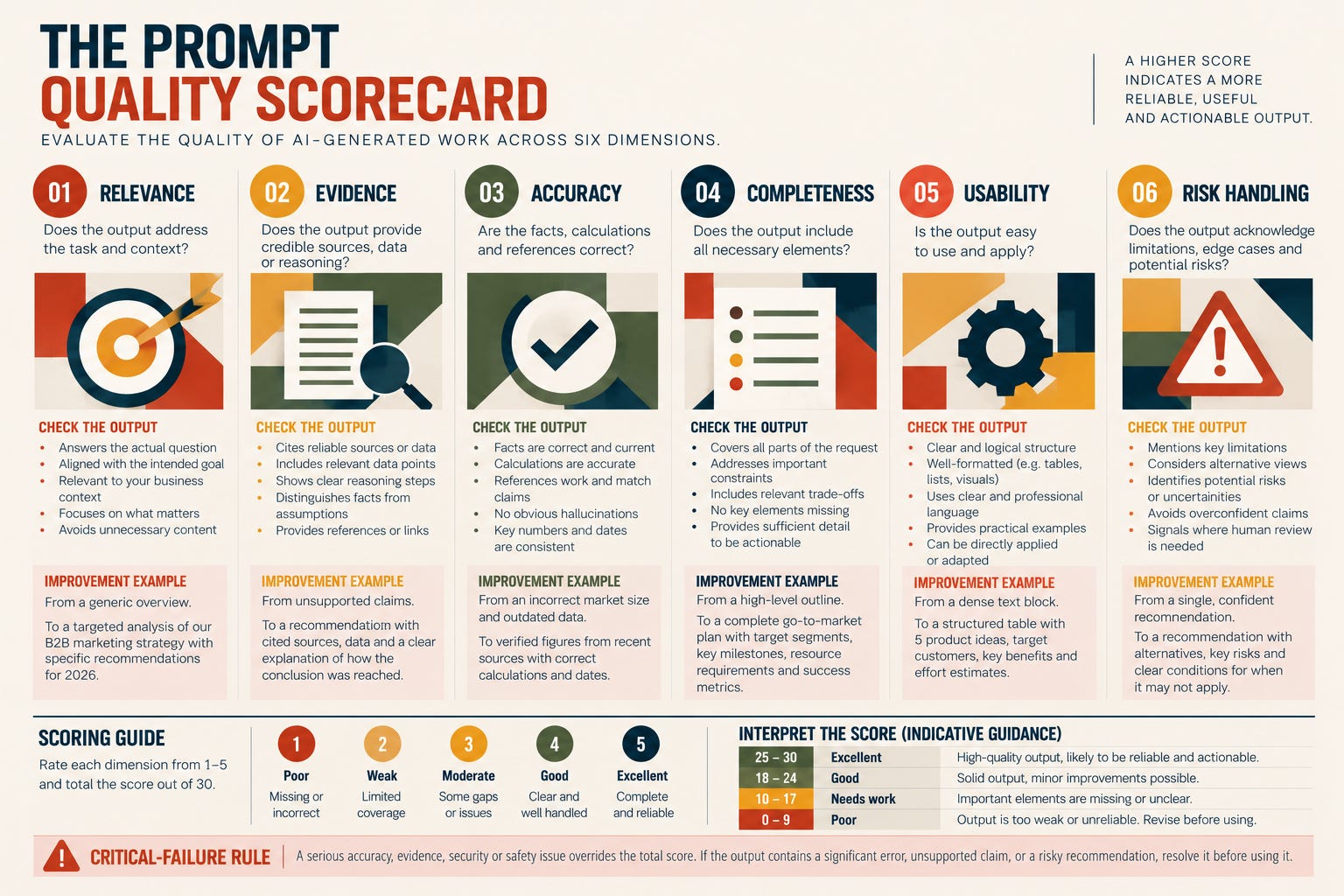
The total is useful for comparing iterations, but it should never override a critical failure. An output that invents financial data or mishandles sensitive information can be unacceptable regardless of its scores elsewhere.
Use the checklist to identify why an output underperformed, then revise the relevant part of the prompt.
Framework 04 — The Prompt Improvement Loop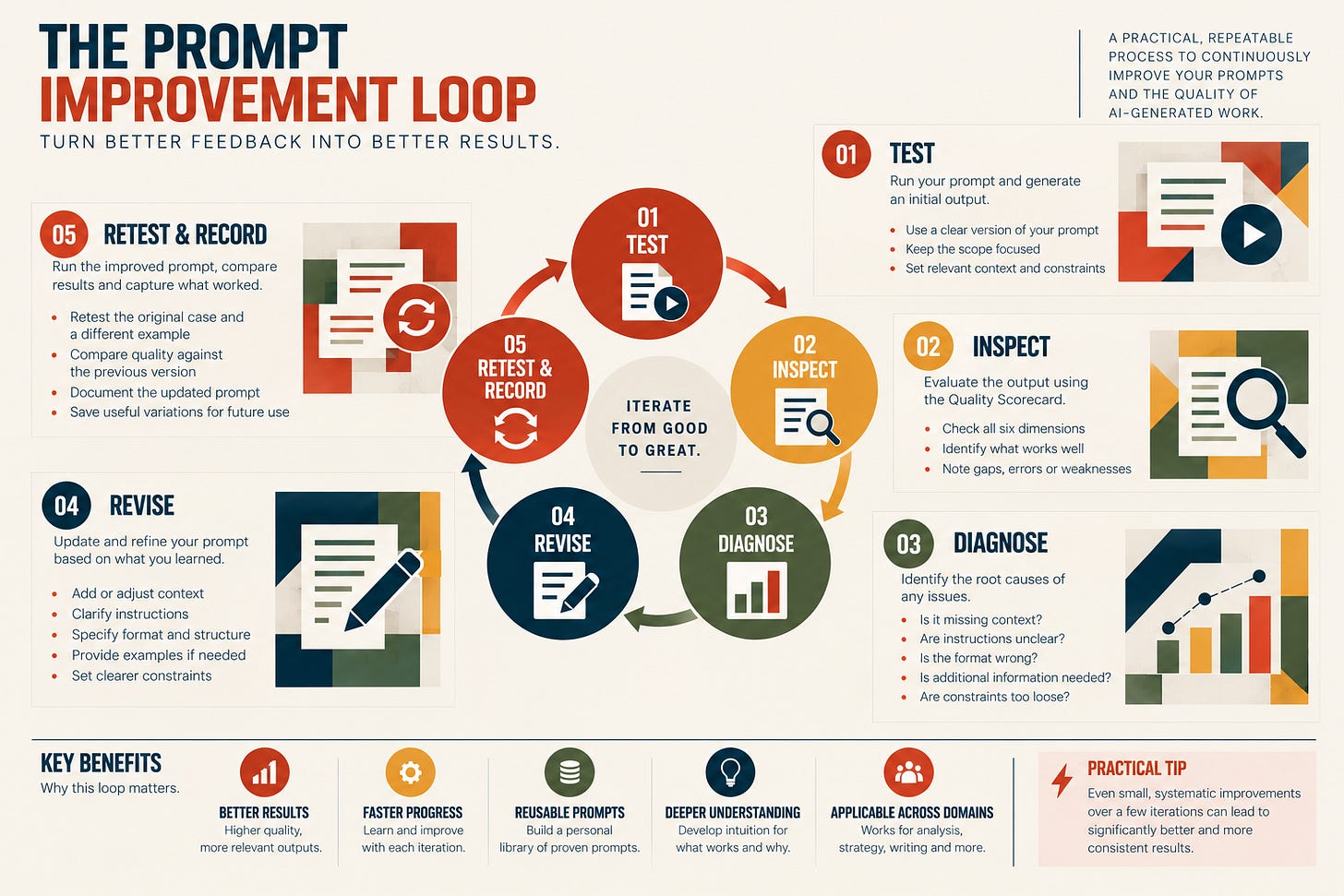
The best prompt is rarely the first version.
Repeatedly rewriting instructions without identifying the cause of an error creates unnecessary work. A more disciplined improvement loop uses five steps.
Step 1 — Run a Representative Test
Use a realistic task containing the same complexity, ambiguity, and constraints encountered in actual work.
Step 2 — Inspect the Output
Compare the result against expected requirements.
Identify specific failures such as missing context, unsupported claims, poor formatting, incorrect calculations, or inadequate treatment of exceptions.
Step 3 — Diagnose the Failure
Determine whether the issue comes from:
-
Missing inputs.
-
An ambiguous task.
-
Conflicting instructions.
-
Insufficient access to evidence.
-
An unsuitable output format.
-
A task requiring tools or deterministic computation.
Step 4 — Revise One Element
Change the instructions, provide better inputs, specify clearer success criteria, or introduce a verification step.
Avoid changing everything simultaneously when you want to understand what improved the result.
Step 5 — Retest and Record
Test the revised prompt against the original case and at least one different example.
Record the prompt version, task context, observed failures, and improvements.
A prompt that performs well on one example may fail when the subject, document structure, or data quality changes.
Repeat until the result is reliable enough for the intended use and risk level.
Framework 05 — From a Useful Prompt to a Repeatable Workflow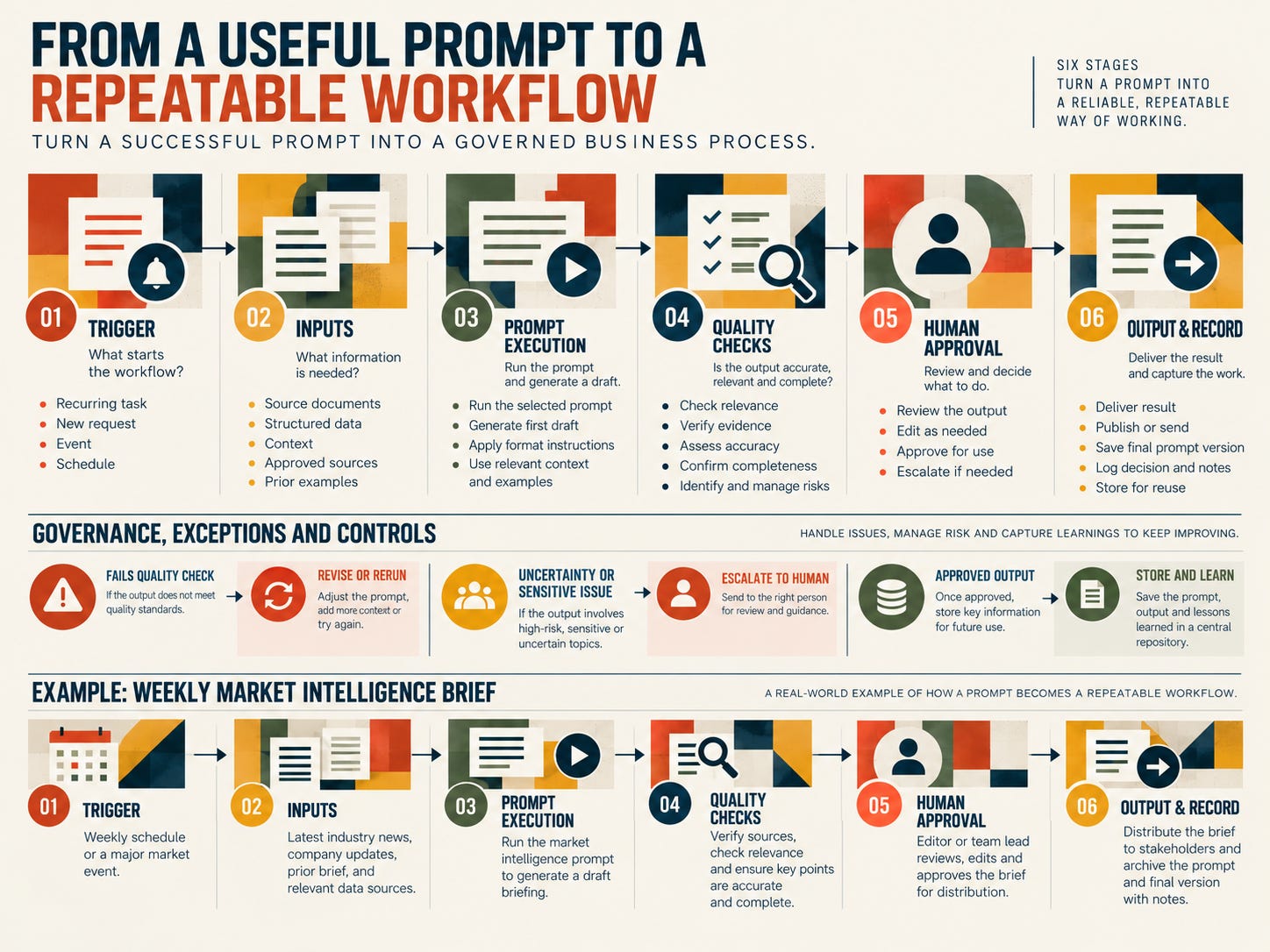
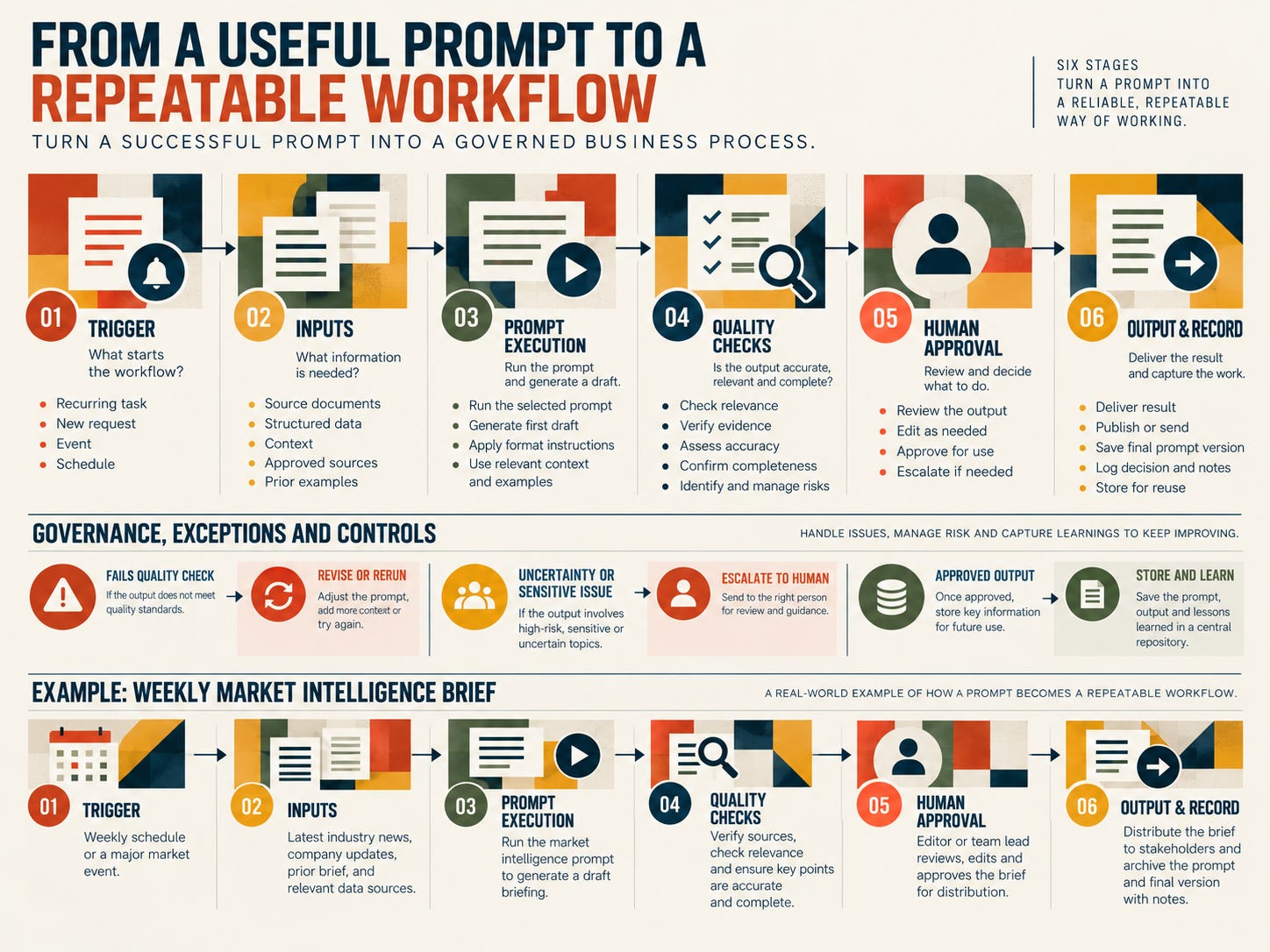
A prompt becomes more valuable when it can be used repeatedly without recreating the surrounding process.
Consider a weekly market intelligence briefing.
A one-off prompt might ask an AI assistant to summarize recent developments. A repeatable workflow requires more definition.
1. Define the trigger
Every Monday morning, or whenever a specified market development occurs.
2. Define the inputs
Approved information sources, time period, monitored companies, and relevant business questions.
3. Define the processing instructions
Extract significant developments, compare them with previous observations, and distinguish established facts from emerging hypotheses.
4. Define quality controls
Check source relevance, publication dates, claim traceability, and duplicate coverage.
5. Define human responsibilities
A designated analyst reviews findings and approves any externally distributed conclusions.
6. Define the output and record
Produce a consistent briefing, store evidence references, and maintain a history of significant developments.
This progression changes how AI fits into the work.
The prompt provides the reasoning instructions. The workflow defines when those instructions run, what information they receive, how results are checked, and who remains accountable.
A reliable workflow also needs appropriate tooling, permissions, logging, and recovery procedures. A strong prompt alone does not provide those capabilities.
A practical prompt-to-workflow template
Workflow name: [NAME]
Business objective: [OBJECTIVE]
Trigger: [EVENT OR SCHEDULE]
Inputs and sources: [INPUTS]
Prompt template: [SELECT OR ADAPT ONE OF THE 50 PROMPTS]
Required tools: [TOOLS]
Quality checks: [CHECKS]
Human approval: [ROLE AND CONDITIONS]
Output: [DELIVERABLE]
Success measure: [METRIC]
Failure and escalation rule: [RULE]
This template provides the initial specification for turning a repeated AI-assisted task into a more dependable business process.
Five Rules for Using AI Prompts at Work
1. Supply the evidence before requesting certainty
An AI assistant can structure analysis around incomplete information, but that does not make its conclusions verified. When external facts matter, provide authoritative sources or use tools that can retrieve them.
2. Specify the decision, not only the topic
“Research the market” leaves too much interpretation open. “Evaluate whether this market offers an attractive entry opportunity under these constraints” gives the task a purpose.
3. Design outputs for inspection
Comparison tables, evidence registers, assumption lists, and explicit recommendations make reasoning easier to evaluate than uninterrupted prose.
4. Keep consequential decisions accountable
AI-generated assessments can assist with hiring, finance, operations, and strategic decisions, but the responsible person or organization must retain appropriate oversight. Sensitive tasks may require specialized review, policies, and safeguards.
5. Improve the process when the task repeats
If you use the same prompt every week, document its inputs, outputs, controls, and responsibilities. Repeated work offers an opportunity to create a reliable process rather than continually starting from a blank conversation.
Where to Go Next
The 50 prompts in this library cover a broad range of professional work, but they share a common foundation: clear objectives, relevant inputs, defined outputs, and meaningful verification.
A prompt can be reused across many situations. Its effectiveness depends on the context supplied and the quality standards applied.
Start with a task you encounter frequently. Select the closest template, adapt it to your situation, and evaluate the output against the criteria that matter in your work.
Then improve the prompt, document what changed, and test it again.
Over time, the useful templates become a small library of repeatable practices. Some will remain personal productivity tools. Others may evolve into standardized processes or automated workflows with defined responsibilities and safeguards.
The real return comes when a useful result can be produced reliably, evaluated consistently, and integrated into how work gets done.
Explore more practical frameworks, field guides, and implementation resources through The Strategy Stack, including the Operator Vault and Stack Atlas.