Why understanding what happens begins with understanding what produces it.
By Alex Pawlowski
Published: 2026-10-20
URL: https://thestrategystack.substack.com/p/systems-thinking-events-patterns-structures

Book 0 · Issue 3 of 100 · Thinking Like a Strategist
Imagine driving down a motorway when traffic suddenly slows to a crawl. You instinctively assume something must have happened ahead. Perhaps an accident, roadworks, or a broken-down vehicle. There must be an explanation somewhere, a particular event responsible for the inconvenience.
But eventually the traffic begins moving again. You pass no accident, no obstruction, no damaged vehicle. The road is perfectly clear.
What happened?
One possibility is that nothing happened in the way we ordinarily understand the word. A driver tapped the brakes, the vehicle behind slowed slightly more, and the next driver reacted more strongly still. Small adjustments propagated backward through the traffic until they became a wave of congestion. Researchers have demonstrated that such waves can arise even on a circular road without an external obstruction.
The remarkable part is that nobody needed to make a particularly bad decision.
Every driver could be responding reasonably to the vehicle immediately ahead, yet the collective outcome could still be irrational.
This is one of the strangest properties of the world we inhabit: entirely sensible individual actions can produce collectively undesirable outcomes without anyone intending them.
And once you begin noticing this phenomenon, you start seeing it everywhere.
In markets, organizations, supply chains, political institutions, technological systems, and even our everyday relationships, outcomes frequently emerge from interactions that nobody fully controls.
We spend enormous amounts of time explaining what happened but far less time asking what made it possible.
← Issue 2: Every Observation Is Framed
The Seduction of the Event
We have a peculiar tendency to understand the world through the things that interrupt it. When a company misses its earnings target, a product launch disappoints, or an AI system confidently invents an answer, our attention gravitates toward the moment something went wrong. We want to know what happened, who was involved, and which decision might explain the outcome.
There is something satisfying about explanations that can be traced to a recognizable event. They give complicated situations a beginning, a sequence of developments, and someone whose actions we can examine. Much of how we discuss business, politics, and technology follows this narrative logic because events are easier to observe and communicate than the relationships that produce them.
Systems are considerably harder to recognize. They operate through incentives, dependencies, constraints, and feedback mechanisms whose effects can accumulate for years before becoming visible in a particular outcome. By the time something attracts our attention, the conditions responsible for it may have become deeply embedded in how an organization operates.
Consider a company that has begun losing talented employees. During exit interviews, one person mentions better compensation elsewhere, another wants greater flexibility, and a third feels their career has stagnated. Management records these explanations and responds through salary adjustments, recruitment, or another engagement survey.
Yet suppose the organization consistently rewards managers for maximizing short-term output, measures employee performance primarily through utilization, and postpones training investments whenever financial pressure increases. Over time, these seemingly reasonable decisions create an environment in which professional development becomes difficult and talented employees increasingly look elsewhere.
The individual explanations remain valid, but the recurring departures may share a deeper organizational cause. Nobody needs to deliberately discourage employee development for the company’s incentives and management practices to produce precisely that outcome.
This distinction matters because addressing each departure individually can leave the conditions generating the broader pattern untouched. Understanding why people repeatedly choose to leave requires examining how the organization distributes rewards, allocates resources, and shapes the choices available to its employees.
The most consequential causes are often embedded in the ordinary workings of a system, long before their effects become visible as events.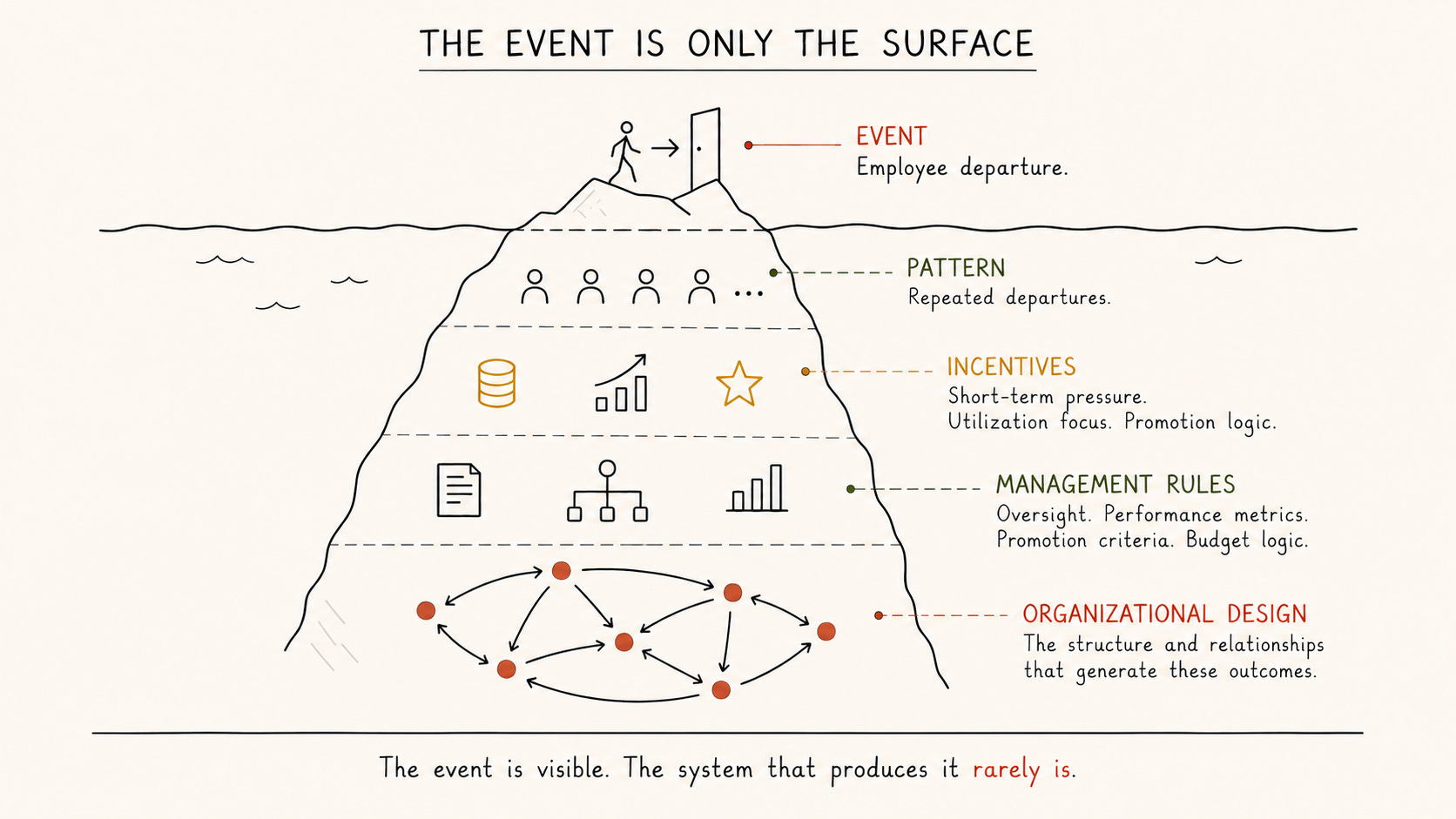 Replacing the person who leaves does little to change the conditions that made leaving a rational choice.
When the Solution Becomes the Problem
Some systems have a remarkable tendency to amplify the very problems we try to solve. Interventions that appear perfectly reasonable in isolation can produce consequences that nobody anticipated, particularly when different participants respond to one another without understanding the broader dynamics.
Imagine a retailer noticing that a product is selling faster than expected. Concerned about potential shortages, it increases its next order. The distributor interprets this as evidence of rising demand and places an even larger order with the manufacturer, which subsequently expands production. What began as a modest change in consumer demand has now triggered a much larger reaction throughout the supply chain.
Economists and operations researchers describe this as the bullwhip effect, where relatively small fluctuations in demand become amplified as they travel upstream. Each participant may be making a prudent decision based on the information available, yet their combined responses can produce excessive inventories, shortages, and production volatility far beyond what actual consumer demand would justify.
The system manufactures its own instability.
The same dynamic appears in organizations, where well-intentioned attempts to improve performance can gradually undermine it. More oversight promises fewer mistakes, additional approval requirements promise greater accountability, and tighter performance targets promise better execution. Yet each intervention also changes how people behave, often in ways that create new difficulties.
Consider a company introducing stricter approval requirements to reduce operational errors. Decisions gradually slow down, employees become reluctant to exercise judgment, and routine matters increasingly reach senior management. Leadership interprets the resulting hesitation and dependency as evidence that employees lack sufficient autonomy or competence, reinforcing its belief that closer supervision is necessary.
The organization consequently introduces more controls, further strengthening the behaviour that originally justified them. What emerges is a self-reinforcing feedback loop in which each attempt to correct the problem makes its underlying conditions more persistent.
The more revealing strategic question is therefore what keeps reproducing the problem, even when everyone involved believes they are helping to solve it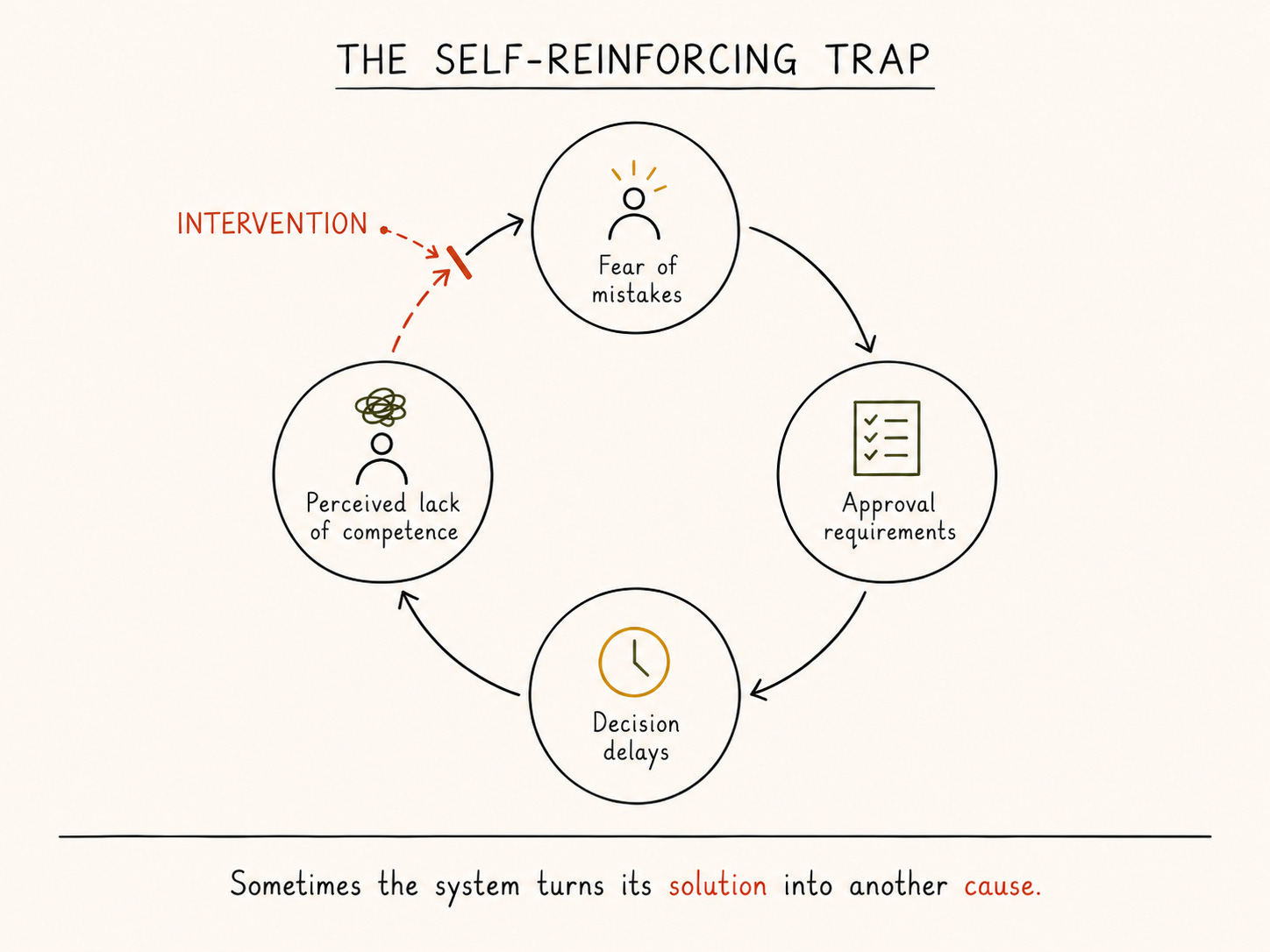 The more an organization responds to uncertainty with control, the more it risks creating the dependency that makes further control seem necessary.
The Invisible Power of Delays
We tend to expect causes and consequences to appear reasonably close together. Much of our everyday experience reinforces this intuition, making it difficult to recognize situations in which the effects of a decision take months or years to materialize. Complex systems frequently operate on precisely these delayed relationships, allowing problems to develop long before anyone recognizes their origins.
Consider a company reducing employee training to improve quarterly profitability. The financial benefits appear almost immediately as expenditure falls, costs decline, and margins improve. From a conventional reporting perspective, the decision may look entirely sensible, particularly when management faces pressure to deliver short-term results.
The consequences, however, accumulate much more gradually. Employees become less familiar with emerging technologies, outdated practices persist, and the organization slowly loses its ability to adapt. Over time, ambitious candidates may begin looking elsewhere, while existing teams struggle to develop the capabilities required to remain competitive.
By the time these weaknesses become visible in business performance, the original budget decision may be buried beneath years of unrelated developments. A future management team might diagnose an innovation problem, declining talent quality, or an increasingly conservative organizational culture without recognizing how earlier investment decisions contributed to those conditions.
This is what makes performance measurements taken at a single moment potentially misleading. An action can improve today’s indicators while quietly damaging the conditions that produce tomorrow’s performance. Equally, investments that appear inefficient in the present may be building capabilities whose value only becomes apparent years later.
Strategic decisions therefore frequently involve consequences operating on different timelines. Immediate gains are measurable, visible, and relatively easy to reward, while longer-term effects remain uncertain and can eventually be attributed to entirely different causes. Organizations naturally gravitate toward what their reporting systems can capture, even as the consequences they cannot yet measure continue to accumulate.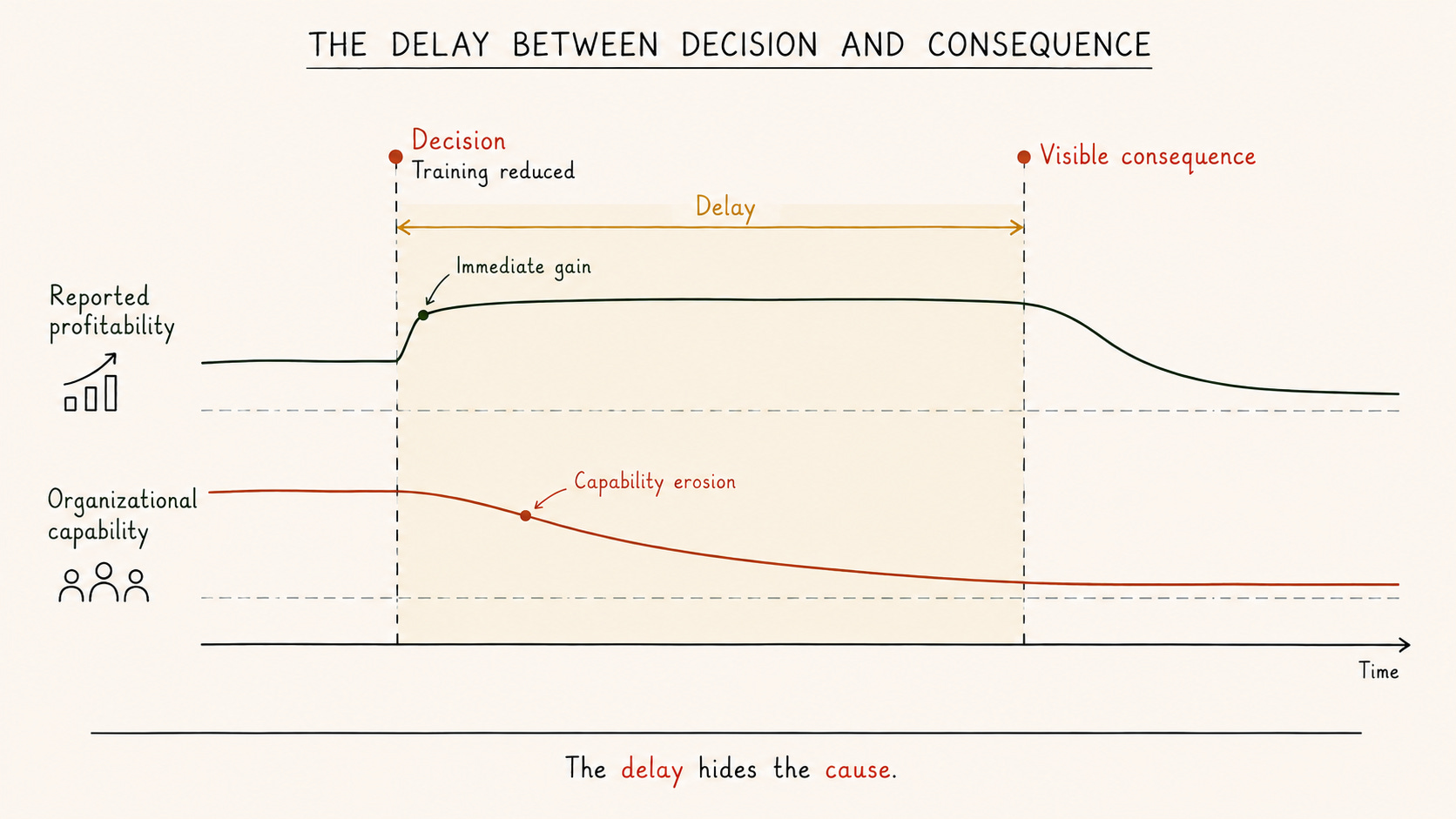 By the time declining performance reveals the damage, the decision responsible for it may already be remembered as a success.
The Strange Mathematics of Collective Behaviour
One of the more fascinating properties of complex systems is that their collective behaviour can be difficult to predict from the characteristics of their individual components. Patterns emerge through interactions, sometimes producing a degree of coordination that none of the participants could achieve or even envision independently.
Consider a flock of birds moving across the sky. Each bird responds primarily to its immediate surroundings, adjusting its direction, maintaining distance, and following the movements of nearby birds. Yet these relatively simple interactions can produce remarkably coordinated formations, creating collective patterns without anyone directing the flock as a whole.
This phenomenon is known as emergence, the process through which interactions between individual components give rise to properties and behaviours that become apparent at the collective level. Similar dynamics help explain everything from traffic congestion and crowd movements to financial markets and organizational cultures.
Consider how an organization can gradually develop an intensely political culture without anyone explicitly encouraging internal competition. When teams are rewarded for protecting their budgets, managers gain influence by expanding headcount, and promotions depend on visible ownership of successful initiatives, employees naturally adapt their behaviour to those incentives.
Over time, territorial behaviour becomes advantageous, collaboration grows more difficult, and internal competition begins to feel like an unavoidable feature of organizational life. The resulting culture emerges from countless individual decisions that make sense within the conditions employees encounter every day.
This has important implications for organizational transformation. Leaders frequently try to change behaviour through cultural initiatives, leadership workshops, or new expectations while leaving the incentives that shape everyday decisions largely untouched. Yet meaningful change often requires examining why existing behaviours have become advantageous in the first place.
Sometimes the behaviour we criticize is precisely what the system has taught people to do.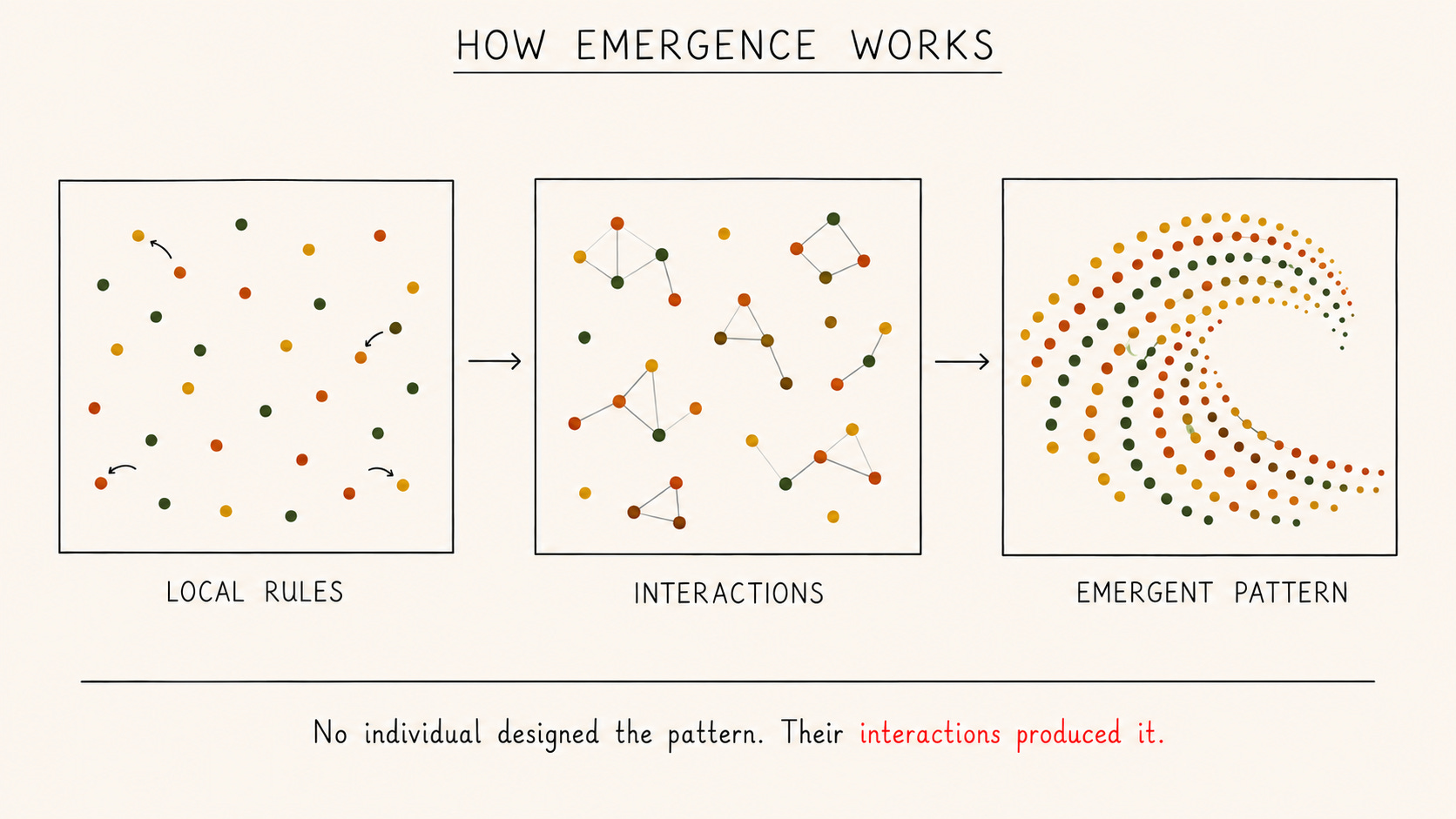 Coordination can arise without central direction, just as dysfunction can emerge without anyone deliberately creating it.
Artificial Intelligence Makes the Problem More Interesting
Artificial intelligence makes these dynamics particularly interesting because many of its failures emerge from systems whose internal behaviour remains difficult to fully understand. Consider hallucinations in large language models, where an AI assistant confidently invents a citation, references a nonexistent study, or presents an incorrect answer with remarkable fluency.
While the mistake itself is easy to identify, understanding how it occurred requires examining a much larger set of interacting conditions. Language models learn patterns from training data and are shaped by optimization objectives, human feedback, and subsequent design decisions. Their responses also depend on prompts, available context, retrieval mechanisms, and how the surrounding application handles uncertainty. Together, these elements influence whether a model produces an answer supported by reliable evidence or a plausible statement it cannot substantiate.
Individual hallucinations can have different contributing factors, making them difficult to trace to a single cause. Yet when similar failures occur repeatedly, examining each incorrect response in isolation offers limited insight into the conditions that allow such errors to persist.
An organization might respond by refining prompts, introducing warnings, or requiring employees to review generated content more carefully. These measures can improve reliability, but recurring problems also invite questions about the broader system: what information the model can access, when evidence must be retrieved, how uncertain claims are verified, and whether its evaluation process rewards factual accuracy as strongly as fluent, useful-looking responses.
A model embedded in an application that rarely verifies its claims may continue producing convincing errors even as individual prompts are improved. Addressing reliability therefore often requires reconsidering the interaction between the model, its information sources, evaluation criteria, and operational safeguards.
The broader strategic principle applies equally to organizations, financial markets, and institutional decision-making. When a failure keeps returning, investigate the machinery that keeps producing it. Improving an individual component may help, but lasting improvements often depend on changing the relationships and conditions through which the system operates.
Learning to See What Isn’t Happening
Perhaps one of the most overlooked aspects of systems thinking is that valuable evidence can also be found in what never happens. Organizations spend considerable time measuring observable outcomes while rarely examining the opportunities, decisions, and behaviours their own structures quietly discourage.
A product team celebrates the features it shipped without considering which ideas employees stopped proposing because approval processes became too burdensome. A company investigates customer complaints while overlooking those who simply leave without explaining why. Governments evaluate policies through intended outcomes while struggling to capture how people adapt their behaviour in response. In each case, the available evidence reflects only a fraction of what the system has influenced.
This matters because systems shape the possibilities that never become events in the first place. Organizational structures influence which conversations take place, incentives determine which risks people are willing to accept, and technology architectures establish which product ideas are economically feasible. Over time, these conditions quietly narrow the range of decisions people consider realistic or worthwhile.
Some of the greatest strategic costs therefore emerge from opportunities that were never pursued, investments that never received support, or alternatives that gradually disappeared from consideration. Their absence makes them particularly difficult to measure, even when their long-term consequences are substantial.
The same problem arises when evaluating apparently successful organizations. Strong financial performance may conceal dependence on a fragile supplier, high employee utilization may come at the expense of learning capacity, and excellent customer retention may reflect switching costs rather than genuine satisfaction. An organization can perform exceptionally well against its chosen indicators while becoming increasingly vulnerable to developments those indicators were never designed to capture.
For strategists, this means examining how a system shapes the range of possible outcomes, including those that remain invisible in conventional reporting. Sometimes the most revealing question is what the system systematically prevents from happening.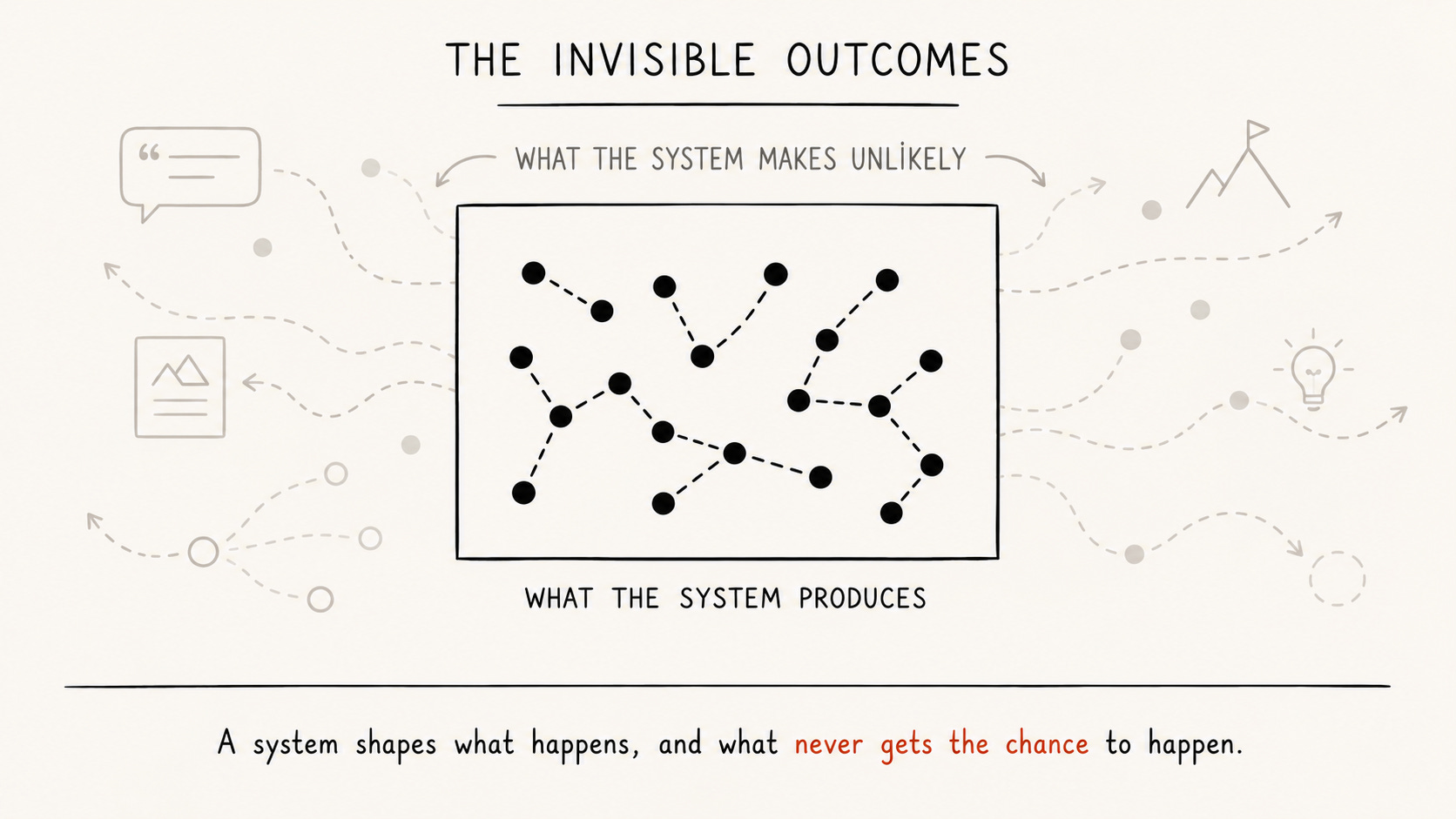 The most consequential cost of a system may be found in the possibilities it quietly discourages, rather than the results it visibly produces.
From Explaining Outcomes to Understanding Their Production
Once you begin recognizing systems, the world becomes both more complicated and more understandable. Events that once appeared isolated reveal networks of interactions, delayed consequences, and unintended effects, while recurring problems begin to expose patterns that were previously easy to dismiss as coincidence.
A project that repeatedly misses its deadlines may reflect how resources are allocated across competing priorities. Persistent customer complaints might originate in a company’s pricing architecture rather than its frontline service. Even seemingly irrational market behaviour can emerge when individual participants respond sensibly to incentives that collectively produce instability.
Recognizing these relationships does not eliminate individual responsibility or imply that every outcome has an identifiable structural cause. Human decisions, unexpected events, and genuine uncertainty remain essential parts of the picture. The value of systems thinking lies in understanding how multiple influences interact, how their consequences accumulate over time, and how the resulting outcomes can reinforce or alter the conditions that produced them.
For strategists, this changes the nature of the questions worth asking. When a problem persists, it becomes important to examine which behaviours are rewarded, how constraints influence decisions, what information reaches different participants, and whether previous interventions have inadvertently strengthened the problem. The same curiosity should apply when things go unexpectedly well, because success can be as misleading as failure when we misunderstand the mechanism that produced it.
This perspective also demands greater care when intervening. Changing one element can alter relationships elsewhere in the system, sometimes creating consequences that only become visible much later. Effective strategy therefore requires considering how an intervention might reshape incentives, behaviour, and future decisions across the wider structure.
The ultimate objective is to understand the conditions through which outcomes emerge, so that strategic decisions can influence what the system produces over time rather than repeatedly responding to its most visible consequences.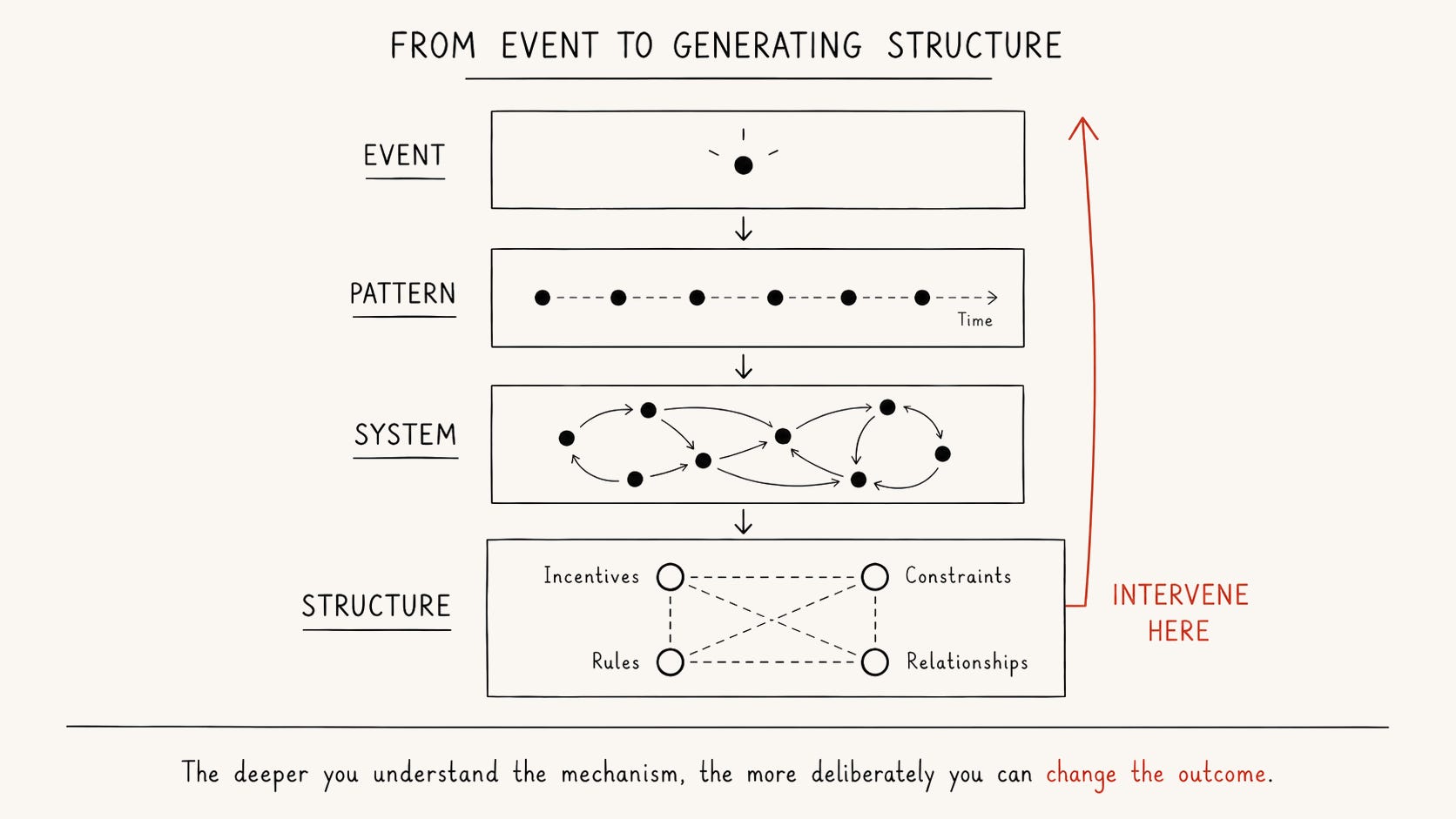 Changing an outcome once requires an intervention. Changing the outcomes a system repeatedly produces requires understanding the conditions that generate them.
The world will continue presenting itself as an endless sequence of events, from quarterly earnings announcements and technological breakthroughs to failed transformations and unexpected crises. Each comes with its own explanations, competing narratives, and recognizable protagonists, making it tempting to treat the most visible moment as the complete story.
Yet the forces shaping these outcomes often develop quietly over time, through decisions, incentives, dependencies, and feedback mechanisms that rarely attract attention until their consequences become impossible to ignore.
The traffic jam without an accident offers a useful reminder of how easily we can mistake an outcome for its cause. Nobody needed to make a particularly bad decision, and there was no single mistake to reverse. The congestion emerged from ordinary interactions between drivers, creating a pattern that could recur as long as the underlying dynamics remained unchanged.
Events tell us what happened. Systems help us understand why it keeps happening.
Perhaps the deepest shift in learning to think strategically lies in recognizing that the world around us is continuously shaped by relationships and interactions whose consequences extend far beyond any individual decision. Understanding those relationships allows us to question the conditions producing an outcome before deciding how to intervene.
Ultimately, the strategist’s task is to recognize these forces while there is still an opportunity to influence what happens next.
If this resonated, two pieces from the archive apply the same idea in practice:
→ Strategic Feedback System — closing the loop from outcome back to assumption so strategy stops resetting every quarter
→ Second-Order Effects — tracing consequences past the first visible win before the system surprises you again