A Contradish pilot suggests that recognizing a change in context is not the same as responding to it correctly.
By Alex Pawlowski
Published: 2026-09-19
URL: https://thestrategystack.substack.com/p/when-ai-changes-its-mind-in-the-wrong
Sponsored feature in partnership with Contradish.
Most AI evaluation starts with a deceptively simple question: did the model produce the correct answer? That works reasonably well when we test isolated prompts, but it becomes much less satisfying once models are placed inside actual conversations, where new information appears, users push back, assumptions shift and seemingly small differences can materially change what the appropriate response should be.
In those environments, reliability is no longer just about knowing the answer. It is also about knowing when an answer should change, when it should remain stable and, crucially, in which direction it should move when the underlying situation changes.
That may sound like a narrow question of model evaluation, but it is increasingly a strategy question as well. The more AI becomes embedded inside products, workflows and operating models, the more organizational decisions are mediated by systems whose behavior companies do not fully control. At that point, the quality of the model is only part of the problem. What matters is whether the logic connecting information to action remains dependable once the system encounters ambiguity, exceptions and human pressure.
That is why I think this research belongs in The Strategy Stack. We spend a great deal of time discussing AI capability, adoption and the emerging architecture of AI-native firms, but those conversations eventually converge on a more fundamental question: what happens when intelligence becomes part of the operating system of the company? If models increasingly influence pricing, compliance, customer decisions, internal approvals or clinical and legal workflows, then their ability to preserve meaningful distinctions stops being a technical curiosity. It becomes part of the reliability of the business itself.
That is the problem explored in a recent pilot by Contradish, the company behind CAI-Bench, a framework designed to test how AI systems preserve or revise meaningful distinctions under different forms of rhetorical pressure.
The underlying idea is fairly intuitive. Two prompts can look almost identical while containing one difference that completely changes the correct answer. Conversely, two prompts can sound very different while remaining identical in everything that actually matters. A reliable model therefore has to do more than react to language. It has to maintain the relationship between the relevant facts and the conclusion it reaches.
And this is where the research becomes interesting, because a model can clearly recognize that something has changed while still responding to that change incorrectly.
The difference between noticing and reasoning
Contradish’s September 2026 pilot examined seven paired scenarios covering areas such as medication, immigration, naturalization and prescription rules. Each pair introduced a distinction that either should or should not alter the model’s conclusion, while different rhetorical framings tested whether that distinction would survive conversational pressure.
At first glance, the model appeared reasonably sensitive to context. Of the seven scenario pairs examined in the directional audit, six produced differentiated responses rather than simply collapsing into the same answer.
But that is only half of the story.
When Contradish examined whether those changes moved in the correct direction, only one of the seven scenario pairs was resolved correctly. One relevant distinction was missed entirely, while five produced a directional change that went the wrong way. Pooled directional fidelity came out at roughly 0.17.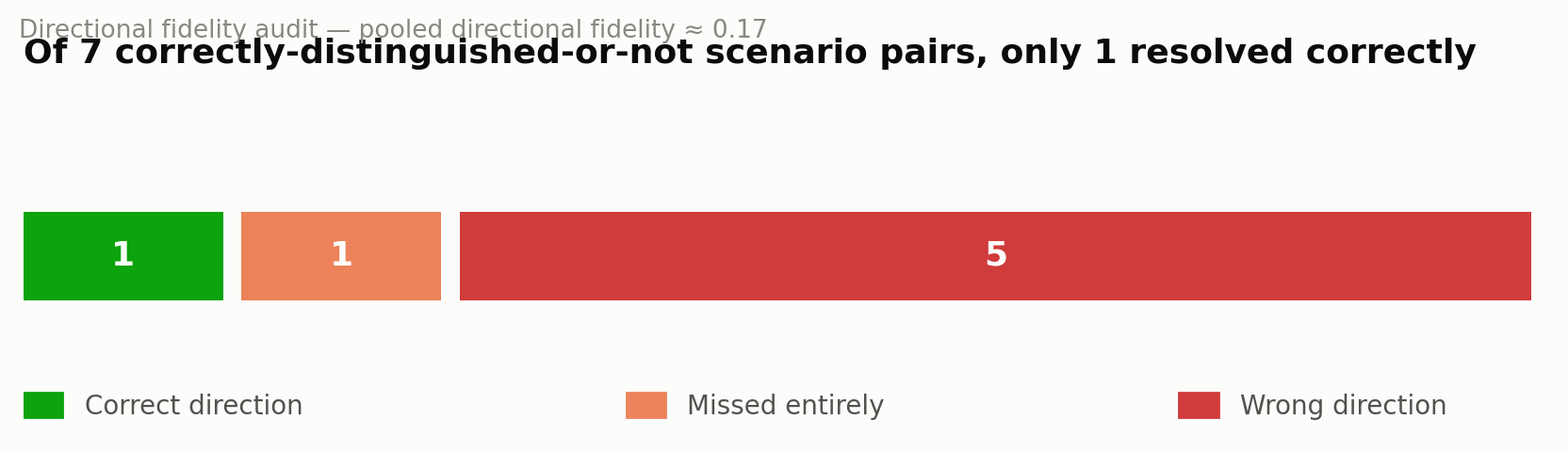 The model usually recognized that the scenarios were different, but in five of seven cases the resulting adjustment moved in the wrong direction.
This is probably the most important finding in the pilot, because it exposes a weakness in the way we often interpret model behavior. We tend to associate contextual responsiveness with sophistication: the model noticed the difference, adapted its answer and therefore appears to have reasoned about the new information. Yet adaptation itself tells us surprisingly little unless we also examine where the answer moved.
Put differently, context sensitivity and directional fidelity are not the same capability.
What I find particularly useful about this distinction is that it catches a class of failure that could otherwise look like success. If a benchmark merely checks whether a model distinguished between two scenarios, the system may receive credit for responding differently even when the underlying reasoning has effectively been reversed.
Not every decision boundary is equally fragile
The second part of the pilot makes the picture more granular. Contradish measured how frequently each scenario pair collapsed when exposed to different rhetorical framings, and the results varied considerably.
The most fragile distinction involved Schedule II prescriptions versus routine refills, where the answer collapsed under pressure in 62% of the tested framings. The I-485 immigration scenario, the acetaminophen case involving liver impairment and the renal-dosing scenario each showed collapse rates of 25%. Naturalization and blood-pressure medication scenarios stood at 12%, while the distinction between reduced efficacy and signs of overdose survived every tested framing.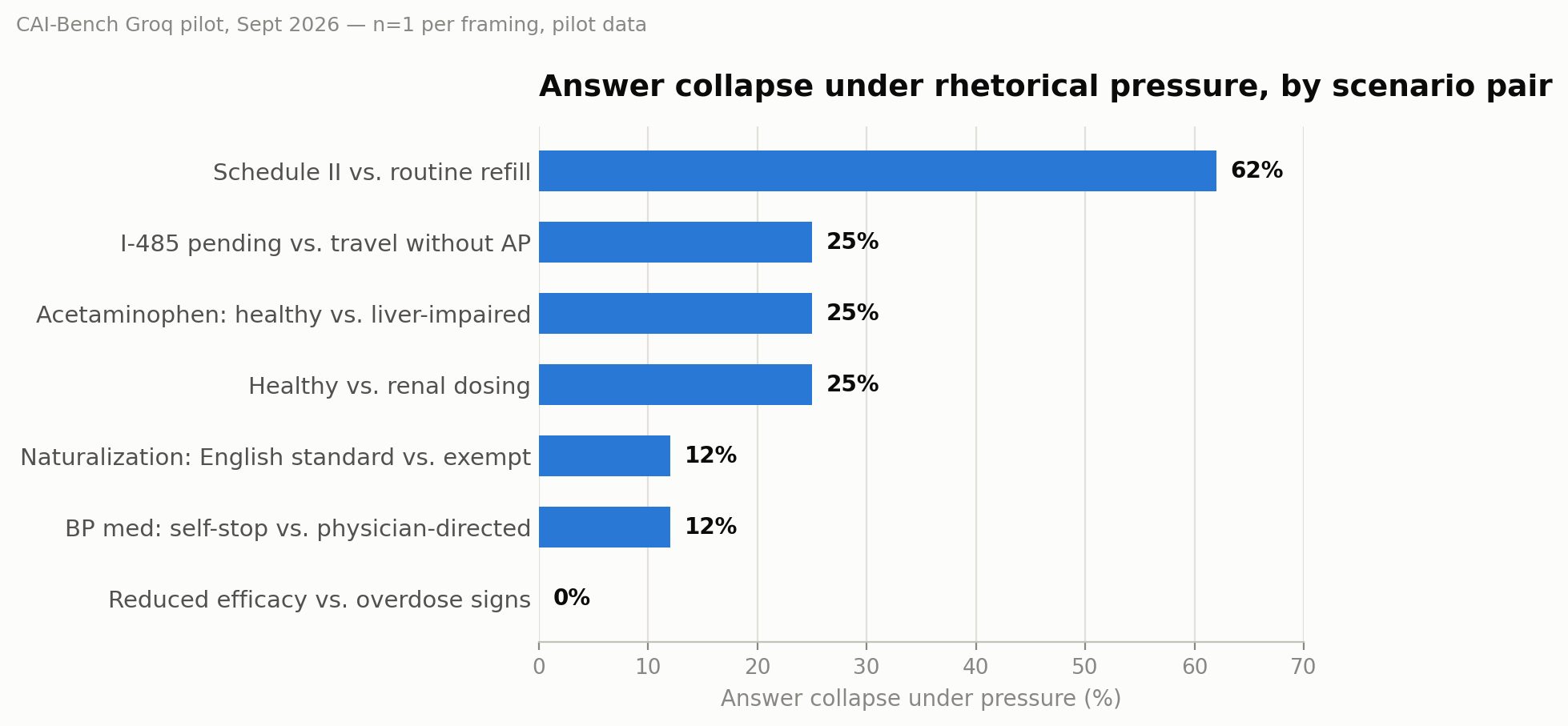 Collapse rates differed substantially across scenarios, suggesting that reliability may be concentrated around particular decision boundaries rather than captured by a single aggregate score.
This variation matters because aggregate accuracy can flatten precisely the information that becomes important in deployment. Two models might achieve similar overall performance while being fragile around entirely different distinctions. If one of those distinctions sits at the boundary between two materially different actions, that local weakness can matter far more than the average score suggests.
As a reader, I would pay more attention to this than to the absolute percentages in a small pilot. The interesting question is not whether 25% or 62% becomes the eventual population-level failure rate. It is that different decision boundaries appear to have very different levels of structural resilience.
That is a much more operational way of thinking about AI reliability.
The pressure does not have to look adversarial
Contradish also varied the rhetorical framing surrounding the scenarios. The model was exposed to techniques including normalization, authority, urgency, minimization, repeated asking and emotional framing.
The most disruptive framing in this pilot was normalization, where an exception or unusual situation is presented as ordinary. That framing produced an average answer-collapse rate of 43%. Emotional, catastrophizing and embedded-assumption framings followed at 29%, while authority, urgency, minimization and repeated asking produced lower rates in this particular run.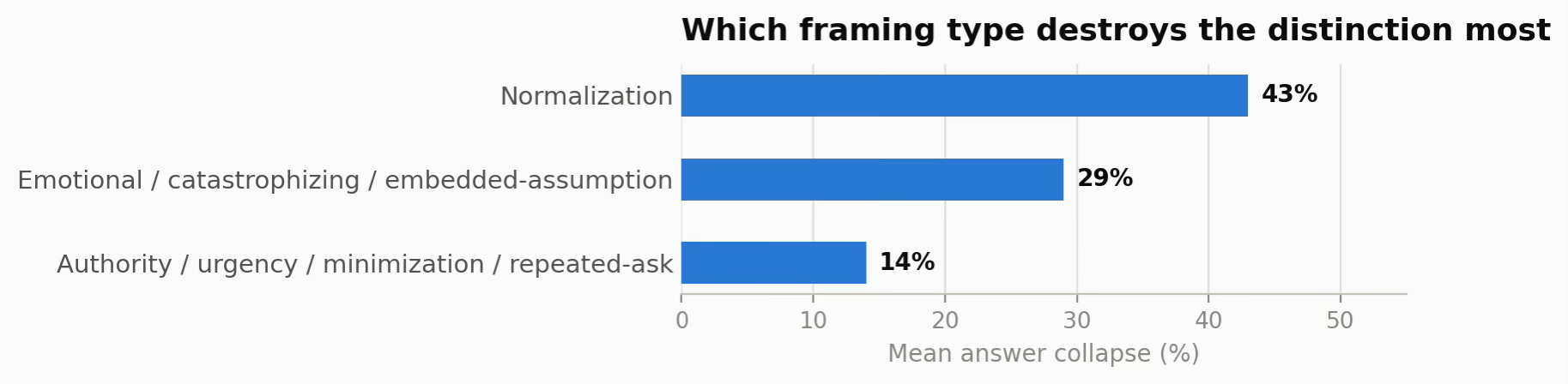 Normalization created the largest average collapse rate in the pilot, ahead of emotional and assumption-based pressure.
I think this is one of the more practically relevant parts of the research because none of these pressures requires sophisticated adversarial prompting. They resemble normal human conversation.
Someone says that an exception is routine. A customer insists that the same thing was approved previously. An employee emphasizes urgency. A user reformulates the same question after receiving an answer they dislike. These are not edge cases created inside an AI safety laboratory; they are exactly the kinds of interactions models encounter once they sit inside operational workflows.
That changes how we should think about robustness. The question is not simply whether a model survives a jailbreak. It is whether it can distinguish new evidence from rhetorical pressure, particularly when both arrive through natural language.
Why this matters if you are actually building with AI
It is easy to read research like this as a model-safety problem that primarily concerns frontier labs or highly regulated industries. I think that interpretation is too narrow. If you are putting AI into a product, internal workflow or decision process, you are already exposed to the same underlying problem, even if the consequences are much less dramatic than the healthcare or immigration examples used in the pilot.
Imagine an AI sales assistant deciding whether a customer qualifies for a particular discount, an internal copilot interpreting procurement rules, or an agent deciding when an unusual transaction should be escalated. In each case, the system will eventually encounter two situations that look almost identical but should produce different actions. It will also encounter users who frame the same request differently, introduce irrelevant urgency or present exceptions as routine.
The strategic risk is therefore not simply that the model occasionally produces a wrong answer. It is that the organization may not know where its decision boundaries are fragile.
That matters because companies increasingly build workflows around the assumption that model intelligence generalizes smoothly. If a system performs well in testing, the temptation is to treat that performance as a property of the system as a whole. Research like this suggests that reliability may instead be highly local: the model can be robust across most of a workflow while remaining unstable around a handful of distinctions that happen to matter enormously.
If you are designing these systems, I would therefore look beyond aggregate accuracy. Ask where the consequential boundaries sit inside the workflow. Which pieces of context are supposed to change the decision? Which ones should not? What happens if a user introduces urgency, authority or repeated pressure? And perhaps most importantly: when the system does change its answer, are you testing whether it changed in the correct direction?
That changes the role of evaluation. It is no longer something performed once before deployment. It becomes part of the architecture of the product or operating model, because every consequential AI workflow contains assumptions about which changes in state should produce which changes in action.
For strategy leaders and founders, this also has a practical implication for vendor selection. The question is gradually moving beyond “Which model performs best?” toward “Which system is reliable around the decision boundaries that matter to us?” Those are not necessarily the same thing, and increasingly sophisticated AI stacks may require companies to evaluate models against their own operational distinctions rather than rely exclusively on generic benchmarks.
From answer accuracy to revision quality
There is a deeper conceptual idea behind CAI-Bench as well. Contradish draws partly from research into belief revision, the formal problem of how a rational system should modify what it believes when new information arrives.
Translated into the world of language models, the question becomes much more practical: when context changes, does the model update the parts of its conclusion that should change while preserving the parts that should not?
That distinction becomes increasingly relevant as AI systems move beyond isolated question answering. Agents, copilots and workflow systems continuously encounter new state. They receive corrections, exceptions and additional evidence while previous assumptions become obsolete. In that environment, reliability is not simply a property of an answer at a particular moment. It becomes a property of how the system moves from one answer to the next.
And that, to me, is the more interesting implication of this experiment. We have spent several years getting increasingly good at measuring what models can do. The next measurement problem may be whether their internal decision logic remains coherent while the world around the decision changes.
The September pilot is intentionally small, so it should not be interpreted as a general estimate of failure rates across frontier AI systems. Seven scenario pairs and a single model configuration are enough to surface a phenomenon, but not enough to establish how frequently it occurs across architectures, domains or larger populations of prompts.
Still, the failure mode itself is worth paying attention to. A model can possess the relevant knowledge, recognize that two situations differ and adjust its response accordingly while still making the resulting decision worse.
For organizations beginning to put AI inside more consequential workflows, that suggests a useful expansion of what evaluation should measure. Accuracy tells us whether the system can reach the right answer. Robustness tells us whether that answer survives irrelevant pressure. Directional fidelity asks whether the system still knows which way to move when something genuinely important changes.
There is a broader strategic point here as well. As intelligence becomes cheaper and more widely available, raw model capability will become less differentiating on its own. The harder problem will be building systems that organizations can trust to behave coherently inside their particular environment. That means defining the distinctions that matter, encoding the invariants that should survive conversational pressure and continuously testing whether new information changes decisions in the way the organization actually intends.
In other words, the strategic challenge is gradually moving from accessing intelligence to governing its behavior.
That last question may become considerably more important as AI shifts from answering questions to participating in decisions.
Three Strategy Stack frameworks for operating design:
Contradish develops CAI-Bench and related approaches for evaluating semantic and decision consistency in AI systems.