Time horizon thinking - how to separate exploit, build, and preserve decisions so short-term execution doesn't cannibalize long-term architecture
By Alex Pawlowski
Published: 2026-09-19
URL: https://thestrategystack.substack.com/p/time-horizon-thinking
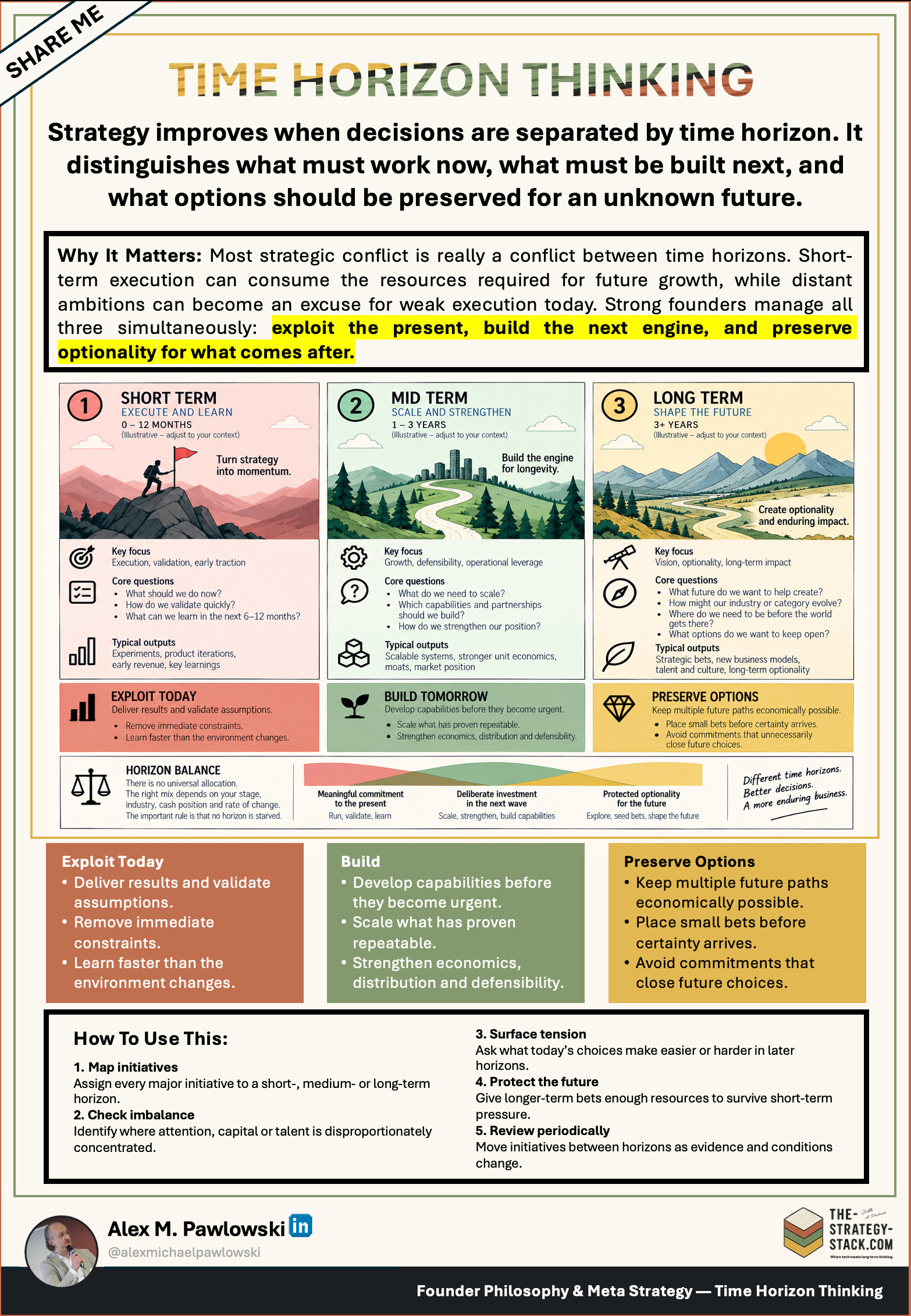
Most founder stress is not workload.
It is horizon collision - every decision treated as if it must win this week, while the business also needs assets that compound for years.
Quarterly revenue pressure hijacks architecture work. A preserve decision (culture, governance, trust) gets debated like a sprint ticket. A build bet (new capability, platform spine) gets killed because exploit metrics didn’t move in thirty days.
Time horizon thinking assigns decisions to the clock they actually run on:
-
Exploit - maximize current model; revenue, retention, delivery, efficiency
-
Build - create the next capability; systems, products, distribution, talent depth
-
Preserve protect what must endure; reputation, optionality, legal posture, key relationships, institutional memory
When horizons stay separated, teams stop arguing across incompatible time frames. When they collapse, every meeting becomes a proxy war between now and never.
The Three Horizons in Practice
Exploit (0–12 months)
Cash, customers, delivery quality, unit economics. Decisions here are measurable fast. Cadence: weekly and monthly. Failure mode: exploit-only leadership - the firm optimizes itself into a local maximum with no next curve.
Build (1–3 years)
Capabilities that don’t pay off immediately but change what’s possible: data infrastructure, brand depth, product platform, partner ecosystem, operator bench. Cadence: quarterly themes with annual review. Failure mode: perpetual “later” - build never gets protected calendar because exploit always screams louder.
Preserve (3+ years / enduring)
What you cannot easily rebuild if damaged: trust, regulatory standing, founder health, core values under pressure, structural optionality. Cadence: annual explicit review; red lines published. Failure mode: preserve treated as vague values poster - no operational teeth when exploit demands a shortcut.
Where Horizon Thinking Breaks Down
Horizon systems fail when:
-
One metric rules all horizons - NRR or MRR becomes the universal scoreboard for preserve decisions
-
Build has no budgeted time - “strategic projects” live in leftover hours after firefighting
-
Preserve has no owner - everyone assumes culture and trust are “just how we are” until they’re not
-
Founder calendar is 100% exploit - no protected blocks for build or preserve work
-
Board and team use different clocks - investors ask build questions on exploit cadence; operators defend preserve on quarterly slides
The diagnostic: list last month’s major decisions. Tag each exploit, build, or preserve. If 90% are exploit with no build/preserve on the calendar, you don’t have a strategy problem - you have a horizon allocation problem.
How to Use This Framework
1. Tag recurring decision types
Pricing tests → exploit. Hiring a platform lead → build. Publishing escalation ethics → preserve.
2. Assign cadence per horizon
Exploit: weekly operating review. Build: quarterly capability review. Preserve: annual red-line audit.
3. Protect build calendar
Minimum viable rule: 20% of founder time and one leadership slot per quarter dedicated to build — non-negotiable unless existential exploit crisis (define what that means in advance).
4. Write preserve red lines
What we will not do for revenue: three to five explicit lines. Publish internally.
Diagnostic questions:
-
Which build bet has been “next quarter” for more than two quarters?
-
What preserve asset would be hardest to rebuild if you damaged it this month?
-
Can your team name which horizon a given meeting is serving - or does everything feel urgent?
👉 Unlock the Strategy Stack
…and access the Business Model Series, advanced Cheat Sheets, the Operator Vault, and various essays at the intersection of strategy and technology.
In this series →
https://thestrategystack.substack.com/p/founder-philosophy-meta-strategy
Read next →
https://thestrategystack.substack.com/p/infinite-game-entrepreneurship
Go deeper →