What others can build on in the strategic shift from centralized control to interoperable infrastructure
By Alex Pawlowski
Published: 2026-09-13
URL: https://thestrategystack.substack.com/p/platforms-to-protocols
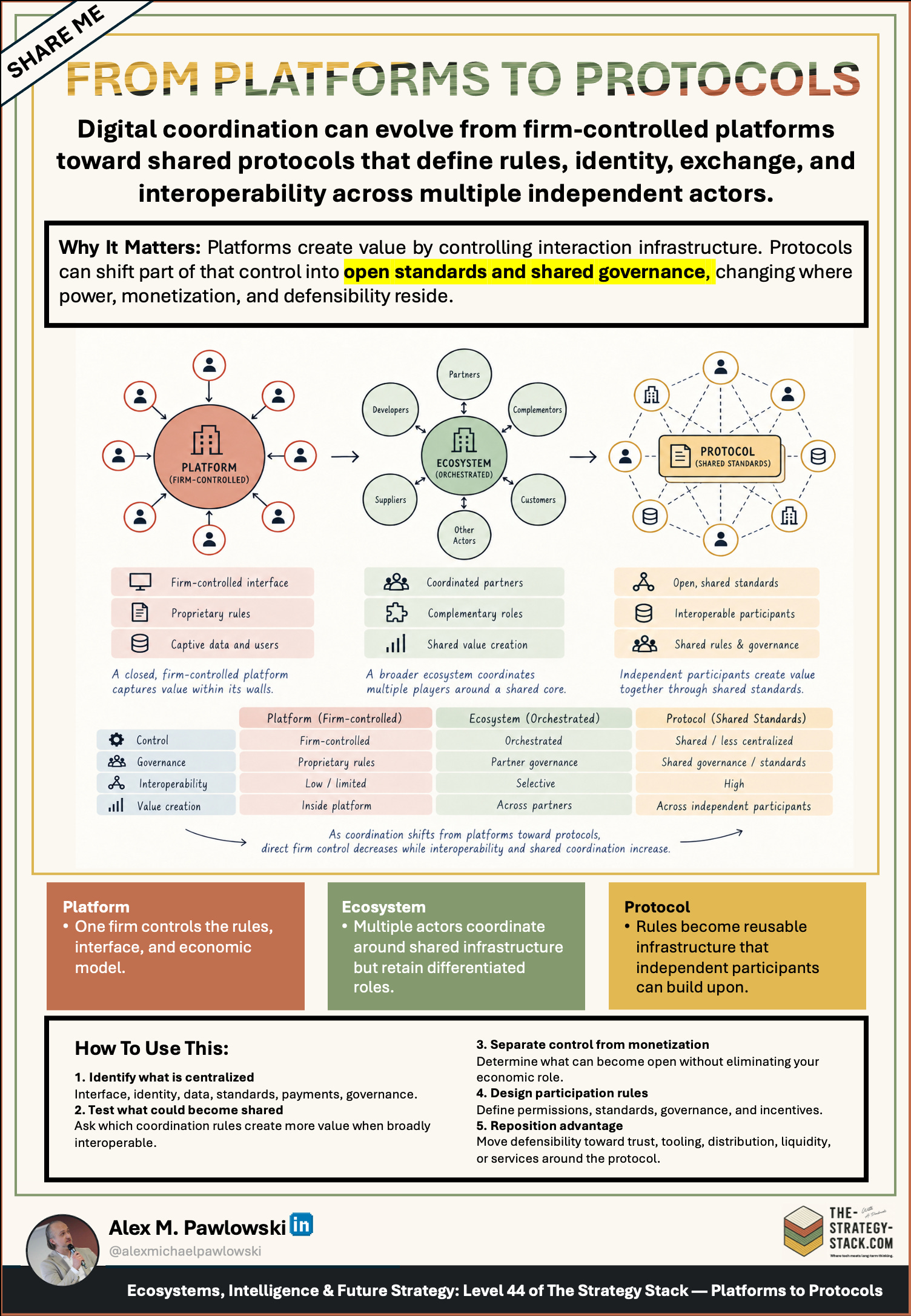
Platforms win by controlling the interface.
Protocols win by becoming infrastructure others depend on - even when they never touch your UI.
The shift from platform to protocol is one of the most misunderstood transitions in digital strategy. It is not about open-sourcing your product or giving up margin. It is about where value concentrates when coordination matters more than control - when AI agents orchestrate across systems, when users express intent instead of navigating dashboards, and when interoperability becomes cheaper than lock-in.
SaaS owned workflow. AI owns coordination. Protocols own the rules of coordination.
The Power Shift: Control vs Infrastructure
Platform logic concentrates power at the center:
-
Own discovery and ranking
-
Own the transaction layer
-
Own participant data
-
Set rules unilaterally
-
Capture margin at the interface
Protocol logic distributes execution while standardizing coordination:
-
Define interoperability standards
-
Enable modular participants to connect
-
Capture value through infrastructure usage, not gatekeeping
-
Evolve governance with ecosystem input
-
Become harder to bypass because everyone builds on the layer
TCP/IP did not own applications - it owned connectivity. Stripe did not own commerce - it owned payment rails. The pattern repeats: abstraction layers capture disproportionate value when complexity moves upstack.
In the AI era, the coordination layer sits above individual SaaS tools - pulling data, interpreting intent, executing across systems. Firms that become that layer - or the protocol beneath it - capture leverage incumbents cannot defend with interface design alone.
From Walled Garden to Protocol Layer
The transition follows recognizable stages:
Stage 1 - Platform maturity
Network effects dense. Governance centralized. Take rates defended. Bypass risk managed through habit and data lock-in.
Stage 2 - Interface pressure
Users want outcomes, not navigation. Agents bypass UI. Multi-homing rises. Feature differentiation collapses toward commodity models.
Stage 3 - Modularity demand
Developers, partners, and enterprises demand APIs, data portability, composable modules. The platform that refuses becomes a bottleneck.
Stage 4 - Protocol emergence
Standards crystallize. Third parties build on shared rails. Governance partially decentralizes. Value migrates from owning transactions to owning coordination rules.
Not every platform should become a protocol. But every platform strategist should know when the shift is coming - and whether to lead it or be disintermediated by it.
Interoperability Economics
Protocols win when three conditions align:
-
Fragmentation on both sides - many suppliers, many consumers, no natural integrator except the protocol layer
-
High coordination cost - without shared standards, every pairwise integration is expensive
-
Compounding network effects on the standard - each new participant makes the protocol more valuable to all others
Protocols lose when:
-
A platform can internalize the full value chain cheaper than coordinating externals
-
Standards fail to achieve critical adoption - fork wars, competing protocols, governance paralysis
-
The protocol captures too little value to fund evolution - becoming a commodity rail
-
Trust requirements exceed what decentralized governance can enforce
The strategic question is not open vs closed. It is where margin lives when the interface dissolves and coordination becomes the product.
Protocol Readiness: How to Test Your Position
1. Map bypass vectors
How do users, agents, or partners achieve outcomes without your interface? Where is intent routed around your control surface?
2. Assess modularity demand
Who wants to build on your infrastructure? What would they need - APIs, data schemas, identity, payment rails, governance participation?
3. Locate your coordination asset
What do participants share through you that they cannot replicate pairwise? Trust, standards, liquidity, identity, compliance, discovery?
4. Stress-test governance evolution
Can rules adapt without breaking participant trust? What would partial decentralization look like - and who would govern?
5. Compare platform vs protocol economics
If interface margin compresses 30%, does coordination-layer margin expand enough to compensate?
Diagnostic questions:
-
Are you defending a UI moat in a market moving toward intent-driven orchestration?
-
Would the ecosystem be stronger if you standardized a layer competitors currently replicate?
-
What happens when agents treat your product as a backend capability - not a destination?
👉 Unlock the Strategy Stack
…and access the Business Model Series, advanced Cheat Sheets, the Operator Vault, and various essays at the intersection of strategy and technology.
In this series →
https://thestrategystack.substack.com/p/ecosystems-intelligence-future-strategy-phase-iv
Read next →
https://thestrategystack.substack.com/p/strategy-stack-os
Go deeper →