Why coordination mechanisms, not asset ownership, determine who captures value in multi-party digital systems
By Alex Pawlowski
Published: 2026-09-13
URL: https://thestrategystack.substack.com/p/orchestration-logic
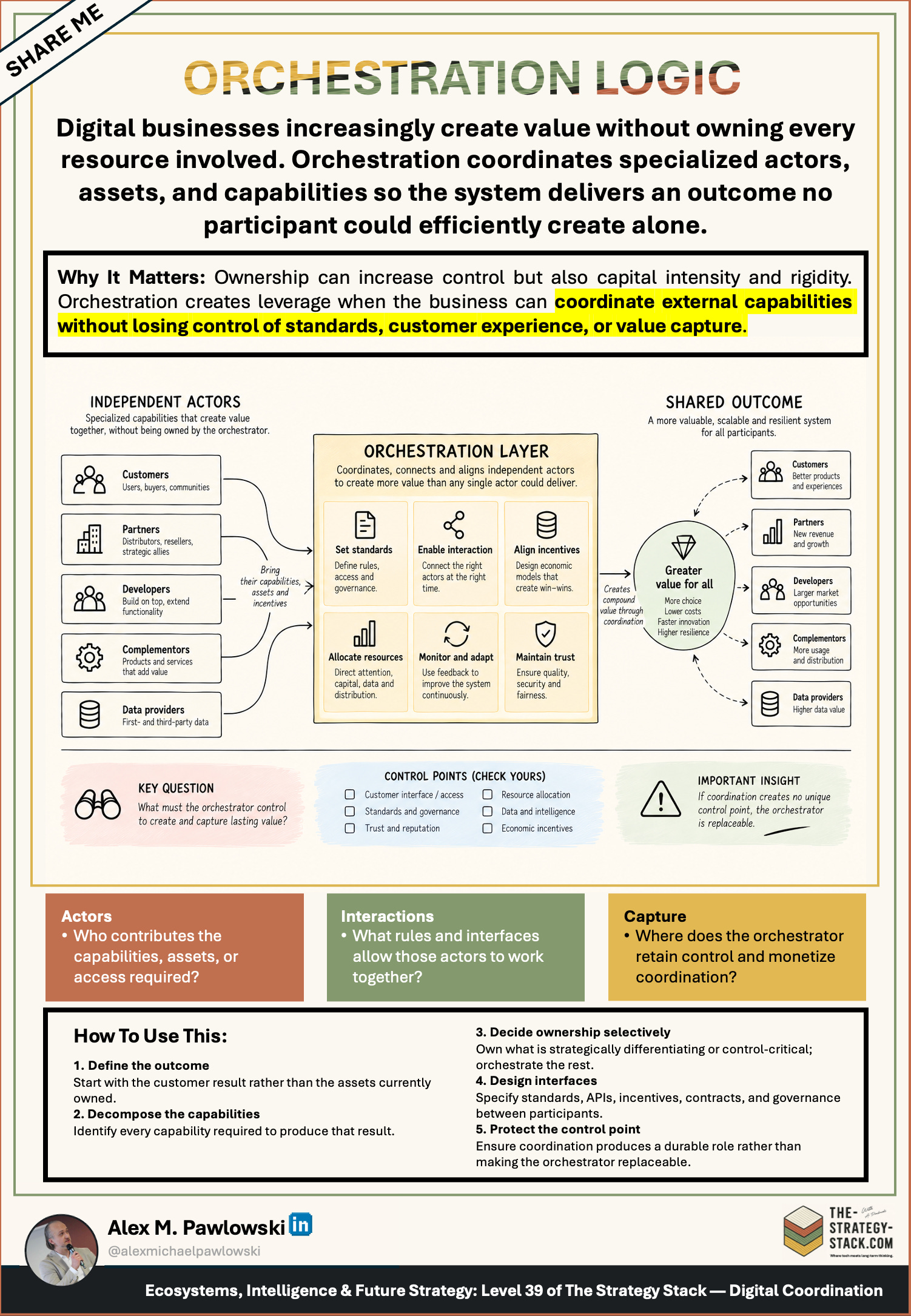
The default corporate instinct is to own the value chain.
Integrate upstream. Acquire the complementor. Build in-house what partners could provide. That instinct made sense when coordination was expensive and vertical integration was the moat.
In digital ecosystems, coordination got cheap - but orchestration got hard. The firms that win often own less than competitors while controlling more of the outcome. They set standards, align incentives, route data, and enforce rules that make independent participants act as one system.
Orchestration logic is the strategic shift from what do we own? to what do we coordinate - and why do others follow our coordination?
Coordination Without Ownership
Orchestration rests on four coordination mechanisms:
Standards - shared language for interaction
APIs, data schemas, certification requirements, interoperability protocols. Standards reduce friction for complementors and users - and anchor dependency on the orchestrator’s definition of compatible.
Incentives - economic alignment across parties
Revenue share, tiered benefits, co-marketing, access to demand, reduced platform fees for quality. Incentives translate orchestration goals into participant behavior without direct employment.
Data protocols - who learns from what
Permissioning, aggregation rules, feedback loops, shared intelligence layers. Orchestrators who control what data flows where often control improvement velocity - even when they do not own the underlying assets.
Governance - predictable rules and evolution
Dispute resolution, quality bars, policy updates, participation requirements. Governance makes coordination durable - participants invest because rules are legible and enforcement is credible.
Ownership is one coordination mechanism - usually the slowest and most capital-intensive. Orchestration asks which of the four can achieve the strategic outcome with the least trapped capital.
The Orchestration Layer
Think of orchestration as a layer above transactions:
Participants transact. The orchestration layer ensures those transactions compose - into better matching, faster innovation, lower trust cost, and compounding data.
Shopify does not own merchant inventory - it orchestrates payments, storefronts, apps, and fulfilment partners into one merchant operating experience.
Visa does not own bank balance sheets - it orchestrates issuers, acquirers, merchants, and standards into global payment acceptance.
Modern AI stacks increasingly orchestrate models, tools, data sources, and agents - the model weights may be commoditized; the orchestration layer determines reliability and outcome quality.
The orchestration layer is where switching costs form in ecosystem businesses - not because you locked data in a silo, but because leaving breaks coordinated workflows others depend on.
Integration vs Orchestration
Integration adds participants by building custom connections - each new partner is a project. Coordination cost rises with headcount. This works at small scale; it breaks at ecosystem scale.
Orchestration adds participants by publishing rules others can plug into - each new partner is a configuration. Coordination cost rises slowly because the layer absorbs complexity.
Salesforce’s shift from SI-dependent implementations toward AppExchange and declarative tooling is orchestration logic applied to enterprise software. AWS’s service catalog follows the same arc - less ownership of customer workloads, more coordination of how workloads compose.
The test: can a qualified outsider create value in your system without a meeting with your engineering team? If not, you are integrating.
Breakdown Signals
Orchestration fails when:
-
Standards are proprietary theater - complementors cannot build without constant manual approval
-
Incentives reward extraction over ecosystem health - top participants churn or fork
-
Data flows one way - participants give intelligence but receive none
-
Governance is opaque or arbitrary - investment in the ecosystem feels like betting on mood
-
Integration masquerades as orchestration - every partner relationship requires custom engineering
The diagnostic: if coordination cost rises linearly with participants, you are integrating, not orchestrating.
Running the Map
1. List what you try to own vs coordinate
Mark every asset, capability, and relationship. Ask which must be owned for strategic reasons - and which is habit.
2. Identify the orchestration bottleneck
Where does the system break if one participant type stops cooperating? That is your leverage point - or your fragility.
3. Design standards before scale
Retroactive standardization after fifty custom integrations is a tax forever. Publish the rules early - even when the ecosystem is small.
4. Close incentive loops
If complementors succeed when the ecosystem succeeds, alignment is structural. If not, orchestration devolves to contracts and coercion.
5. Make governance visible
Participants should predict how rules change. Surprise enforcement destroys the investment orchestration depends on.
Diagnostic questions:
-
What would leave with you if your top three partners exited - standards, data, demand, or just integrations?
-
Can a new participant onboard and create value without a bespoke deal?
-
Is your coordination layer getting stronger with scale - or heavier?
👉 Unlock the Strategy Stack
…and access the Business Model Series, advanced Cheat Sheets, the Operator Vault, and various essays at the intersection of strategy and technology.
In this series →
https://thestrategystack.substack.com/p/ecosystems-intelligence-future-strategy-phase-iv
Read next →
https://thestrategystack.substack.com/p/ecosystem-power-laws
Go deeper →