Value chain vs. value network — how multi-participant businesses create value through exchanges the focal firm coordinates but does not always own
By Alex Pawlowski
Published: 2026-09-03
URL: https://thestrategystack.substack.com/p/value-chains-vs-value-networks
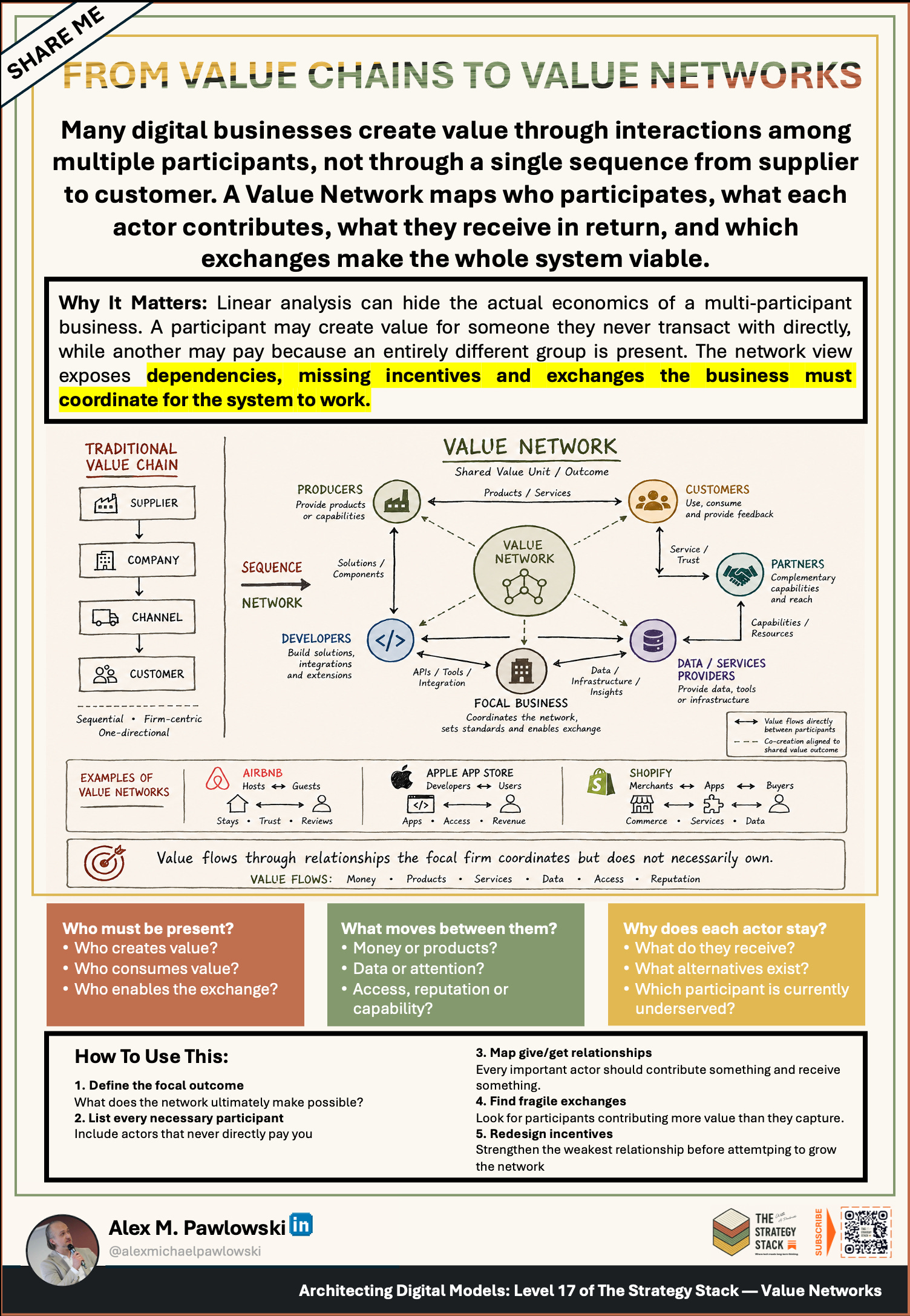
Traditional strategy maps a line:
Supplier → Company → Channel → Customer.
Sequential. Firm-centric. One-directional.
Many digital businesses do not work that way. They create value through interactions among multiple participants — coordinated by a focal business that sets standards and enables exchange, but does not necessarily own every relationship in the network.
Value flows through connections the firm orchestrates. Linear analysis obscures the economics. A value network map exposes them.
The Map
At the center: the focal business — coordinates the network, sets standards, enables exchange.
Surrounding participants typically include:
Producers — products, capabilities, supply
Customers — use, consume, provide feedback
Partners — complementary reach and capabilities
Data / services providers — infrastructure and insights
Developers — integrations, extensions, solutions
What moves between them is not only money and products. Data, access, reputation, trust, and capability flow through the network — often in non-linear paths.
What Linear Analysis Misses
In value networks, participants may create value for someone they never transact with directly.
The App Store mediates discovery, access, trust, and often payment between developers and users — the value exchange is triangulated, not simply “user pays developer.”
A host on Airbnb creates trust and inventory for guests the platform acquires. A Shopify merchant’s catalog, apps, payment providers, logistics partners, and storefront jointly create an experience no single participant produces alone.
If you analyze only your direct customer relationship, you miss:
Dependencies on participants you do not control
Incentive misalignments that stall growth
Exchanges where one side contributes more value than they capture
The diagnostic goal: who must be present, what moves between them, and why each actor stays.
Fragile Exchanges
Networks fail when exchanges are unstable:
-
A participant contributes more than they capture — and leaves
-
Incentives favor short-term extraction over long-term liquidity
-
Standards are unclear — coordination cost exceeds benefit
-
The focal business optimizes take rate while starving the edges
Growth without incentive alignment produces hollow networks.
How to Use This Framework
1. Define the focal outcome
What does the network ultimately make possible?
2. List every necessary participant
Include actors who never pay you directly.
3. Map give/get relationships
Every important actor should contribute something and receive something.
4. Find fragile exchanges
Who is underserved? Who has credible alternatives?
5. Redesign incentives
Strengthen the weakest relationship before scaling the network.
👉 Unlock the Strategy Stack
…and access the Business Model Series, advanced Cheat Sheets, the Operator Vault, and various essays at the intersection of strategy and technology.
In this series →
Read next →
Go deeper → 
Hit subscribe to get it in your inbox. And if this spoke to you:
➡️ Forward this to a strategy peer who’s feeling the same shift. We’re building a smarter, tech-equipped strategy community—one layer at a time.
Let’s stack it up.
A. Pawlowski | The Strategy Stack