Distribution strategy and compounding reach — how to build growth assets that generate repeatable demand without rebuilding from zero each period
By Alex Pawlowski
Published: 2026-09-03
URL: https://thestrategystack.substack.com/p/distribution-leverage
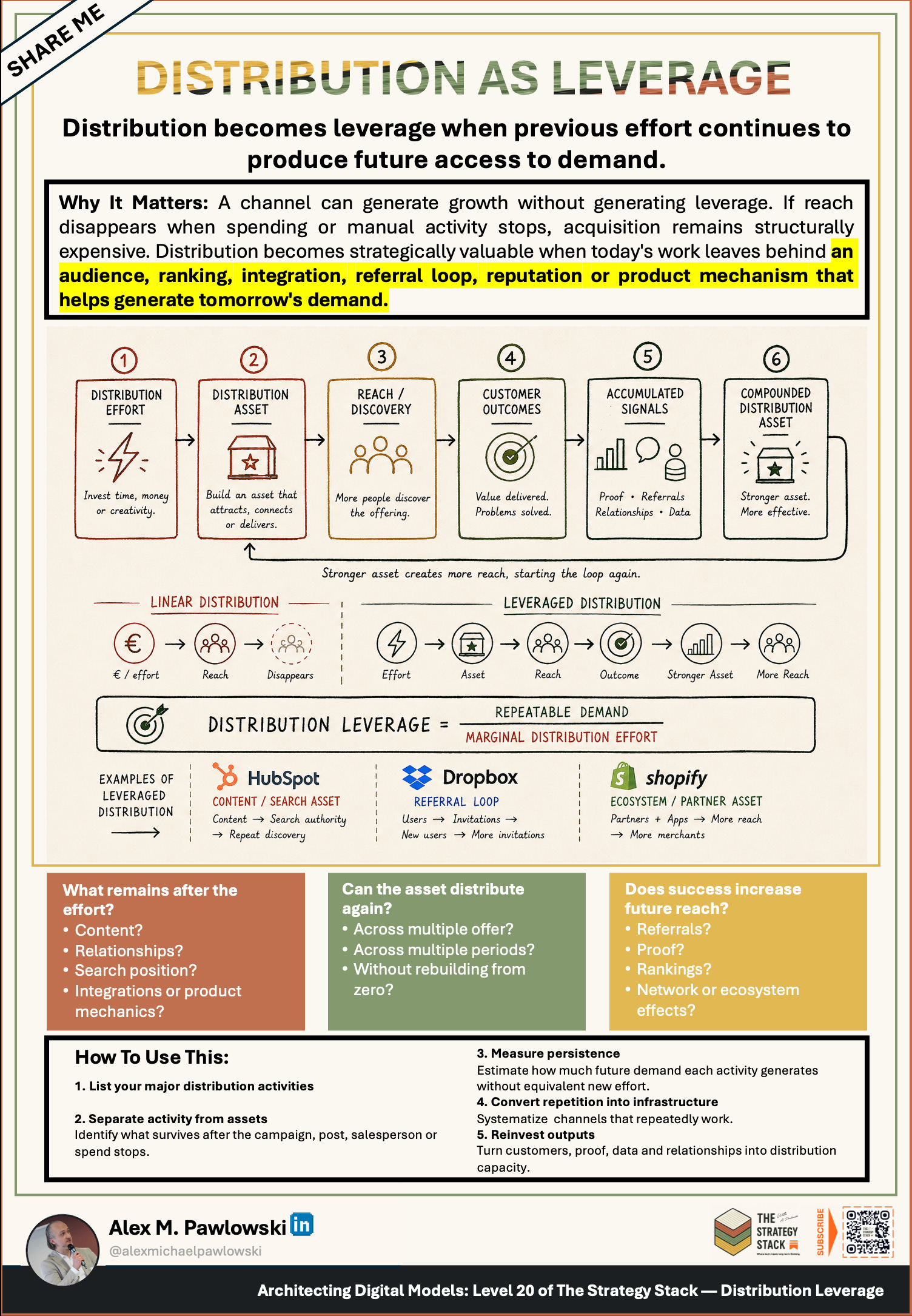
A channel can grow without creating leverage.
If reach disappears when spending stops, you have rented attention — not distribution strategy that compounds.
Distribution leverage exists when previous effort continues to produce future access to demand. Work leaves behind an audience, ranking, integration, referral loop, reputation, or product mechanism that generates tomorrow’s customers with lower marginal effort than yesterday’s.
This framework is about persistence and marginal cost — not channel mix or creative tactics.
The Mechanics
Linear distribution: Effort → Reach → Disappears
Each period starts near zero. Growth requires repeated spend or effort at similar intensity.
Leveraged distribution: Effort → Asset → Reach → Outcome → Stronger Asset → More Reach
The asset survives the campaign. Each cycle can reduce marginal distribution cost.
A useful diagnostic ratio:
Distribution leverage ≈ Repeatable demand / Marginal distribution effort
Estimate both honestly. A channel with high reach but zero persistence scores low on leverage regardless of how impressive the spike looked.
The Compounding Loop
1. Distribution effort — time, money, creativity invested
2. Distribution asset — something that attracts, connects, or delivers
3. Reach / discovery — more people find the offering
4. Customer outcomes — value delivered, problems solved
5. Accumulated signals — proof, referrals, relationships, data
6. Compounded asset — stronger for the next cycle
HubSpot: content → search authority → repeat discovery without rebuying the same campaign
Pinterest: saved pins → ranking / recommendation surfaces → ongoing discovery from prior saves
Slack: shared workspace invites → team adoption → more invites from inside the product
Each pattern leaves something behind that distributes again. Persistence is the test — not the channel name.
What Decays
Teams celebrate channel growth while ignoring asset decay:
-
Paid media that stops when budget stops
-
Influencer spikes with no retained audience
-
Launch PR with no searchable residue
-
Product virality without a mechanism that repeats
The diagnostic: What remains after the effort ends — and can it distribute again across offers and time periods?
How to Use This Framework
- List major distribution activities — everything that creates demand today.
- Separate activity from assets — what survives when the campaign or spend stops?
- Measure persistence — estimate future demand generated without equivalent new effort.
- Convert repetition into infrastructure — systematize what works repeatedly.
- Reinvest outputs — turn customers, data, and relationships back into distribution capacity.
👉 Unlock the Strategy Stack
…and access the Business Model Series, advanced Cheat Sheets, the Operator Vault, and various essays at the intersection of strategy and technology.
In this series →
Read next →
Go deeper → 
Hit subscribe to get it in your inbox. And if this spoke to you:
➡️ Forward this to a strategy peer who’s feeling the same shift. We’re building a smarter, tech-equipped strategy community—one layer at a time.
Let’s stack it up.
A. Pawlowski | The Strategy Stack