#159: The Economics of AI Are Taking Shape.
By Alex Pawlowski
Published: 2026-07-14

If you’ve followed AI closely over the past years, you may have noticed something similar to what I’ve been feeling.
The excitement hasn’t disappeared.
It’s become more demanding.
Every breakthrough immediately raises another question. Not Can it do this? but What does it cost? Who deploys it? Who owns the infrastructure? Where does the value actually end up?
I found myself asking those questions repeatedly while reading this week’s developments.
They don’t replace the conversation about intelligence.
They build on it.
Because the more capable AI becomes, the more attention shifts toward the systems, organizations, and investments required to make that capability matter.
OpenAI – GPT-5.6: Frontier intelligence that scales with your ambition (official announcement)

What happened?
OpenAI officially introduced GPT-5.6, its latest frontier model, expanding its flagship family with improvements in reasoning, coding, multimodal understanding, and enterprise deployment. Beyond raw capability gains, the release emphasizes flexibility through multiple model variants designed to balance performance, latency, and cost across different use cases. The launch follows an increasingly cautious rollout process as frontier AI systems receive greater scrutiny from governments and enterprise customers alike.
Why it matters
Every major model release raises the performance ceiling a little higher.
What is becoming more interesting, however, is how quickly frontier capability is becoming an expectation rather than a differentiator.
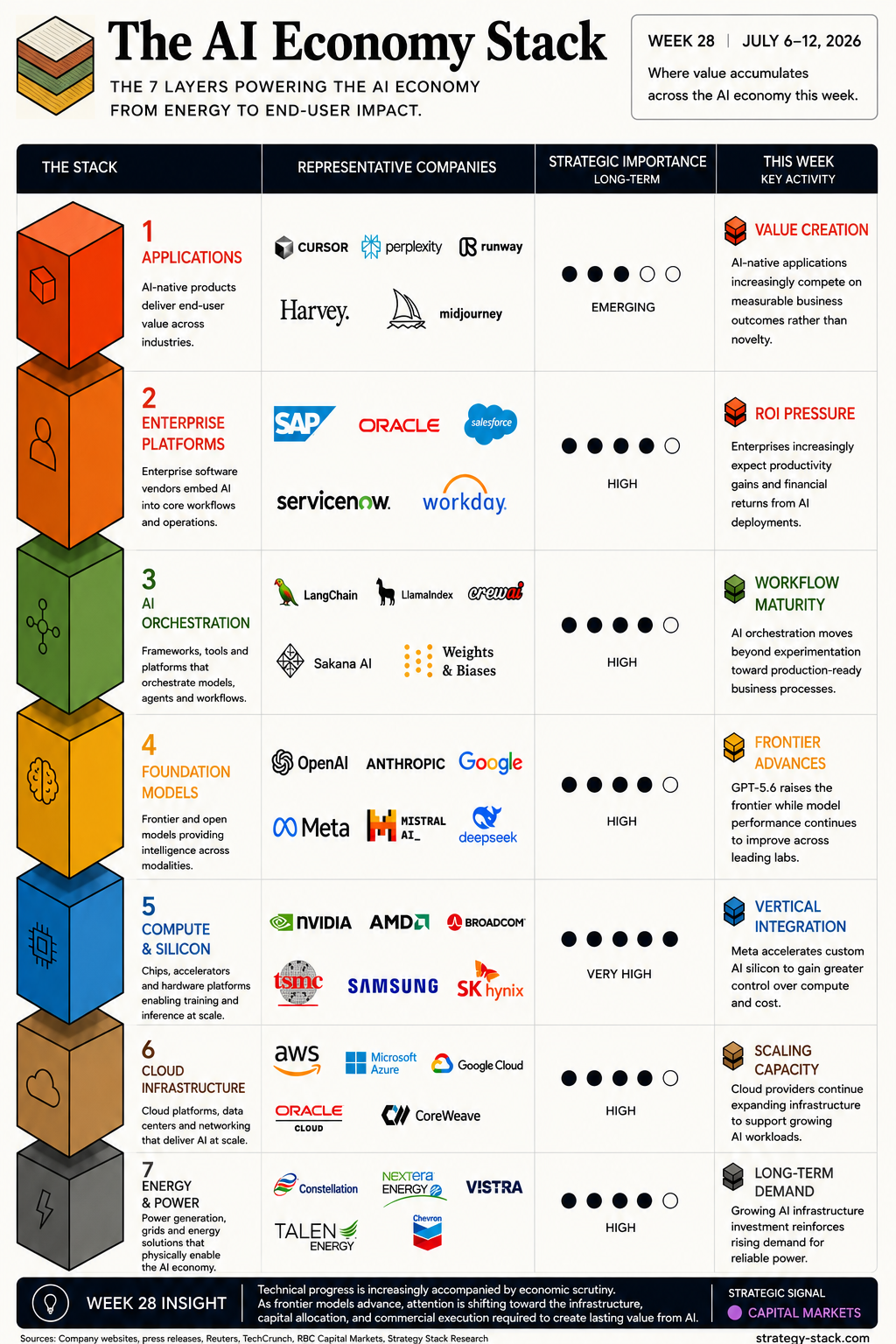
Reasoning, coding, multimodal interaction, and tool use are rapidly becoming standard features across leading AI labs. As technical performance begins to converge, competition naturally shifts elsewhere—to infrastructure, developer ecosystems, enterprise integration, governance, and distribution.
The question is gradually changing from “Who has the smartest model?” to “Who makes intelligence easiest to deploy?”
That is a much harder competitive problem.
Strategic takeaway
Frontier models remain essential, but sustainable competitive advantage is increasingly built around the ecosystem that surrounds them rather than the model itself.
Meta could start production of Iris AI chip in September

What happened?
Meta is preparing to begin production of its first large-scale in-house AI training chip, codenamed Iris, as early as September. Developed with Broadcom and manufactured by TSMC, the chip forms part of Meta's broader strategy to reduce dependence on external suppliers while significantly expanding its AI computing capacity over the coming years.
Why it matters
For years, AI competition focused primarily on software.
Meta is making a different bet.
Owning more of the hardware stack changes the economics of AI. Custom silicon reduces infrastructure costs, improves efficiency, and gives companies greater control over one of the industry’s most constrained resources: compute.
This reflects a broader shift across the industry.
The companies shaping the next phase of AI are no longer investing only in better models. They are investing in the physical infrastructure required to train, deploy, and continuously improve them.
Infrastructure is becoming strategy.
Strategic takeaway
The next generation of AI leaders will likely own more of their technology stack—from chips and data centers to models and applications—creating advantages that competitors cannot easily replicate.
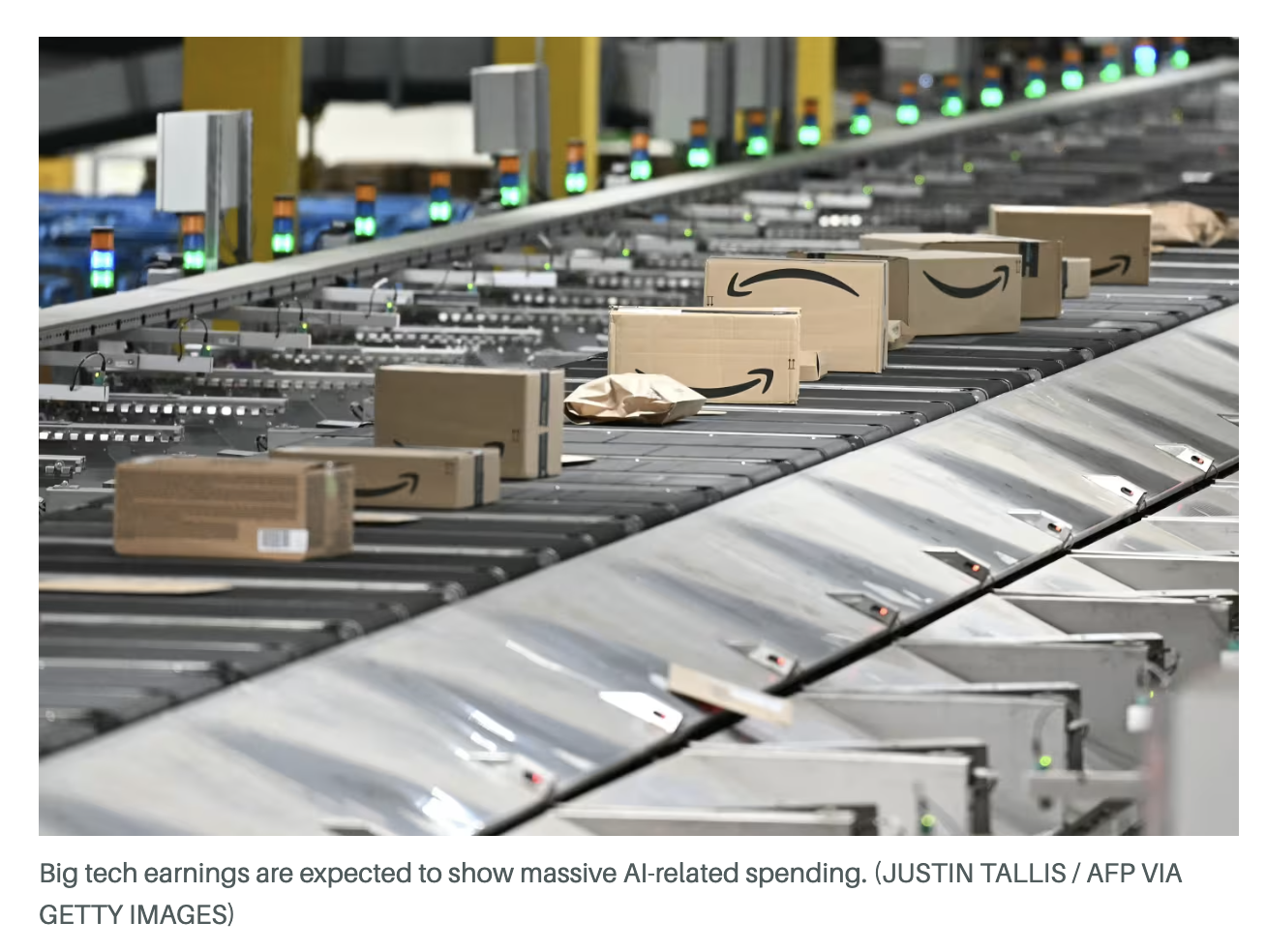
Big Tech Is Pouring Billions Into AI, and the Stock Market Wants to See the Payoff—Now
What happened?
As the next earnings season approaches, investors are increasingly focused on one question: when will unprecedented AI investment begin translating into measurable financial returns? Alphabet, Microsoft, Amazon, and Meta continue committing hundreds of billions of dollars to AI infrastructure, yet markets are beginning to look beyond spending announcements and toward tangible evidence of productivity gains, revenue growth, and profitability.
Why it matters
For the past two years, AI spending itself was treated as a positive signal.
That phase is ending.
Capital markets are beginning to distinguish between companies that are building AI capabilities and those that can convert those capabilities into economic value.
This is a familiar transition.
New technologies often attract investment long before sustainable business models emerge. Eventually, attention shifts from potential to execution.
AI appears to be reaching that point.
The next competitive race may not be about spending the most, but about proving that intelligence can improve margins, accelerate growth, and create durable competitive advantage.
Strategic takeaway
The defining metric of the next AI cycle will be return on intelligence—not simply return on investment.
Looking Ahead
For much of the past three years, the conversation around AI has been dominated by one question: How capable can the models become?
That question is far from settled. Frontier labs will continue pushing the limits of reasoning, multimodality, and autonomy.
But another question is steadily moving to the foreground.
Who can turn those capabilities into durable economic advantage?
This week’s stories offer three different perspectives. OpenAI continues expanding the frontier of intelligence. Meta is investing in the infrastructure required to support it. Investors, meanwhile, are becoming increasingly interested in what all of that spending ultimately produces.
One pattern stands out.
The discussion is becoming increasingly economic. Technical capability still commands attention, but it now sits alongside questions of capital allocation, infrastructure ownership, organizational execution, and measurable returns.
As earnings season unfolds, watch where companies spend their time. Are they talking about better models, larger deployments, lower costs, higher productivity, or new revenue? The answers will reveal just as much about the direction of the industry as the next benchmark or leaderboard.
Quote of the Week
"The cost of intelligence is falling. The cost of deploying it effectively is not."
— Satya Nadella, Microsoft CEO (July 2026)
Further Reading
📄 Report
Ropes & Gray — Artificial Intelligence Q1 2026 Global Report
Why read it?
One of the best strategic overviews published this year. Rather than focusing on model benchmarks, it examines where capital is flowing, how AI infrastructure is evolving, why hyperscalers continue accelerating CapEx, and what is driving enterprise AI adoption.
Why it matters: This week's edition argues that AI competition increasingly depends on infrastructure, commercialization, and execution. The report provides quantitative evidence behind exactly those shifts—from the estimated $2.9 trillion AI infrastructure buildout through 2028 to the growing concentration of AI investment and enterprise operationalization.
📘 Book
Kai-Fu Lee — AI 2041: Ten Visions for Our Future (2026 Edition)
Rather than focusing on benchmarks or individual models, Lee explores how increasingly capable AI systems reshape industries, business models, and competitive dynamics. It provides a useful long-term perspective on why infrastructure investment and commercialization are becoming central themes across the AI economy.
📊 Analysis
AI Adoption in S&P 500 Firms (July 2026)
A newly published empirical study examining how deeply AI has actually been integrated into America’s largest companies. Instead of measuring AI hype, the authors distinguish genuine operational adoption from experimentation using SEC filings and other enterprise indicators.
It offers an excellent complement to this week’s discussion of AI investment by asking a different question: how much of that investment has translated into real organizational transformation?

Hit subscribe to get it in your inbox. And if this spoke to you:
➡️ Forward this to a strategy peer who’s feeling the same shift. We’re building a smarter, tech-equipped strategy community—one layer at a time.
Let’s stack it up.
A. Pawlowski | The Strategy Stack