#158: The AI race is becoming an ecosystem race.
By Alex Pawlowski
Published: 2026-07-05
URL: https://thestrategystack.substack.com/p/this-week-in-ai-002-july-5-2026
Last week, I argued that the AI race was becoming more regional.
Export restrictions, enterprise adoption, and infrastructure investment all pointed toward the same underlying shift: AI advantage is no longer determined by model capability alone.
That matters because intelligence is not useful in isolation.
A powerful model only becomes economically valuable when organizations can access it, trust it, integrate it, govern it, and run it at scale. Once that happens, competition naturally moves beyond the model itself and into the systems surrounding it: infrastructure, regulation, distribution, talent, energy, capital, and organizational design.
This week, that pattern became even clearer.
Governments are beginning to shape who can access frontier AI. Companies are discovering that deploying AI requires internal restructuring, not just better tools. And nations continue investing billions into the semiconductor and infrastructure base required to sustain the next phase of AI development.
Taken individually, these stories seem unrelated.
Taken together, they suggest something more important.
The AI race is no longer just a technology race.
It is becoming an ecosystem race.
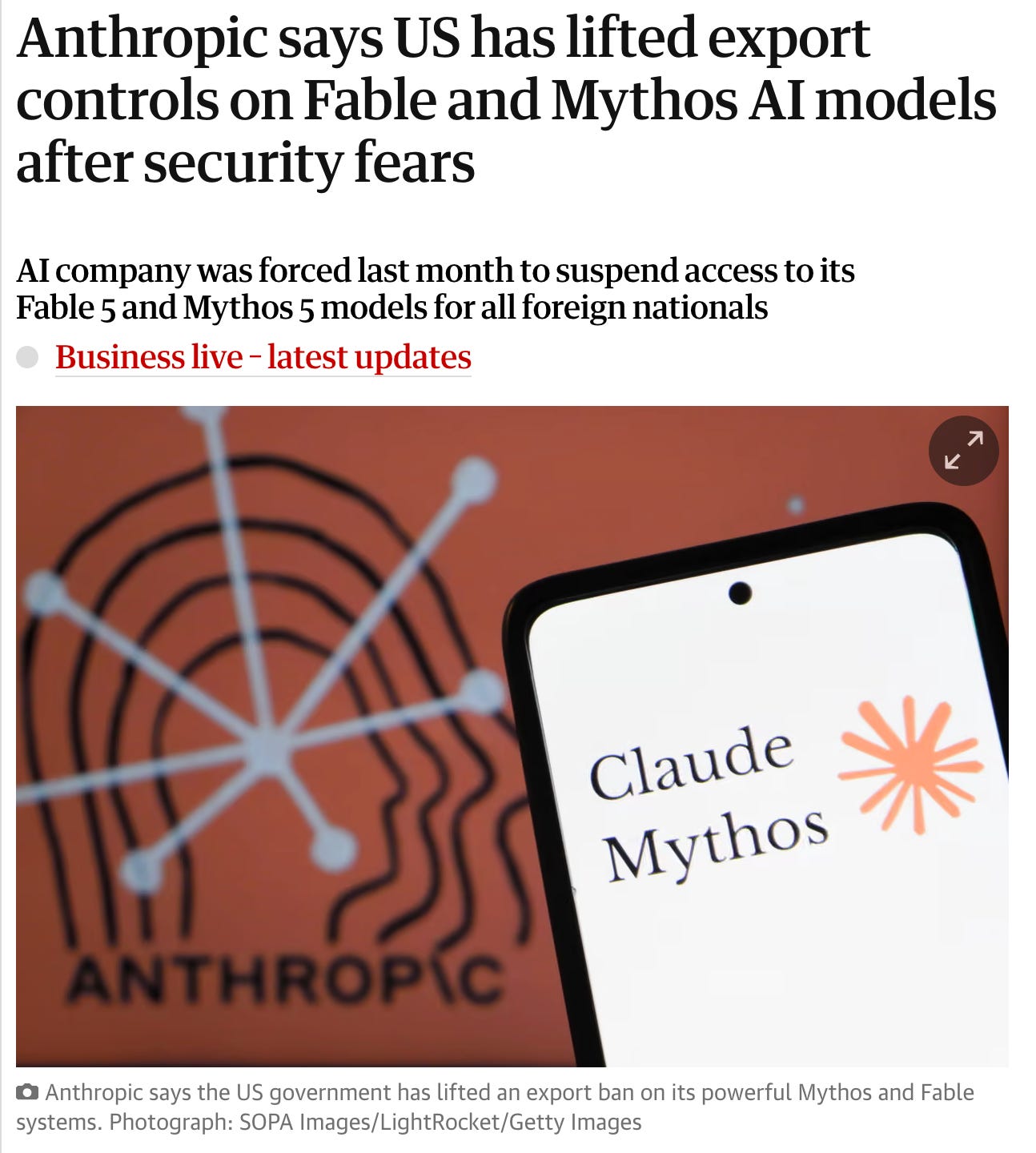
U.S. removes curbs on Anthropic’s latest Fable and Mythos AI models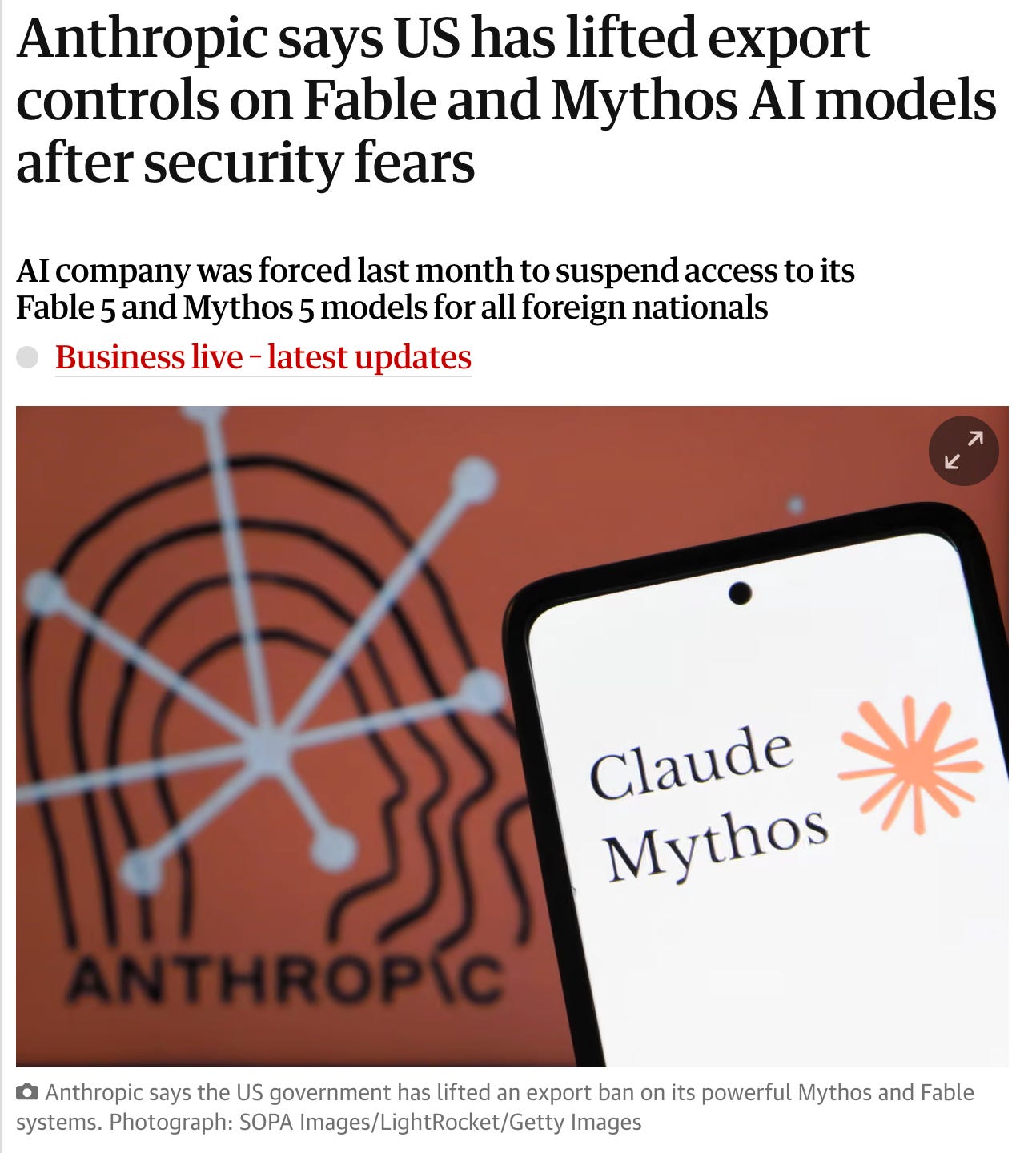
What happened?
Less than three weeks after ordering Anthropic to restrict access to its most advanced AI models, the U.S. Commerce Department lifted export controls on Fable and Mythos.
The original restriction was imposed over national security concerns, particularly around the potential misuse of advanced models for cybersecurity-related tasks. Anthropic had temporarily disabled access to the models after the order, while working with the U.S. government on additional safeguards.
The reversal does not mean the concern disappeared. It means the government accepted a new control layer: stronger detection, narrower access rules, and closer cooperation between frontier AI labs and state institutions.
Why it matters
This story is not really about one model being switched off and then switched back on.
It is about governments becoming part of the AI access layer.
For most of the software era, access was primarily a commercial decision. A company built a product, sold it globally, and customers decided whether to use it. Frontier AI is beginning to break that logic because the product is not only software. It is a general-purpose capability that can be applied to cybersecurity, science, intelligence, automation, and potentially military use.
That creates a new problem: the more powerful the model, the less it behaves like a normal product.
If a model can meaningfully expand offensive cyber capabilities, accelerate vulnerability discovery, or support critical infrastructure defense, then access becomes a strategic question. Who gets to use the model? Under which conditions? With which safeguards? And who decides?
That is the second-order effect: frontier AI companies may remain private businesses, but their most powerful systems are increasingly being treated like strategic infrastructure.
Strategic takeaway
Organizations should prepare for a world where access to frontier AI is shaped not only by vendor contracts, but also by government policy, national security concerns, and trust-based access regimes.
Meta’s AI agent progress is slower than expected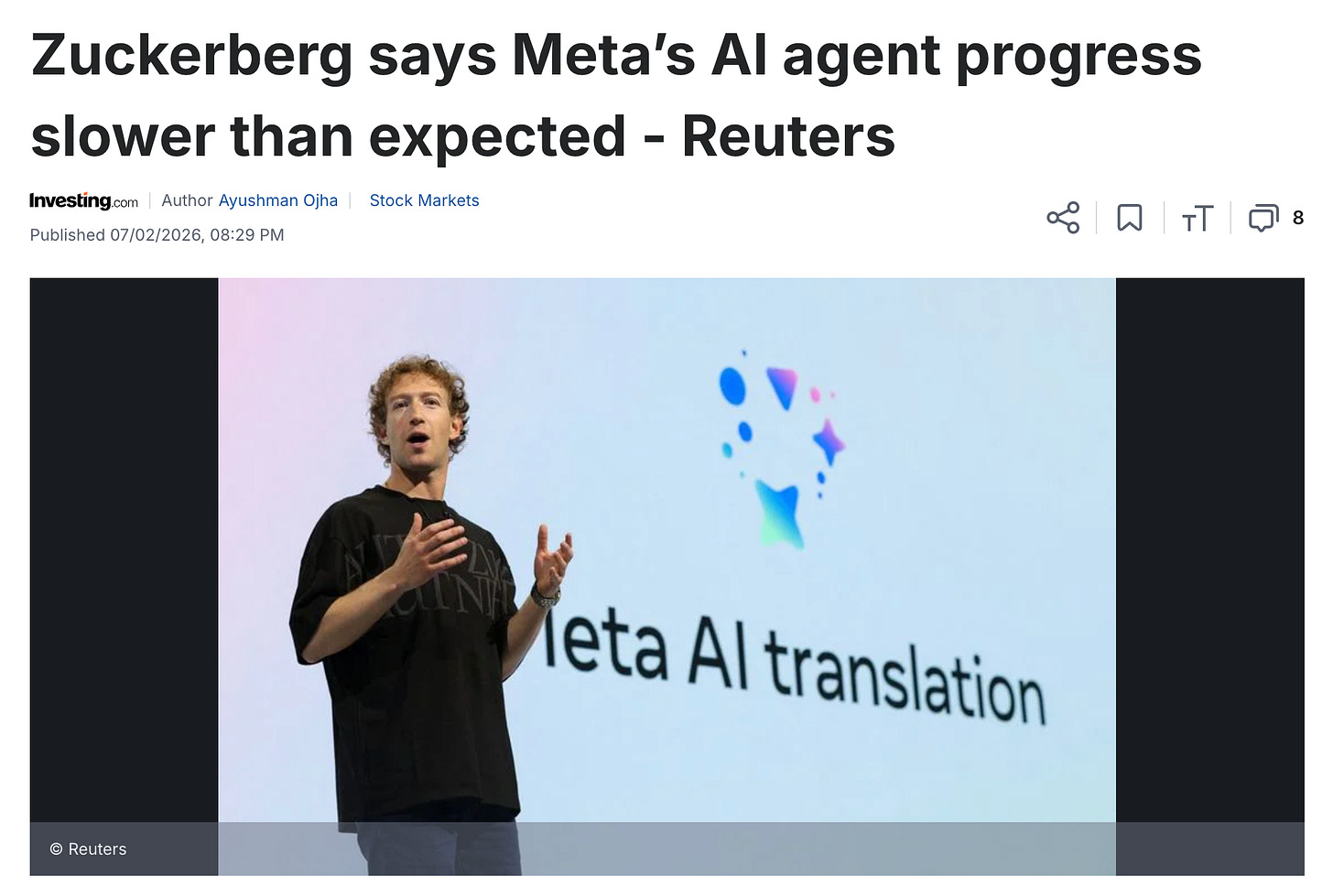
What happened?
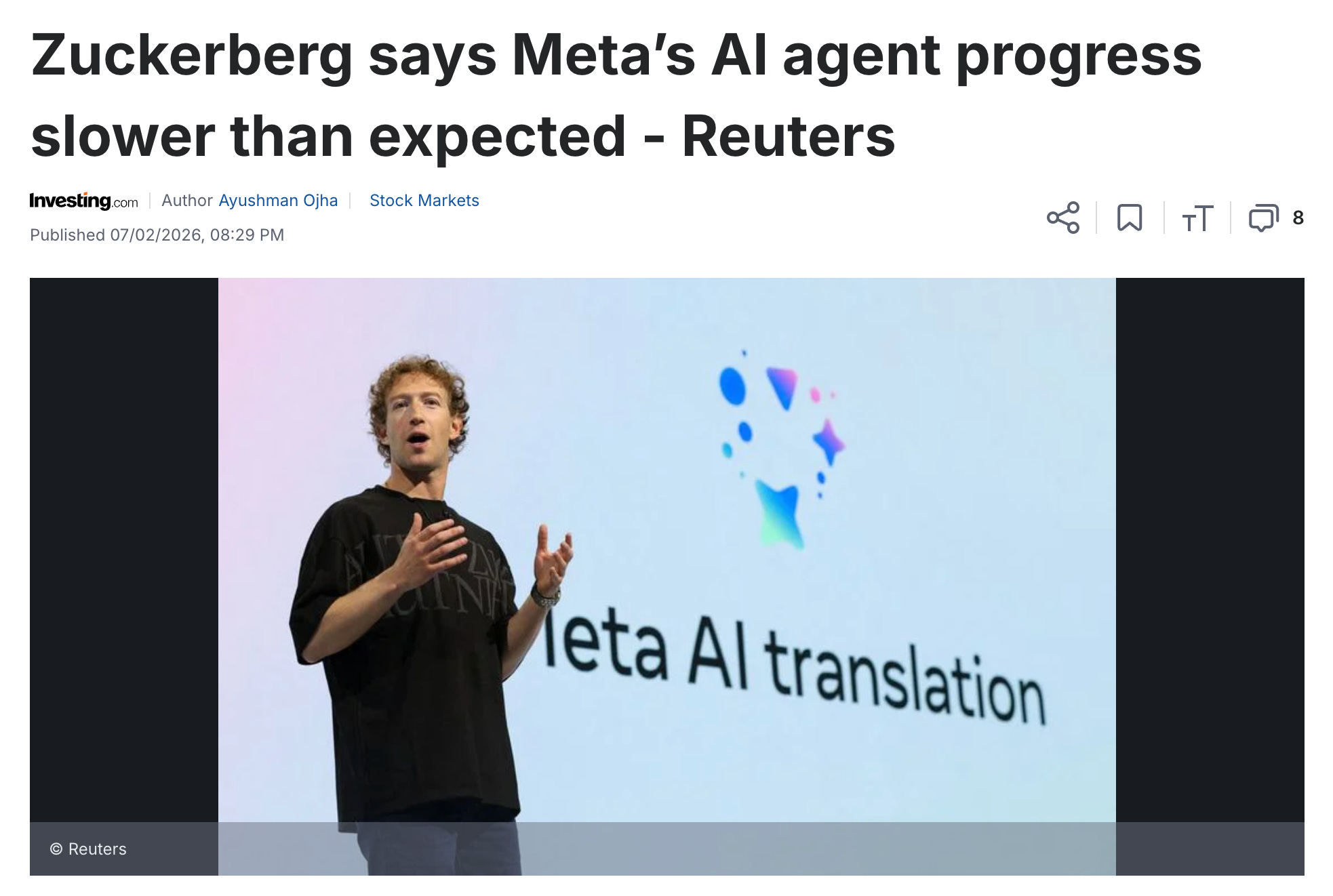
Reuters reported that Mark Zuckerberg told Meta employees that the company’s AI agent development has progressed more slowly than expected.
This comes after a major internal restructuring designed to accelerate Meta’s AI efforts. The company has reassigned thousands of employees toward AI initiatives, cut parts of the workforce, and committed enormous capital to AI infrastructure. Meta is expected to spend up to $145 billion on AI infrastructure this year.
The important point is not that Meta is “behind.”
The important point is that one of the world’s largest technology companies is discovering that reorganizing around AI is harder than announcing an AI strategy.
Why it matters
For the past two years, much of the AI discussion has focused on model capability.
Can the model reason better? Can it code better? Can it use tools? Can it act as an agent?
But once AI moves from demo to deployment, a different constraint appears: the organization itself.
Agents are not just smarter chatbots. If they are supposed to perform work, coordinate tasks, interact with systems, and deliver business outcomes, they collide with the deepest parts of the company: workflows, permissions, data quality, accountability, incentives, compliance, and management structures.
That is why this story matters.
Meta has capital, talent, distribution, infrastructure, and leadership attention. If even Meta finds agent development and organizational transformation slower than expected, the lesson for every other company is obvious: AI transformation is not primarily a tooling problem.
It is an operating model problem.
The second-order effect is that companies may underestimate the internal redesign required to make AI useful. Buying access to models is easy. Changing how work actually happens is much harder.
Strategic takeaway
Companies should stop treating AI agents as standalone tools and start treating them as organizational roles that require redesigned workflows, governance, accountability, and operating models.
South Korea launches massive AI chip and data center investment drive

What happened?
South Korea announced one of the largest AI infrastructure investment drives yet, with Samsung Electronics and SK Hynix committing hundreds of billions of dollars to expand the country’s semiconductor manufacturing base.
The plan includes new chip fabrication sites, AI memory capacity, semiconductor clusters, and major investment in AI data centers. Reuters reported that South Korea is aiming to invest 550 trillion won in AI data centers by 2029 and more than 1,000 trillion won by 2035.
This is not just another semiconductor expansion.
It is a national AI infrastructure strategy.
Why it matters
AI does not scale in the abstract.
It scales through chips, memory, energy, data centers, packaging, cooling, talent, and supply chains. Every frontier model, every enterprise deployment, and every agentic workflow ultimately depends on a physical industrial base.
South Korea understands this because it already sits at one of the most important points in the AI value chain: memory.
Models need compute, but compute increasingly depends on high-performance memory. As AI systems become larger, faster, and more widely deployed, memory bottlenecks become strategic bottlenecks. That makes companies like Samsung and SK Hynix critical not only to the semiconductor industry, but to the AI economy itself.
The second-order effect is that AI competition is moving from labs into national industrial systems.
Countries are no longer asking only: “Can we build AI companies?”
They are asking: “Can we build the infrastructure that AI companies depend on?”
That is a much deeper form of competition.
Strategic takeaway
The next phase of AI leadership will depend on national and regional ecosystems that can combine models, compute, memory, energy, data centers, and industrial policy into a coherent infrastructure base.
Looking Ahead
The AI race is becoming an ecosystem race.
Last week, the key pattern was fragmentation: model access became uncertain, regional alternatives emerged, and infrastructure costs moved to the center of the AI debate.
This week, the pattern moved one layer deeper.
The U.S. government’s reversal on Anthropic shows that frontier AI access is now being actively managed. Meta’s internal struggles show that even the most powerful technology companies cannot simply “install” AI into the organization. South Korea’s investment drive shows that countries are treating chips, memory, and data centers as the foundation of national AI power.
The common thread is that AI advantage is becoming institutional.
It depends on governments, companies, capital markets, infrastructure providers, semiconductor manufacturers, cloud platforms, and organizational redesign all moving in the same direction.
That has an important implication.
The winners of the next phase may not be the companies with the single best model. They may be the organizations and countries that build the strongest ecosystem around intelligence.
Over the coming months, watch less for isolated model launches and more for signs of ecosystem formation: government access regimes, national infrastructure strategies, corporate AI restructurings, sovereign compute initiatives, and enterprise platforms that turn AI from capability into operating system.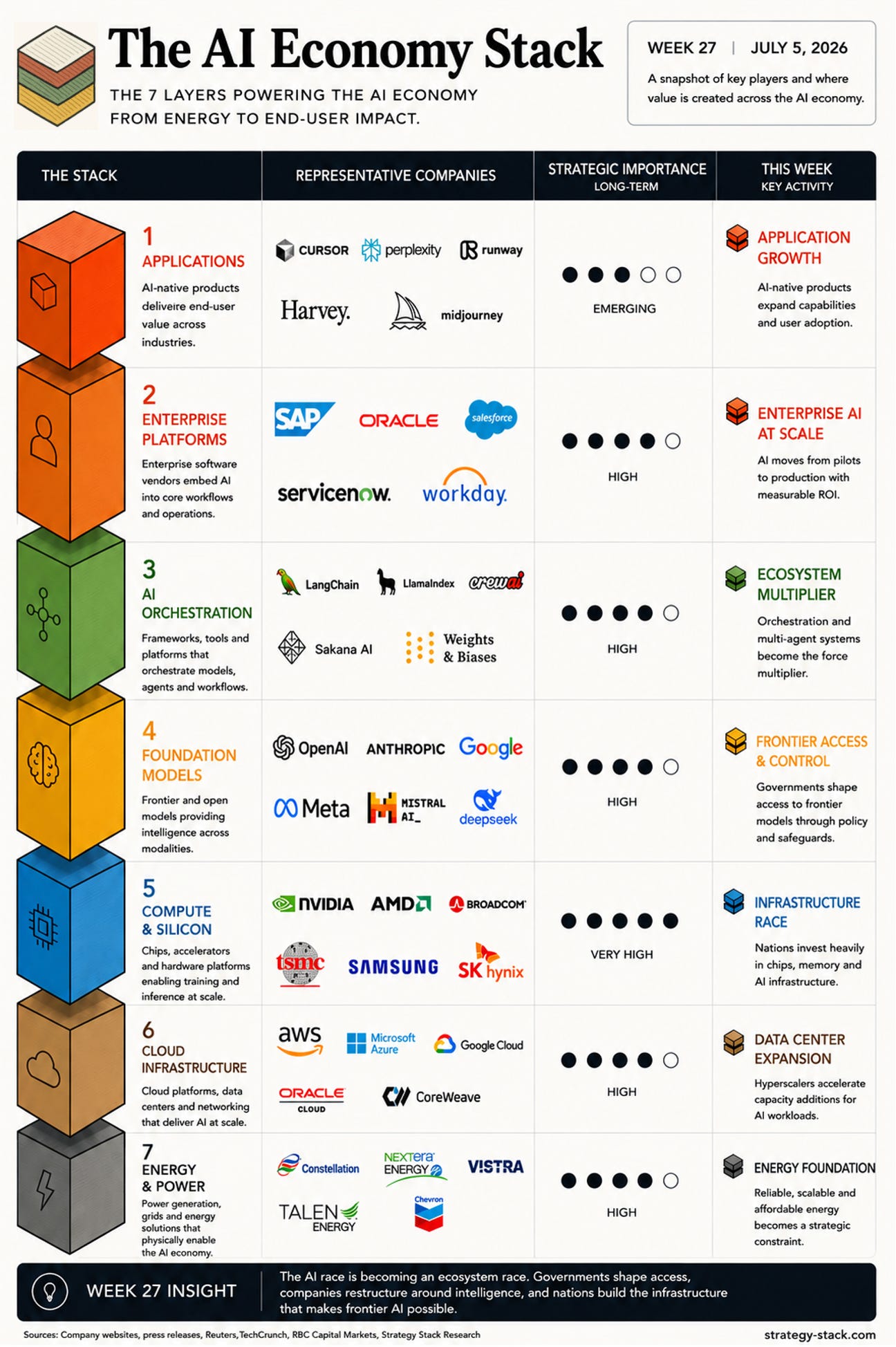
Quote of the Week
“The trajectory of the agentic development over at least the last four months hasn’t really accelerated in the way that we expected.”
— Mark Zuckerberg, CEO, Meta
Further Reading
📄 Report
United Nations – Independent International Scientific Panel on Artificial Intelligence (Preliminary Report, July 2026)
Why read it?
This week’s edition argues that AI competition is evolving from a race between models into a race between ecosystems.
The UN’s first independent scientific assessment arrives at a remarkably similar conclusion from a governance perspective. It argues that AI capabilities are advancing faster than both scientific understanding and governments’ ability to respond, while highlighting the growing importance of agentic systems, compute infrastructure, energy constraints, and international coordination.
Why it matters: If this week’s stories explain how governments, companies, and nations are reorganizing around AI, this report explains why those institutional changes are becoming necessary.
📘 Book
Reid Hoffman & Greg Beato — Superagency: What Could Possibly Go Right with Our AI Future (2025)
Rather than focusing on AI replacing humans, Hoffman explores how individuals, organizations, and societies can expand their capabilities by learning to work alongside increasingly autonomous AI systems.
It provides a useful long-term perspective on many of the organizational and ecosystem shifts highlighted throughout this week’s edition.
📊 Analysis
Stanford University — AI Index Report 2026
The AI Index remains one of the most comprehensive annual overviews of the global AI landscape, covering frontier models, investment, research, infrastructure, enterprise adoption, talent, and public policy.
This year’s report provides valuable context for understanding why governments are treating AI as strategic infrastructure and why competition is increasingly shifting from individual companies toward entire national ecosystems.

Hit subscribe to get it in your inbox. And if this spoke to you:
➡️ Forward this to a strategy peer who’s feeling the same shift. We’re building a smarter, tech-equipped strategy community—one layer at a time.
Let’s stack it up.
A. Pawlowski | The Strategy Stack