AI can fill the internet with content that means nothing, faster than anyone can watch it. That is brainrot. Stop swallowing it, and stop making it.
By Dr Sam Illingworth
Published: 2026-07-10
URL: https://theslowai.substack.com/p/you-are-making-ai-brainrot
Brainrot is a product. Someone designed the feed, funded the feed, and watched a dashboard to see how long it held you.
In this post I will:
- Say what brainrot and AI slop actually are, and what they are not.
- Show you what happened when a company built a feed of pure slop and put real money behind it.
- Give you five ways to spot brainrot, refuse it, and stop making it yourself.
You probably already use the word, or your kids do. It came out of internet culture, ironic and knowing, a name for the absurd content we half-love even as we feel it soften our attention. Oxford made it Word of the Year in 2024, with usage up 230% in a year.
The machine has changed what the word points to. There used to be a limit on how much thin content the world could produce, because a person had to make it. That limit is gone. The stuff is now generated as fast as you can swallow it, by something that never tires and never runs out.
What AI slop actually is
When people complain about AI writing, they point at the surface. The balanced sentence. The rule of three. The em dash. None of those is the problem. They are good techniques, and writers have used them for centuries because they land. The machine copies them for exactly the same reason.
Slop lives underneath the technique. It is content with no agency, no depth, and no purpose. Nobody needed to say it. Nobody chose it. It was made because making it was possible, to fill a slot and feed a feed. A sentence can be perfectly built and still be slop, if nothing in it was meant.
Slop is older than AI, and so is brainrot. Slop is the broad thing: filler with no reason to exist, from junk mail to content farms to the fifth near-identical listicle. It has been with us for as long as there has been a slot to fill. Brainrot is one kind of slop, the kind that rots your attention as you scroll, and it predates the machine too. Daytime filler on TV and doomscrolling on social media were doing that job long before a model could.
AI’s contribution was scale. It removed the one thing that used to hold slop back, the effort of a human making it, and the supply exploded. AI slop is slop at a volume no human-driven content farm could reach. AI brainrot is that volume aimed at your attention.
So the question to hold against anything the machine makes, and anything you make with it, is simple.
Did this need to exist at all?
That is the loop we are sliding into. Content that exists only to exist, made by a machine to fill a feed, consumed by people who scroll only to scroll. We are close to becoming vessels for the machines, which serve the algorithms, which serve the companies that need us scrolling. Brainrot is what fills the loop.
If this names something you have felt in your own feed, send it to one person who would get it.
The three marks of AI slop
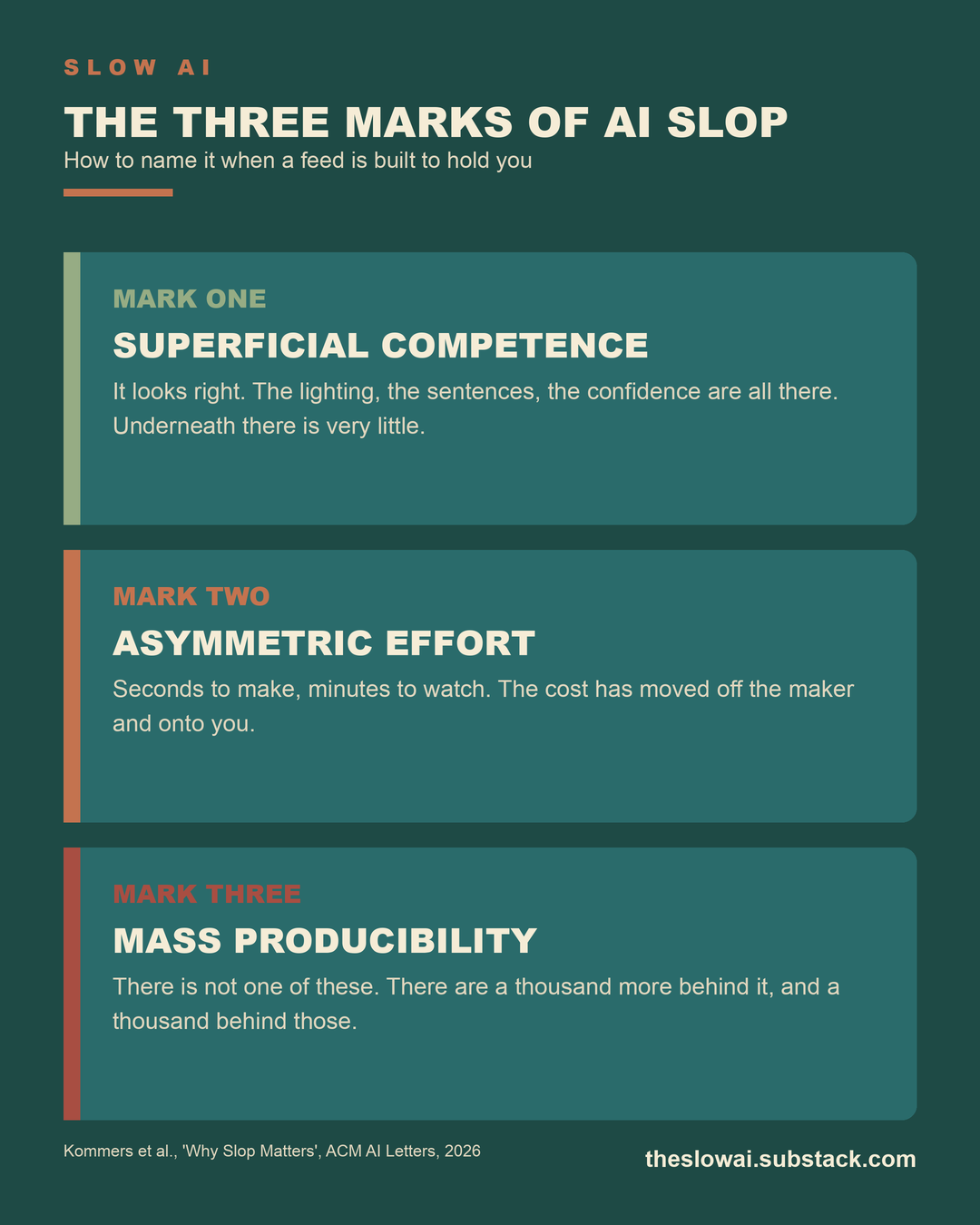
Slop has three marks. I take them from a paper published earlier this year ‘Why Slop Matters’:
- Superficial competence. It looks right. The lighting is good, the sentences scan, the voice is confident. Underneath there is very little.
- Asymmetric effort. It took seconds to make and it takes minutes to watch. The cost has moved off the maker and onto you.
- Mass producibility. There is not one of these. There are a thousand more behind it, and a thousand behind those.
The researchers from this paper make a real case that slop has a function. People want more content than human beings can make, slop is the supply-side answer, and some of it has a rough charm. The trouble is the third mark, and what gets built to exploit it.
A feed built on purpose
In late 2025, OpenAI launched Sora as a standalone app: a feed of AI-generated video you could scroll like any other. Meta shipped its own, Vibes, at around the same time. These were products, staffed and funded, with a feed at the centre.
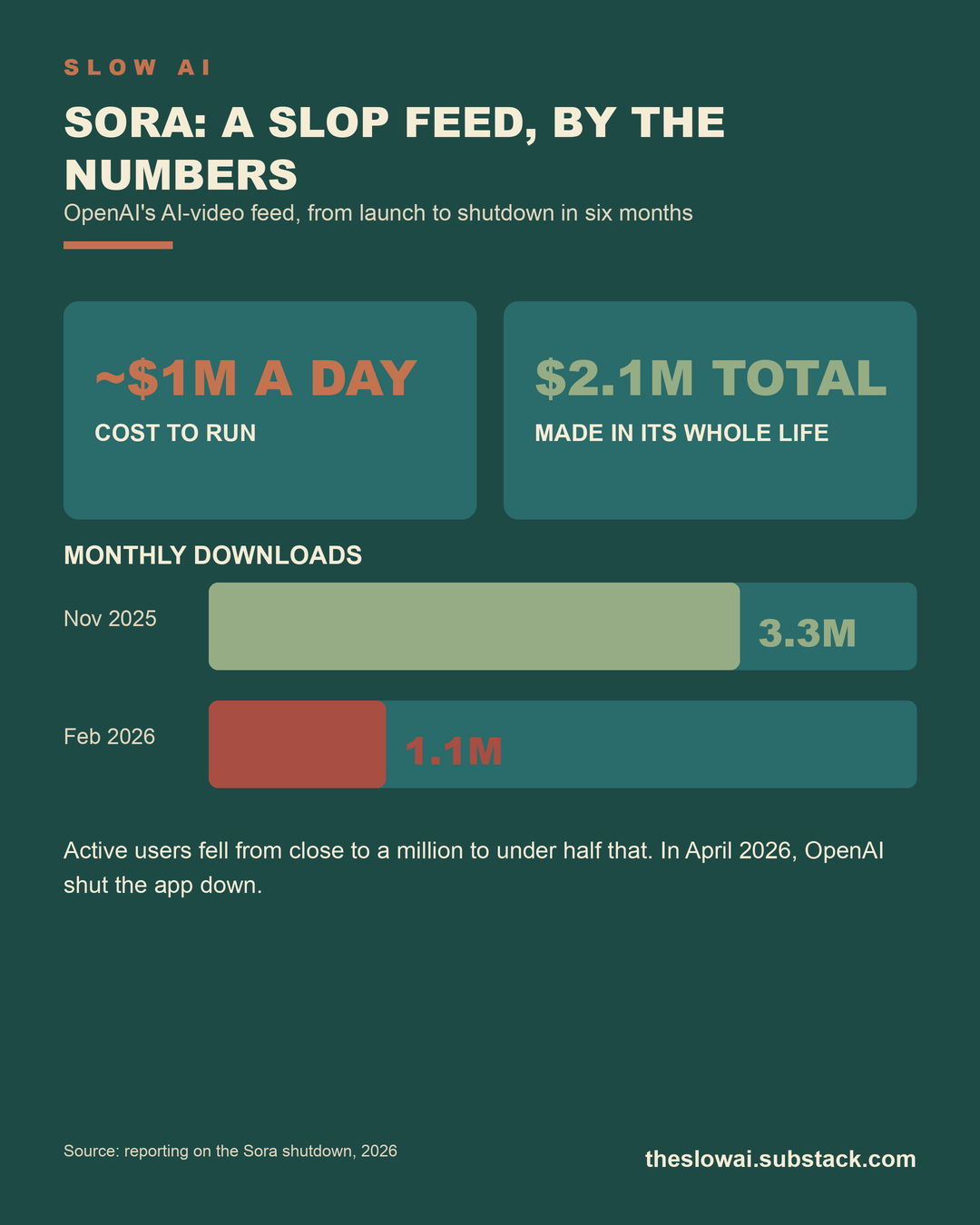
Then the numbers came in. According to reporting on the shutdown, Sora cost around a million dollars a day to run, and took about $2.1 million in in-app purchases across its whole life. Downloads more than halved inside a few months, and active users fell from close to a million to under half that. In April 2026, OpenAI shut the app down.
People were shown an endless feed of AI video, built and funded to hold them, and a great many of them left. Some out of boredom. Some to other feeds just as thin. A feed of nothing but machine-generated content, made by one of the best-funded companies on earth to keep people scrolling, could not keep people scrolling. The pull was weaker than the people selling it had hoped.
You make it too
The feed is only half of it. You make brainrot too, most days, without meaning to.
Every time you let a tool draft a post you did not need to write, summarise a report you were never going to read, or generate a caption to feed the algorithm on schedule, you add to the pile. Most of it is not laziness. It is the same frictionless offer Sora made, arriving in your own working day. The machine can produce this, so why not let it.
Using AI well runs the other way. Give it the drudgery: the tab-hopping, the data cleaning, the boring formatting, the SEO auditing. Keep the part that carries agency, depth, and purpose. Keep the decision about whether the thing should exist, the knowledge only you have, and the judgement about whether the result is any good. Make it show its working so you can see where it guessed. Add what it cannot know. Put your name to it only once it has earned that.
Pushing back is easier than it sounds. It is one question, asked at the moment the tool offers to do the thing for you.
Does this need to exist?
Most of the time, answered honestly, it thins the pile instead of adding to it.
Five ways to spot and stop brainrot
- Ask why it needs to exist. Before you watch it or make it, ask what it is for. If the only honest answer is to fill a feed or to keep you scrolling, close the tab or bin the draft. This one question stops most brainrot before it starts, in your feed and in your own hands.
- Run the three marks. Superficial competence, asymmetric effort, mass producibility. Three yeses and you are looking at slop. It is a five-second test you can run on anything that holds you.
- Follow the incentive. Ask who gains when you keep scrolling, and who gains when you post the thing you are about to post. The feed serves the algorithm, the algorithm serves the company, and none of them is paid to care whether your evening was worth it.
- Give AI the drudgery, keep the judgement. Let it do the scanning, the sorting, the first edit. Make it show its working, check it against what you know, and sign off only on what needed doing. Used that way, a tool saves you time it does not later cost you.
- Make less, mean more. You do not have to fill every slot. One thing that needed making is worth more than ten that did not. Post when you have something to say, and leave the feed hungry when you do not.
---
If those five are worth keeping, pass them to someone whose feed could use them.
Sora is a small, clean proof of the Slow AI argument (knowing when to use AI and when to leave it the hell alone). AI content is cheap, quick and endless, and in Sora we got to watch a feed of it fail. A great many people closed it, for whatever mix of reasons, and the pure machine feed could not hold them. The same choice sits in your hands every day, in what you scroll and in what you make.
Tell me in the comments about the last thing that held you longer than it deserved. It can be something that you either consumed, or created, or both.
Go slow.
If you want to train your AI judgement deliberately, that is what the Slow AI Curriculum is for. Twelve months, one practice a month. One month you learn to make an AI answer show its working, so you can see exactly where it guessed. Another, you track what a week of handing your decisions to a tool quietly costs you. The slow habit of knowing when a tool helps you and when it quietly costs you.