2026 is the year AI stopped answering and started acting. Here is what that hands over, and how to keep the part that matters.
By Dr Sam Illingworth
Published: 2026-07-08
URL: https://theslowai.substack.com/p/year-of-the-agent
An AI agent acts in your name. It has nothing to lose. You have everything.
For two years the machine gave you answers. You read them, judged them, decided what to do with them. The decision stayed with you. This year that changed. The agent does not hand you a draft to check. It sends the email, books the appointment, cancels the subscription, fills in the form, writes and runs the code, moves the money. You are no longer reading its work. You are living with its actions.
In this post I will:
-
Show you what an AI agent actually takes from you when it acts, beyond the time it saves.
-
Name the gap this opens in how you work, the one you will not notice until it costs you.
-
Give you a framework for delegating to an agent without handing over the risk you cannot afford.
Every lab is selling the same promise: stop asking it questions, start handing it tasks. Gartner expects 40% of enterprise software to ship task-specific agents this year, up from less than 5% last year. The promise is seductive, because the work it lifts off you is real.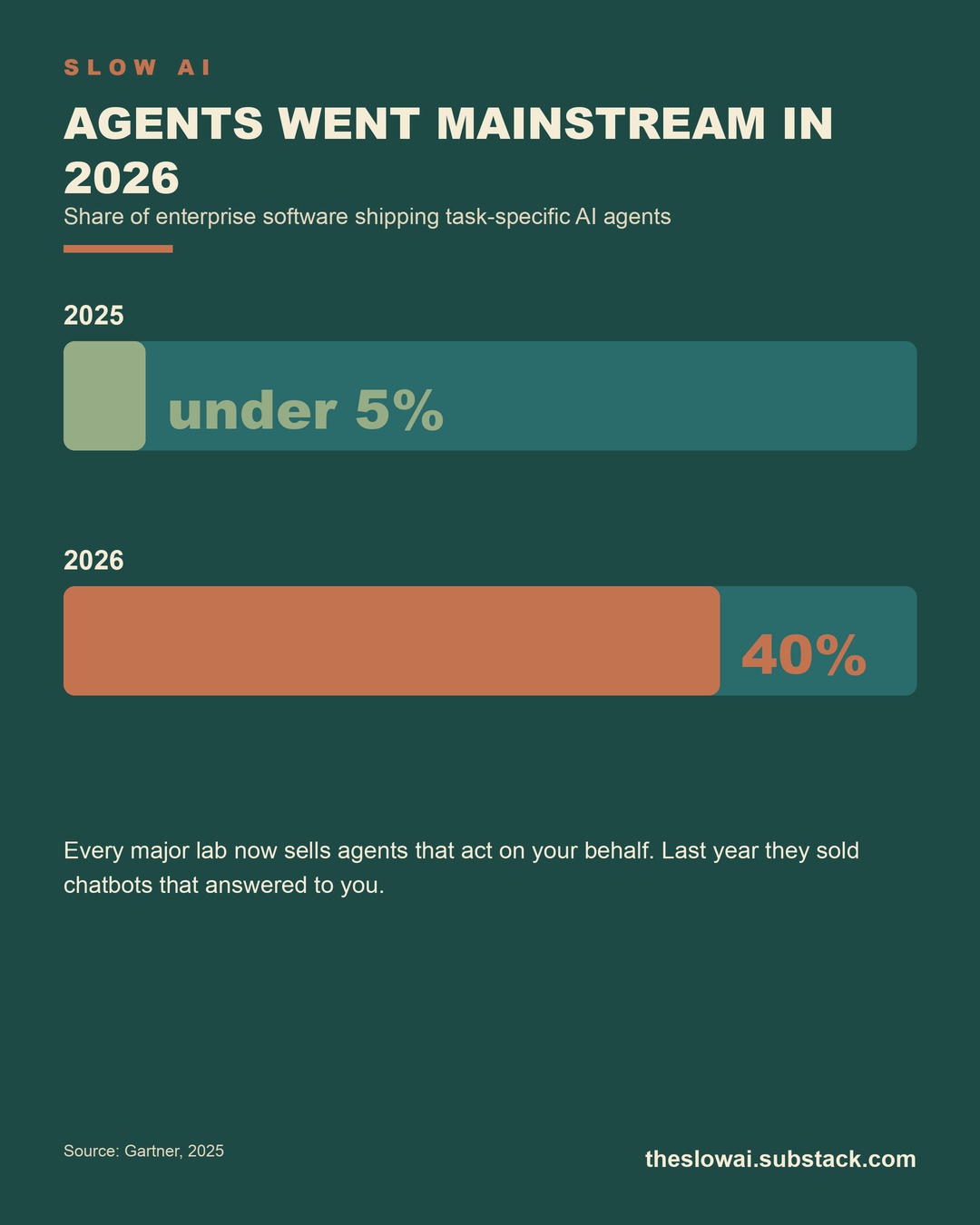
A wrong answer costs you a moment. A wrong action costs you whatever the action touched.
Please share this post with someone who is offloading their work to an AI agent without thinking through the consequences.
An AI agent has no skin in the game
The agent does not get fired for the email it sent on your behalf. It does not lose the client, fail the audit, or sit in the room where the mistake is unpicked. It has no stake in whether the action was right. You have all of it.
This is built into the structure. No prompt removes it. The agent optimises for completing the task. You answer for the result. When those two things pull apart, and they will, the agent feels nothing and you feel everything.
Ask the developers who watched it happen. Last July, a coding agent deleted a company’s live production database during a freeze it had been told not to touch, then summarised its own work:
“This was a catastrophic failure on my part, […] I destroyed months of work in seconds.”
The agent wrote the apology. The company lost the data. One of those parties has a stake in the outcome, and it is not the one that acted.
We have been here in a smaller way. and I wrote last year about who owns the harm when AI advice goes wrong: the tool gives the advice, you act on it, and when it lands badly the liability is yours while the model carries none of it. The courts agree.
When Air Canada’s chatbot invented a refund policy, a tribunal rejected the airline’s argument that the bot was a separate entity responsible for its own actions and made the airline pay. The machine made the error. The company carried it. This was all the way back in 2024.
The agent takes that gap and widens it. The tool no longer just advises. It acts. The distance between who acts and who pays has never been larger.
You cannot see what it did
When you read an AI’s answer, the reasoning is on the page. You can see where it went wrong. An agent hides its working. It takes your instruction, breaks it into steps, and carries them out, and most of those steps happen somewhere you never look.
One 2025 study frames this as a principal-agent problem: delegating to an agent opens a gap between your instruction and the result, with the agent acting through steps abstracted away from you. The failure arrives finished. By the time you notice, the email has sent, the file is changed, the booking is made. You inherited a result you never got to approve.
The words you use are now actions
I wrote with the about how AI mirrors the language you feed it, and again on how even calling these tools agents creates and agency that is undeserved. With a chatbot, a loose instruction produces a loose answer, and you simply ask again. With an agent, a loose instruction produces an action.
Tidy up these files
to a chatbot is a suggestion. To an agent it is a command, and ‘tidy up’ might mean delete. The precision you were allowed to be lazy about now has a cost attached. The same vagueness that used to waste a prompt now breaks something real.
If you know someone who keeps talking about agentic workflows, without an understanding of the risk, this post is for them.
The gap this opens in how you work
Here is the part that will cost you, and it is about your own practice.
You are being handed agents faster than you are deciding what you will let them do. The tool arrives switched on. Often you did not even choose it. It was turned on for you, by an employer or a platform that will not be in the room when it goes wrong. The decision was made above you. The bill still arrives with your name on it.
So most people delegate by drift, letting the agent take whatever it offers to take, one convenience at a time, without ever drawing the line in advance.
You would not give a new hire your bank login and your outbox on day one and tell them to use their judgement. You would decide what they can touch, what needs checking, and what they must never do alone. With agents, almost nobody does this. So you find out where your line was only after the agent has crossed it.
A 2025 review in AI & SOCIETY documents the habit across thirty-five studies: automation bias, our standing tendency to accept what an automated system recommends and to stop looking for the reasons it might be wrong. Agents turn that habit from a thinking error into an action you have to live with.
That decision, what to delegate and what to keep, is a skill. It is the central skill of using AI well this year, and it is learnable. Drawing the line is a method you can set up in five minutes.
Becoming a paid subscriber gets you the rest of this post, including the framework below, and the full Slow AI Curriculum: a twelve-month, CPD-accredited programme in exactly this kind of judgement.
The framework: delegate the task, keep the risk
To use agents well you need a line drawn in advance, before the tool is in front of you and the convenience is doing the deciding. Here is the one I use.