By Working Smarter with AI
Published: 2026-04-04
URL: https://thepromptshell.substack.com/p/the-origin-of-artificial-intelligence-df9
Part 2: When more became different (2012–Today)
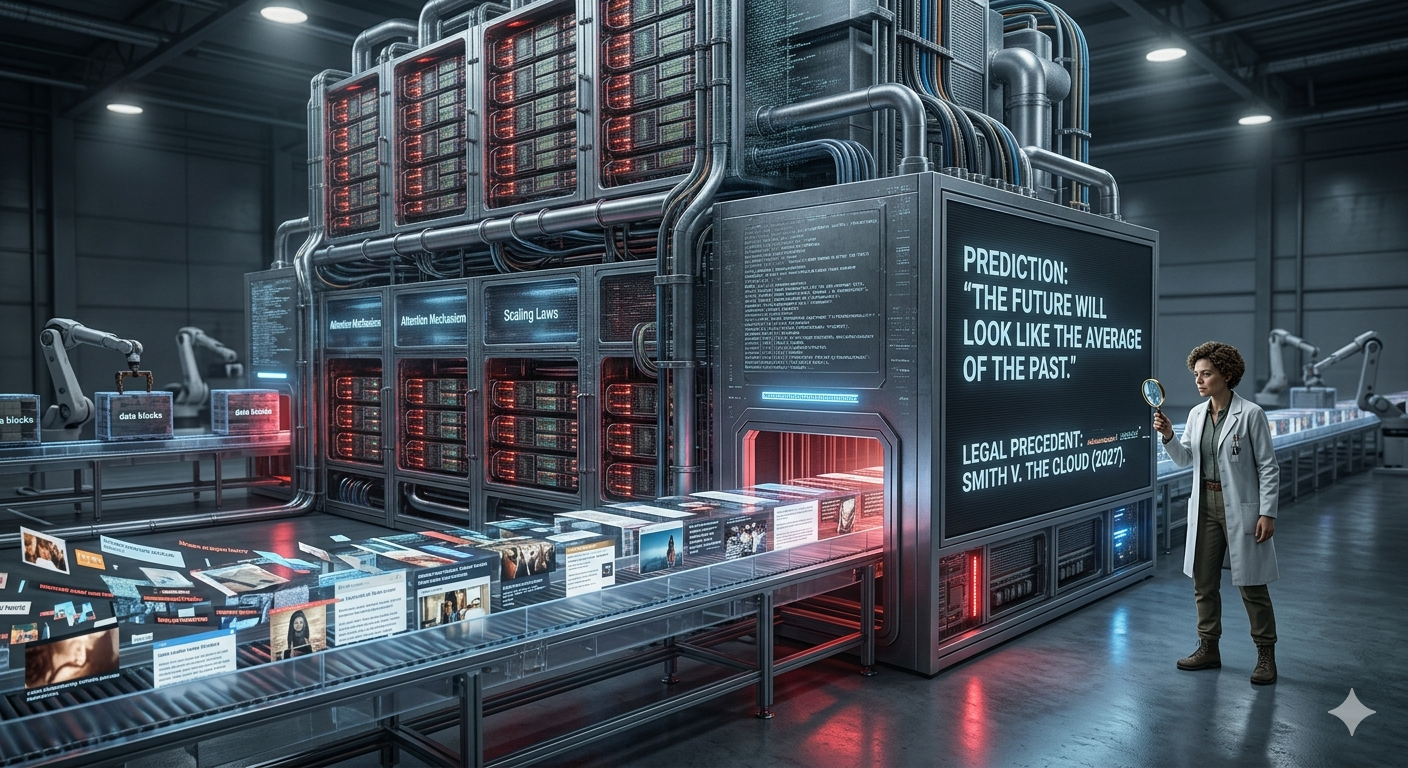
In 2012, we stopped trying to teach computers how to think and started forcing them to “memorize the entire internet”.
By feeding the model with every scrap of data on the internet, we created a system that doesn’t “think”, it just calculates the most likely next step based on everything we’ve done before.
The “Click” of 2012
For 60 years, neural networks were a scientific punchline. That changed in 2012 with AlexNet.
A team at the University of Toronto took a decades-old mathematical concept, fed it with 15 million images from the internet, and ran it on NVIDIA GPUs, chips originally designed to render explosions in video games and for the first time the machine “learned” and got some “intelligence”.
In reality, we didn’t get a breakthrough in “intelligence.” We just finally had enough “brute force” to make it work.
This program proved that Scale was more important than Logic.
2017: The “Attention” Revolution
In 2017, eight researchers at Google published a paper caller “Attention Is All You Need” and introduced the Transformer which was a structural shift.
Before the Transformer, AI read text like a human. One word at a time, left to right. If a sentence was too long, it “forgot” the beginning by the time it reached the end.
The Transformer changed the architecture so the machine could look at an entire library simultaneously, calculating the mathematical relationship between every single word.
We moved from “reading” to “ingesting” at a scale that was previously mathematically impossible.
Why OpenAI beat the Giants
One of the companies that took a big advantage of this massive architecture change was a small company called OpenAI, that you all know today as the owner of ChatGPT.
They understood the huge impact of this discovery and applied in a way that the big companies like Meta or even Google were not able / didn’t had de courage to do it.
Despite being the “inventor” of the Transformer, Google was a trillion-dollar company at that time, and simply paralyzed by the fear of a “hallucination” making the evening news.
On the other hand, OpenAI exploited the “Move Fast and Break Things” mantra. They had much less legacy products to protect and realized that the public would forgive a “lying” AI if it was impressive enough.
From Automation to Cognition
Today, companies are moving past simple automation (doing repetitive tasks) to Automated Cognition.
- Old AI: A robot arm that moves a box.
- New AI: A system that reads 5,000 legal contracts and “flags” the risky ones.
In the boardroom, this is being treated as a strategic partner.
According to 2026 corporate governance trends, over 35% of boards are now using Generative AI to summarize voluminous materials and surface market insights.
It moved from being a “cool tool” to the new corporate infrastructure.
The Skeptic’s Reality Check: Is it Phase 4?
We are currently told that we are in Phase 4 (Reasoning) but a skeptic looks at “hallucinations” where the AI still lies many times with total confidence show us that we are not really there.
For a skeptical. these models don’t “know” facts. They calculate the statistical probability of the next word.
But the world is also full of believers that claim AI is already Reasoning. Some studies and events are used to highlight that:
· Theory of Mind: Recent studies suggest high-level LLMs can pass tests that require understanding, a trait once thought to be uniquely human.
· Coding and Math: In 2026, we see AI solving niche coding bugs that have never appeared on the internet before. It isn’t “copy-pasting”. It is applying logic to a new architecture.
· System 2 Thinking: New techniques (like “Chain of Thought”) force the AI to write out its steps before giving an answer. This looks more like a human “showing their work.”
The current AI is brilliant but fragile. It can pass the Bar Exam in the 90th percentile, but it might fail a simple logic puzzle that a 6-year-old can solve if that puzzle is phrased in a way the AI hasn’t seen 10,000 times before.
My Closing Provocation
My final thoughts are in fact the major questions that I’ve not able yet to get a clear answer.
In my opinion we have built a machine that is the perfect reflection of our collective digital past.
But if the machine only knows what we have already written, can it ever lead us to a discovery we haven’t made yet?
Or have we just built a very expensive way to automate our own biases at scale?
I would really love to ear your opinion on this because I’m not sure exactly where all of this will lead us.