By Working Smarter with AI
Published: 2026-04-02
URL: https://thepromptshell.substack.com/p/the-origin-of-artificial-intelligence
The 70-Year Failure That Finally Worked
Artificial Intelligence isn’t the result of a recent scientific breakthrough. It is in fact, a 70-year-old project that spent most of its life failing until it was rescued by the massive volume of data we dumped onto the internet.
1956: The Room where it happened
The term “Artificial Intelligence” appeared for the first time in 1956 at the Dartmouth Conference in New Hampshire that had the goal of exploring if machines could or not simulate human intelligence.
Among the organizers of this conference there was a man called Claude Shannon, which is considered the “father of information theory.”
If you’re wondering why one of the world’s most powerful AI models today is named Claude (by Anthropic), you should know that it’s a direct tribute to the man who first figured out how to turn information into binary code.
1966: The “20-Year” delusion
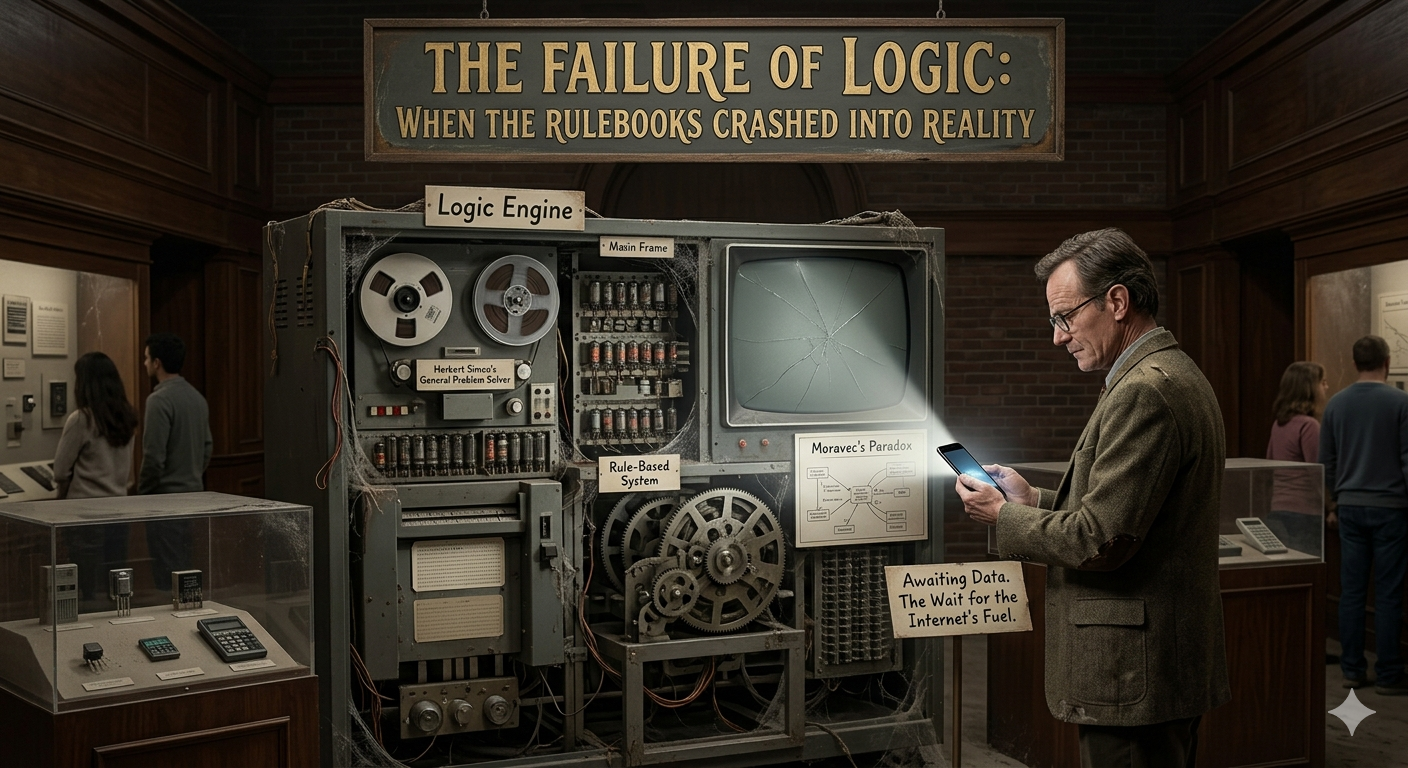
By the 60s, the mood was arrogant. Herbert Simon, a Nobel laureate and Turing Award winner, famously predicted in his book “The New Science of Management Decision” that within 20 years, machines would be capable of doing any work a man can do.
The world waited for 1986 but his theory didn’t materialized. This was the start of the first “AI Winter” which arrived because the “if-this-then-that” approach couldn’t handle the messy, unwritten rules of the real world.
The Japanese failure and expert systems
In the 80s, the focus shifted to Expert Systems. Japan launched a massive national program to build “Fifth Generation” computers that would mimic how a human expert (like a doctor or engineer) makes decisions.
The result? A total failure.
Why? Because humans are so terrible at explaining how we know what we know.
If you wanna know more about this reality, you should look for the Moravec’s Paradox that explains it very well. The “hard” things (math, chess) are easy for computers, but the “easy” things that humans do, like walking, recognizing a face, common sense are incredibly hard to program.
1997: Brute force vs. real genius
When IBM’s Deep Blue defeated Garry Kasparov in 1997, the world panicked because it seem to be the materialization of Herbert Simon predictions.
The pure reality was that Deep Blue wasn’t “smart” than Garry Kasparov. It was just a “specialized calculator” that could look at 200 million chess positions per second and make decisions. It didn’t “understand” chess. It just won by brute-force exhaustion.
The great pivot: Machine Learning
By the late 90s, the industry realized that if we couldn’t teach the rules to a computer, we had to let it learn from examples.
There were also some important events that combined made this process of learning possible:
- 1990s: The rise of the PC put chips in every home.
- 2004-2007: Facebook and the iPhone appear. Suddenly, we weren’t just using computers. We were carrying sensors that tracked our location, our photos, and our conversations 24/7.
- 2010-2012: Google buys Android and mobile apps explode. The “Big Data” era begins.
For the first time in history, we had enough digital examples of “being human” to finally feed the the neural networks and allow them to Learn.
But a question remained. Is a model that learns by “inhaling” the internet actually intelligent? Or is just a big and old encyclopedia that as all the information?
The End of the beginning
By 2011, the stage was set for a transformation that the pioneers at Dartmouth Conference could never have imagined.
We had spent decades trying to “program” intelligence into machines, only to realize that the human mind is far too messy to be written on a manual.
But with the explosion of the mobile internet and the accidental power of gaming chips, we stopped trying to be teachers and started being archivists.
We finally had enough data to stop guessing how we think and start calculating how we behave.
The engine was built, the fuel was loaded, and in 2012, someone finally turned the key.