How to Know Where Your Organization Really Stands
By The Practical AI Strategist
Published: 2026-02-24
URL: https://thepracticalaistrategist.substack.com/p/the-ai-capability-maturity-curve
This post is part of the AI Transformation Series, exploring what is really needed to transform businesses into AI-enabled organizations.
If the last post was about what blocks AI adoption (skills, confidence, culture), this one is about where you actually are on the journey.
Because here’s the truth: Most leaders wildly overestimate their organization’s AI maturity.
They think they’re “experimenting.” They’re actually dabbling. They think they’re “scaling.” They’re actually piloting. They think they’re “AI‑ready.” They’re actually AI‑curious.
And when you misdiagnose your maturity, you invest in the wrong things.
So today, I want to share a simple, practical way to assess your organization’s AI maturity and what to prioritize at each stage.
Thanks for reading! Subscribe for free to receive new posts and support my work.
The 5 Stages of AI Capability Maturity
The first step is to diagnose your stage correctly. These are the 5 stages of AI maturity.
1. Awareness
- People are curious but unsure how AI applies to their work
- Pilots may exist but lack standards or clear use cases
- Leadership shows interest but has no formal plan
2. Experimentation
- Individuals and teams try tools on their own initiative
- Champions begin to emerge organically across the org
- Multiple pilots launched to prove early wins
3. Enablement
- Leaders invest in formal training and tool access
- Role-based skills form and workflows are redesigned
- Prompt libraries and first templates emerge
4. Integration
- AI embedded in core workflows across the organization
- Teams ship agents, templates and automations reused cross-team
- Clear outcome metrics defined and governance in place
5. Optimization
- Continuous improvement mindset established; AI literacy normalized
- Innovation emerges bottom-up from across the org
- Measurable enterprise value delivered consistently
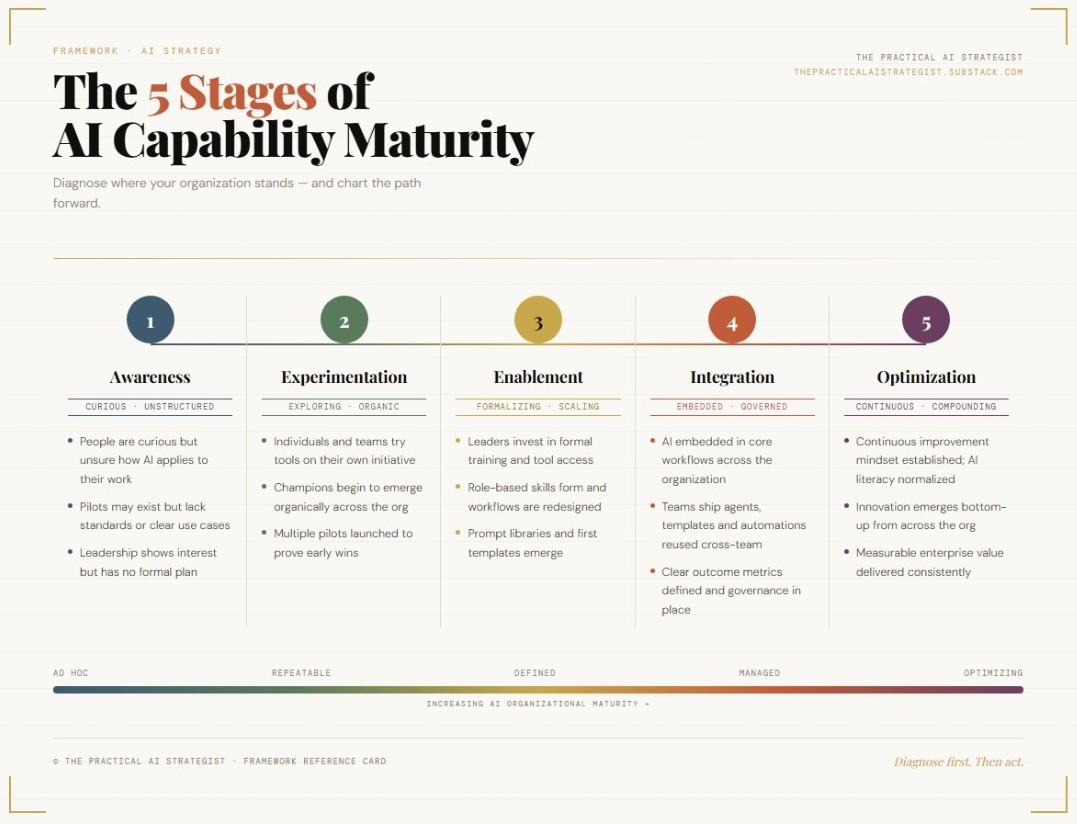 \A Visual Framework\
Diagnose where you are in 10 minutes
Run this quick exercise in a leadership huddle or with a cross‑functional team. It’s designed to surface the right signals fast.
Step A: Prep (1 minute) Share the five stage names on a slide or whiteboard.
Step B: Rapid evidence round (6 minutes) Ask each of these five questions; have participants shout one‑line answers or use sticky notes.
- Where is AI used today in daily work? (List 3 examples.)
- Name one repeatable AI output your team relies on. (Template, agent, script.)
- Who are the champions and how do they help others?
- How do you validate AI outputs today? (Manual review, tests, metrics.)
- What metric would prove AI is delivering value for your team?
Step C: Quick mapping (2 minutes) Match the evidence to the stage descriptions above. If answers are mostly ad hoc examples and “we’re experimenting,” you’re Stage 1–2. If you have templates, governance, and measurable outcomes, you’re Stage 3–4. If you have continuous improvement loops and enterprise ROI, you’re Stage 5. Diagnostic tools and 10‑minute readiness tests from vendors and consultancies follow this same quick pattern.
What leaders should prioritize at each stage
1. Awareness
- Expose teams to concrete use cases, not demos. Show workplace examples.
- Create psychological safety: normalize “bad prompts” as learning.
- Start a lightweight inventory of where people already use AI.
Quick wins: 1‑hour demo + 1 team “show & tell.” Don’t do: Launch org‑wide mandatory training or heavy governance yet.
2. Experimentation
- Formalize champions: give them time, mandate, and a simple playbook.
- Collect repeatable examples and centralize prompt templates.
- Begin role‑based mapping: identify 5 workflows per role.
Quick wins: Champion office hours; shared prompt repo. Don’t do: Invest heavily in enterprise tooling or strict governance that kills experimentation.
3. Enablement
- Invest in role‑based training and just‑in‑time learning embedded in tools.
- Redesign 1–2 core workflows with cross‑functional teams.
- Define minimum viable proficiency per role and measure confidence.
Quick wins: 4–6 week AI sprint to ship a template or agent. Don’t do: Treat training as a one‑off; avoid generic “AI 101” programs.
4. Integration
- Standardize governance and validation: tests, review processes, and SLAs.
- Measure outcomes (cycle time, error rates, throughput) and tie to incentives.
- Scale reuse: libraries, APIs, and internal marketplaces for agents/templates.
Quick wins: Publish an internal “AI playbook” and a scorecard. Don’t do: Overcentralize decision‑making; don’t freeze innovation with heavy controls.
5. Optimization
- Institutionalize continuous improvement: quarterly reviews, A/B tests, and knowledge flows.
- Invest in capability pipelines: rotations, advanced training, and internal hiring.
- Measure enterprise ROI and reallocate resources to high‑impact areas.
Quick wins: Cross‑team hackathons and a public dashboard of AI impact. Don’t do: Assume maturity means “done”; complacency kills momentum.
Common pitfalls and what not to do
- Don’t skip stages. Jumping to governance before enablement kills adoption.
- Don’t measure vanity metrics. Tool installs and logins don’t prove value. Measure outcomes.
- Don’t centralize everything. Overly rigid central control slows learning and local innovation.
- Don’t outsource the human problem. Buying training content without workflow redesign won’t move the needle.
- Don’t ignore validation. Probabilistic systems need explicit quality checks; silent errors are the worst risk.
Quick checklist leaders can use after the 10‑minute diagnostic
- If Stage 1–2: fund champions, run 1 sprint, collect examples.
- If Stage 3: run 2 workflow redesigns, embed micro‑learning, measure confidence.
- If Stage 4: standardize validation, build reuse libraries, publish scorecards.
- If Stage 5: scale capability pipelines, measure enterprise ROI, and keep iterating.
A Practical Framework Leaders Can Use Tomorrow
I’ve created a one-page free diagnostic worksheet leaders can use to assess their organization’s maturity stage. Download the free AI Maturity Diagnostic Worksheet here.
Bottom line
Diagnosing maturity is not an academic exercise, but a leadership tool. Be honest about where you are, pick the right priorities for that stage, and avoid the common traps above. The fastest path to real AI value is not buying more tools; it’s aligning people, workflows, and measurement to the stage you’re actually in.
Thanks for reading! Subscribe for free to receive new posts and support my work.