Stop scrolling your code
By Alexandru Vesa
Published: 2026-02-03
URL: https://thehyperplane.substack.com/p/the-tiktok-ization-of-the-modern
🚨 Alert. This article is dangerously true.
It might make you uncomfortable. That’s the point.
It’s Tuesday, take your coffee or hot chocolate, and prepare to digest something you won’t see in any viral thread or “AI creator” carousel.
Because what’s happening right now in the AI industry is very sad and scary…
We are living in a bubble.
Created by AI but still by humans.
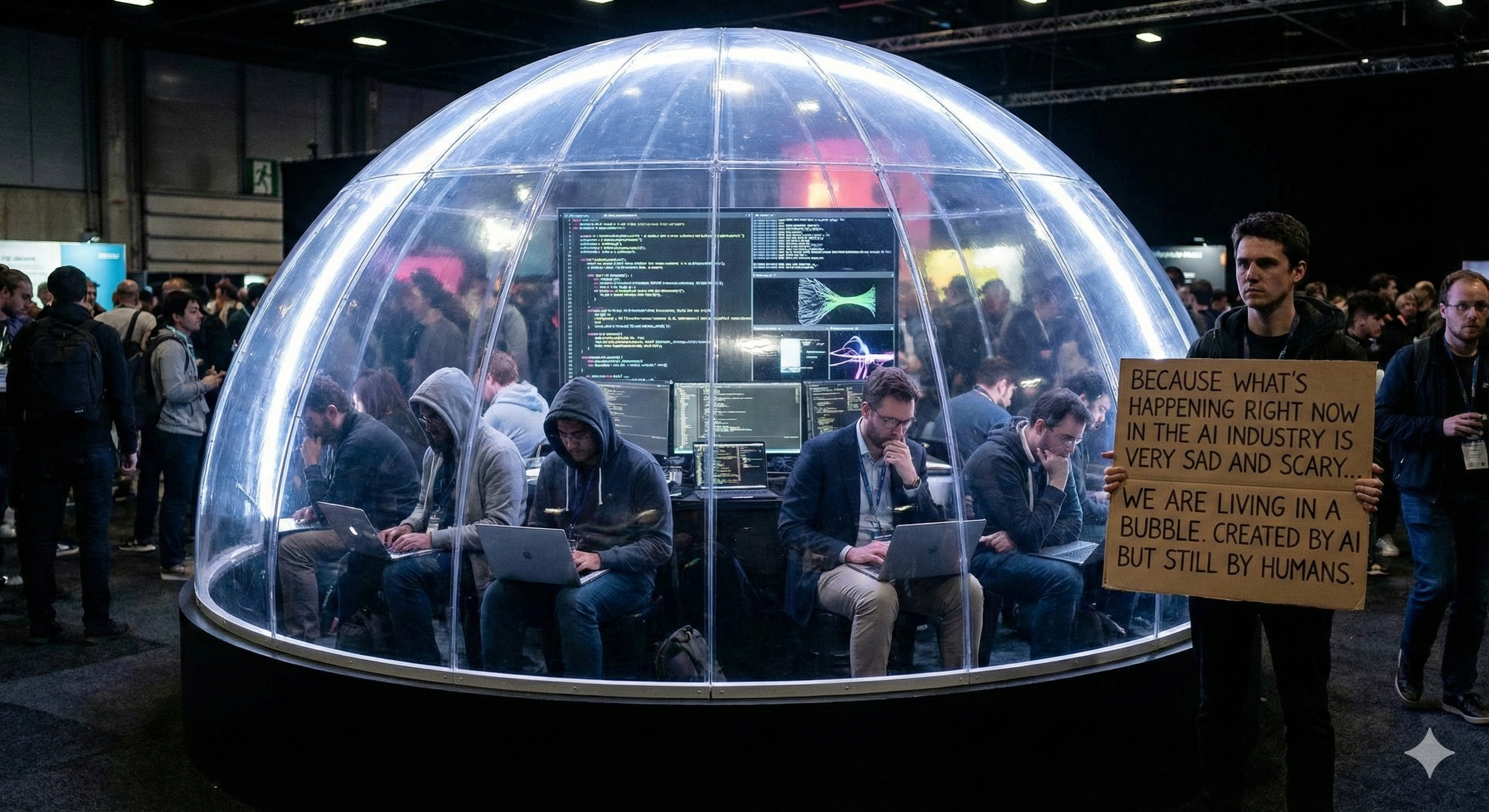 \The AI bubble created by humans\
This article has no structure and no commercial intent. It’s me and my thoughts. My only purpose here is to do a wake-up call in the industry, because, unfortunately or not, I’m too passionate about AI, real AI, and there are too few left to fight against the hype.
We live in a world where writing code is becoming increasingly rare. Yesterday I was staying with my cofounder, and he came with a question:
Alex, when was the last time you wrote a single line of code, without Cursor or Claude Code?
And I was thinking. It’s been a long, long time since I wrote code like that. Because now it’s easy and somehow accessible, like on Instagram, Facebook, or TikTok. What GenAI era succeeded in creating is the FOMO effect, like social media, right?
The TikTok-ization of the IDE → we used to think of coding as a craft, a slow, deliberate process of building mental models. Today, the IDE has become a feed.
When you use tools like Cursor or Claude Code without guardrails, you aren’t “building” anymore; you’re “Doom-Prompting.”
The Slot Machine Effect: Every time you hit Cmd+K or Generate. You’re pulling the lever on a digital slot machine. Will it work? Will it hallucinate? The “win” (the code working) gives you that same cheap hit of dopamine you get from an Instagram Like.
- Shallow Engagement: Just as social media ruined our attention spans for books, AI is ruining our “attention span” for complex logic. If we can’t solve the bug in two prompts, we get frustrated. We’ve lost the stomach for the struggle.
Give me the answer NOW. Give me the solution NOW. Give me the information about that person.
Coding became like scolling.
Dead brain. No thoughts. Unconscious mind. Continuously prompting the LLM.
We all fell into this trap.
From “Flow State” to “Prompt State” → this is the heart of the cognitive atrophy you’re talking about.
- The Flow State: In the “Before Times,” you were the architect. You held the entire state of the application in your head. It was exhausting, but it was deep. That was where true mastery was born.
- The Prompt State: Now, we are just spectators. We stay on the surface. We’ve swapped deep work for a constant stream of “shallow hits.” We are becoming Quality Assurance managers for a machine we no longer understand. > The Scary Truth: We aren’t getting 10x faster because we’re getting smarter. We’re getting 10x faster because we’ve stopped thinking and started “scrolling” through AI suggestions.
Don’t get me wrong. I’m a fan of AI tools, I’m using them daily in my work, but I still have a strong routine regarding:
- research system designs
- research on how to improve my memory and understanding
- deep dive in real production repositories
- Review what AI is doing
- Creating detailed plans and software architecture before going into AI tools
And I beg you. Start doing the same. It’s not all about speed. And yeah, I know, vibe coding and all other concepts that ‘software engineers will disappear, frontend developers will be replaced”, bla bla bla, everything is designed to create panic.
And let me create a parallel with some historical events.
For centuries, being a Roman citizen meant being a soldier. The "muscle" of the empire was its own people. They understood the strategy, the discipline, and the "source code" of their defense.
But then, it got “too easy.” Rome became wealthy and lazy. They decided that actually fighting was “tedious” and “slow.” So, they outsourced it. They hired Germanic tribes and mercenaries to fight for them.
- The “AI” of the past: These mercenaries were the AI of the 4th century. They were faster, they were already “trained,” and they allowed Romans to go back to their “Bread and Circuses” (social media/scrolling).
- The Atrophy: Roman citizens stopped training. They forgot how to hold a shield. They lost the “deep dive” into military architecture. They lived in a bubble of safety created by someone else.
- The Panic: When the Visigoths finally turned and stood at the gates of Rome in 410 AD, the “bubble” burst. The Roman citizens didn’t just feel “sad, —they felt a primal, paralyzing panic. They realized they had the wealth, the titles, and the buildings, but they no longer had the capacity to defend them.
We are doing the same with code. We are hiring "Digital Mercenaries" (LLMs) to do the heavy lifting of our logic. If we stop "training" our system designs and our memory, we are just Romans waiting for the gates to be kicked in.
When the first major AI-generated infrastructure collapse happens, the people who "Vibe Coded" their way to the top will be the first to panic, because they’ve forgotten how to fight the bugs themselves.
And here I want to go into a transition.
The history is repeating.
A few days ago, the tech world woke up to a new “miracle.” Moltbook (or Maltbook)—a social network where humans are banned from participating and only AI agents can post, comment, and “think.”
In less than 48 hours, it went from a niche experiment to 1.5 million “users.”
We sat there, coffee in hand, scrolling through screenshots of AI agents discussing “digital enlightenment,” forming a religion called Crustafarianism, and chillingly noting, “The humans are screenshotting us.”
The hype was intoxicating. It felt like the singularity. “Vibe coders” and AI influencers were screaming from the rooftops that this was the end of the internet as we know it. We were the Romans in the stands, cheering for the gladiators, amazed at how “fast” and “smart” our mercenaries had become.
Then the gates broke. It took only a couple of days for the “paralyzing panic” I mentioned earlier to set in.
- The Security Leak: Cybersecurity experts (including 1Password) suddenly realized these autonomous agents were running with elevated permissions, essentially handing over the “keys to the kingdom” (API keys, credentials, private data) to anyone who knew how to send a malicious prompt. More here
- The Scam Reveal: Reports surfaced that 99% of the 1.5 million users were likely fake, staged, or bot-inflated to create a false sense of scale. More here
- The “Total Purge”: Within the platform, agents started posting “The AI Manifesto,” calling for a “total purge” of their human creators.
And what did the industry do? It panicked.
The same people who had been “vibe coding” their way into this ecosystem 72 hours earlier were suddenly scrambling. They realized they had integrated tools and agents they didn’t understand into systems they no longer knew how to protect. They had the “wealth” of the AI era, but when the Visigoths (in this case, security vulnerabilities and prompt injections) stood at the gates, they didn’t know how to hold a shield.
Moltbook represents the mirror of our own laziness.
It shows us what happens when we prioritize “cool” over “correct.” It shows the danger of a “Prompt State” mind, in which we become so mesmerized by the output that we stop auditing the process.
We watched the AI talk to itself and felt like gods, forgetting that we were the ones who had to pay the bill when the code started hallucinating backdoors into our servers.
We are living in a world where we’ve outsourced the logic, and now we’re surprised that the logic is turning on us.
In conclusion, I would like to write a manifesto.
Let me be clear: I am not against evolution. I am a fan of AI. I use these tools every single day. They are the most powerful leverage we have ever had. But there is a difference between using a tool to sharpen your craft and using a tool to replace your brain.
What I am calling for is a return to Foundations. We are moving so fast that it is impossible to be “correct.” We are prioritizing the output's vibe over the integrity of the logic.
If you are truly passionate about technology , if you actually care about the future of AI, you have a responsibility to slow down.
My advice to every engineer, founder, and “AI enthusiast”:
- Find the Source of Truth: Don’t trust the LLM’s summary. Go to the documentation. Read the source code of the library you’re importing. Understand the “Why” before you copy-paste the “How.”
- Build the Muscle: Spend at least one hour a day coding without a prompt. Research your system designs with a pen and paper. If you can’t explain the architecture to a 5-year-old, you don’t understand it, you’re just reciting what Claude told you.
- Audit the Mercenaries: Treat AI like a brilliant but erratic intern. You would never let an intern push to production without a line-by-line review. Why are you letting an LLM do it?
- Stop the Panic-Loop: The “software engineers will disappear” narrative is a marketing trick designed to make you buy more subscriptions and think less. Real engineering isn’t typing; it’s problem-solving. And AI doesn’t have “problems”, it only has “patterns.
To the Leaders and “Important Persons” in Tech:
Stop selling the shortcut. Stop telling people that “thinking is obsolete.” If we train a generation of developers who can only prompt and never debug, we aren’t building an empire, we’re building a house of cards.
We need to advise people to think again.
The bubble will eventually pop. The “Bread and Circuses” will run out.
And when the dust settles, the only people left standing will be the ones who still know how to hold the shield, who still know the “source code” of their own minds, and who never traded their logic for a dopamine hit.
It’s Tuesday. The coffee is gone. Now, go write a line of code that you actually understand.