A Deep Dive Into In-Memory Caching
By The Coding Gopher
Published: 2026-09-17
URL: https://thecodinggopher.substack.com/p/a-deep-dive-into-redis
When modern applications need to process data at lightning speed, traditional relational databases often become the bottleneck. The solution to this need for sub-millisecond latency is almost universally Redis.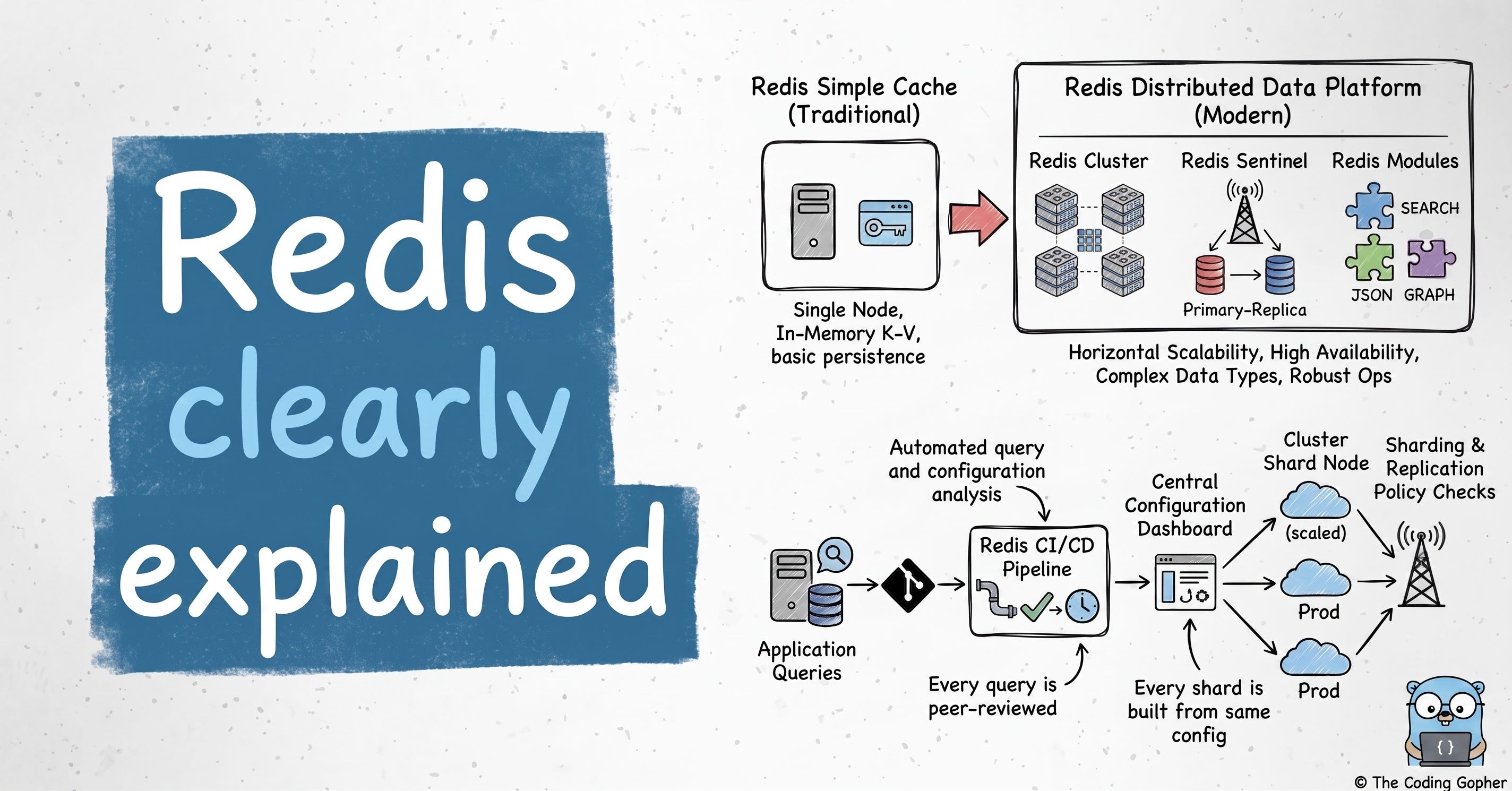 Redis (Remote Dictionary Server) is an open-source, in-memory data structure store. It is widely used as a high-performance database, cache, message broker, and streaming engine. Because it stores data directly in RAM rather than on a disk, it delivers sub-millisecond response times for massive, real-time workloads.
Originally an acronym for Remote Dictionary Server, Redis has evolved from a simple caching tool into a robust, in-memory data structure store. It is utilized across the industry as a database, cache, message broker, and streaming engine.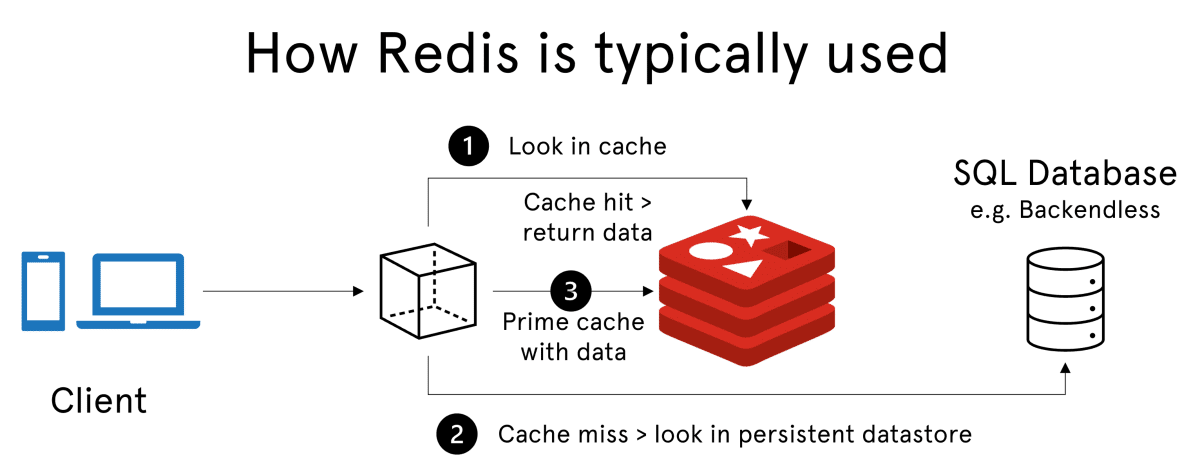 Redis is an open-source, in-memory data structure store, widely used as an application cache to dramatically reduce database load and improve read times. By keeping frequently accessed data in RAM, it eliminates the need to continuously execute slow, resource-heavy queries against your primary database.
Here is a comprehensive look at how Redis works, its core data structures, and why it has become foundational to high-performance system architecture.
Join a community of senior engineers. Subscribe and get FREE access to System Design deep dives.
The Core Philosophy: Why is Redis so Fast?
At its heart, Redis operates on two fundamental design principles that differentiate it from traditional databases like PostgreSQL or MySQL. Redis is incredibly fast, capable of handling hundreds of thousands to millions of operations per second with sub-millisecond latency. Typical operations complete in the single-digit microsecond range (around 100 to 120 nanoseconds), making it thousands of times faster than traditional disk-based databases. By storing all data directly in RAM, Redis completely bypasses the slow I/O seek times of traditional HDDs (10+ milliseconds) and SSDs (100+ microseconds).
-
In-Memory Storage: Traditional databases store data on solid-state drives (SSDs) or hard disk drives (HDDs). Even with aggressive caching, disk I/O remains a physical bottleneck. Redis stores its entire dataset in the server’s Random Access Memory (RAM). Accessing RAM is orders of magnitude faster than accessing a disk, allowing Redis to consistently deliver sub-millisecond read and write response times.
-
Single-Threaded Event Loop: Surprisingly, the core command execution in Redis is single-threaded. By processing commands one at a time, Redis completely eliminates the overhead of context switching and thread locks. Because memory access is so fast, CPU is rarely the bottleneck; the single thread can handle millions of operations per second without the complexity of race conditions.
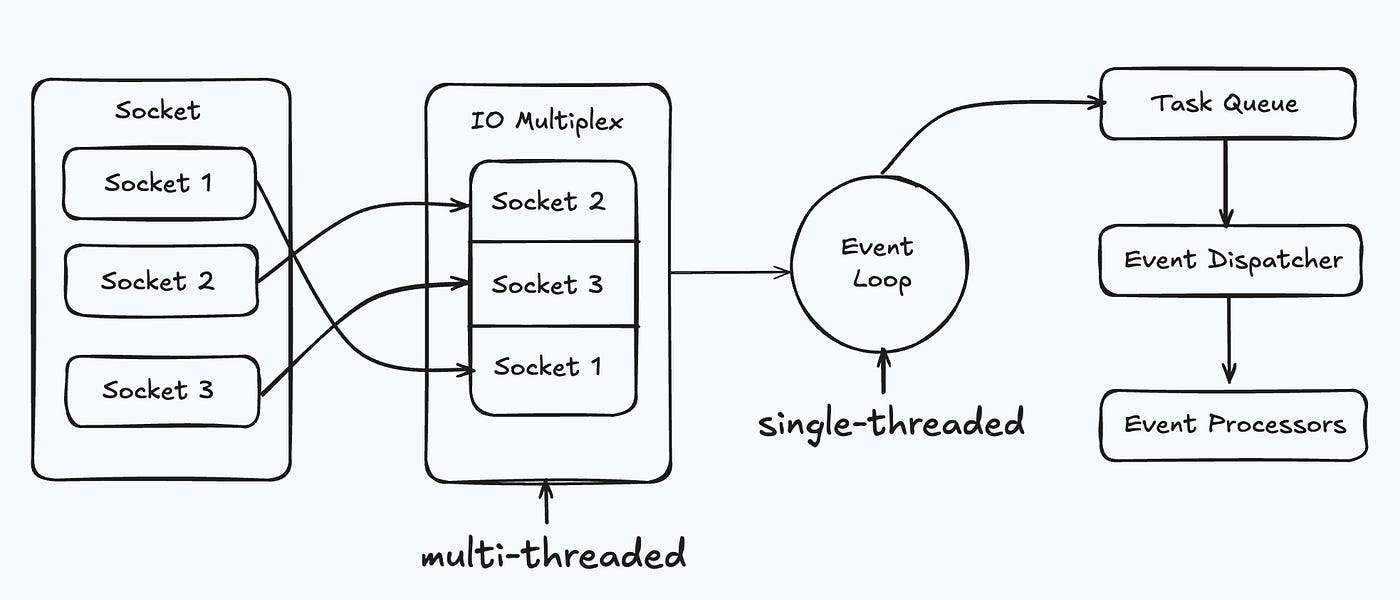 Redis uses a single-threaded event loop to execute all core database commands sequentially. While traditional databases spawn a new thread or process for each client connection, Redis routes every operation through one main thread to eliminate the overhead of context switching and resource locking.
Beyond Simple Strings: Redis Data Structures
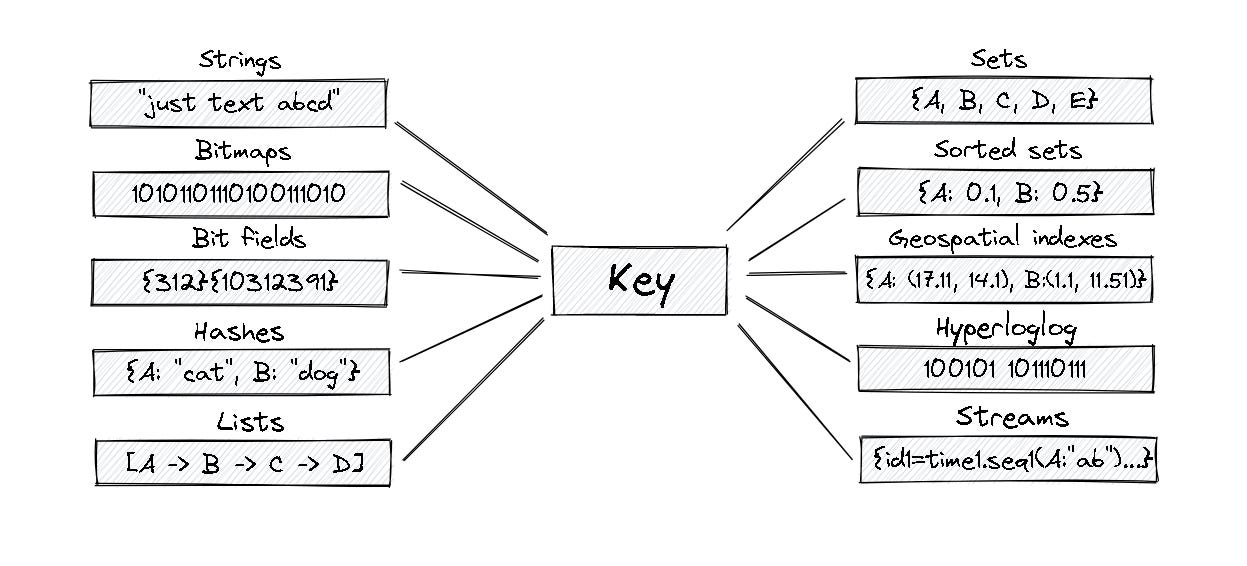
Calling Redis a “key-value store” is an understatement. It is more accurately described as a data structures server. You don’t just store strings; you store complex data types that allow for atomic operations directly on the server.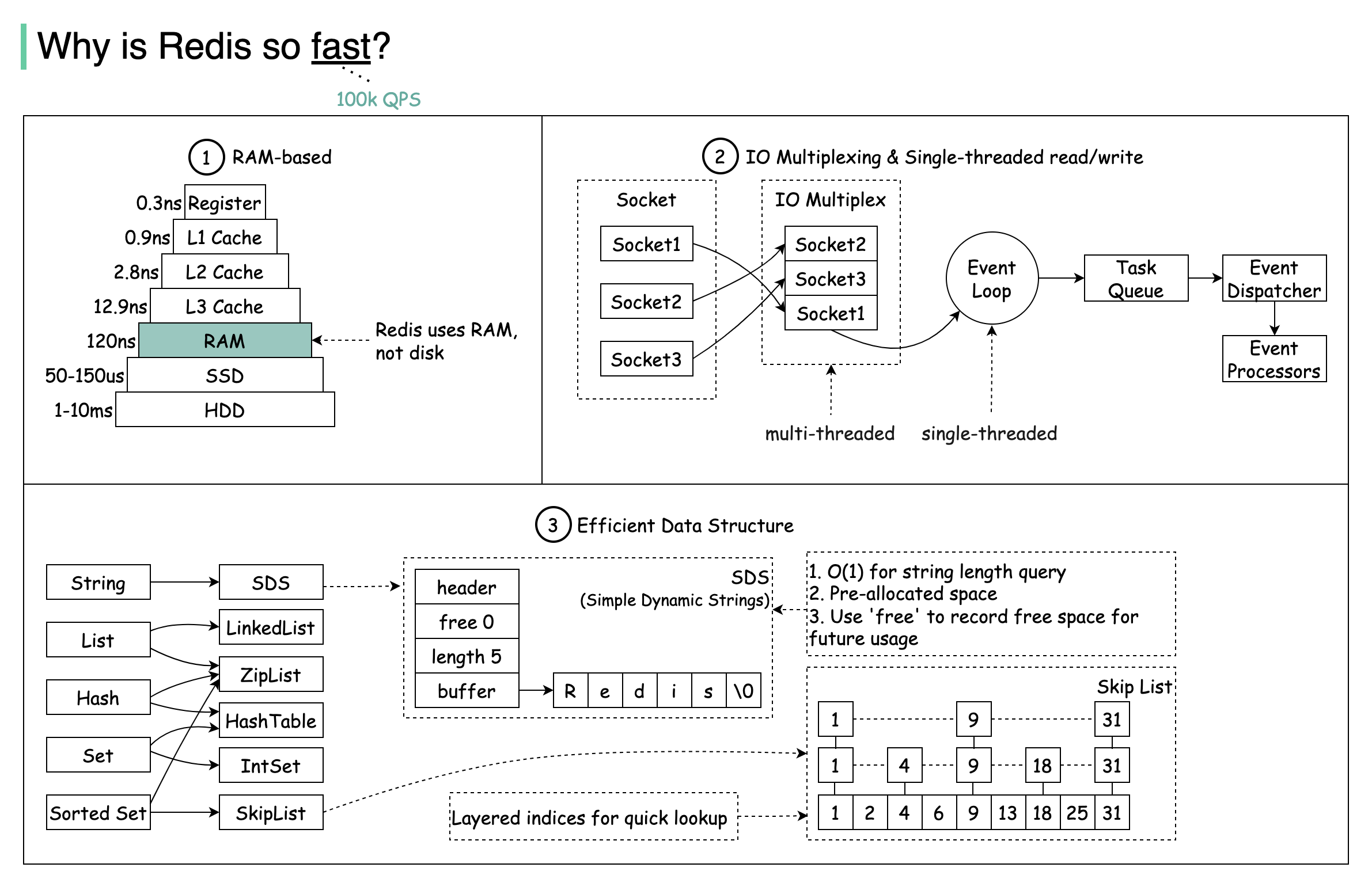 Redis is an in-memory, key-value data store that supports a diverse set of native data structures beyond simple text. The most fundamental type is the String, which holds binary-safe data like text, integers, or serialized JSON up to 512 MB. For organizing multi-element data, Redis offers Lists (ordered sequences of strings ideal for queues), Sets (unordered collections of unique items), and Sorted Sets (where every unique member is tied to a score for automatic ranking). It also features Hashes to represent objects as field-value pairs, Streams for append-only log data, and advanced specialized types like Bitmaps, Geospatial indexes, and HyperLogLogs for highly efficient probabilistic and coordinate-based tracking.
-
Strings: The most basic type, but highly versatile. Strings are binary-safe (meaning they can store anything from text to a JPEG image) and can be up to 512MB in length. They are heavily used for caching HTML fragments, API responses, and atomic counters (like page views).
Note: Being binary safe means a system or function processes input as a raw stream of bytes without assuming the data is text. It guarantees that data will not be corrupted, altered, or prematurely truncated. To understand binary safety, it helps to look at the historical limitation that made data processing unsafe.
-
Binary-Unsafe (e.g., Traditional C Strings): In older programming languages like C, strings are often “null-terminated”. This means the computer reads text until it hits a specific “null byte” (a zero value, \0), which tells it the string has ended. If you try to pass binary data (like an image or an audio file) through these functions, the system might hit a random zero byte in the middle of your file, assume it’s the end of the string, and corrupt or cut off the rest of your data.
-
Binary-Safe: A binary-safe function or database reads a specific number of bytes based on an explicit length tracker, rather than stopping when it encounters a null byte. This allows the data stream to contain any characters, including non-ASCII bytes and null characters, without affecting the integrity of the data.
-
Lists: Implemented as linked lists. You can push or pop elements from both the head and the tail in constant time, making Lists the perfect underlying structure for background task queues or timelines (e.g., a user’s recent activity feed).
-
Sets: Unordered collections of unique strings. Redis can perform rapid, server-side set operations like intersections, unions, and differences. This is highly useful for tagging systems or finding mutual friends in a social graph.
-
Hashes: Maps between string fields and string values, conceptually similar to a flat JSON object or a Python dictionary. They are ideal for representing objects (e.g., a user:1001 hash containing name, email, and age fields) without needing to serialize the whole object into a single string.
-
Sorted Sets (ZSets): Similar to Sets, but every string element is associated with a floating-point number called a score. The elements are always sorted by their score. This is the ultimate data structure for building real-time leaderboards or rate limiters.
-
Advanced Structures: Redis also includes Geospatial indexes (for location-based radius queries), HyperLogLogs (for estimating the cardinality of massive datasets with tiny memory footprints), and Bitmaps (for highly compressed boolean analytics).
Join a community of senior engineers. Subscribe and get FREE access to System Design deep dives.
Solving the Volatility Problem: Persistence Options
Because RAM is volatile, a server crash theoretically means losing all data. Redis solves this by offering mechanisms to persist data to disk asynchronously, blending the speed of in-memory processing with the durability of traditional databases.
You can configure Redis to use one or both of the following methods:
1. RDB (Redis Database Backup)
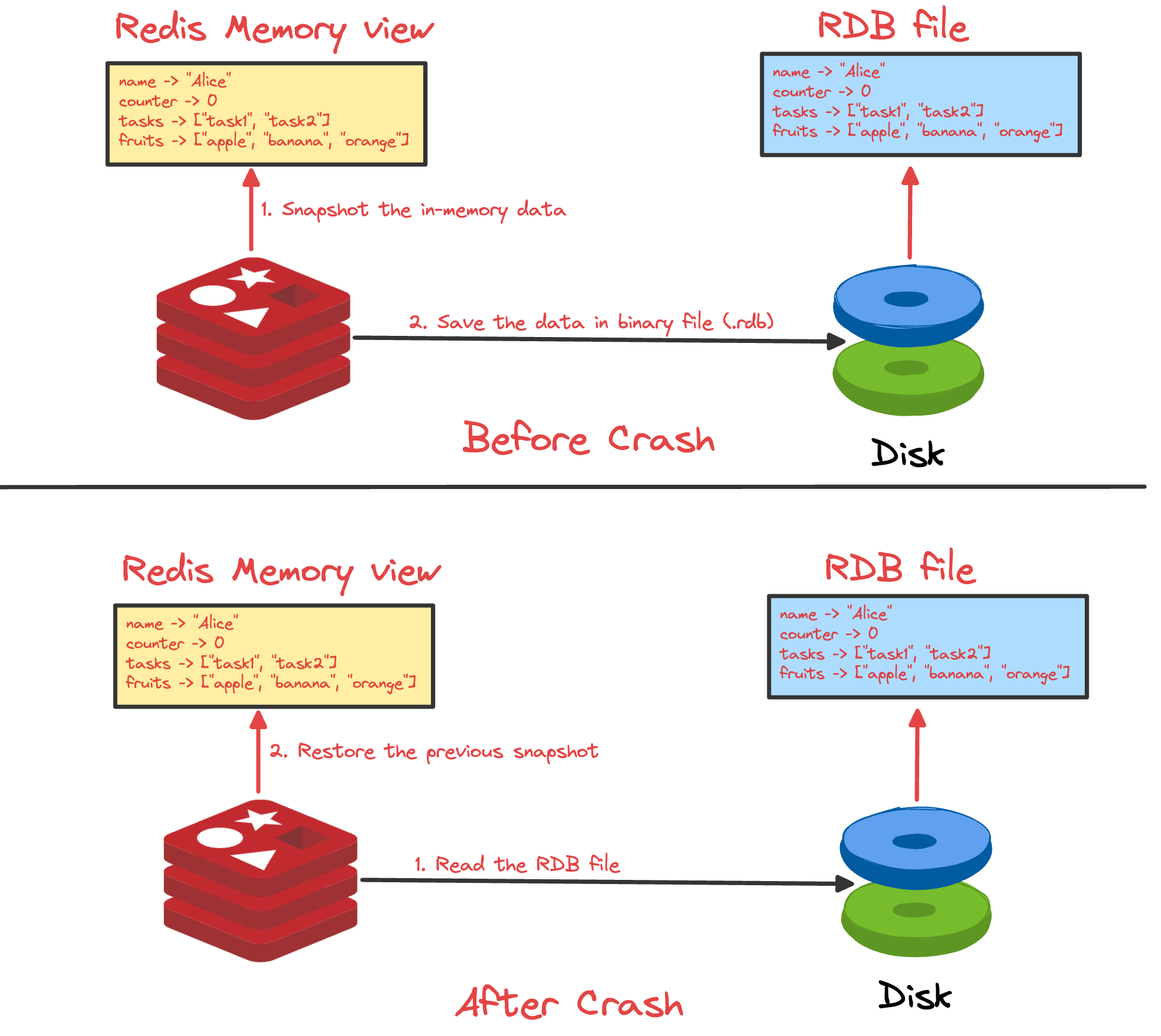 Redis Database (RDB) is a persistence mechanism that creates compact, point-in-time binary snapshots of your dataset. It is optimized for fast read/writes and disaster recovery, allowing for quick restarts, though it carries a slight risk of data loss for recent, un-saved operations.
RDB creates point-in-time snapshots of your dataset at specified intervals (e.g., “save if 1000 keys changed in the last 60 seconds”).
-
Pros: Creates highly compact, single-file backups that are perfect for disaster recovery. Redis forks a child process to handle the save, ensuring the main thread never blocks.
-
Cons: If Redis crashes, you will lose all data written since the last snapshot.
2. AOF (Append-Only File)