System Design Fundamentals for High-Traffic Applications
By The Coding Gopher
Published: 2026-08-13
URL: https://thecodinggopher.substack.com/p/designing-a-scalable-url-shortener
How to build and scale a service that maps long URLs to short aliases.
A URL shortener converts a massive web address into a tiny, unique string. Architecturally, this is achieved by assigning every long URL a unique numeric database ID, and then mathematically converting that Base-10 integer into a Base-62 string to create a compact, URL-safe link.
Building a URL shortener involves taking a long string, saving it in a database, and returning a short string. While the premise is straightforward, scaling the system to handle millions of new links and billions of real-time redirects introduces specific bottlenecks regarding database collisions, caching, and network routing.
Here is a breakdown of how a production-grade URL shortener operates.
1. Base62 Encoding
The fundamental requirement of a short URL is that it must be compact while containing enough unique combinations to handle years of data.
Engineers typically use Base62 Encoding. A standard URL can safely contain 62 distinct alphanumeric characters: 26 lowercase letters (a-z), 26 uppercase letters (A-Z), and 10 digits (0-9).
If the system generates a short link that is exactly 7 characters long (e.g., bit.ly/aB3x9Qz), the total number of unique URLs it can support is 62^7, which equals roughly 3.5 trillion unique combinations.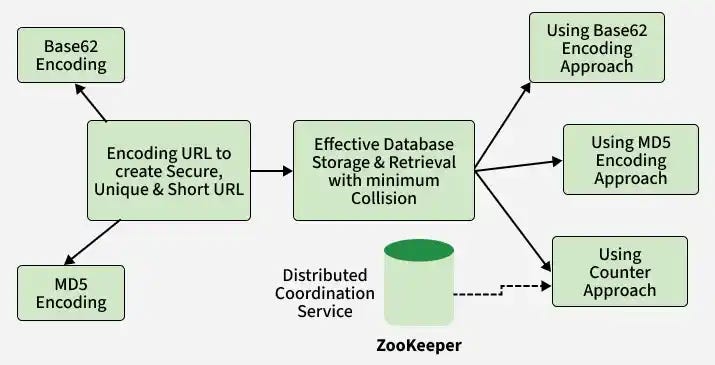 Base 62 is an alphanumeric encoding scheme that represents data using 62 safe, case-sensitive ASCII characters: 0-9 (10), a-z (26), and A-Z (26). It is primarily used in URL shorteners (like bit.ly) to compress large database IDs into short, human-readable, and URL-safe strings without special characters.
2. Preventing Collisions
The system must accurately map a specific long URL to a specific 7-character Base62 string without generating the same short link for two different destinations.
Hashing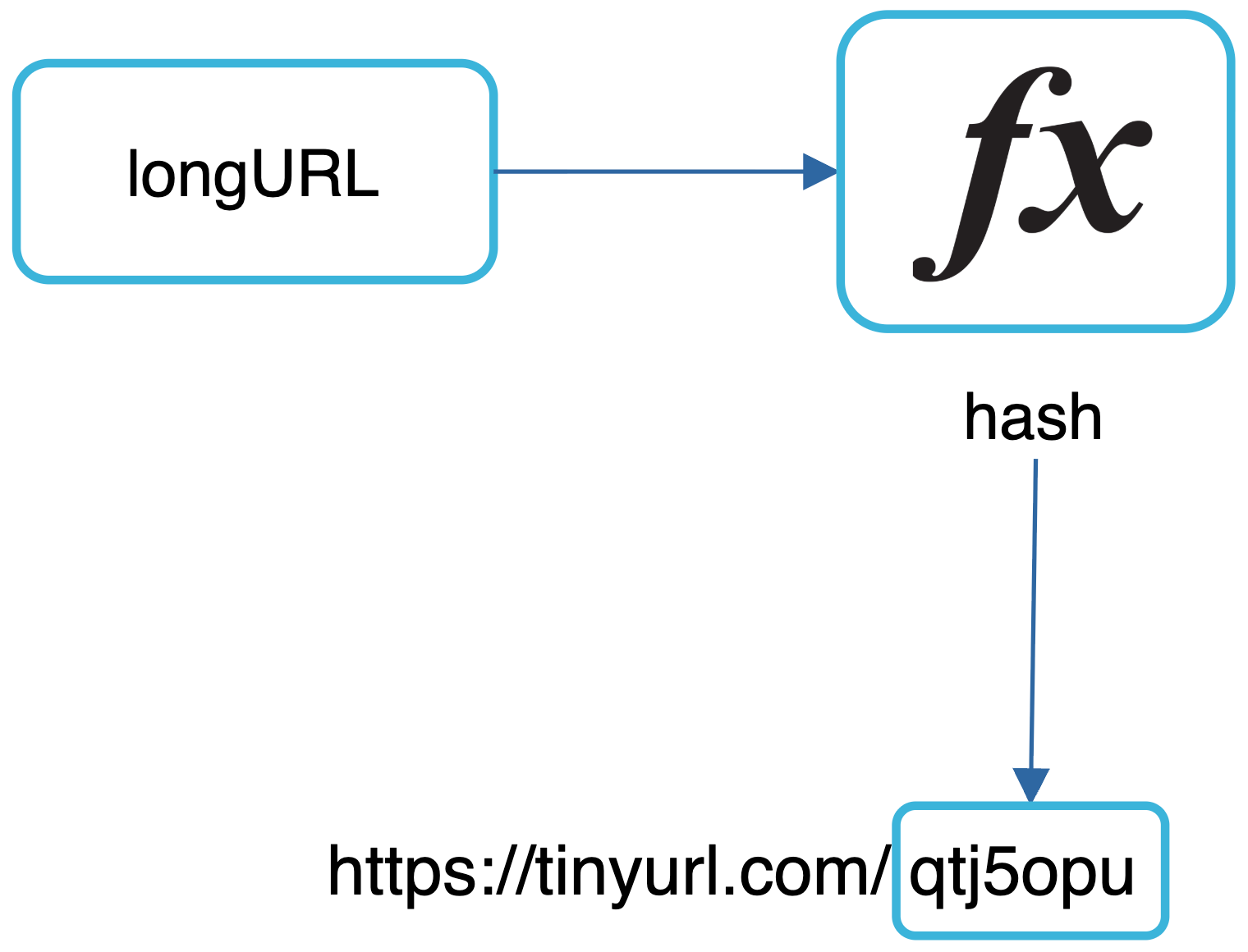 To convert a long URL into a short TinyURL style link using hashing, the most common approach is to hash the long URL using MD5 or SHA-256 and encode the resulting bytes into a Base62 string. This process creates a compact, 7-to-8 character unique identifier that serves as the shortened link's path.
An initial approach might be to run the long URL through a cryptographic hash function like MD5 or SHA-1, and take the first 7 characters of the output. The limitation here is collisions. If two users submit the exact same long URL, or if the hash fragments overlap by mathematical chance, the database will attempt to assign the same short link to two different destinations.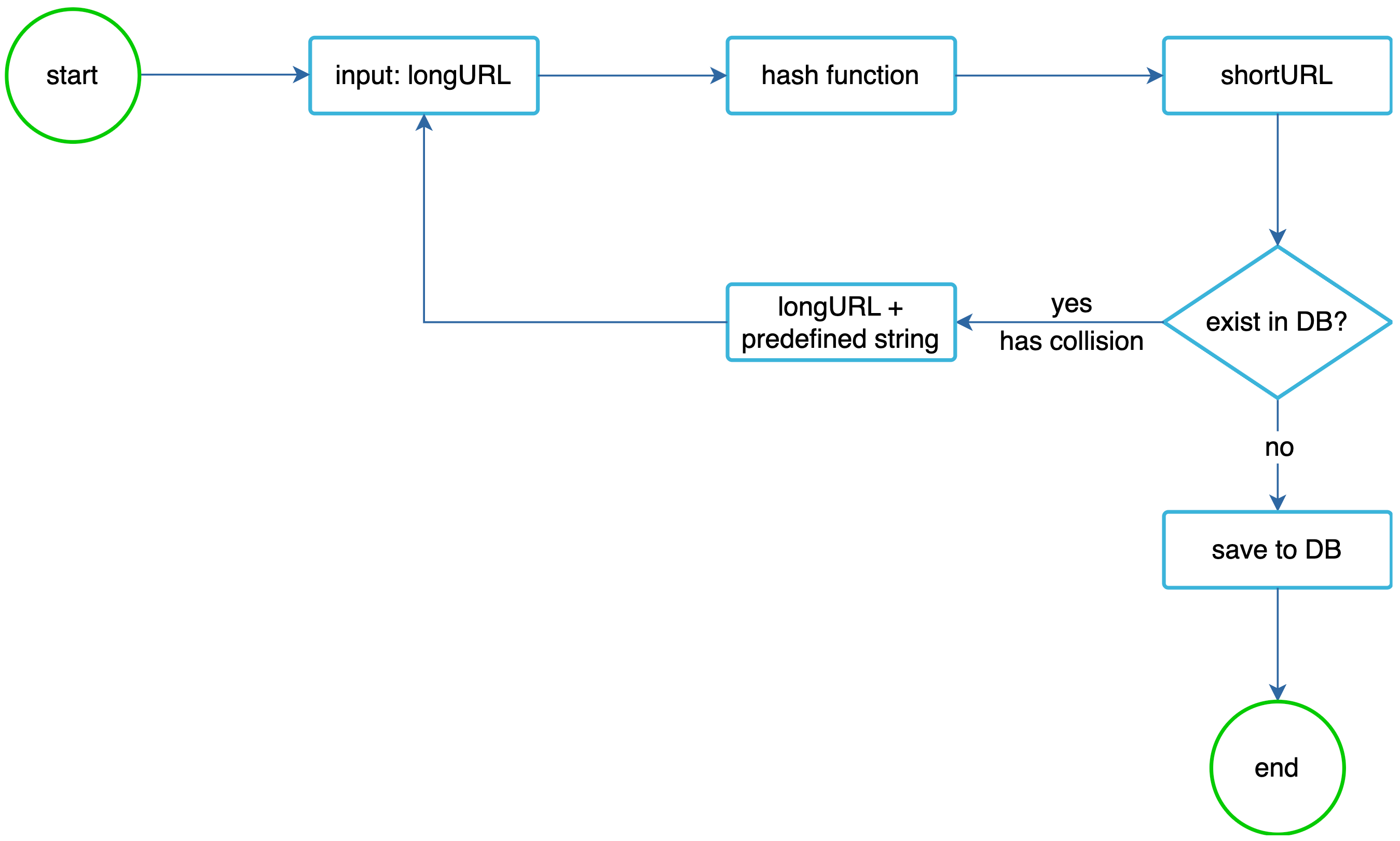 To prevent hash collisions in a URL shortener, you can use a recursive re-hashing technique. If the initial hash of your original URL results in a collision, you recursively append a predefined string (often called a "salt" or "pepper") to the URL and re-hash it until a unique string is generated.
Database Counters
To guarantee absolute uniqueness, modern systems use an atomic database counter or a dedicated Key Generation Service.
-
When a user submits a long URL, the database assigns it a unique, auto-incrementing integer ID (e.g., ID 125,000,000).
-
The application layer takes that Base-10 integer and mathematically converts it into a Base-62 string.
-
Because every database ID is strictly sequential and unique, the resulting Base-62 short link is guaranteed to be collision-free.
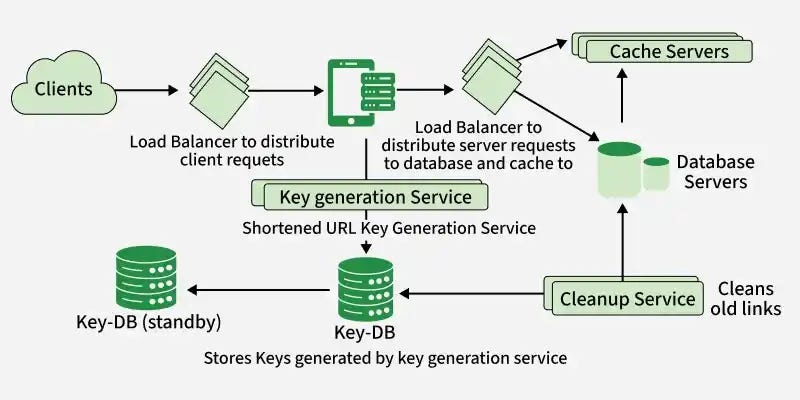
In a URL shortener system design, using an auto-incrementing ID converted to a Base62 string is a foundational approach for generating unique keys, though it is often decoupled from a central database via a dedicated Key Generation Service (KGS) to prevent scalability bottlenecks.
𝐋𝐞𝐚𝐫𝐧 𝐭𝐨 𝐛𝐮𝐢𝐥𝐝 𝐆𝐢𝐭, 𝐃𝐨𝐜𝐤𝐞𝐫, 𝐑𝐞𝐝𝐢𝐬, 𝐇𝐓𝐓𝐏 𝐬𝐞𝐫𝐯𝐞𝐫𝐬, 𝐚𝐧𝐝 𝐜𝐨𝐦𝐩𝐢𝐥𝐞𝐫𝐬, 𝐟𝐫𝐨𝐦 𝐬𝐜𝐫𝐚𝐭𝐜𝐡. Get 40% OFF CodeCrafters: https://app.codecrafters.io/join?via=the-coding-gopher
This Substack is reader-supported. To receive new posts and support my work, consider becoming a free or paid subscriber.
3. Caching for Read-Heavy Traffic
A URL shortener is highly asymmetric. For every link a user creates (a write), that link might be clicked thousands of times by other people across the internet (reads). The read-to-write ratio is often 100:1 or higher.
If the system queries the primary relational database for every single click, the database will quickly become overwhelmed by the I/O load.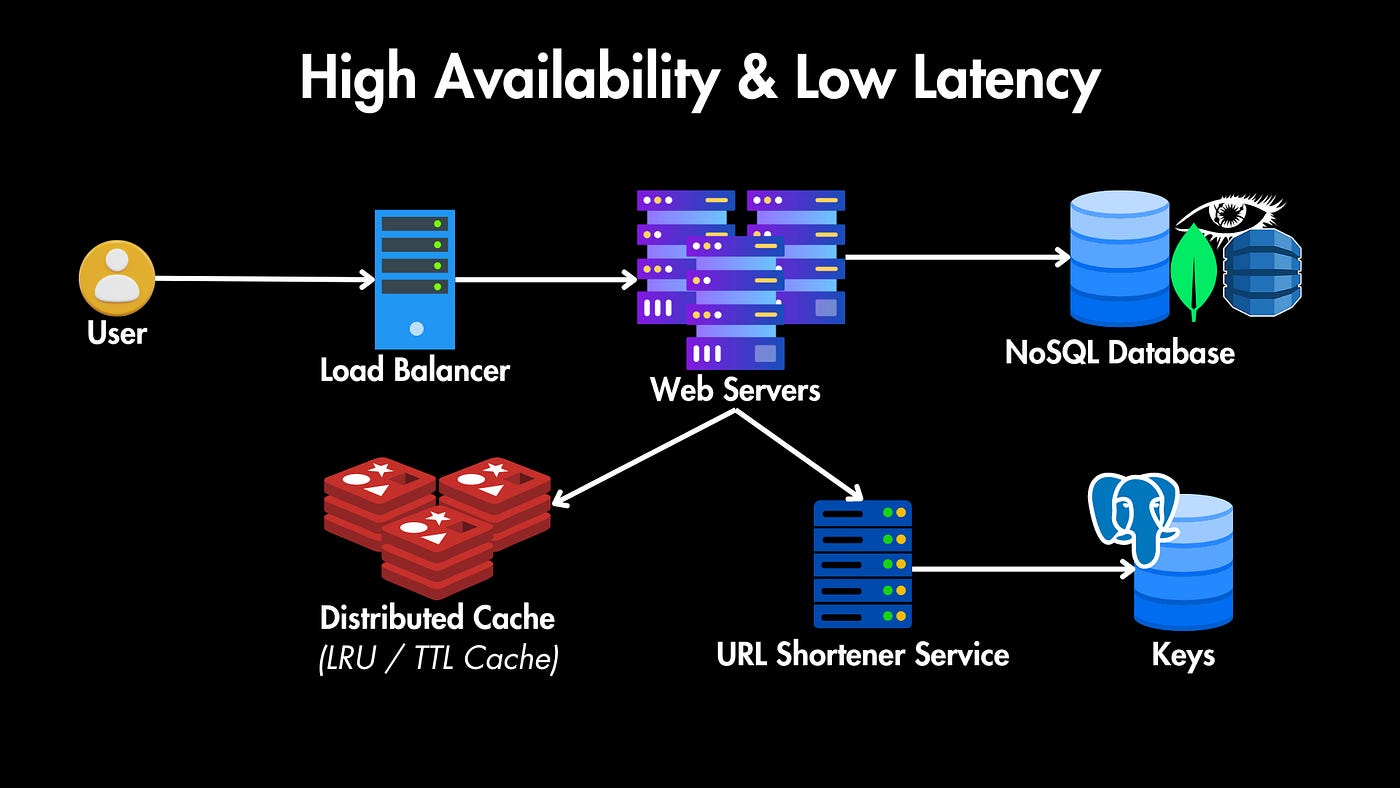 Caching is critical for URL shorteners to handle high read volumes and maintain millisecond-level redirect latency. Because redirection is the most frequent operation, caching the mappings between short codes and long URLs drastically reduces database load.
To handle this, an aggressive caching layer (using Redis or Memcached) is placed directly in front of the database. When a short link is clicked, the application checks the in-memory cache first. If the mapping exists, it instantly redirects the user without querying the database. Caches are typically configured to hold the top 20% most active links, which often account for 80% of all global traffic.
4. HTTP Redirection: 301 vs. 302
When the server successfully finds the long URL, it must send an HTTP status code to the user’s web browser to execute the redirect. The choice of status code impacts the system’s server load and analytics capabilities.
-
301 (Permanent Redirect): This informs the user’s browser that the short link will always point to this specific long URL, instructing the browser to save it in its local cache.
-
Advantage: Subsequent clicks on the short link by the same user will be redirected locally by their browser, completely bypassing your servers and reducing load.
-
Disadvantage: Because the traffic bypasses the server, you cannot track repeat clicks. Analytics for that specific user will be incomplete.
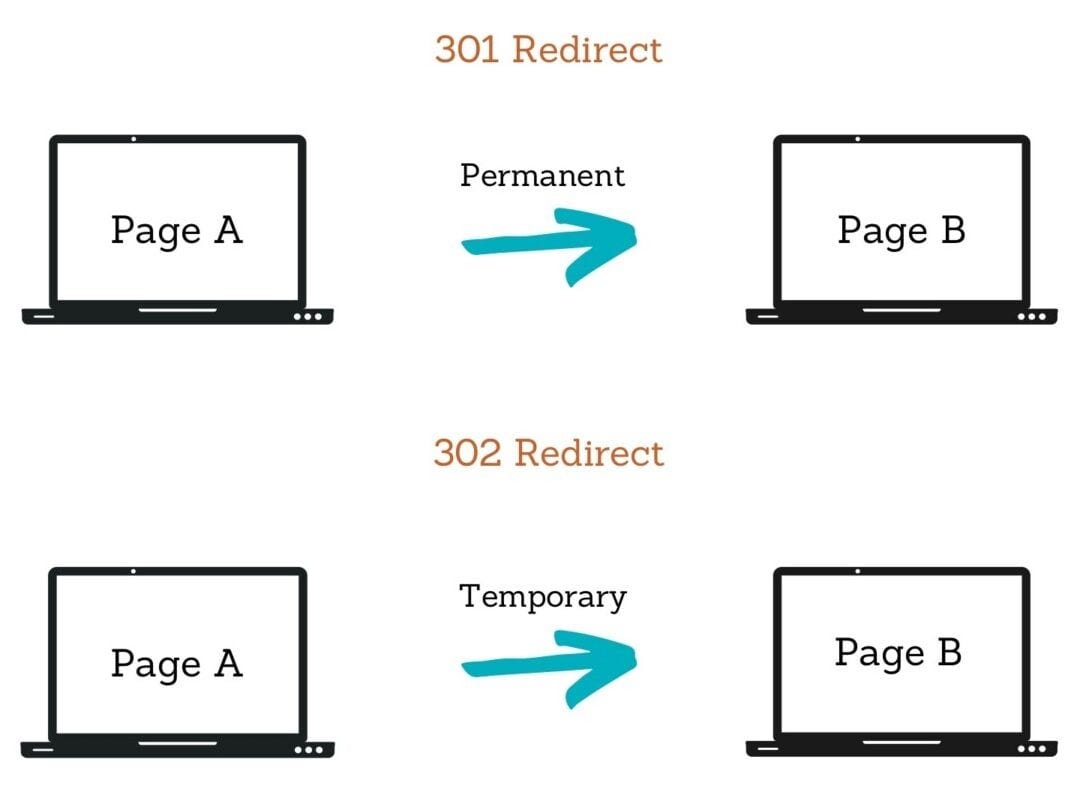 For URL shorteners, 302 (temporary) redirects are generally the better choice. Because short links frequently change destinations, expire, or require tracking, 302 redirects give the server full control. 301 redirects should only be used if you intend for the short link to permanently point to a destination forever.
-
302 (Temporary Redirect): This instructs the browser to navigate to the long URL for this specific instance, but to check back with the server for any future clicks.
-
Advantage: Every single click is routed through the servers, allowing for highly accurate tracking of click rates, user locations, and referral data.
-
Disadvantage: The system must provision significantly more server infrastructure and caching capacity to handle the continuous traffic volume.
This Substack is reader-supported. To receive new posts and support my work, consider becoming a free or paid subscriber.
Thanks for reading! This post is public so feel free to share it.