The science of the workplace soundtrack.
By Alex Press
Published: 2026-09-07
URL: https://thealexpress.substack.com/p/who-gets-the-aux-cord
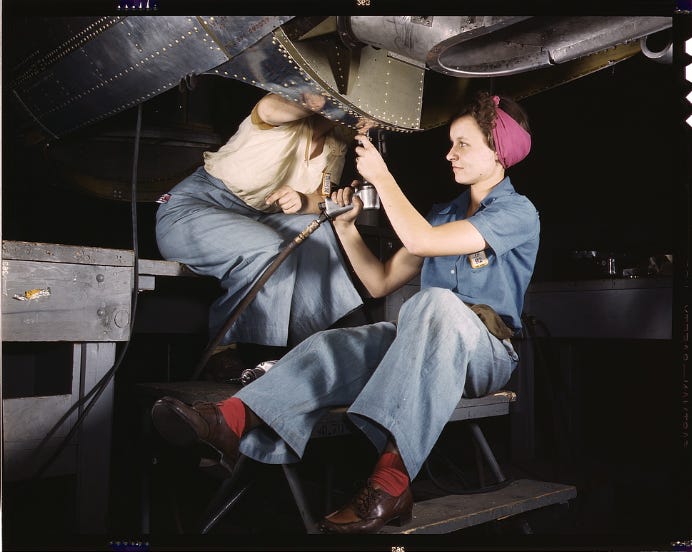 Women at work on bomber, Douglas Aircraft Company, Long Beach, Calif. Alfred T. Palmer / Farm Security Administration - Office of War Information color slides and transparencies collection (Library of Congress)
A few years ago, someone at a coffee shop in Manchester put on “the most ferocious-sounding Balkan metal imaginable.” As barista RM Clark recounted in the Financial Times, no one admitted responsibility, although “the 6ft 2in Bosnian barista was looking sheepish.”
A few days later, management banned heavy metal. Taylor Swift was banned too. The baristas were permitted to play only “cool” music: Tame Impala, Father John Misty, Bill Withers. As Clark understood management’s thinking, the coffee shop wasn’t a big chain, so Taylor Swift wouldn’t do, but neither was it “legitimately countercultural,” so heavy metal was out too. An independent coffee shop, wrote Clark, “must suggest all things almost-but-not-quite subversive.”
The Alex Press is a reader-supported publication. To receive new posts and support my work, consider becoming a free or paid subscriber.
The prohibition didn’t entirely work. One morning, Clark picked up the communal iPod Touch and saw what had recently been playing: “Balkan Bangers.”
(At a café where I once worked, who got to pick the music was an ongoing source of friction—my choices were definitely far from popular, though in my defense, I was going through it.)
In 2021, researchers published the results of a 56-week experiment at eight Filippa K clothing stores in Stockholm. At four stores, employees were given an app that let them influence the music, choosing between playlists with different intensities, changing the volume, and skipping songs. At the other four, management retained control.
Sales fell 6 percent at the stores where workers got more say over the music. The employees tended to play higher-intensity music and skip slower songs; they also had, as the researchers put it, “diverse music preferences.” The authors concluded that “store owners might want to limit” employees’ opportunities to influence the music.
In 1944, the War Production Board (WPB) devoted 66 pages to sound in the workplace. Its Guide to Industrial Sound called a factory sound system a “production tool.” It could be used for paging, “morale building talks,” emergency announcements, and “playing music for the relief of fatigue and boredom.
“A maximum of about 2-1/2 hours of music per 8 hour shift has been found to be sufficient,” the guide advised. “More music, even though the employees request it, causes a surfeit resulting in decreased effectiveness.” Better to follow “the showman’s principle of leaving the audience wanting more.”
“The usual practice is to start the morning off with a short period of march music or other peppy tunes,” it continued. “This helps to wipe away the morning gloom.”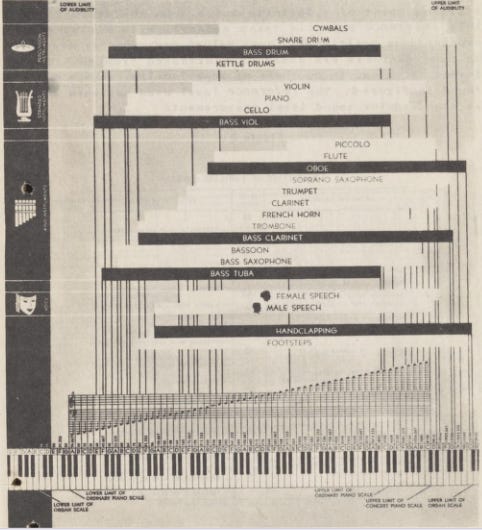 Figure from the WPB’s Guide to Industrial Work
The timing could be worked out scientifically. In 1941, R. L. Cardinell began systematically studying music in industry at the Stevens Institute of Technology. As historian Alexandra Hui recounts, Cardinell measured workers’ output at ten- or fifteen-minute intervals and plotted the “fatigue curve,” which typically showed productivity dropping in mid-morning and again shortly before the end of the workday.
The WPB took over funding the research in 1943, and the guide put the idea to use. “Music played just before and during a fatigue period serves as a pick-up.” Selections could be arranged “in order of increasing stimulus.”
The songs required some thought. Industrial music should have a “well defined melody and rhythm.” Full orchestras were preferable to solo instruments because otherwise “the tune may become lost in the machinery noise.” “Hot music or Jive is best avoided also,” the guide warned. “The demand for it may be great, but too much of it is overstimulating.” Employee requests could be included, “but only with discrimination.” Requests that didn’t fit the plan could be played at lunch.
Some songs presented more specific problems. “At a minimum, the music was not to distract or annoy workers (or enrage them),” writes Hui.
Alternatively, the music could not become such a preoccupation that work declined — the playing of “Deep in the Heart of Texas” was discouraged because some factories had reported problems with workers unable to resist stopping their tasks to clap along with the chorus. Slow, sentimental songs could remind female workers of their lovers away at war and cause them to become depressed.
The factory already had a lot of sounds. Presses, motors, looms, and other machinery could make ordinary conversation difficult and damage workers’ hearing. Muzak claimed that its recordings could “literally ‘cut through’ factory noise” without simply being played louder. The WPB guide warned that turning up the music could make it another “source of annoyance.” Work music should instead be kept at “as low a level as is compatible with good definition.” By 1948, Muzak was reporting that direct increases in production were possible while “completely ignoring employee music preferences.”
There was at least one case in which workers objected to the arrangement altogether. Per Hui, around 1941, an employer tried piping music to a group of stevedores while they worked. Their union suspected that it was an attempt to make them work faster and threatened to strike. Management stopped the music.
Mostly, though, workers seem to have liked having something to listen to. In Britain, the BBC began broadcasting Music While You Work in 1940. Its original proposal called for two half-hour broadcasts a day of rhythmic music, with no announcements. Among the virtues the BBC listed for the program were that it would “emphasise the drive towards production” and “relieve the tedium of work.”
A BBC report the following year collected employers’ assessments.
“In the absence of music there is a great tendency to discuss the doings of the night before and to talk across the machines,” one reported. “Immediately music is heard conversation tends to fade away.”
At another factory, women had been leaving their stations early. “Before the introduction of music female workers used to wander off to the cloakrooms towards the end of the day and were absent for 15 or 20 minutes. Since the introduction of music this practice has ceased.”
One manager thought music had a “humanising effect” that helped counteract “the evil effects of the mechanisation of the workers.” “This, indirectly, is a decided benefit to production.”
Music at work wasn’t confined to factories. By the 1940s, programmers were distinguishing between music for physical and mental labor. As Hui notes, Muzak had separate programs for physical fatigue (Green), mental fatigue (Purple), and boredom (Gold). The Purple Program, designed for offices, promised to “relieve mental and visual fatigue and nervous tension”; music for mental work was supposed to stay quiet enough to “recede into the background.”
The personal stereo changed the arrangement. With a Walkman, a worker could choose what to hear without making everybody else listen to it. Headphones could offer a private soundtrack for an entire shift.
At Amazon warehouses, workers have fought management over whether they can use headphones. At the DDP9 delivery station in Philadelphia in 2022, 90 of roughly 120 workers signed a petition demanding the right to use earbuds. At DBK4 in Queens, workers organized around the same issue. “People want to listen to their music,” worker Dylan Maraj told Labor Notes. “People need to feel that sort of comfort to get through this work.”
Amazon had prohibited earbuds on safety grounds while managers sometimes played music over loudspeakers. “We shouldn’t let management dictate what we listen to with a loudspeaker,” Maraj said.
After the organizing, Amazon began allowing workers at select sites to wear one of two company-approved earbuds. At other warehouses, a lot of workers just hide earbuds under beanies or otherwise keep them out of sight.
P.S. I continue to receive very few Shift Notes submissions! Not nearly enough to do it as envisioned, combining several sets of notes, publishing entries on a regular basis. Rectify this problem! Send bullet points, send jokes, send profound life lessons! All to [email protected]. More info about what to send is in the post.
The Alex Press is a reader-supported publication. To receive new posts and support my work, consider becoming a free or paid subscriber.