There are so many books about Hollywood. Here are a few worth reading.
By Alex Press
Published: 2025-11-19
URL: https://thealexpress.substack.com/p/film-industry-lit
I’m writing a freelance piece about Hollywood (in addition to the book and everything else), and it has led me to look back through books about Tinseltown. Ever since I started covering the dream factory’s working conditions, it’s been one of my favorite subjects.
By now, I give at least one talk a year about What Makes Sammy Run?, Budd Schulburg’s novelization of old Hollywood and the founding of the Screen Writers’ Guild, the WGA’s predecessor. (This year’s talk happened last week: I have once again brought the joys of the name-naming Schulburg’s tome to a new generation of college students).
It’s not hard to understand why I like reading about Hollywood: here’s the site where capitalist dynamics are on steroids and under spotlights. Hierarchy, monopoly, limitless advertising, dog-eat-dog brutality, technological doomsaying, labor organizing, vulgar individualism: it’s all there. Plus, reputation’s the coin of the realm, making gossip a potent weapon, which is why nobody dishes like showbiz people.
The Alex Press is a reader-supported publication. To receive new posts and support my work, consider becoming a free or paid subscriber.
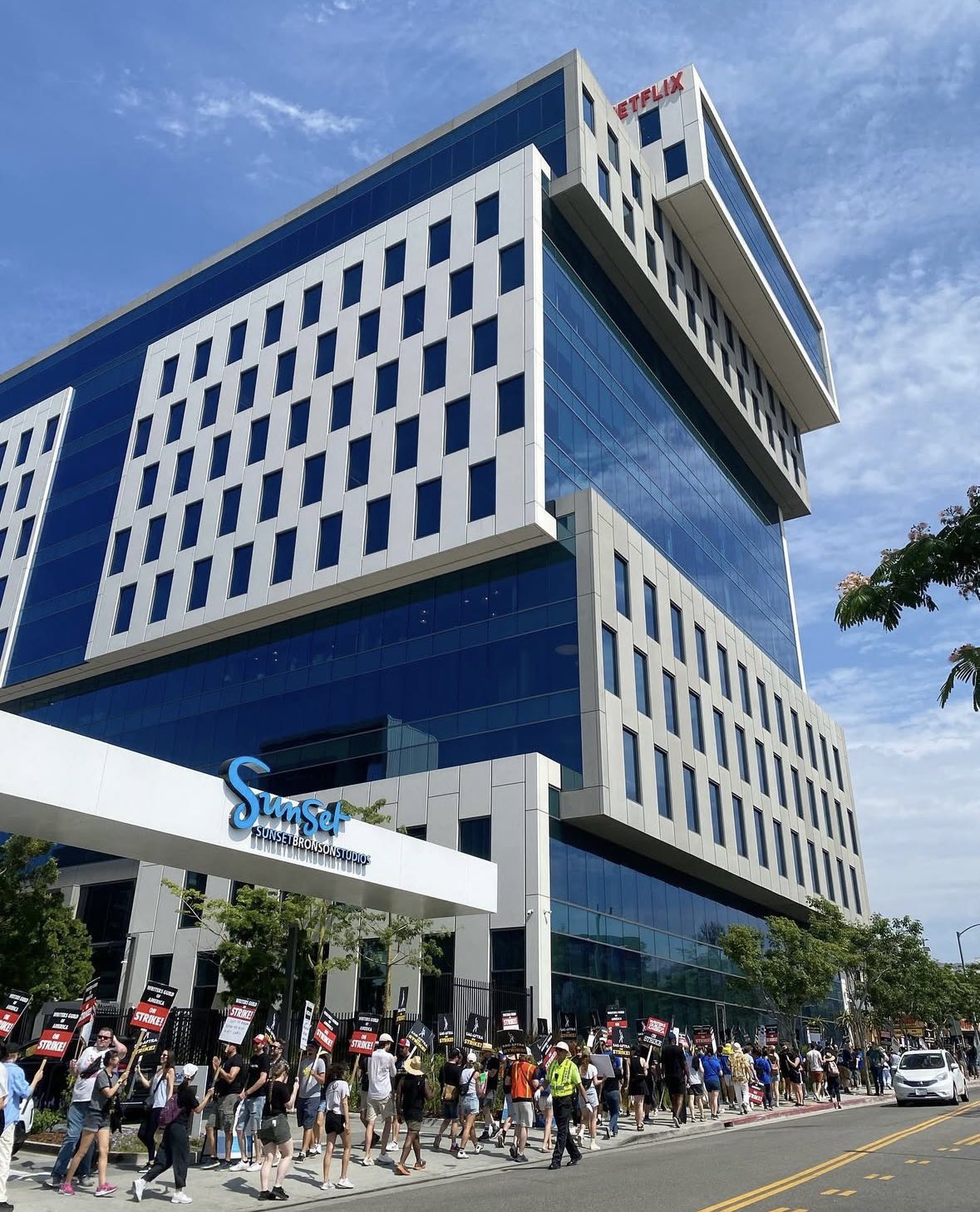 \Netflix picket line, Summer 2023\
Throw in the fact that writers are a central part of the industry—usually as its shit heel, hence the joke about the actress who was so dumb that she slept with a screenwriter to try to get ahead—and you’ve got an inexhaustible supply of accounts to read, fiction and nonfiction.
The fiction version of this list may broaden the Hollywood category to mean Los Angeles in general—because it’s a company town once one considers not only the people whose names you see in lights but also the below-the-line work and that adjacent to the industry (catering, events, even manufacturing)—but I’ll stick with the film industry specifically for now since a list of the best nonfiction about LA would be far too long.
Best Hollywood Literature (in no particular order)
The Studio / John Gregory Dunne. As far as the film industry in particular, this one’s underrated. It’s somewhat of an update on Lillian Ross’s Picture (a deserved classic in the genre) but it’s one of my favorites, fiction or nonfiction. 20th Century Fox gave Dunne effectively unlimited access to the studio’s operations—Dunne was married Joan Didion and they were an incredibly glamorous duo, so I imagine Darryl Zanuck figured all press would be good press in this case.
The result isn’t terribly critical, but it is extremely funny. (More people have read Monster, John and Joan’s account of their failure as screenwriters: that one’s good too but The Studio’s better.)
Another City, Not My Own / Dominick Dunne While we’re on the Dunne family: John’s brother Dominick wrote a completely ludicrous, vaguely fictionalized account of his time as a star reporter covering OJ Simpson’s trial in Los Angeles for Vanity Fair. Dominick is social climbing and status consciousness personified, but that makes him perfect to write about the media frenzy and celebrity fascination with the trial. He’s always dining out with movie stars and executives, so if you can accept his tone—self-puffery, elitism—it’s an amazing account of an event that ushered in our publicity-obsessed era.
Note: It’s easier accept his pretentiousness when you remember that his own daughter was murdered by a man with whom she’d been romantically involved, giving Dunne a righteousness underneath all his frivolity. Absolutely crazy ending too, I didn’t know whether to laugh hysterically or throw the book across the room.
What Happens Next / Marc Norman. In the lead-up to the writers’ strike, I read a bookshelf worth of screenwriters’ books and memoirs, and Norman’s is the best mixture of informative and fun. Norman wrote the screenplay for Shakespeare in Love, among other movies, so he’s well-positioned to explain the industry, but as the title promises, it’s also a page-turning anecdote-heavy rollick through the industry’s history with the kicked-around lowly writers.
Others in this genre: The Writers by Miranda Banks is the book a lot of WGA members read to learn their own history. Adventures in the Screen Trade is a classic, more fun than The Writers but also more dated. Class Struggle in Hollywood by Gerald Horne is a guide through the at times quite complicated history of labor organizing in the industry—when I went to the Valley to interview Lindsey Dougherty, the head of the Teamsters’ Motion Picture Division, she was reading this one too.
Making Movies / Sidney Lumet. Excellent director-side explanation of the industry. Lumet’s worked with everybody and made masterpieces, so he really has the authority to talk about the subject. The chapter on cameras helped me finally appreciate cinematography! Plus, the stories Lumet uses to illustrate his point are incredible: Marlon Brando doing thirty-four takes to get a line right, for instance. Excruciating.
Powerhouse: The Untold Story of Hollywood’s Creative Artists Agency / James Andrew Miller. CAA founder Michael Ovitz is the embodiment of Hollywood, which is why I’m always collecting anecdotes about the cartoonish Hollywood super-agent.
A classic is the time he went to see David Miscavige, the head of the Church of Scientology, because his client Tom Cruise was getting into it. He read Dianetics before seeing Miscavige: “The book was a good read, though nothing I would find as a religion. I could see though why actors would like Scientology: They’re gypsies, in a way. They don’t go to an office, so it grounds them.” (He told Miscavige that his star client would not be discussing the Church in interviews if Ovitz could help it.)
The Grove Book of Hollywood / Edited by Christopher Silvester. Gigantic edited volume that draws from the books I’ve mentioned and many more, just one excerpt after another from them. Great way in to figuring out which ones you want to pick up and read in full—at least that’s what I did.
It’s not about the film industry but I have to round out the list with City of Quartz, Mike Davis’s masterpiece about Los Angeles. It really isn’t a slog—if you haven’t read it yet, what are you waiting for?? What a genius that guy was.
OK I could keep going—You’ll Never Eat Lunch in This Town Again!—but enough for now. I’ll do fiction next, not that anybody asked—and if you’ve made it this far, here’s a moment that I will stretch to being about the film industry: I happened to be standing behind director Mira Nair, Zohran Mamdani’s mom, at his Election Night party when we saw on the screen that the race had been called. A very sweet video.
If you didn’t see it, I wrote a piece on the final days of the mayoral race, joining Mamdani as he met taxi drivers and hospital workers on the night shift. (I’ve got another article out today : on the Starbucks strike and Brian Niccol, one of the great enemies of the working man.)
P.S. If you want to read good film criticism, A.S. Hamrah has TWO new books out.
The Alex Press is a reader-supported publication. To receive new posts and support my work, consider becoming a free or paid subscriber.