a16z’s token math, fun as the new moat, and the case against mega-funds. From the director’s seat.
By The AI Leadership Edge
Published: 2026-07-19
URL: https://theaileadershipedge.substack.com/p/humans-are-now-cheaper-than-software

Hi, I’m Raffaela, and welcome to AI Leadership Edge, a newsletter for investors and business leaders who want to gain leverage with AI.
Join a community of 41,000 board directors and leaders, with 13,500+ newsletter subscribers. Subscribe free and get the free AI Boardroom Edge Course

This edition is powered by BoardLens, the AI edge for boards and portfolios. Your board materials, read against thousands of outside signals through your lens, never trained on and auditable to source. Independent directors use it on one board; GPs across the whole portfolio. Start free at www.boardlens.ai.
Humans Are Now Cheaper Than Software
George Sivulka published one of the more interesting AI essays I have read this year over at Andreessen Horowitz, on humans being cheaper than software for the first time in history. Two of his charts make the case on their own. Annualized AI spend per employee at the top 1% of firms has already crossed the cost of the average US worker, around $98K a year, and at its current growth rate it passes the average software engineer, around $192K, before year end. And two years after adoption, the heaviest AI adopters have grown headcount by 10.2%. Not cut it, grown it.
I would actually go one step further than him.
I think this makes the ultimate argument for the future of leadership in an AI-driven world, and why leaders, and boards, will become more valuable, not less.
The next decade won’t belong to the companies with the smartest AI. It will belong to the companies that learn how to lead it.
Boardroom takeaway: AI isn’t reducing the need for leadership. It’s increasing its leverage. Every company is building a second workforce, one human, one digital. The organisations that outperform won’t simply deploy more AI. They’ll build leaders and boards capable of governing both.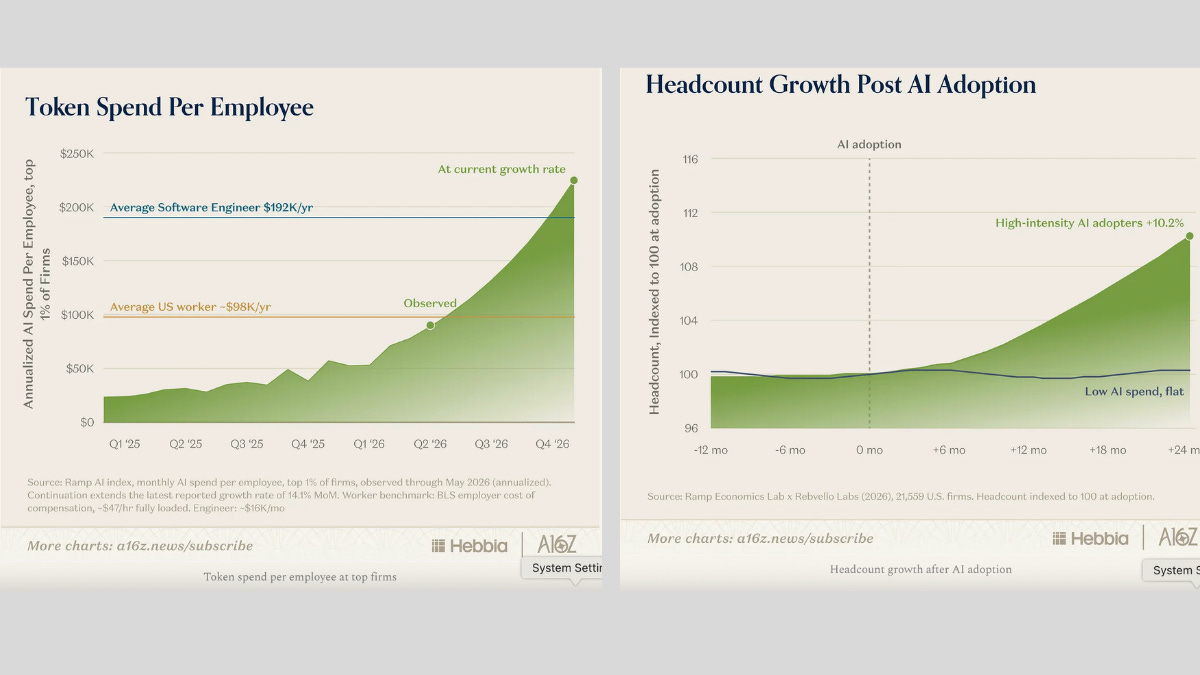
Image source: a16z / Hebbia
Read the essay → For the first time in history, humans are cheaper than software
Having Fun Is the New Moat
How to build a moat in the age of AI is a recurring theme in this newsletter. We looked at it when we covered The Future Technology Company won’t look like a Startup. It will look like Dior, and again with The moat is dead, long live taste. Justin Welsh, one of the best-known solo operators on the internet, just nominated a new candidate: fun.
His logic is hard to argue with. When copy, visuals, systems and entire funnels can be built in an afternoon for a few hundred dollars, every proven playbook gets cloned the moment it starts working. What cannot be cloned is a person who loves the work and would do the work anyway. His example is a small-town newsletter builder who hosts community game nights and prints physical issues, not because a growth guide told him to, but because he loves it. Readers feel the difference, and they stay.
For boards and investors: Energy is a leading indicator, and it shows up in the room long before it shows up in the numbers. Encourage your executive teams to have fun and keep a character of play.
Read Justin Welsh’s essay → Having fun is the new moat
Fewer Junior Investors, More Engineers
The new Data Driven VC Landscape Report 2026 is out, and the hiring plans tell you exactly where analyst work is heading. Across the 137 firms surveyed, 49% plan at least one engineering hire in the next 12 months, not a single one plans engineering cuts, and 51% expect flat teams. Junior investing roles run the other way: 45% of firms plan to cut them, 53% are holding steady, and just 2% plan to add. It is the first cycle in which engineering teams are expected to grow faster than junior investment teams, as firms automate the sourcing, screening and memo work analysts and associates used to do.
For fund directors and LPs: the associate desk was never just labor. It was the apprenticeship that produced the next generation of partners. Ask the funds you sit over where partner judgment will come from once the bottom rung is automated away. A firm that hasn’t thought about it is running an experiment on its own succession.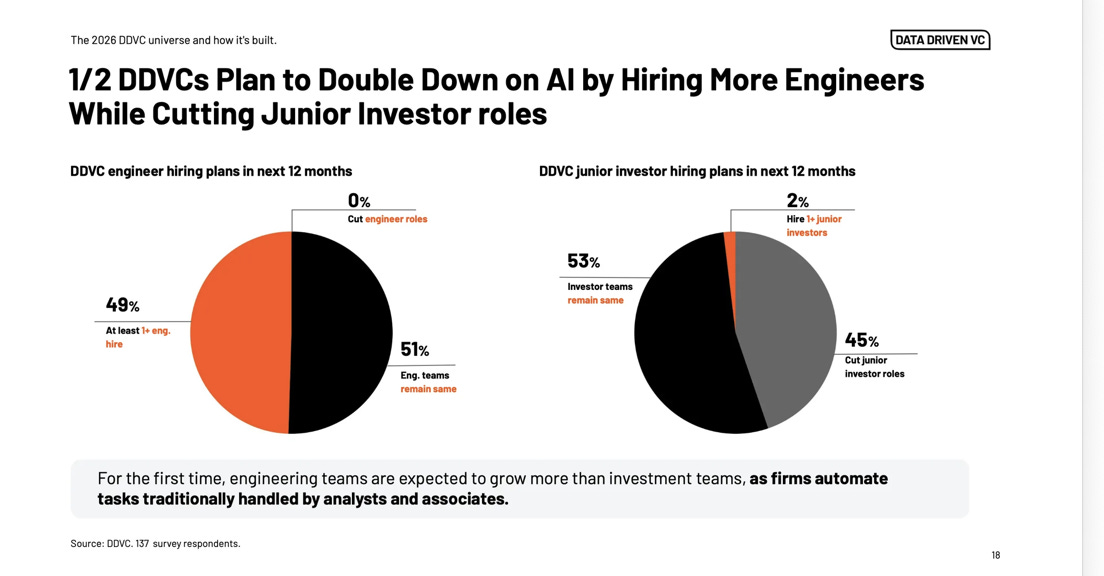
Image source: Data Driven VC
Read the report → Data Driven VC Landscape 2026
US Companies Are Switching to Cheaper Chinese AI Models
Futurism reports that companies including DoorDash, Airbnb and Siemens are moving parts of their AI workloads onto open-weight Chinese models from DeepSeek, Z.ai and Moonshot, and that the agent startup Lindy has dropped Anthropic entirely for DeepSeek’s V4. The economics explain it: the companies most committed to AI now spend around $7,500 per employee per month on it, per the Ramp AI Index. At that run rate, a model that is nearly as capable at a fraction of the price starts winning procurement reviews.
Boardroom takeaway: last week we covered the US and China splitting into two incompatible AI stacks. If management proposes cutting the AI bill with cheaper models, make sure the review covers what changed besides the price: where the data goes, who can audit the model, and how much geopolitical exposure came bundled with the savings.
Read the piece → US Companies Are Realizing That Chinese AI Models Are Way Cheaper
Decision Agents Reach the Boardroom
Most AI budgets buy operational efficiency. BCG’s new piece looks at the least-funded and perhaps most valuable use instead: decision agents that support executive committees through their highest-stakes calls. Think of one as an extra seat at the table, a chief of staff with supercomputing power that pulls evidence from every function into a single picture, stress-tests scenarios live in the meeting, and comes back with concrete recommendations and follow-ups.
BCG points to three places: integrated business planning, where volume, capacity and budget decisions have to line up across functions; portfolio investment allocation, where strategy, finance and operations inputs need to be synthesized into one capital view; and market-entry decisions, where risk, feasibility and timing get assessed together instead of in sequence. The number that stays with you: companies expect to double AI investment to 1.7% of revenues, yet decision-making ranks last among AI investment priorities, at just 14%.
Boardroom takeaway:
Everyone is buying efficiency. Almost nobody is investing where the leverage is highest, the quality of the decisions themselves.
Board question: which recurring executive-committee decision would you trust an agent to prepare first, and what would it need to see to do it properly?
Read the BCG piece → Decision Agents Bring AI into the Boardroom
Posts of the week
Subscribe for more
This Substack is reader-supported. To receive new posts and support my work, consider becoming a free or paid subscriber.
🔐 Paid subscribers also get access to the Top 1% of Playbooks for Leaders, GPs and Boards (updated monthly), Top Prompting Hacks for Boards and Fund leaders, plus a weekly premium deep dive. Many subscribers expense it as personal development.
💭 Remember! As a premium subscriber you get access to every playbook in this series. The most worth reading alongside this one:
1️⃣ What the best PE boards do that the rest don’t · Read here
2️⃣ 5 Ways Leaders Are Using AI to Coach Themselves · Read here
3️⃣ AI: A tool that thinks for you, or a tool that makes you think? · Read here
4️⃣ How to track AI productivity · Read here
5️⃣ Build your own chief of staff with AI. Save $160,000 and 10 hours a week. · Read here
6️⃣ How to build a board that creates value instead of diluting it for PE and VC · Read
🗣 Or you can always invite a friend and earn rewards along the way:
→ 1 friend = The AI Leadership Prompt Library
A community of 41,000 board directors and leaders. 13,500+ newsletter subscribers are already inside.