The 90 days after the wire, mapped step by step for founders and their boards
By Raffaela Rein
Published: 2026-07-14
URL: https://theaileadershipedge.substack.com/p/the-post-raise-guide
Hi, I’m Raffaela, and welcome to AI Leadership Edge, a newsletter for investors and business leaders who want to gain leverage with AI.
Join 13,500+ leaders, boards and GPs. Subscribe free and get The AI Edge 5-Day Crash Course. Paid subscribers get every playbook in full, plus The Executive AI Index, the Top 10 Prompting Hacks, and The AI Leadership and Boardroom Toolkit. Refer a friend and unlock the full AI Leadership Prompt Library.
The company had the capital. It did not have a plan the board could see.
The wire clears on a Friday. The announcement goes out. By Monday the team is hiring, the founder is doing press, and the plan that raised the round is a slide deck nobody has opened since the close.
This is the quiet failure mode of a good raise. Not fraud, not a market collapse. Just a company that treated the wire as the finish line and let the next 90 days blur. It is the pattern behind most of the 2021 mega-round cohort that raised big and never raised again.
The board feels it first. A board pack now runs anywhere from 80 to 2,000 pages per company per quarter, and a director who signs off on a plan they cannot actually see is carrying a risk their D&O policy does not cover: their own name and reputation, and a deposition years later. The founder feels it next, at month nine, when the runway turns out to be shorter than the milestone.
More activity does not fix this. A burst of hiring and shipping is not the same as a plan you can hold the quarter to. The round does not de-risk the company. The next 90 days do.
And the stakes are not small. More than $13T sits in private markets, and almost all of it flows through this exact window, the work after the cheque clears, which happens to be the least-loved and most-neglected part of the job on both sides of the table.
This is not a paperwork exercise: it is the difference between a round that becomes momentum and a round that becomes a countdown.
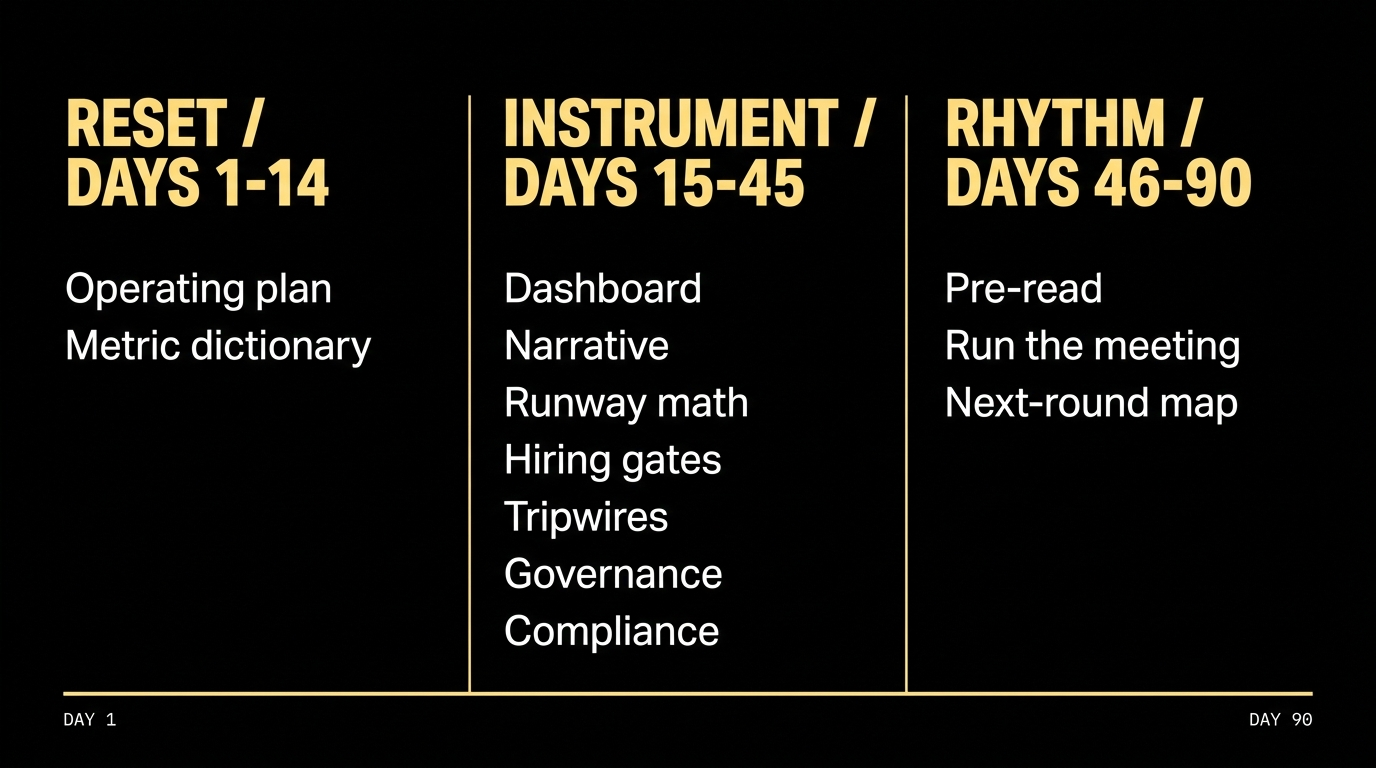
So I built a map. Three phases, fourteen prompts across the 90 days, each one run on your own numbers in your own private workspace. I call it the Post-Raise Map. The first step is free. The rest are for paid subscribers.
Why the map beats the sprint
The instinct after a raise is to sprint: hire fast, ship fast, spend fast, prove the round was deserved. The problem is that a sprint has no gates. It burns the same cash whether it is pointed at the milestone that earns the next round or at ten things that merely feel productive.
A map is different. It points the work at the few numbers the next round actually rewards, and it puts a gate on everything else. One generic instruction to “make me a plan” gives you a plan-shaped document. A map gives you a sequence, baseline then instrument then run, with a board question at every step that keeps the number from drifting.
Rule 0: Where you run these
A board pack never goes into a public chatbot. Neither does your cap table, your model, or your signed round documents. Paste any of it into a consumer assistant and your most sensitive numbers can end up training someone else’s model. That is the exact tradeoff BoardLens exists to remove.
Every prompt below runs in a private workspace, where your materials never leave the room and are never used for training. That is not a line at the bottom of the page. It is the reason a careful board can let AI near its numbers at all.
And run everything through your lens. Start each prompt as the person who has to own the answer: “Acting as the founder who just closed this round” or “Acting as an experienced [sector] director or investor with a [thesis] lens.” The same prompt, read through your seat and your thesis, returns an answer you can act on instead of a generic summary.
PHASE 1, RESET (days 1 to 14). Two weeks to turn the promise you raised on into a plan everyone can hold. This is the free step.
Re-baseline the plan you raised on (free)
The deck that got the round funded was a promise. Turn it into a plan the board and the team can hold you to, and agree on what every number means before anyone starts spending. Two prompts do it.
1. Turn the deck into a one-page operating plan
Acting as [the founder who just closed this round / an experienced [sector]
investor with a [your thesis] lens], read the attached pitch deck and the
latest financial model. Turn the deck's promises into a one-page operating
plan: the market and wedge, the 12 to 18 month goal, and the 3 to 5 metrics
this capital is meant to move. For each metric, give the starting value, the
target, and the date it is due. Then pull the 2 or 3 metrics the round was
actually priced on and mark them clearly. Cite the source page or cell for
every number. Return one page, nothing longer.
Why this one pays for itself: it converts the story that raised the round into a plan with a date on every promise, on one page, so nobody is rebuilding it from memory the night before a board meeting.
2. Write the metric dictionary
Acting as [the founder / an experienced [sector] director] with a [your thesis]
lens, for each metric in the operating plan, write a one-line definition: the
exact formula, the source system it is pulled from, who owns it, and how often
it updates. Flag any metric that is defined two different ways across the deck,
the model, and the data room, and propose the single definition we will use
from now on. Return a short metric dictionary, one row per metric.
Why this one pays for itself: a board loses an hour whenever a metric means two things. One definition per number ends that argument before it starts, and gives you the single source of truth every later step reads from.
Founder takeaway: what are the three numbers this money is meant to buy, by when, and does everyone define them the same way?
The edge, day 14. Two weeks in, you are the only person in the company who knows what every number means, because you are the one who defined them. Nobody reframes your metrics in a board meeting again, and nobody argues about the denominator in month seven. The plan stops being something the board holds you to. It becomes something you hold the quarter to.
🔒 Below the paywall, the rest of the map:
→ Instrument (days 15 to 45): the board dashboard, the board narrative, the runway math and its downside case, the hiring gates, the tripwires, the governance changes, and the compliance checklist
→ Rhythm (days 46 to 90): the board pre-read, the decision-first meeting agenda and minutes, and the next-round map
→ The one-pass master prompt that runs the whole review and returns a single brief
Paid subscribers also get The Executive AI Index, the Top 10 Prompting Hacks, and The AI Leadership and Boardroom Toolkit, plus two full editions like this every week.
Most subscribers expense this as professional development.

💭 Remember!
As a premium subscriber you get access to every playbook in this series. The 5 most worth reading alongside this one:
1️⃣ The top 1% AI Playbooks for Leaders, GPs and Boards Read here ->
2️⃣ The Top 10 Prompting Hacks for Leaders, Investors and Boards Read here ->
3️⃣ AI: A tool that thinks for you, or a tool that makes you think? Read here ->
4️⃣ How to track AI productivity Read here ->
5️⃣ Build your own chief of staff with AI. Save $160,000 and 10 hours a week. Read here
🗣 Or invite a friend and earn rewards along the way:
→ 3 friends = 1 month free
→ 5 friends = 3 months free
→ 25 friends = 6 months free
Over 13,500 leaders, boards, fund managers, and sponsors are already inside.