History shows that technological shifts first feel like loss, then become periods of reorganization, adaptation, and new opportunity.
By The Agentic Teacher
Published: 2026-08-01
URL: https://theagenticteacher.substack.com/p/opportunity-arrives-wrapped-in-pain
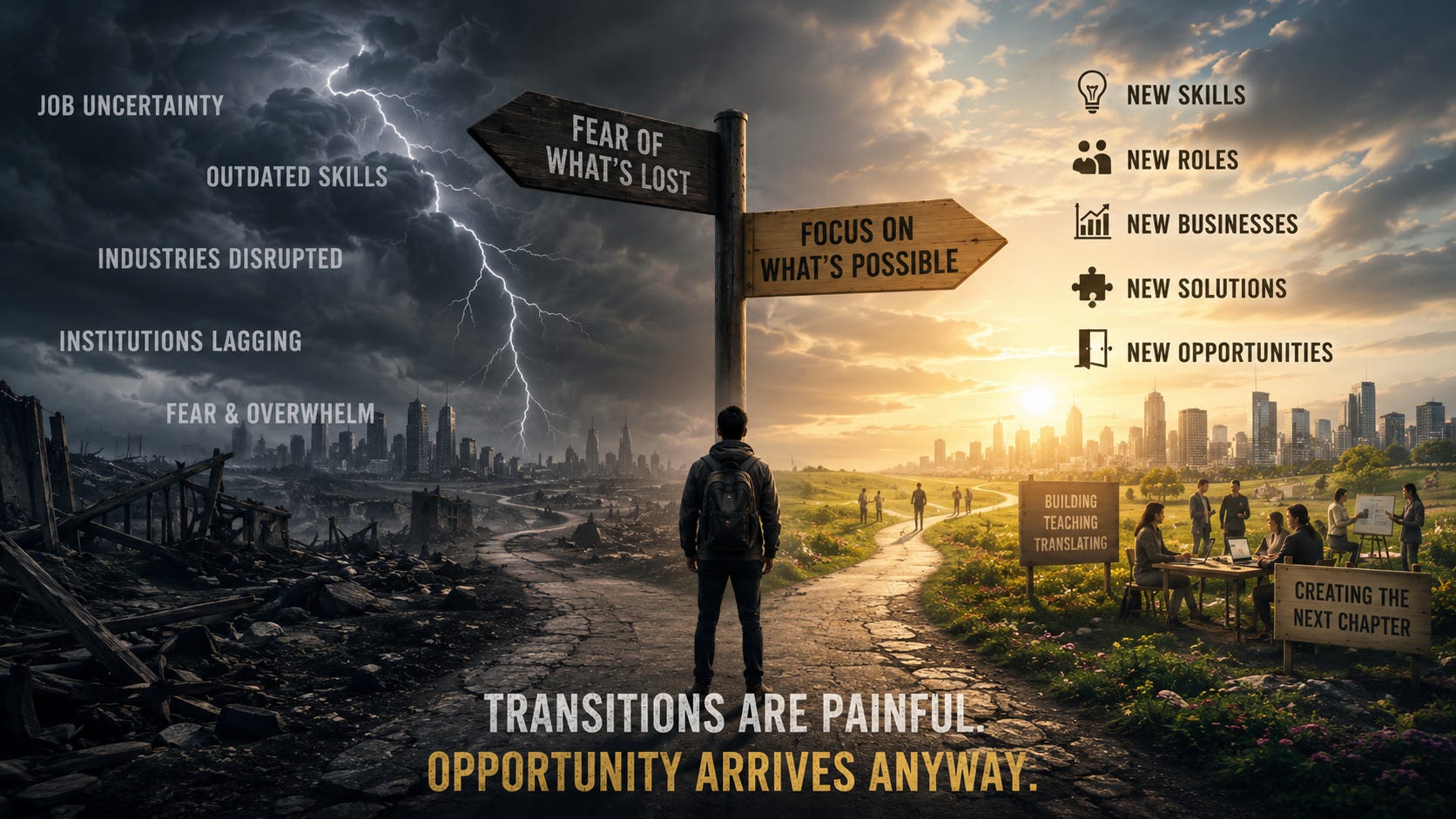
I taught Social Studies for many years, so I tend to look at moments like this through a historical lens.
One thing I often had to help students understand is that history books make events look orderly.
One chapter follows another.
One war follows one economic crisis.
One invention follows one social movement.
But that is not how people experience history while they are living through it.
In real time, everything overlaps.
Wars are happening.
New technologies are emerging.
Prices are rising.
Institutions are lagging.
People are questioning what kind of future they are walking into.
Fifty years from now, what we are living through may be taught as a clean sequence of events.
But right now, it feels messy because we are inside it.
And for many knowledge workers, small business owners, educators, creators, and independent professionals, AI does not feel like a tidy chapter in a textbook.
It feels like the ground under work is changing.
The rules feel less stable. The future feels harder to predict. Entire industries are trying to figure out what AI means for their survival.
And underneath a lot of the conversation is a quiet fear:
What happens to people like me if the world changes too fast?
That fear is real.
But historically speaking, it is also normal.
Disruption Always Feels Unprecedented From the Inside
Every major technological shift creates a period where the old world starts breaking before the new one is fully built.
That middle space is uncomfortable.
People lose confidence.
Institutions move slowly.
Familiar skills begin to feel less secure.
And because we are living inside the transition, it can feel like nothing like this has ever happened before.
But it has.
The printing press did not simply create more books. It threatened institutions that controlled information.
Industrial machinery did not simply make production faster. It disrupted skilled labor, family economies, and entire ways of working.
Electricity did not simply light rooms. It reorganized factories, cities, communication, and daily life.
The automobile did not simply replace the horse. It reshaped roads, suburbs, logistics, oil, retail, travel, and the rhythm of modern life.
The internet did not simply give people websites. It rewrote media, music, publishing, commerce, education, advertising, and communication in a single generation.
Every one of those transitions created fear.
Not because people were weak.
Because the threat was real.
The First Story Is Loss
When technology changes the structure of work, people do not just worry about tools.
They worry about identity, income, relevance, status, and whether the skills they spent years building will still matter.
That is not irrational.
That is human.
For a writer, AI can raise the question: what happens when drafting becomes cheap?
For a consultant, it can raise the question: what happens when research, synthesis, and analysis become easier to automate?
For an educator, it can raise the question: what happens when students can generate answers faster than institutions can redesign learning?
For a small business owner, it can raise the question: what happens when competitors start using AI to move faster, create more, and operate with less friction?
These are not imaginary concerns.
They are part of the first story of disruption.
Loss.
Loss of certainty.
Loss of status.
Loss of old categories.
Loss of the feeling that yesterday’s way of working will be enough tomorrow.
But history also shows something else.
The first story of a technological transition is usually loss.
The second story is reorganization.
The Second Story Is Reorganization
Old categories weaken.
New categories appear.
Some work disappears.
Other work becomes more valuable.
New businesses form around the confusion.
New teachers emerge.
New translators become useful.
New systems are needed because the old systems no longer explain the world clearly.
That is where opportunity often hides.
Not outside the pain.
Inside it.
During the gold rush, not everyone got rich mining gold.
Some people built supply businesses. Some sold tools. Some organized transportation. Some created maps. Some opened stores. Some fed, housed, guided, and equipped the people trying to enter the new economy.
The opportunity was not only in the gold.
It was in helping people adapt to the world the gold rush created.
That is how I think about this AI moment.
The opportunity is not simply to “use AI.”
That is too small.
The deeper opportunity is to become useful in the transition.
Useful as a teacher.
Useful as a translator.
Useful as a builder.
Useful as a strategist.
Useful as someone who can take confusion and turn it into structure.
What Adaptation Looks Like Now
For knowledge workers and small business owners, adaptation does not only mean learning the newest AI tool.
It means learning how your work changes when AI becomes part of the working environment.
It means asking different questions.
What parts of my work are becoming easier to automate?
What parts still require judgment?
What context does AI need before it can help me well?
What standards do I use to decide whether an AI-assisted output is good enough?
Which workflows can be made repeatable?
Which parts of my expertise need to be turned into instructions, examples, review criteria, or reusable systems?
That is practical adaptation.
A creator may need to turn scattered ideas into a reusable content system.
A consultant may need to turn their judgment into clearer frameworks and client-facing processes.
An educator may need to redesign assignments around thinking, evidence, and review instead of simple answer production.
A small business owner may need to organize their audience context, offer language, customer objections, service process, and quality standards so AI can support real work instead of producing generic output.
This is not about becoming technical overnight.
It is about making your work easier to understand, repeat, improve, and delegate.
AI rewards people who can give it structure.
Fear Is Not a Strategy
Most people are not refusing to adapt because they are lazy.
Many are overwhelmed because the ground is moving faster than their current systems can interpret.
They do not need more fear.
They need orientation.
They need language.
They need examples.
They need structure.
They need people who can say:
This is not magic.
This is not the end of everything.
This is a transition.
And transitions can be learned.
That does not mean pretending the disruption is painless.
Some jobs will change dramatically. Some industries will contract. Some people will wait too long. Some organizations will underestimate what is happening until the market forces them to respond.
But fear alone is not a strategy.
The Better Question
A better question is:
Don’t leave useful teaching buried in your next search.
Subscribe free to unlock the Free Resource Hub—a growing collection of practical articles, guides, and tools to help you think more clearly, make better judgments, and move your work forward.
Join free and get access now.
What becomes valuable when the old system stops organizing work the way it used to?
That question opens a different door.
Because in moments like this, value often moves toward people who can learn quickly, communicate clearly, organize complexity, build systems, and help others make sense of the new terrain.
That does not require pretending to be technical if you are not.
It does require becoming adaptable.
It requires paying attention.
It requires building before the map is complete.
It requires enough courage to stop waiting for official permission to notice that it is raining.
This Is a Creation Window
The social contract around jobs is being rewritten.
AI is forcing that conversation faster than most institutions are prepared to admit.
But this is not the first time technology has disrupted society.
And it will not be the last.
The real question is not whether change is coming.
It is already here.
The question is whether we will relate to this moment only as a threat, or also as a creation window.
Opportunity rarely arrives looking clean.
More often, it arrives wrapped in uncertainty, friction, and pain.
That does not make the opportunity fake.
It just means we have to learn how to recognize it before the new rules become obvious to everyone else.
For knowledge workers, small business owners, educators, and independent professionals, the next step is not to panic or chase every tool.
The next step is to organize your adaptation.
Start with the work in front of you.
What do you need to understand better?
What do you need to make repeatable?
What context do you need to preserve?
What standards do you need to define?
What part of your expertise needs to become easier for AI, collaborators, or clients to use?
That is where the transition becomes practical.
Not in predicting the whole future.
In building the structures that help you work inside it.