Small businesses get real leverage when they stop using AI randomly and start building repeatable workflows around the work they already do.
By The Agentic Teacher
Published: 2026-07-31
URL: https://theagenticteacher.substack.com/p/businesses-dont-need-more-ai-tools
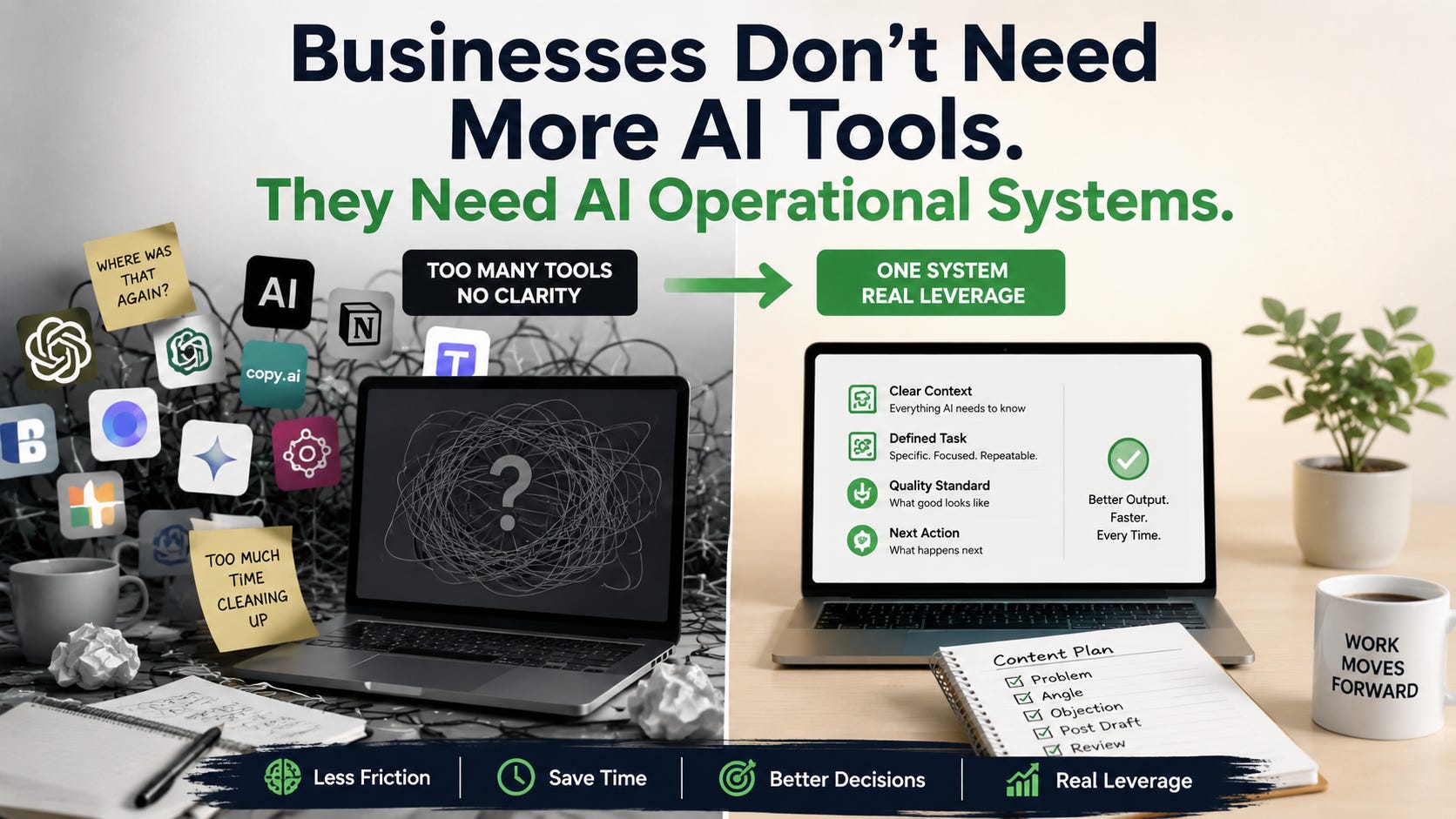
Every week, a new AI tool shows up.
An AI writing tool.
An AI meeting assistant.
An AI sales tool.
An AI research tool.
An AI automation platform.
An AI agent that promises to do half your business by Tuesday.
For a lot of small business owners, this does not create clarity.
It creates tool fatigue.
The problem is no longer that businesses cannot access AI. Most people can open ChatGPT, Claude, Gemini, or another tool within minutes.
The real problem is that the AI use is scattered.
One day it is used to write a post.
Another day it is used to answer an email.
Another day it is used to summarize notes.
Then it gets forgotten until the next urgent task.
That is not a system.
That is random assistance.
And random assistance does not compound.
The Misdiagnosis
Many business owners think the answer is a better AI tool.
So they keep looking for the next app.
But most of the time, the problem is not the tool.
The problem is the workflow around the tool.
If your process is unclear, AI will usually make the mess faster.
It may give you more words, more drafts, more options, and more things to review.
But more output is not the same as more leverage.
A business does not need AI to create more noise.
It needs AI to reduce friction inside real work.
That means the question changes.
Instead of asking:
“Which AI tool should I use?”
A better question is:
“Where does my work keep slowing down, repeating, or getting messy?”
That is where AI should go first.
A Simple Example
Take a local service business.
Maybe it is a landscaping company, plumbing company, cleaning business, or home repair service.
The owner wants to post more consistently online.
So they open ChatGPT and type:
“Write me a Facebook post for my business.”
ChatGPT gives them something polished.
But it sounds generic.
Now the owner still has to fix the message, clarify the customer, adjust the tone, make it sound local, and decide whether the post is even worth publishing.
That did not buy back much time.
It just outsourced a first draft while keeping all the thinking load on the owner.
A better approach is to turn that recurring task into a simple AI workflow.
Not a complicated system.
Just a repeatable way to help AI understand the job before it starts writing.
Instead of asking for a post immediately, the owner might first clarify:
Who is this for?
What problem is the customer already feeling?
What objection might stop them from acting?
What should this post help the customer understand?
Now AI is not just writing.
It is helping organize the thinking before the writing happens.
That is the shift.
From Prompt to Workflow
A prompt is one instruction.
A workflow is a repeatable way of getting useful work done.
For example, instead of starting from scratch every week, the business could create a simple weekly content rhythm:
Identify the customer problem.
Choose the best angle.
Clarify the objection.
Draft the post.
Review it against a clear standard.
That does not require complicated software.
It requires a repeatable process.
The same idea applies to other common business tasks:
Customer follow-up emails.
Meeting summaries.
Sales replies.
Proposal reviews.
Weekly planning.
Offer clarification.
Decision support.
The goal is not to build some massive AI operation overnight.
The goal is to stop using AI randomly.
Start with one recurring task.
Notice what context you keep repeating.
Notice where the output still feels generic.
Notice what standard you use when deciding whether the work is good enough.
That alone can improve the usefulness of the output.
The Real Shift
Businesses do not need infinite prompts.
They need repeatable AI support around work that already matters.
That is what I mean by an AI operational system.
Not a giant enterprise platform.
Not a complicated automation maze.
A simple repeatable way to use AI inside recurring business work so the value does not disappear after one chat.
The important shift is not complexity.
It is continuity.
When AI has context, a clear job, a standard for good work, and a next step, it becomes more than an answer machine.
It becomes part of how the business thinks, organizes, and moves work forward.
So before adding another AI tool, look at the work you already repeat.
Where are you rewriting the same kinds of messages?
Where are you making the same decisions from scratch?
Where are you losing time because the thinking is scattered?
Start there.
Build one repeatable AI workflow.
That is where the leverage begins.
If you want to test this in your own business, reply with one recurring task where AI still gives you generic output.
This Substack is reader-supported. To receive new posts and support my work, consider becoming a free or paid subscriber.