Teachers are not short on knowledge. They are buried under years of it. Codex can help organize, question, and repurpose the materials they already built.
By The Agentic Teacher
Published: 2026-06-08
URL: https://theagenticteacher.substack.com/p/codex-for-teachers-turn-scattered
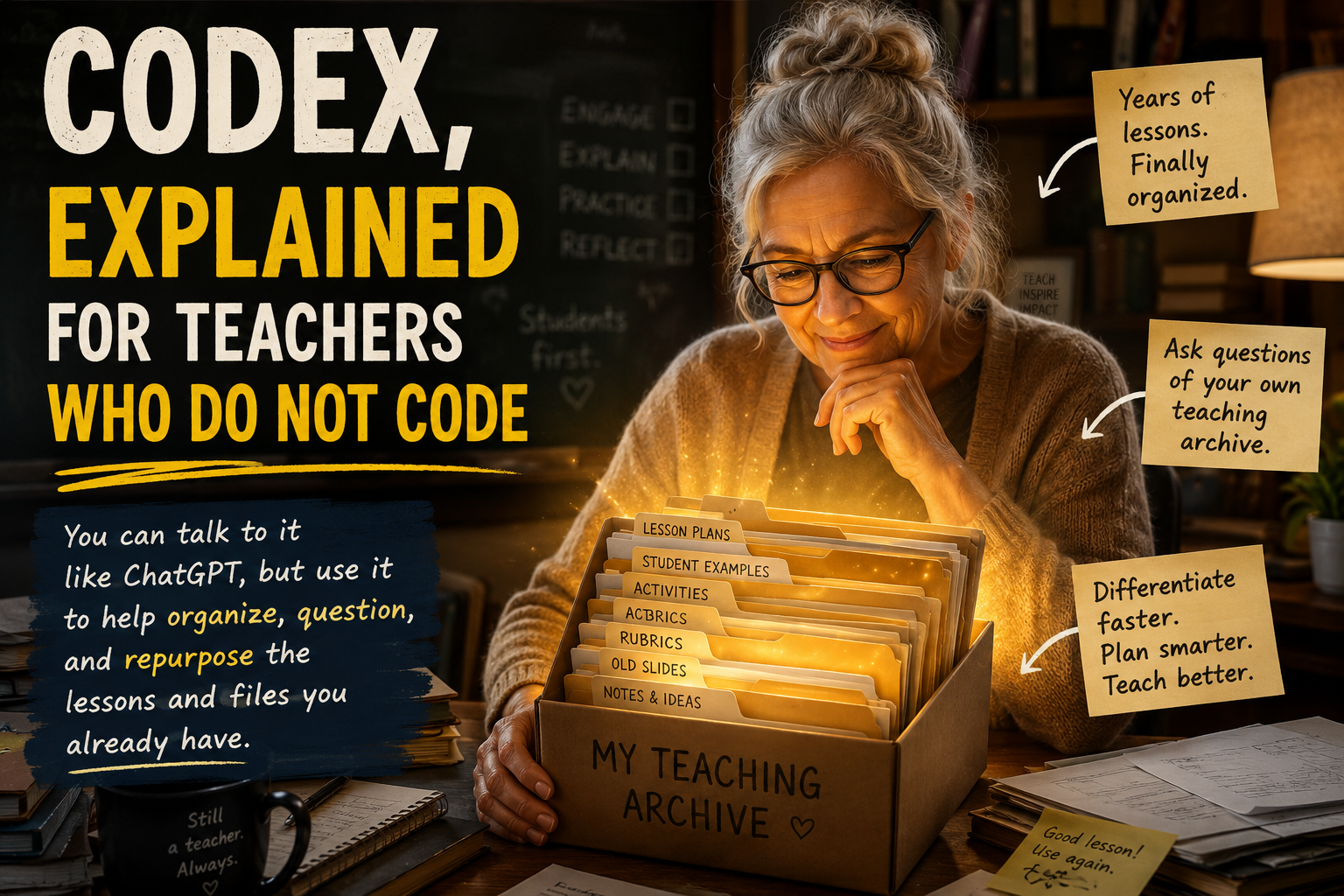
Week 1 of 4: Codex for non-coders. Start the Codex shift with the files you already have. ChatGPT is about to merge with Codex. This will help you can take advantage of the upgrade what and why you should use it.
Teachers are not usually short on knowledge.
They are buried under years of it.
Old lesson plans. Slides. Worksheets. Rubrics. Notes. Student examples. Activities that worked once but got lost somewhere. Units from three curriculum changes ago. Explanations you know you gave well, but cannot find when you need them.
If you have ever had folders inside folders, files with names that made perfect sense five years ago, or a document called something like “Final Version 3 REALLY FINAL,” you understand the problem.
And this is not only a teacher problem.
Consultants have this problem.
Coaches have this problem.
Trainers have this problem.
Business owners have this problem.
Writers, creators, workshop leaders, and knowledge workers have this problem.
Teaching makes the problem easy to see, but the pattern is much bigger. Anyone whose work depends on accumulated knowledge eventually runs into the same issue.
They have years of useful thinking, material, examples, notes, frameworks, client language, drafts, outlines, and unfinished ideas. But much of it is scattered across old folders, drives, documents, chats, and half-remembered systems.
The problem is not always:
“I need AI to create something new.”
Sometimes the problem is:
“I know I already have something useful for this, but I cannot find it.”
Or:
“I know I explained this before, but I do not remember where.”
Or:
“I have years of material, but it is not organized in a way I can reuse.”
That is where Codex got my attention.
First, I am a retired school teacher. If I had to write code to save my life, I would be doomed.
So I did not get interested in Codex because I wanted to become a coder.
That was never the point.
I got interested because I started to see what it could mean for teachers, knowledge workers, and people who have spent years building ideas, explanations, lessons, resources, frameworks, and working materials.
Most of the discussion around Codex focuses on coding. That makes sense. It was built with software development deeply in mind, and many of the people talking about it are programmers.
But from my perspective as a teacher and knowledge worker, one of its most interesting possibilities is not simply writing code.
It is working with accumulated knowledge.
In plain English, Codex is an AI workspace where you can give instructions in normal language and ask the AI to help inspect, organize, revise, or create things using the files and materials you give it access to.
That matters because a lot of knowledge work does not live only in a conversation.
It lives in the materials.
The old lesson.
The worksheet.
The notes.
The slides.
The rubric.
The client example.
The workshop outline.
The document you forgot existed.
The folder of unfinished ideas.
The easiest way I currently explain it is this:
ChatGPT is like a smart assistant you can talk to.
Codex is like giving that assistant access to a workspace.
Not unlimited access.
Not magic access.
Not “go do whatever you want.”
More like:
“Here are the materials. Look through them. Tell me what you see. Help me organize this. Help me turn this into something I can use.”
That is a different kind of AI help.
For a teacher, I think of it like this:
ChatGPT is like having a conversation with a strong teaching assistant.
Codex is like giving that teaching assistant access to the lesson binders, the file cabinet, the planning board, the old worksheets, the classroom materials, and the messy folder system you have been pretending is “organized enough.”
And unlike a real teaching assistant, it will not quietly judge the folder labeled “Final Final Final Use This One Maybe.”
The teacher still decides what matters.
The teacher still judges what is clear.
The teacher still knows the students.
But now the assistant is not just talking about the work.
It can help inside the place where the work lives.
A Simple Example
Imagine a teacher has years of files about persuasive writing.
Old slides.
Sample essays.
Rubrics.
Lesson plans.
Graphic organizers.
Student examples.
Notes from past years.
In the usual way of working, the teacher might think:
“I know I have something on this somewhere.”
Then the search begins.
Folder by folder.
Drive search.
Old laptop.
Downloads folder.
Maybe an email attachment.
Maybe a file with a name that only made sense during a planning period in 2018.
This is where teachers lose time and energy.
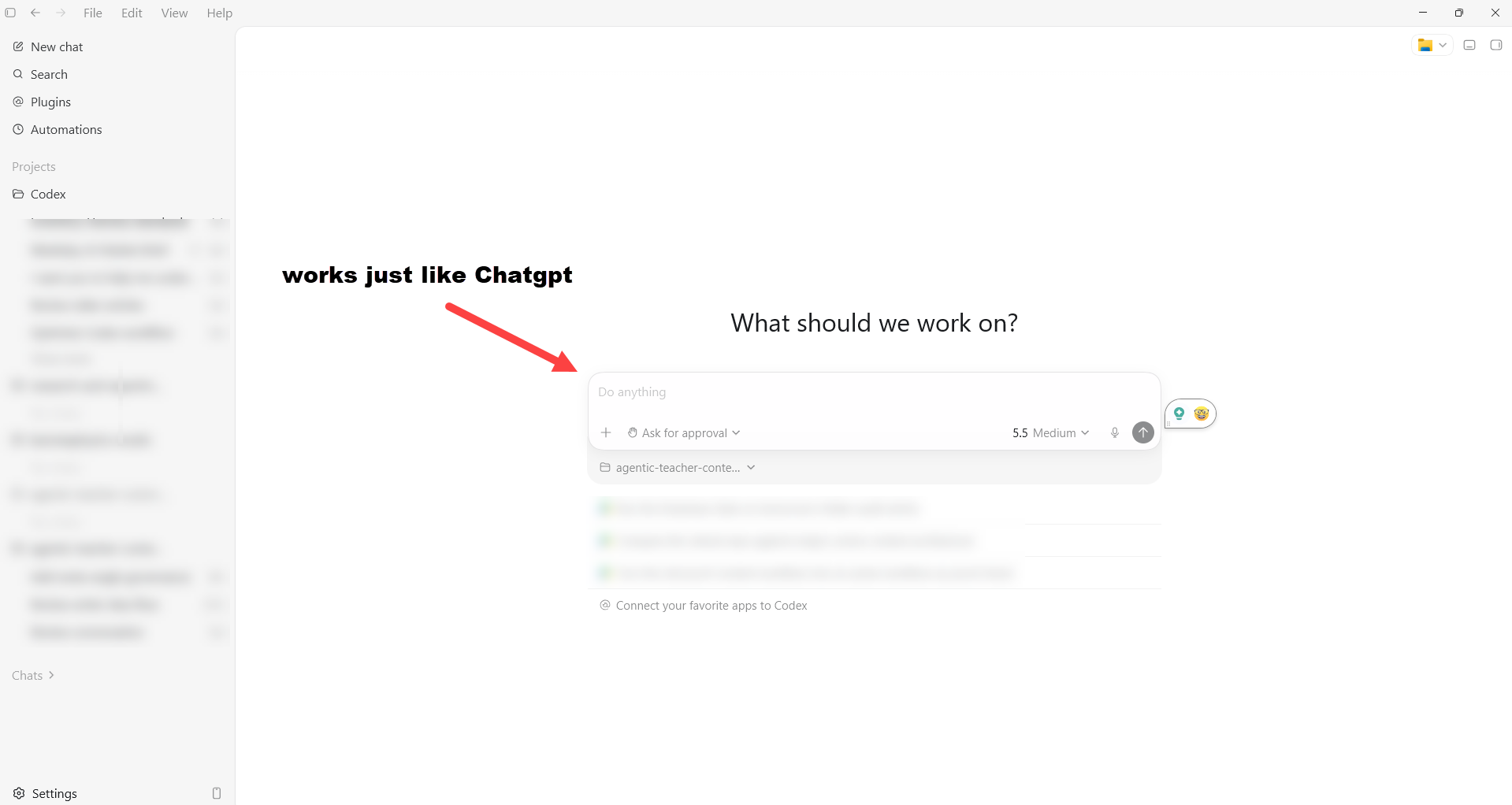
With Codex, the possibility is different.
You will type or speak the instructions into the interface like you would with ChatGPT.
A teacher could place those materials into a workspace and ask:
“Look through these persuasive writing materials. Find the strongest activities. Identify anything that could be reused. Suggest how I could turn this into a three-day sequence for students who struggle with organizing evidence. Do not change the original files yet. First, show me what you found.”
That instruction is plain language.
It is not C++, JavaScript, or JSON. No coding or technical language is required.
It sounds like something a teacher would say to a capable assistant.
And notice what is happening.
The teacher is not saying:
“Do my job.”
The teacher is saying:
“Help me inspect these materials so I can make a better decision.”
That is the difference.
This is not AI replacing teacher judgment.
This is AI helping the teacher work with the knowledge and materials they have already built.
That same pattern applies outside the classroom too.
A consultant could ask Codex to inspect old client strategy documents and find recurring problems.
A coach could ask it to organize past worksheets into a clearer program sequence.
A business owner could ask it to compare old SOPs, drafts, templates, and internal notes.
A creator could ask it to find recurring themes across old essays, newsletters, and outlines.
The deeper pattern is the same:
You are not starting from zero.
You are learning how to make your existing body of work usable again.
Teachers Already Know How to Give Codex Instructions
This is the part that clicked for me.
A lot of non-technical people hear about Codex and assume they need to use it like a programmer.
That assumption makes sense.
Most of the examples online are technical. They focus on writing code, building apps, fixing bugs, or automating software workflows. So it is easy to think Codex is mainly for people who already live in that world.
That is not how I think about it.
What surprised me is that I could interact with it in plain language, much like I already do with ChatGPT (see image above).
From a teacher’s perspective, it feels less like learning a new technical identity and more like using a familiar AI assistant inside a workspace that can work with your materials.
And teachers already know how to give instructions.
We do it all the time.
Read this first.
Use this example.
Do not change the original.
Make this easier for struggling students.
Create a more challenging version for advanced students.
Keep the learning goal the same.
Show your work.
Tell me what you found.
Wait before moving on.
Those are not technical instructions.
Those are teaching instructions.
And that is the bridge.
Working with Codex does not have to mean becoming a programmer. If you are already comfortable talking with ChatGPT, the interaction can feel very familiar.
You do not need to start with technical skills.
You need the same ability teachers use every day:
Give clear directions.
Set expectations.
Provide materials.
Explain what should and should not change.
Ask for a review before anything is finalized.
That is not coding.
That is directing work.
In many ways, it is less like learning to code and more like directing a capable student, assistant, or planning partner.
You describe the task.
You provide the materials.
You tell it what to look for.
You explain what should not be changed.
You ask it to show you what it found.
Then you decide what is useful.
That is a skill teachers already have.
Differentiation Is Where This Gets Even More Useful
Teachers do not usually create one clean lesson for one imaginary student.
They are constantly adjusting.
One student needs more structure.
Another needs a challenge.
Another needs vocabulary support.
Another needs the directions simplified.
Another needs a different example.
Another needs the same idea taught with less text.
That is differentiation.
And differentiation is hard because it multiplies the planning load.
The teacher is not only asking:
“What am I teaching?”
The teacher is also asking:
“How do I make this accessible to different students without losing the point of the lesson?”
This is where working inside a workspace becomes powerful.
With a regular chatbot, a teacher might paste a lesson into a conversation, ask for differentiated versions, then manually copy the results into separate documents, organize the files, and continue editing from there.
That can help.
But it still leaves the teacher as the middleman between every step.
Codex points to something different.
A teacher could say:
“Use this lesson as the base. Create three versions: one for students who need more scaffolding, one on-level version, and one extension version. Keep the same learning goal. Do not water down the thinking. Show me the differences before finalizing.”
Again, that is a teacher instruction.
Not a coding instruction.
The value is not that the AI magically knows the students.
It does not.
- The teacher still reviews it.
- The teacher still adapts it.
- The teacher still knows what will actually work in the room.
But the teacher is no longer starting from a blank page, and they are not manually moving every piece of content between tools.
In some cases, a process that might have taken close to an hour can move into a first usable draft in a few minutes.
- The thinking does not disappear.
- The judgment does not disappear.
- The teacher does not disappear.
What changes is how quickly the teacher can move from an idea in their head to something tangible they can review, revise, and improve.
This Is Not About Replacing the Teacher
This distinction matters.
Codex does not know your students the way you do.
It does not know what happened in third period yesterday.
It does not know which student is shutting down because the reading level is too high.
It does not know which activity looks good on paper but will fall apart in a real classroom.
It does not know the full context behind your instructional decisions.
The teacher still holds the judgment.
The teacher still knows the students.
The teacher still decides what matters.
And often, the knowledge being used is already the teacher’s knowledge.
Your lessons.
Your resources.
Your examples.
Your curriculum materials.
Your accumulated understanding of what works and what does not.
What changes is not who provides the expertise.
What changes is who helps manage the administrative work around that expertise.
Teachers spend a lot of time managing the materials around teaching.
Finding.
Sorting.
Updating.
Repurposing.
Reformatting.
Comparing.
Rebuilding.
Reusing.
Preparing.
Those tasks are important, but they are not the same as deciding what students need, how content should be taught, or why a particular approach matters.
That is what Codex made me think differently about.
The question is not:
“Can AI teach for me?”
That is the wrong question.
The better question is:
“Can AI help me organize, manage, and work with the knowledge and materials I have already built, so I can spend more energy on the actual teaching?”
That is a much better question.
The same is true for many knowledge workers.
The better question is not:
“Can AI replace my expertise?”
The better question is:
“Can AI help me structure, retrieve, and reuse the expertise I have already developed?”
That is where the real leverage begins.
The Bigger Shift
As a teacher and knowledge worker, I had already learned that AI becomes more useful when it has more than a prompt.
It needs context.
It needs source material.
It needs standards.
It needs examples.
It needs decisions.
It needs a way to reuse what has already been created.
Personalization helps AI remember general things about you.
But serious work needs more than general memory.
It needs structure.
That is why Codex matters to me.
It points toward a different way of thinking about AI.
Not just:
“Ask AI a question.”
But:
“Give AI a structured workspace where it can help you work with your own materials.”
For teachers, that means old lessons, notes, examples, rubrics, slides, and activities do not have to stay buried.
They can become part of a working knowledge base built from your own experience, decisions, examples, and materials. Instead of sitting in disconnected folders, your knowledge can become something you can search, question, organize, and reuse.
You could ask:
“What misconceptions keep showing up across these lessons?”
“Which examples have I used repeatedly?”
“What old material could become a review activity?”
“What parts of this unit are still useful?”
“What should be updated?”
“What can be turned into a differentiated version?”
“What materials support this standard?”
“What do I already have that could save me from starting over?”
That is the real promise.
Not coding.
Not hype.
Not pretending AI solves everything.
The possibility is more practical than that:
Your old materials can become usable again.
Your scattered knowledge can become searchable.
Your lessons, files, examples, and explanations can become a workspace.
And this is the bigger point for anyone who works with knowledge.
A body of work should not die in old folders.
A good explanation should not disappear because you forgot the file name.
A useful process should not have to be rebuilt from memory every time.
A strong idea should not be trapped in a document no one can find.
Codex is interesting because it points toward a future where non-technical people can work with their own knowledge in a more structured way.
You do not need to become a software developer to understand why that matters.
I am a 63-year-old retired teacher. Over the years, I also built a six-figure coaching business and a YouTube channel in another niche that grew to more than 100,000 subscribers. I do not mention that as a credential for coding—I still do not know how to code. I mention it because building educational content, coaching programs, and online businesses taught me the same lesson repeatedly: knowledge becomes far more valuable when it is organized into systems that can be reused, improved, and scaled.
But like many teachers, I am a systems thinker.
Curriculum design is systems thinking.
Lesson planning is systems thinking.
Assessment is systems thinking.
Differentiation is systems thinking.
Classroom management is systems thinking.
Teachers already understand how different parts of a system have to work together.
What really caught my attention about Codex was that it gave me a way to build a system of context around my AI. Instead of relying only on a conversation or a handful of prompts, I could organize files, materials, instructions, examples, and accumulated knowledge into a workspace the AI could actually work with.
That changes the relationship entirely.
The AI is no longer responding only to what I type in the moment. It can work within a structured environment built from the context I provide.
For me, that is one of the most important developments in AI because it allows knowledge workers to create systems of context that simply are not possible through chat alone.
It is not just a tool for programmers.
It points toward a future where teachers, creators, consultants, coaches, trainers, and business owners can work with the knowledge they have already built without starting over every time.
For teachers, the promise is clear:
Not AI replacing the work.
AI is helping turn scattered materials into a workspace that gives teachers back more time for the teaching only a teacher can do.
And for every knowledge worker with years of scattered files, forgotten notes, old drafts, reusable ideas, and buried expertise, the lesson is the same:
Start small.
Pick one folder of old materials.
Not your whole career.
One folder.
Do not ask Codex to create from scratch. Ask it to inspect what is already there, summarize what can be reused, identify what is outdated, and suggest one useful way to reorganize it.
That is the first move.
The future of AI is not just better prompts.
It is better workspaces.
A Roadmap For This Series
This is the first week in a four-week sequence. Each week has a Monday pillar, a Wednesday short tip, and a Friday workflow.
- Week 1 starts with Codex and the files you already have.
- Week 2 shows why better prompts are not enough.
- Week 3 gives your knowledge a home.
- Week 4 builds the first working version.
By the end of the 4-week sequence, you will know how to turn scattered AI use into a reusable system Codex can work from.
Part of the Codex for Non-Coders Series
This article is part of a four-week Agentic Teacher sequence on using Codex as a non-coder.
The series moves from understanding what Codex is, to organizing reusable context, to building your first Codex-usable knowledge repo.
The goal is simple: help you turn scattered AI use into a working system Codex can actually use.
Next in the series: “How Non-Coders Can Start Using Codex With the Files They Already Have”
This Substack is reader-supported. To receive new posts and support my work, consider becoming a free or paid subscriber.