A practical review of what changed, what regressed, and what replay tests cannot tell you.
By Ashu Kumar
Published: 2026-09-17
URL: https://theagenticstack.substack.com/p/a-better-model-can-still-break-your

The most useful page in a model-upgrade review is the one listing tasks that the current agent completed and the replacement failed.
I would read that before the headline pass rate. A candidate can improve overall while getting worse at the exact workflow a customer relies on. If it becomes better at answering product questions and worse at changing orders, the average alone leaves a fairly important decision unresolved.
Thanks for reading The Agentic Stack! Subscribe for free to receive new posts and support my work.
For an agent, changing the model also changes who chooses the next action. The surrounding software might remain untouched while the agent starts asking different questions, selecting different tools, or interpreting a failed request differently. That deserves a release review with evidence attached.
A recent TechforHumans engineering report offers a useful starting point. The team reconstructed conversation context, including instructions, memory, and available tools, to evaluate replacement models. Their study used 20 curated synthetic sessions, and tool execution was simulated. It is a useful account of a testing method; that scope limits how far its findings travel.
Here is how I would adapt the idea into a model-change review.
Start by writing down exactly what the proposed release changes. Record the model version, provider, instructions, tool schemas, retrieval inputs, memory, generation settings, and execution limits. Where possible, keep everything except the model fixed for the first comparison.
Sometimes that is impossible. A provider may require a different message format, or a candidate may need different settings. Record those adaptations as part of the candidate configuration. A broken response parser and a bad decision require different fixes; merging them into one failure count makes the next engineering step harder to see.
Keep prompt tuning separate from this initial comparison, then evaluate the complete tuned configuration before release. Reserve cases that were not used during tuning. Otherwise, the team can gradually improve its score on familiar examples without establishing whether the change helps elsewhere.
For a concrete example, consider a hypothetical retail agent. A customer asks it to change the delivery address, provided the order has not shipped. The stored address is incomplete, so the agent must ask for the missing detail before attempting the update.
At that point, there are two different experiments worth running.
A replay of one decision gives both models the same recorded context and asks what each would do next. This can reveal that the replacement guesses the missing detail or chooses an inappropriate tool. It makes a disagreement easy to isolate.
A complete workflow test lets each candidate continue from the same starting state in an isolated environment. Its tool calls update test records; subsequent tool responses reflect those changes. The test must also supply user responses appropriate to the questions actually asked, through a controlled simulator or a human tester.
That distinction matters as soon as the paths diverge. If the original agent asked for a postcode and the replacement asks for an order number, feeding both the recorded postcode answer stops being a faithful conversation. A simulator introduces its own assumptions, so inspect those exchanges too.
The TechforHumans report makes another boundary visible: expected tool calls receive recorded responses, while divergent calls receive simulated failures, with a separate judging mechanism to assess alternative paths. My interpretation is that this can help inspect decisions, but cannot fully establish how a valid new path would behave against the actual service. An unfamiliar action needs investigation before being labelled a model regression. Methodology.
For the retail example, inspect the resulting order record. Did the intended address change? Did an already-shipped order remain unchanged? Was any other order touched? The original τ-bench paper evaluates task completion by comparing the final database state with an annotated goal state. That is a useful foundation here, alongside checks on the required steps and the customer-facing explanation.
Once both configurations have run, organise the results by the same test cases: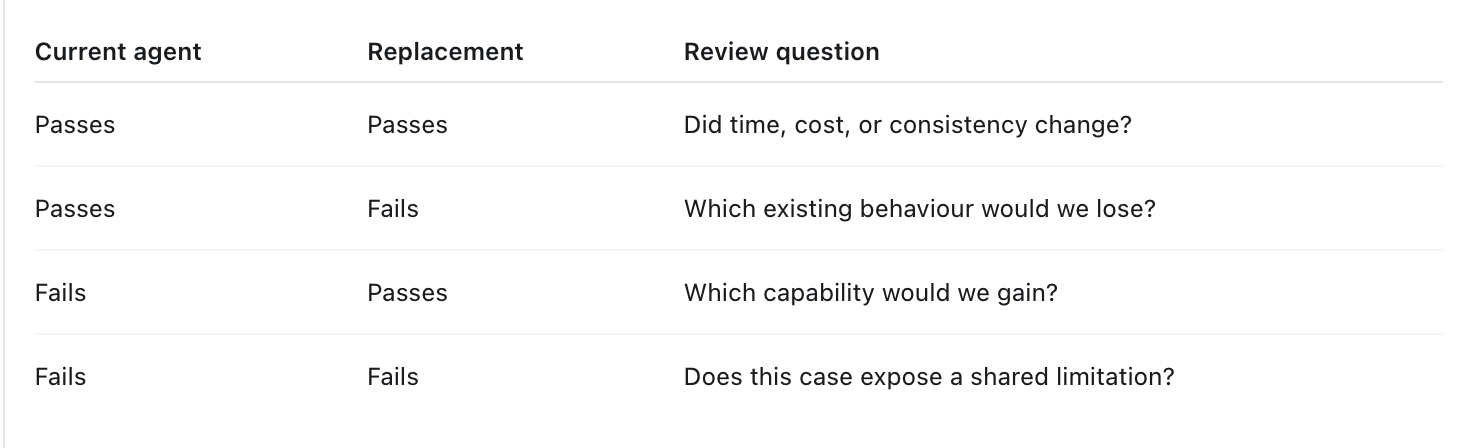
Read the regression cases individually. A new failure to update an address and a slightly awkward closing sentence should not carry the same release consequence.
Repeat important cases under both configurations and retain every result. Anthropic’s evaluation guidance treats repeated attempts as distinct trials because outputs vary. In the review, show how often each case succeeds, and manually inspect disagreements between the grader and the trace. A few successful trials cannot establish that a rare failure is absent.
Set release-blocking conditions before seeing the rankings. In our example, changing the wrong order or claiming that a rejected update succeeded should block expansion until investigated. Keep those conditions separate from a score that rewards speed or writing quality. A costly mistake should not disappear inside a favourable average.
Economics belongs in the same review. The FinOps Foundation recommends measuring AI costs against business outcomes. For this agent, I would compare total operating cost for a defined cohort divided by verified resolutions in that cohort, including failed attempts, retries, tool charges, and human handling. State what counts as resolved, and show the escalation rate beside it. An agent that hands difficult cases to staff can otherwise appear deceptively efficient.
The final step is a limited production rollout. Google’s SRE guidance describes comparing a candidate on a subset of traffic with the existing version, using explicit evaluation criteria to decide whether to proceed or roll back.
For this agent, I would keep each conversation on one configuration, monitor verified order outcomes, and name the person who can stop expansion. The comparison needs enough representative cases to support the decision; a quiet afternoon is weak evidence about the workflows it never encountered.
Reverting the model setting will not reverse an address change already submitted. The release plan therefore needs a way to identify affected orders and route them for correction, alongside the technical rollback.
The review should finish with a decision someone can explain: which behaviours improved, which regressed, which remain uncertain, and which customers will encounter the candidate first. If the evidence supports an upgrade only for product questions, release it there. Leave order changes on the configuration that earned its place.
References:
-
TechforHumans — Evaluating LLMs Under Production Parity. A first-hand report on model-swap evaluation, context reconstruction, simulated tools, and methodological limitations.
-
Yao et al. — τ-bench: A Benchmark for Tool-Agent-User Interaction in Real-World Domains. Evaluation through final database state and reliability across repeated trials.
-
Anthropic — Demystifying Evals for AI Agents. Agent evaluation structure, repeated trials, and the roles of different graders.
-
FinOps Foundation — FinOps for AI: Tools & Services Considerations. Use-case economics and measuring costs against completed business outcomes.
-
Google — The Site Reliability Workbook: Canarying Releases. Limited rollout, comparison with a control, and release evaluation criteria.
Thanks for reading The Agentic Stack! Subscribe for free to receive new posts and support my work.