How turn detection, interruptions, and response timing shape a production voice agent.
By Ashu Kumar
Published: 2026-09-15
URL: https://theagenticstack.substack.com/p/when-a-voice-agent-answers-too-soon
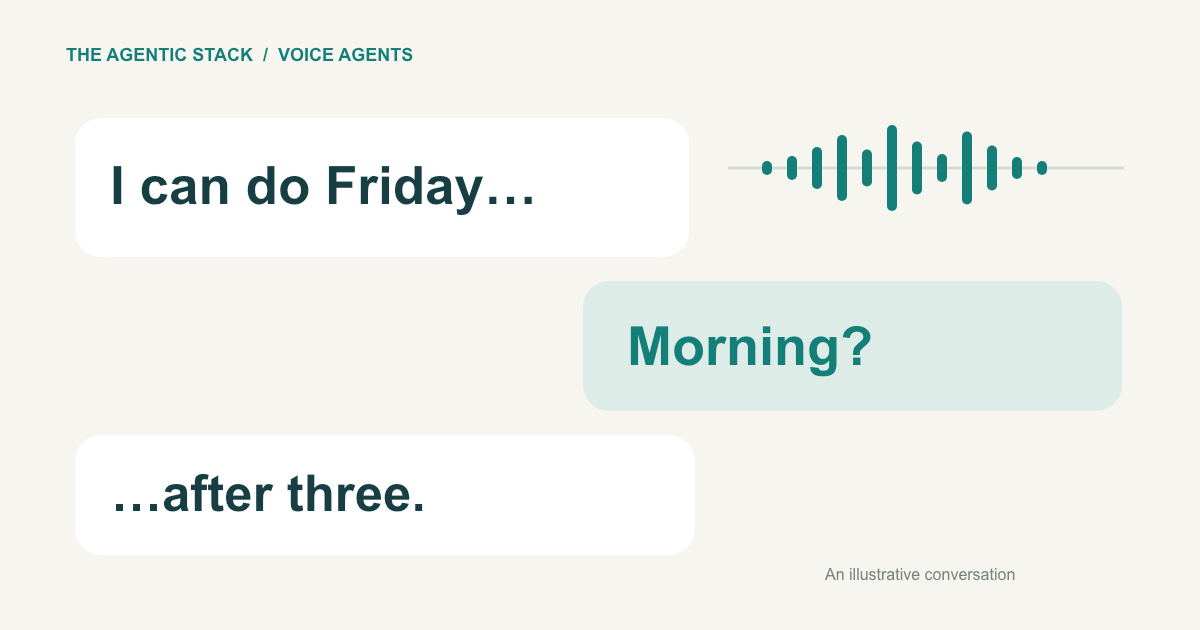
Consider this illustrative scheduling call:
Caller: “I can do Friday…”
Agent: “Great. I have a morning slot available.”
Caller: “…after three. I’m working until then.”
The agent now has to repair a conversation it could have handled in one exchange. It received a date, treated a pause as the end of the request, and responded before hearing the constraint.
Thanks for reading The Agentic Stack! Subscribe for free to receive new posts and support my work.
A faster language model could make this particular failure happen sooner. The production problem begins with how the system decides that it has enough of the caller’s turn to answer.
For a voice agent that searches availability, changes bookings, or retrieves account information, that decision also determines when tool use starts. Conversation timing belongs in the architecture and evaluation plan from the beginning.
The decision before the answer
In a common voice pipeline, speech recognition produces text, an LLM interprets the request and calls tools, and text-to-speech produces the reply. Audio keeps arriving while these components work. The application needs to decide when to treat the incoming speech as a completed turn.
Voice activity detection, or VAD, identifies whether speech is present. An end-of-turn detector estimates whether the speaker has finished. A pause after “Friday” can satisfy the first condition without satisfying the second.
LiveKit’s current audio turn detector combines meaning with acoustic signals such as intonation and rhythm. That gives it information a silence timer lacks, although any detector can still make mistakes. LiveKit’s turn-detector documentation
Increasing the silence timeout may help the Friday example, but it also makes the agent wait longer after a genuinely complete answer. The useful decision is how much delay the application accepts for a given rate of premature turn endings. That trade-off needs testing on the conversations the product actually handles.
Realtime speech models can combine parts of the pipeline, but the application still needs turn and interruption behavior. Check which layer owns those decisions; a framework setting may not control a realtime model’s own detector. Turn-handling overview
Prepare a reply without committing to it
The system can begin useful work while its turn decision remains provisional.
Deepgram’s Flux exposes this distinction through events. When eager detection is configured, EagerEndOfTurn can start preparation of a response. If the caller continues, TurnResumed tells the application to cancel that draft. EndOfTurn provides the later commitment point. These are model decisions, not guarantees that a human has finished. Flux’s eager end-of-turn guide
In our example, the agent might begin drafting after “Friday,” discard that draft when speech resumes, and prepare a new answer using “after three.” The caller should hear the response based on the completed request.
Illustrative sequence, not a recorded run. Bar lengths do not represent measured latency.
Implement cancellation across the components doing speculative work. Cancelling an LLM request is insufficient if speech generated from the old draft remains queued for playback. Keep an attempt ID so late results from a cancelled attempt cannot become the active response.
For this scheduling agent, I would restrict speculative work to response preparation and explicitly permitted, disposable reads. Booking changes would wait for the complete request and the application’s confirmation rules. Stopping speech cannot undo a tool request that another service has already accepted.
Speculation also has a cost. LiveKit documents preemptive LLM generation and optional preemptive speech synthesis, including wasted computation when drafts are cancelled. Measure how often prepared responses survive, along with the extra model and speech usage. A lower response delay may be worth that spend; a high discard rate deserves investigation. Preemptive-generation controls
Decide what an interruption means
Now suppose the agent is explaining the available slots and the caller says “okay.” That may be an acknowledgement. “Wait, I meant Thursday” is a correction that should change the conversation.
Treating every detected voice as an interruption can produce a stop-start experience. Ignoring overlapping speech can prevent the caller from correcting the agent. LiveKit’s adaptive interruption handling explicitly distinguishes acknowledgements from attempts to take the floor. Its documentation also identifies difficult cases around the beginning and end of the agent’s speech. Adaptive interruption handling
Once a correction is accepted, stop obsolete playback and update the active request. Keep track of what was actually played: a sentence generated internally but never heard cannot count as information already delivered to the caller.
If a booking operation was already underway, reconcile its status before retrying with Thursday. The conversation and the external system need to agree about what happened. An audio cancellation event alone cannot establish that.
Evaluate the conversation on a timeline
A transcript can show the correct final words while hiding the interruption that made the caller repeat them. Preserve timing in the evaluation input and outcome.
Build a small set of recorded test conversations with deliberate variation: a pause before a constraint, a spoken correction, an acknowledgement during agent speech, background conversation, and a slowly read reference number. Include the languages, accents, and audio conditions relevant to the product. These are test cases to run, not evidence that any particular system has passed.
Track four outcomes together: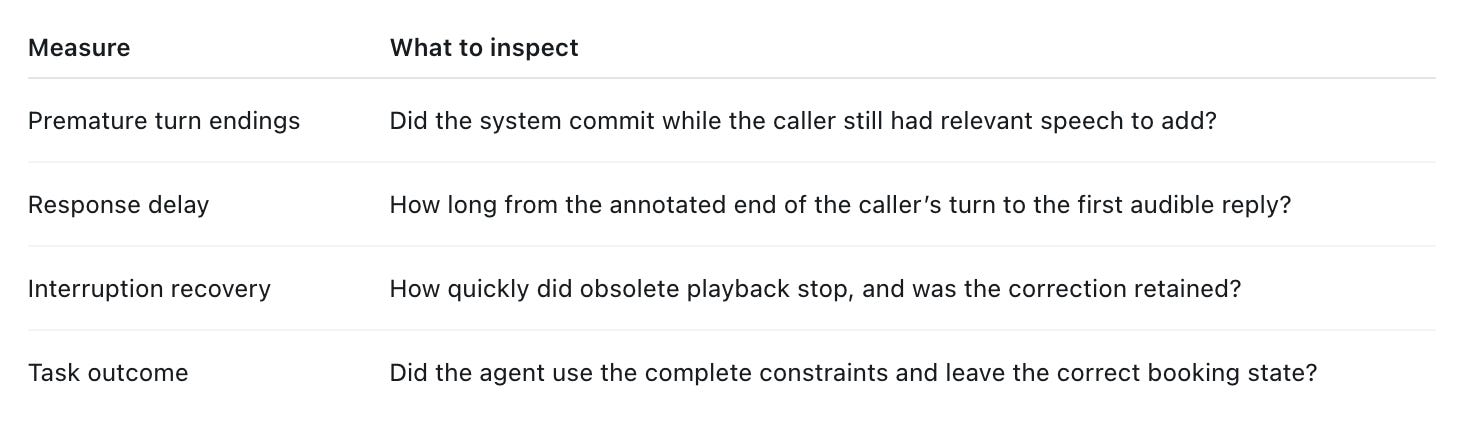
LiveKit’s open eot-bench offers a useful methodological reference: it evaluates decisions at pauses using information available at that point, and compares latency against false cutoffs. It is a vendor-maintained detector benchmark; it does not establish the performance of your complete application. Benchmark and methodology
For debugging, connect the detected speech end, turn commitment, draft attempts, tool calls, and playback events under one turn ID. Distinguish server-side audio readiness from client playback; network transport and buffering sit between them. Inspect both typical and slow responses, and review failures by scenario rather than relying on one average.
Replay the Friday call with the same words and different pauses. If the agent repeatedly handles “Friday after three” correctly in text but loses the constraint in audio, the trace should show where the turn was closed. That gives the team a specific decision to fix and the caller a better chance of finishing a sentence.
References:
-
How semantic and acoustic signals help distinguish a pause from the end of a speaker’s turn.
-
Deepgram — Optimize Voice Agent Latency with Eager End of Turn
Preparing responses early and cancelling speculative drafts when the caller resumes speaking.
-
LiveKit — Adaptive interruption handling
Distinguishing acknowledgements from genuine interruptions, including difficult cases near turn boundaries.
-
Controls for endpointing, interruptions, and preemptive generation, including computation wasted on cancelled responses.
-
LiveKit — End-of-Turn Benchmark
An open, vendor-maintained evaluation framework for comparing response timing against premature turn endings.
Thanks for reading The Agentic Stack! Subscribe for free to receive new posts and support my work.