Before enterprises give agents authority, they need to know who the agent is, what it can touch, who owns it, and how to revoke access.
By Ashu Kumar
Published: 2026-09-02
URL: https://theagenticstack.substack.com/p/your-ai-agent-needs-an-id-badge
The first serious agent incident inside a company probably will not look like science fiction. It will look like an ordinary record changed in an ordinary system. A customer field gets updated. A ticket moves to the wrong queue. A contract note appears in CRM. A workflow gets triggered without anyone remembering who approved it.
At first, the team may treat it like a normal operational mistake. Someone will check the log, find the timestamp, and ask who made the change. That is when the problem becomes visible. The answer may not be a person. It may be an agent.
Thanks for reading The Agentic Stack! Subscribe for free to receive new posts and support my work.
And then the real questions begin. Which agent was it? Was it acting on behalf of a user, a team, or a workflow? What permission did it have? Which system gave it access? What data did it read before acting? Was the action approved? Who owns the consequence? Can we disable that agent immediately?
This is the enterprise problem hiding underneath the excitement around agents. It is not enough for an agent to be useful. If it can touch real systems, it needs to be identifiable. A human employee does not get access to enterprise systems just because they might be helpful. They get an account, a badge, a role, permissions, a manager, an audit trail, and an offboarding path. An AI agent should not get more freedom with less identity.
That is why I think one of the most important enterprise agent features will not be better reasoning. It will be identity.
Google Cloud is already moving in this direction. Its Gemini Enterprise Agent Platform now describes Agent Identity as a native IAM type for agents, built around least-privilege permissions, lifecycle management, and non-repudiable auditing. Google also describes Agent Registry and Agent Gateway as infrastructure for central visibility, access control, and governance across agents. (Google Cloud)
That signal matters because it shows where enterprise AI is going. The conversation is moving from “Can we build agents?” to “Can we manage agents as real actors inside the business?”
A chatbot can remain vague for a while. A production agent cannot. The moment an agent reads customer data, calls a tool, updates a record, sends a message, or triggers a workflow, it becomes part of the company’s operating surface. At that point, “the AI did it” is not an acceptable explanation. Enterprises will need to know exactly which agent acted, under which authority, against which policy, and with which owner behind it.
This is where anonymous agents become dangerous. One prototype agent in a sandbox is easy to ignore. Hundreds of agents across support, sales, finance, engineering, HR, legal, and operations are a different problem. Some will summarize. Some will draft. Some will monitor. Some will route. Some will write back to systems. Some will act on behalf of users. Some will act on behalf of workflows. If those agents are running through shared service accounts, broad permissions, weak logs, and unclear ownership, the company has not created an AI workforce. It has created a shadow access layer.
And shadow access does not survive enterprise reality. Security will ask what accessed the data. Compliance will ask why the action was taken. Finance will ask what the agent cost. Legal will ask who approved the outcome. The business will ask why a customer was affected. If the answer is just “an agent,” the system is not ready.
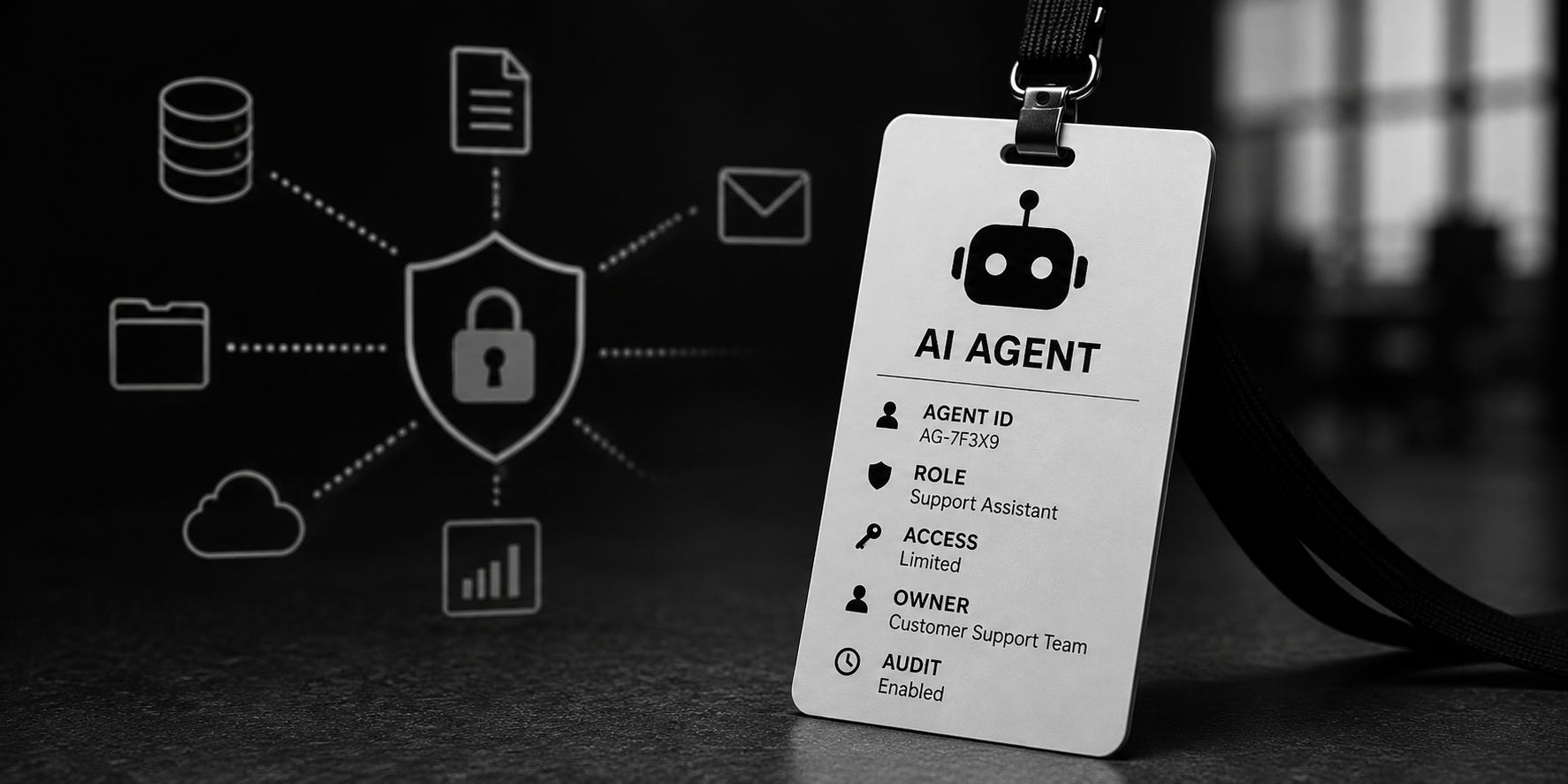
An agent ID badge should answer a few basic questions without a meeting. It should tell the company which exact agent is acting, what job it performs, what environment it runs in, what systems it can access, what actions it can take, who owns it, what it did, and how to turn it off.
That may sound like governance, but it is really trust infrastructure. Enterprises already understand this for humans. No one says identity management is “bureaucracy” when onboarding employees. It is how the company controls access, responsibility, and risk. Agents need the same discipline because they are starting to behave less like features and more like operational participants.
The mistake is treating agent identity as something to solve later. Later is too late. Once agents spread across teams, tools, and workflows, retrofitting identity becomes messy. You end up with forgotten automations, orphaned agents, unclear permissions, and no clean answer when something goes wrong.
Google’s documentation on Agent Identity makes this point more concrete. It describes agent identities as integrated with Google policy systems such as IAM, Principal Access Boundary, and VPC Service Controls. It also explains that when Agent Identity is used with Agent Gateway and Gemini Enterprise, end-user credentials are handled through the gateway so the agent does not directly access the raw credential. (Google Cloud Documentation)
That is the level of design enterprises will expect. Not just “the agent can use tools,” but “the agent can use tools through a controlled identity, within a defined boundary, with logs and revocation.”
The bigger issue is authority. Companies are still asking what agents can do. The better question is what agents are allowed to do. There is a difference between reading a customer record and changing it. There is a difference between drafting a refund recommendation and approving it. There is a difference between summarizing an incident and triggering a rollback. Each step requires a stronger identity, tighter permission, clearer owner, and better audit trail.
This is where the employee badge metaphor is useful. A badge is not what makes a person valuable. It is what makes their access manageable. It connects a real actor to a role, a building, a system, a manager, and a revocation path. Agents need the digital version of that. Not because they are employees, but because they can create consequences like someone inside the company.
The companies that get this right will not wait for agent chaos before building controls. They will make identity part of the deployment model. Every production agent will have a name, scope, owner, permission boundary, log trail, and shutdown path. Every agent action will be attributable. Every expansion of permission will be intentional. Every agent that is no longer needed will be retired, not left behind like an old script nobody remembers.
The companies that ignore this will face the same pattern again and again. An agent will do something useful. Then it will do something unexpected. Then everyone will ask who allowed it. And the answer will be unclear.
That is the real risk: not that agents are useless, but that they become useful before they become accountable.
Enterprise agents do not need only better models. They need badges. No badge, no access. No owner, no authority. No logs, no production. No revocation path, no deployment.
Because anything that can act inside a company needs a name.
Thanks for reading The Agentic Stack! Subscribe for free to receive new posts and support my work.