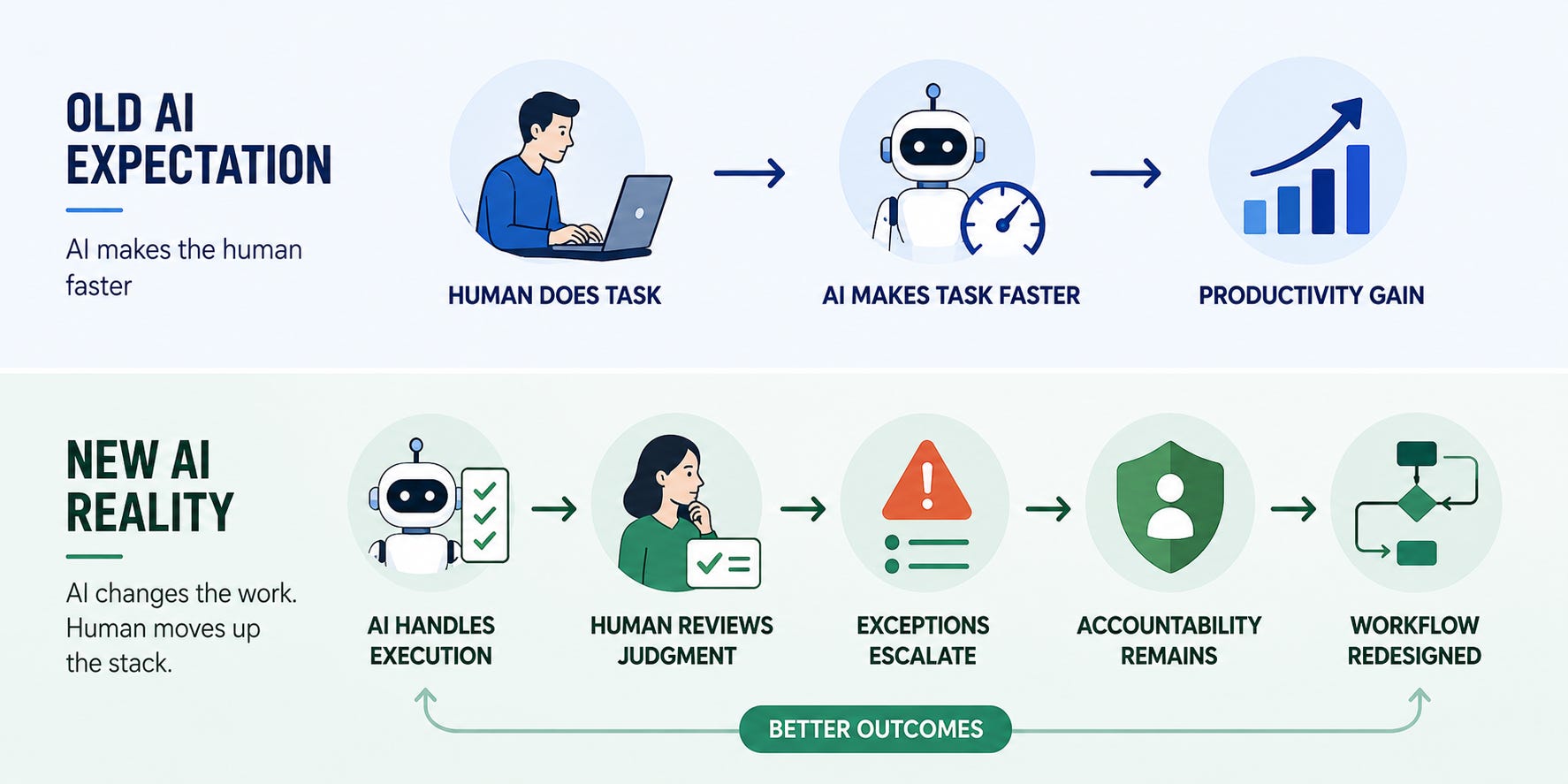
AI was expected to replace manual work. Instead, the strongest pattern is humans moving from execution to judgment, review, exception handling, and accountability.
By Ashu Kumar
Published: 2026-08-26
URL: https://theagenticstack.substack.com/p/the-human-was-not-removed-from-the
The first promise of AI sounded simple.
Give every employee a copilot.
Make every task faster.
Remove repetitive work.
Automate the busywork.
Reduce the number of people needed to move a workflow forward.
Thanks for reading The Agentic Stack! Subscribe for free to receive new posts and support my work.
That was the early story many companies bought into.
AI would sit beside the worker, speed up the worker, and eventually remove chunks of the worker’s job.
Some of that is happening.
But the more interesting pattern is not that humans are disappearing from the workflow.
They are moving to a different place inside it.
Less clicking.
Less copying.
Less searching.
Less first-draft creation.
Less manual routing.
Less repetitive status updating.
But more review.
More judgment.
More escalation.
More exception handling.
More boundary-setting.
More ownership of outcomes.
That is the mindset shift many companies are still missing.
AI does not remove the human from the loop.
It changes what the human is in the loop for.
And if companies keep treating AI only as a task automation tool, they will miss the deeper redesign happening underneath the work.
The old expectation was productivity
The first wave of enterprise AI adoption was sold around productivity.
A faster analyst.
A faster engineer.
A faster marketer.
A faster support rep.
A faster consultant.
A faster manager.
This made sense.
The first visible AI use cases were personal and task-based: write the email, summarize the meeting, generate the report, draft the code, explain the document, create the slide, answer the question.
The unit of value was the individual task.
Could AI make this person faster?
That is still useful, but it is not enough.
McKinsey’s 2025 State of AI research shows how wide AI adoption has become, with nearly nine out of ten respondents saying their organizations regularly use AI. But the same research also says scaled impact is still uneven, and only 39 percent of respondents attribute any level of EBIT impact to AI. The pattern is important: the companies seeing more value are not just using AI more; they are redesigning workflows around it.
That is the real lesson.
Usage is not transformation.
A company can give everyone AI tools and still leave the work mostly unchanged.
The emails get drafted faster, but the approval still waits for the same manager.
The report gets summarized faster, but the source data is still scattered.
The ticket response gets written faster, but the customer problem still bounces between teams.
The code gets generated faster, but the review burden moves somewhere else.
The meeting summary appears instantly, but nobody owns the decision after the meeting.
AI improves the task.
But the workflow remains stuck.
That is where the expectation has to change.
The work does not vanish. It changes shape.
Look at a support workflow.
Before AI, a human support rep reads the customer message, searches documentation, checks account history, writes a reply, updates the ticket, and decides whether to escalate.
With AI, some of that changes.
The agent can summarize the thread.
It can find relevant documentation.
It can draft the reply.
It can detect sentiment.
It can suggest escalation.
It can update the ticket fields.
So what is left for the human?
Not nothing.
The human now has to judge whether the response is appropriate for this customer, this account tier, this policy, this risk level, and this moment.
The human checks whether the agent missed emotional context.
The human decides whether this is a standard issue or an exception.
The human sees whether the ticket should really be closed or whether the customer will come back angry tomorrow.
That is not the same job as before.
It is a higher-level job.
The human moved from performing every step to supervising the quality and consequence of the workflow.
The same pattern appears in finance.
AI can classify invoices, identify mismatches, summarize contract terms, and recommend next steps.
But someone still has to decide whether an exception is acceptable, whether a vendor relationship matters, whether a policy should be overridden, and whether payment risk is tolerable.
In engineering, AI can write code faster.
But humans spend more time defining the problem, reviewing architecture, validating security, checking edge cases, and deciding whether the generated solution should exist at all.
In compliance, AI can collect evidence.
But humans still need to decide whether the evidence is acceptable, current, complete, and defensible.
The human role does not disappear.
It moves from doing the repetitive part of the work to owning the judgment around the work.
This is why “human in the loop” is too small a phrase
For years, “human in the loop” has sounded like a safety feature.
The AI does something, and a human checks it before the final step.
That framing is too narrow now.
In real enterprise AI, the human is not just a final checkbox.
The human may be the person who defines the goal.
The human may decide which workflow is worth automating.
The human may set the boundary of what AI is allowed to do.
The human may approve exceptions.
The human may handle ambiguous cases.
The human may update the policy when reality changes.
The human may own the business outcome when the system is wrong.
That is not a loop.
That is a new operating role.
Microsoft’s 2026 Work Trend Index frames this shift as organizations rebuilding the operating model around agents and human agency. It describes “Frontier Firms” as organizations that deliberately design work across functions and match the level of human involvement to the outcome.
That phrase matters: match human involvement to the outcome.
Because not every task needs the same human role.
Some work can be automated quietly.
Some work should be drafted by AI and reviewed by a human.
Some work should be recommended by AI but approved by a manager.
Some work should be escalated immediately.
Some work should never be automated.
That is the new design question.
Not:
Where can we remove the human?
But:
Where does human judgment matter most?
The mistake is adding AI to the old job
Many companies are still adding AI to old jobs instead of redesigning the job around AI.
They say:
Give the support rep an AI assistant.
Give the analyst an AI assistant.
Give the engineer an AI assistant.
Give the salesperson an AI assistant.
Give the manager an AI assistant.
That is a reasonable starting point.
But if the job stays exactly the same, AI becomes another layer on top of the old workflow.
The employee still owns the same backlog.
The same handoffs remain unclear.
The same approval path remains slow.
The same metrics reward the wrong behavior.
The same manager still becomes the bottleneck.
The same exception cases still bounce between teams.
The only difference is that some outputs appear faster.
That can even make the problem worse.
If AI helps people produce more drafts, more tickets, more code, more summaries, more recommendations, and more actions, then someone has to review all of it.
The bottleneck moves.
It does not disappear.
A team that used to struggle with creation may now struggle with validation.
A manager who used to wait for reports may now drown in AI-generated recommendations.
An engineering team that used to write code slowly may now review more code than it can safely absorb.
A support team that used to answer tickets slowly may now close them faster while unresolved customer issues remain underneath.
That is why the human role has to be redesigned.
AI changes the shape of work, so the job around the work has to change too.
The new human role is judgment
The more AI handles execution, the more valuable judgment becomes.
Judgment means knowing when the output is good enough.
It means knowing when the case is not standard.
It means knowing which policy matters.
It means recognizing when the data is incomplete.
It means deciding when to escalate.
It means seeing the human cost behind a clean metric.
It means asking whether the work should be done at all.
This is why AI does not make expertise irrelevant.
It makes shallow execution cheaper and deep judgment more important.
A junior analyst may use AI to draft a market scan, but someone still needs to know which assumptions are weak.
A developer may use AI to generate a function, but someone still needs to know whether the design is maintainable.
A legal team may use AI to summarize a contract, but someone still needs to know what risk the business is actually accepting.
A product manager may use AI to synthesize feedback, but someone still needs to know which customer pain matters strategically.
The future worker is not valuable because they can manually produce every artifact.
They are valuable because they can decide what is worth trusting, changing, approving, rejecting, or escalating.
That is a very different skill stack.
The new human role is exception handling
AI is usually strongest on repeatable patterns.
Clean inputs.
Known workflows.
Common requests.
Standard policies.
Frequent tasks.
But companies do not only run on clean patterns.
They run on exceptions.
The unusual customer.
The missing field.
The conflicting policy.
The old contract.
The regional rule.
The edge case.
The unclear owner.
The request that does not fit the form.
This is where humans become more important, not less.
AI can prepare the exception.
It can gather context, summarize history, identify policies, compare cases, and recommend an action.
But humans still need to decide what the exception means.
Is this a one-off case or a signal that the policy is broken?
Should the customer receive special treatment?
Should the workflow change?
Should this be escalated?
Should the AI learn from this case or ignore it?
Exception handling becomes a higher-value human role because the routine layer gets automated.
The best companies will not waste humans on repetitive execution.
They will use humans where the workflow stops being obvious.
The new human role is accountability
This is the part many AI strategies avoid.
If AI drafts the response, who owns the customer impact?
If AI recommends the refund, who owns the financial risk?
If AI summarizes the evidence, who owns the compliance decision?
If AI writes the code, who owns the production failure?
If AI escalates the incident, who owns the severity call?
The answer cannot be “the AI.”
Work still needs an accountable owner.
That owner may not perform every step manually anymore, but they own the consequence.
This is why AI changes management.
Managers cannot only ask, “Did the team use AI?”
They have to ask:
What decisions are humans still accountable for?
What outputs need review?
What exceptions need escalation?
What actions can AI take without approval?
What evidence must be shown?
What metrics prove the workflow improved?
What should stop if the system is uncertain?
IBM’s Think 2026 message made a similar point from the operating-model side: enterprises pulling ahead are not simply deploying more AI; they are redesigning how the business operates. IBM describes the AI operating model as a combination of agents, data, automation, and hybrid governance working together.
That is the right level of thinking.
AI adoption is not just a tool rollout.
It is a redesign of responsibility.
The mindset shift leaders need
The first AI mindset was:
How much work can we automate?
The better mindset is:
How should work change when AI can handle parts of it?
That sounds subtle, but it changes everything.
If the goal is only automation, leaders look for tasks to remove.
If the goal is work redesign, leaders ask a deeper set of questions.
Which parts of this workflow are repetitive enough for AI?
Which parts require human judgment?
Which steps exist only because the software is hard to use?
Which handoffs are unclear?
Which decisions need approval?
Which exceptions should go to humans?
Which metrics should change if the workflow improves?
Which roles become more important because AI handles the lower-level work?
That is where value appears.
Not from dropping AI into every task.
From redesigning the work around what AI is good at and what humans are still responsible for.
McKinsey’s research on organizations rewiring for gen AI found that workflow redesign had the biggest effect among tested attributes on an organization’s ability to see EBIT impact from gen AI.
That is the difference between adoption and transformation.
Adoption asks people to use AI.
Transformation redesigns the work so AI and humans each do the parts they are best suited for.
What this looks like in practice
A redesigned support workflow does not just give every agent a chatbot.
It changes the work.
AI handles first-pass summarization, historical context, suggested response, knowledge retrieval, sentiment detection, and reopen-risk scoring.
Humans handle high-risk replies, frustrated customers, enterprise accounts, policy exceptions, and unresolved root causes.
The manager no longer reviews random tickets. They review cases where risk, emotion, value, or uncertainty is high.
A redesigned finance workflow does not just use AI to summarize invoices.
AI identifies exceptions, compares purchase orders, checks contract terms, gathers evidence, and recommends a resolution.
Humans approve policy exceptions, vendor-sensitive decisions, high-value payments, and ambiguous matches.
The finance analyst moves from manual checking to exception judgment.
A redesigned engineering workflow does not just ask AI to write code.
AI drafts implementation, generates tests, explains dependencies, and identifies likely edge cases.
Humans define architecture, review security, validate tradeoffs, and decide whether the change fits the long-term system.
The developer moves from typing every line to owning the integrity of the solution.
In each case, AI does not simply remove the person.
It changes where the person creates value.
The companies that miss this will measure the wrong thing
If companies keep thinking about AI as task automation, they will measure the wrong outcomes.
They will ask:
How many employees are using AI?
How many prompts were submitted?
How much time did the tool save?
How many documents were generated?
How many tickets were summarized?
How many drafts were created?
These are not useless metrics, but they are incomplete.
The better questions are:
Did the workflow improve?
Did cycle time decrease?
Did error rate fall?
Did escalations become cleaner?
Did customers get better outcomes?
Did humans spend less time on repetitive work and more time on judgment?
Did managers get better visibility into exceptions?
Did AI create review overload?
Did the role actually change?
This last question is important.
If employees use AI but their role does not change, the company may only get shallow productivity.
The deeper value comes when the organization changes what humans spend their time on.
The new skill is knowing what not to delegate
In the early AI wave, many people asked:
What can I delegate to AI?
That is still useful.
But the more mature question is:
What should I not delegate?
A good worker in the AI era will know which tasks are safe to automate, which outputs need review, which decisions require context, and which cases should be escalated.
They will know when AI is helpful and when it is creating false confidence.
They will know when a draft is good enough and when it needs real expertise.
They will know when a workflow is ready for automation and when it is still too ambiguous.
They will know when speed is useful and when speed increases risk.
This is not anti-AI.
It is the skill of using AI seriously.
Microsoft’s Work Trend Index material describes advanced AI users as moving beyond simple prompting into multi-step workflows and agent collaboration, while also emphasizing that leaders must rearchitect work rather than just deploy tools.
That is the direction.
The best workers will not be the ones who hand everything to AI.
They will be the ones who know how to divide the work.
AI for execution.
Humans for judgment.
AI for preparation.
Humans for accountability.
AI for pattern recognition.
Humans for exceptions.
AI for speed.
Humans for meaning.
That is the new operating rhythm.
Final thought
The early AI story was about removal.
Remove repetitive work.
Remove manual steps.
Remove time.
Remove cost.
Maybe remove people.
The better story is about redesign.
AI changes the shape of the work.
When AI handles more execution, humans do not become irrelevant.
They become responsible for higher-value parts of the system: judgment, review, exceptions, boundaries, and accountability.
That is the real shift.
The human was not removed from the loop.
The human moved up the stack.
And the companies that understand this will stop asking only:
How much work can AI do?
They will start asking:
What should humans be responsible for now?
That is where the next phase of AI value will come from.
Not from adding AI on top of old work.
From redesigning the work around a new division of labor.
Discussion prompt
Where do you see humans moving up the stack first: support, engineering, finance, compliance, sales, operations, or management?
Thanks for reading The Agentic Stack! Subscribe for free to receive new posts and support my work.