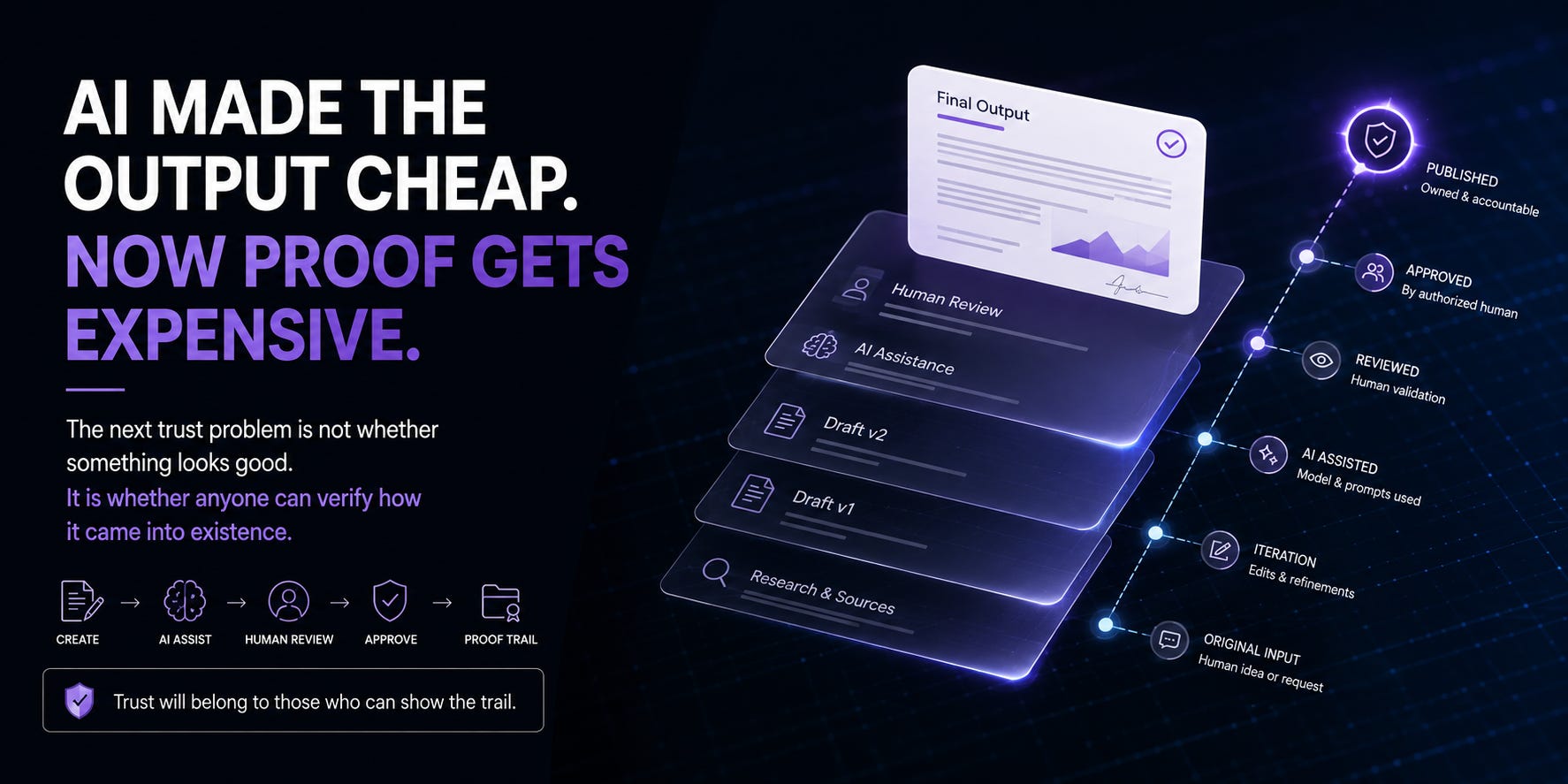
The next trust problem is not whether something looks good. It is whether anyone can verify how it came into existence.
By Ashu Kumar
Published: 2026-08-12
URL: https://theagenticstack.substack.com/p/ai-made-the-output-cheap-now-proof
A polished report lands in Slack.
It is clean, structured, and written in the exact tone leadership likes. The charts are readable. The summary is sharp. The recommendations sound confident.
Thanks for reading The Agentic Stack! Subscribe for free to receive new posts and support my work.
A customer email follows. It is calm, empathetic, and professional.
A code change passes the first review.
A design mockup looks almost ready.
A strategy memo reads like it came from someone who has been thinking about the market for weeks.
Then someone asks the question that changes the room:
Who made this, what helped make it, and can we prove the path?
That is the trust shift we are entering.
For years, people judged work mostly by the final artifact. If the memo was thoughtful, the memo earned trust. If the code worked, the code earned trust. If the report looked polished, the report earned trust.
AI changes that.
Now almost anything can look polished.
The final artifact is no longer enough.
The next trust problem is not whether something looks good. It is whether anyone can verify how it came into existence.
That is why proof is about to become more valuable than output.
The old world trusted the artifact
The old trust model was simple.
Someone wrote the report. Someone prepared the deck. Someone pushed the code. Someone built the spreadsheet. Someone drafted the customer response.
You could question the quality, but you usually did not question the existence of the process.
There was an assumed trail behind the work, even if no one asked to see it.
A writer had drafts.
A developer had commits.
An analyst had sources.
A consultant had notes.
A designer had iterations.
A manager had context from meetings.
The process was messy, but believable.
The artifact carried some of that trust because producing it required effort. If the output was good, people assumed there was work behind it.
AI weakens that assumption.
A polished paragraph no longer proves a person understood the topic.
A clean deck no longer proves the team did the thinking.
A convincing analysis no longer proves the sources were checked.
A working code snippet no longer proves the tradeoffs were understood.
A professional customer email no longer proves the company reviewed the risk.
The output may still be useful.
But the output by itself proves less than it used to.
That is the uncomfortable part.
AI did not only make creation faster. It made the final artifact less trustworthy as evidence of the work behind it.
The accusation will become easier than the defense
This is already becoming visible in writing, education, hiring, journalism, design, and software.
Someone submits a piece of work.
Another person says:
This feels AI-generated.
That suspicion may be right.
It may also be wrong.
AI detectors have struggled with reliability across different domains, generators, formatting styles, and writing contexts. A 2026 study on AI-generated text detection found that systems can perform well on benchmark data but fail under cross-domain and cross-generator shifts, suggesting that some detectors learn dataset-specific stylistic cues rather than stable signals of machine authorship. (arXiv)
That creates a strange world.
The accusation can be vague.
The defense has to be specific.
“I wrote it myself” may not be enough.
“I only used AI for editing” may not be enough.
“I checked the sources” may not be enough.
“The model helped, but I made the decisions” may not be enough.
The person or company may need a trail.
Drafts.
Sources.
Version history.
Prompts.
Model-use notes.
Human edits.
Review comments.
Approval records.
Final accountability.
This is the new burden.
When output becomes cheap, proof becomes expensive.
Proof moves upstream
The important shift is that trust moves upstream.
It moves from the final file to the process behind the file.
A company reading an AI-assisted market analysis may not only ask:
Is this report good?
It may ask:
Which sources supported it?
Which parts were generated?
Who reviewed the claims?
What changed between draft and final?
Which assumptions came from the analyst?
Which recommendations came from the model?
Who owns the final conclusion?
A software team reviewing AI-assisted code may not only ask:
Does it pass tests?
It may ask:
Who accepted the change?
What prompt created it?
What security checks were run?
What dependencies changed?
What tradeoffs did the developer validate?
What did the AI suggest that was rejected?
A legal, compliance, or finance team reviewing AI-assisted work may ask even harder questions:
Which data was used?
Was any sensitive information exposed?
Was the output checked by a qualified human?
Was there a policy or approval step?
Can we reconstruct what happened later?
That is the proof layer.
Not one tool.
Not one watermark.
A working record of how the output came into existence.
Watermarks help, but they are not the whole answer
Regulation and platform behavior are moving in this direction.
The EU AI Act’s Article 50 transparency obligations apply from 2 August 2026. The European Commission says the rules require certain AI providers and deployers to inform people when they interact with AI systems and, for providers, to add machine-readable marks to help detect AI-generated or manipulated content. (Digital Strategy)
The Commission’s quick facts page also says providers must apply machine-readable marks to synthetic content generated or manipulated by AI, while deployers must disclose deepfakes and certain AI-generated text on matters of public interest, with defined exceptions and compliance details. (Digital Strategy)
Companies are responding. Anthropic reportedly announced invisible, machine-readable watermarks for Claude-generated text and C2PA-style provenance metadata for supported image files, partly in response to new EU transparency requirements. (The Verge)
This matters.
But it does not solve the whole trust problem.
A watermark may help identify that AI was involved.
It does not explain whether the idea was original, whether the sources were reliable, whether the human understood the work, whether the conclusion was reviewed, or whether the final owner accepts responsibility.
C2PA-style provenance is also important, especially for media. Its explainer describes Content Credentials as containing assertions about an asset’s origin, modifications, and AI use. (C2PA)
But provenance systems are not magic either. A 2026 independent security analysis of C2PA argued that current specifications should not be relied on prematurely for high-stakes uses such as journalism, financial disclosures, or legal evidence. (arXiv)
So the lesson is not:
Add a watermark and trust is solved.
The better lesson is:
Technical labels are useful, but trust still needs process evidence.
The proof layer is bigger than detection.
It is the trail of human judgment.
The enterprise version is bigger than content
Most people think about this problem through writing, images, or school assignments.
But the enterprise version is much larger.
A customer success team uses AI to write a renewal risk memo.
A finance team uses AI to classify invoice exceptions.
A sales team uses AI to draft pricing justification.
An engineering team uses AI to generate code.
A compliance team uses AI to collect evidence.
A support team uses AI to recommend escalation.
An agent updates a ticket, changes a customer field, or triggers a workflow.
In each case, the final output is only part of the story.
The company needs to know what happened behind it.
What did the AI see?
Which systems did it access?
Which sources did it cite?
Which recommendation did it make?
What did the human approve?
What did the human edit?
What did the system change?
What was logged?
Who owns the final action?
This is where provenance becomes operational.
Not just:
Was this AI-generated?
But:
Was this AI-assisted work trustworthy enough to use?
That is a different question.
And it requires a different kind of record.
The proof trail will become part of the work
A lot of teams will resist this at first.
They will say it slows things down.
They will say the output is what matters.
They will say employees already use AI informally.
They will say there is no time to document every draft, prompt, source, and review step.
Some of that concern is fair.
Nobody wants bureaucracy around every low-risk email or internal note.
But for important work, the trail will matter.
A board memo.
A customer-facing statement.
A legal analysis.
A financial recommendation.
A security change.
A product decision.
A research report.
A compliance artifact.
An autonomous agent action.
If the output matters, the process matters.
The proof trail does not need to be heavy every time. It needs to match the risk.
Low-risk work may only need light disclosure.
Medium-risk work may need source links and reviewer notes.
High-risk work may need version history, approval logs, system access records, and clear human accountability.
Critical work may need formal auditability.
The future is not “document everything equally.”
The future is risk-based proof.
The winners will show their work
There is a simple reason this will become valuable.
When everyone can produce polished output, the advantage moves to people who can prove the work.
The writer who can show drafts will be trusted faster.
The analyst who can show sources will be taken more seriously.
The developer who can explain what AI wrote and what they validated will be safer to rely on.
The consultant who can show assumptions, edits, and review history will stand apart from generic AI-generated advice.
The company that can reconstruct an AI-assisted decision will be easier to audit.
The agent platform that can show what it saw, suggested, changed, and escalated will be easier to deploy in production.
This is the new credibility signal.
Not perfection.
Traceability.
In the AI era, trust will belong to the people and organizations that can show how the work happened.
Where proof gets expensive
Proof gets expensive because it asks teams to change habits.
It is easy to generate a clean answer.
It is harder to preserve the path.
Where did the first idea come from?
What was the original human input?
Which AI tool was used?
Which sources were checked?
What changed between drafts?
Which claims were removed?
Which recommendations survived review?
Who approved the final version?
Most teams are not built to capture this naturally.
Their work is scattered across docs, chats, email, notebooks, code repos, design files, ticketing systems, spreadsheets, model logs, and browser tabs.
The evidence exists, but it is fragmented.
That is why the proof layer will become a product opportunity.
Tools that preserve source trails.
Writing tools that show draft lineage.
Code tools that separate AI suggestions from human edits.
Design tools that carry provenance metadata.
Enterprise agents that log actions and approvals.
Knowledge systems that connect output to evidence.
Compliance tools that capture AI-use records automatically.
The market will not only need tools that create.
It will need tools that prove.
The wrong response is hiding AI use
Some people will try to solve the trust problem by pretending AI was not involved.
That is the wrong direction.
The issue is not whether AI touched the work.
The issue is whether the final owner can stand behind the work.
Using AI to brainstorm is different from using AI to fabricate sources.
Using AI to edit a paragraph is different from publishing an unchecked AI-written claim.
Using AI to draft code is different from merging code no one understands.
Using AI to summarize evidence is different from letting the model invent evidence.
The future standard should not be:
No AI was used.
That will become unrealistic in many fields.
The better standard is:
AI was used responsibly, the work was reviewed, the sources were checked, and a human owns the result.
That is a healthier trust model.
Not anti-AI.
Anti-untraceable work.
Final thought
AI will keep making it easier to create.
That is the upside.
More drafts.
More ideas.
More prototypes.
More analysis.
More code.
More content.
More experiments.
But the easier output becomes, the more people will question what sits behind it.
Who made this?
What helped make it?
What was checked?
What was changed?
Who approved it?
Who owns it?
That is where trust is moving.
Not away from AI.
Away from unsupported artifacts.
The final output is no longer the whole story.
The story is the trail.
Show your work.
The future will reward those who can.
Discussion prompt
What proof trail do you think will matter most in the AI era: draft history, source trail, AI-use disclosure, human review, approval logs, or agent action history?
Thanks for reading The Agentic Stack! Subscribe for free to receive new posts and support my work.