The next interface shift is not another dashboard, chatbot, or copilot. It is software that understands what you want done — and figures out which tools to use.
By Ashu Kumar
Published: 2026-08-06
URL: https://theagenticstack.substack.com/p/ai-is-moving-from-apps-to-intent
A lot of enterprise work still begins with a strange ritual.
You open one app to find the customer. Another app to check the ticket. Another to look at usage. Another to check billing. Another to find the contract. Then you search Slack because, somehow, the most important context is not in any official system.
Thanks for reading The Agentic Stack! Subscribe for free to receive new posts and support my work.
After that, you go back to the first app and update a field.
This is so normal that we barely notice how much work is actually software navigation.
The user is not trying to “use CRM.”
The user is trying to understand whether a customer is at risk.
The manager is not trying to “use a dashboard.”
The manager is trying to know what needs attention.
The finance analyst is not trying to “use the billing system.”
They are trying to understand why an invoice is blocked.
For years, apps were the way we got to the answer. You had to know which system to open, which record to search, which field to trust, which dashboard to read, and which person to ask when the system did not tell the full story.
That was the app era.
AI starts to change the starting point.
The user should not have to think first about the app. The user should be able to express the outcome.
“Prepare the renewal risk brief.”
“Find why these invoices are blocked.”
“Draft the escalation summary.”
“Show me what changed before the incident.”
“Collect the evidence for this control.”
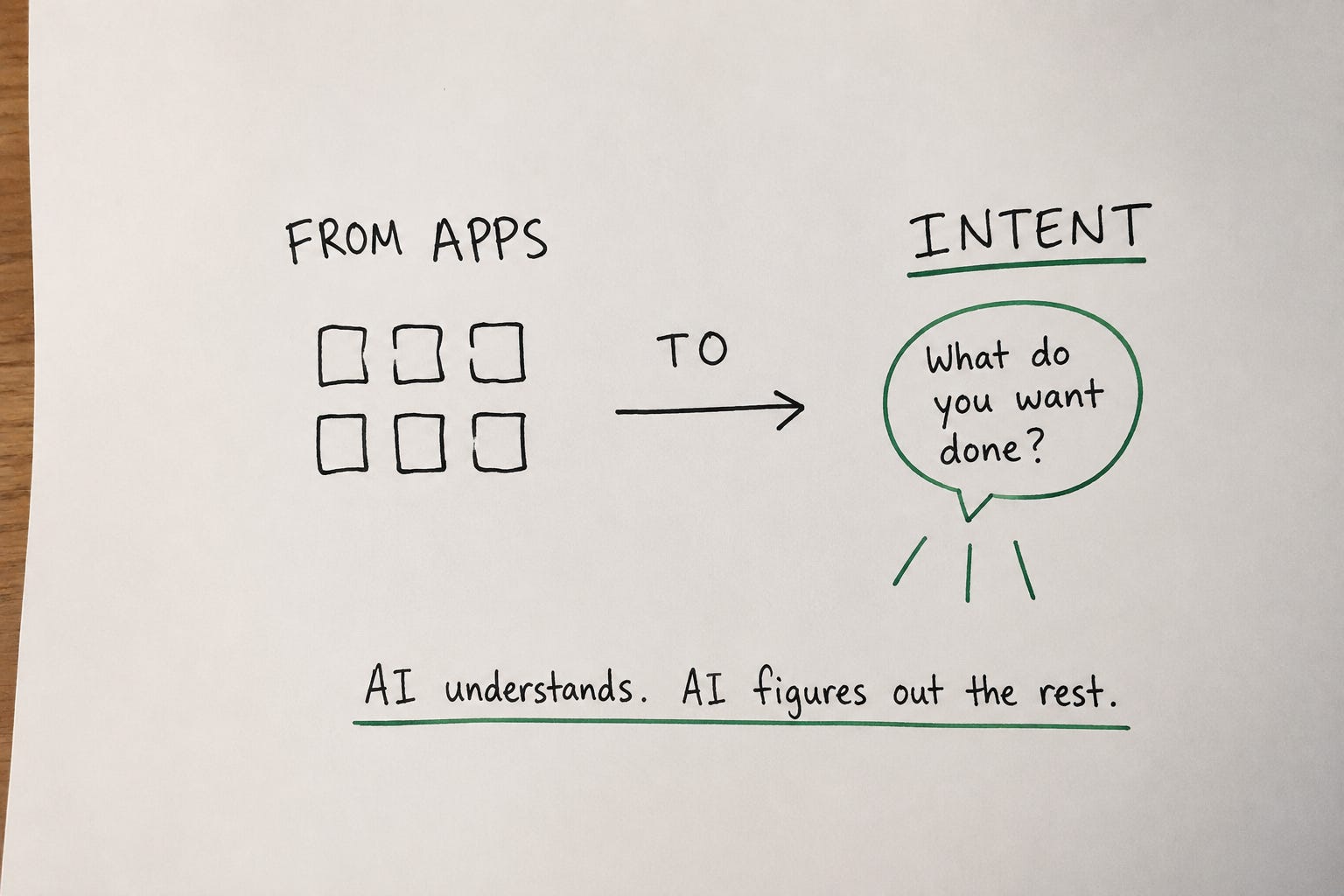
That is the shift from apps to intent.
The interface is no longer only asking:
Where do you want to click?
It starts asking:
What do you want done?
We built software around navigation
Most SaaS products were designed for a world where software waited and humans operated.
The app stored the data. The human found it.
The app exposed the workflow. The human moved it forward.
The app showed the dashboard. The human decided what mattered.
This made sense when software could not understand the work. CRM did not know why a customer was at risk. A ticketing system did not know which issue would reopen. A finance system did not know which invoice exception mattered most. A document repository did not know which policy applied to the case in front of you.
So we built products around screens.
Dashboards. Tables. Filters. Forms. Record pages. Search bars. Reports. Comments. Notifications. Admin panels.
Each screen made sense on its own, but the actual work usually lived across several of them.
That is why so many enterprise workflows feel heavier than they should. The work is not only the decision. The work is finding the context required to make the decision.
AI changes that expectation.
Not because apps disappear, but because users should not have to manually translate every business intent into software steps.
Chat helped, but it did not fully solve the problem
Chat was the first big crack in the old interface.
Instead of clicking through ten screens, you could ask a question.
“What happened with this customer?”
“Summarize this document.”
“Draft a response.”
“Explain this error.”
That is useful. It reduces friction. It makes software feel less rigid.
But chat still leaves a lot of work on the user.
The user has to know what to ask. They have to know what context is missing. They have to decide what to do next. They still carry the workflow in their head.
That is why many AI assistants feel impressive for a few minutes and then strangely incomplete. They answer the question, but they do not always move the work forward.
The next step is not just better chat.
It is software that understands the intent behind the request, gathers the right context, chooses the right tools, prepares the next action, and shows the evidence before anything important happens.
That is when AI stops being a helper inside the app and starts becoming the layer above the apps.
Intent is not a prompt. It is a workflow request.
When someone says, “Prepare a renewal risk brief for Acme,” that is not a simple prompt.
It is a workflow.
The system may need CRM history, open support tickets, product usage, billing status, contract terms, meeting notes, executive relationships, recent escalations, and renewal dates.
A human knows this because they have done the work before. They know the renewal risk is not sitting in one field. It is scattered across tools and conversations.
An intent-first system should understand that.
It should not ask the user to manually open CRM, then support, then billing, then analytics, then documents, then Slack.
It should gather the context, prepare the brief, show the evidence, and ask for review where needed.
That is the difference between a chatbot and an intent layer.
A chatbot responds.
An intent layer prepares work.
Apps move underneath the intent layer
This does not mean apps go away.
The CRM still matters. The ticketing system still matters. Billing still matters. Documents still matter. Analytics still matters. Calendar and email still matter.
But they become less visible to the user in everyday work.
They become systems of record, tool layers, action surfaces, and audit trails.
The user expresses the outcome. The agent coordinates the software underneath.
In the old model, the user moved through apps.
In the new model, the agent moves through tools, and the user reviews the prepared outcome.
That is a big change.
It means the most important interface may not be the dashboard anymore. It may be the place where intent becomes a structured decision:
Here is what you asked for.
Here is the context I found.
Here is what changed.
Here is the recommended action.
Here is the evidence.
Here is the risk.
Here is what needs approval.
That is much more useful than another screen full of raw data.
The hard part is not language. It is work understanding.
A lot of products will claim to be intent-based because they accept natural language.
That is not enough.
Understanding the sentence is the easy part.
Understanding the work is the hard part.
If a user says, “Handle this escalation,” the system needs to know what “handle” means in that company.
Does it draft a reply?
Does it notify a manager?
Does it check customer tier?
Does it attach product logs?
Does it create a task?
Does it ask for approval?
Does it stop if the customer is enterprise?
Does legal need to review anything?
Does the account owner need to approve the tone?
Without that understanding, the system may produce a confident but shallow answer.
That is the danger of intent-first software.
It can make vague requests look executable before the workflow is actually understood.
The best systems will not blindly act on intent. They will clarify it, constrain it, and turn it into safe work.
The new interface will be part chat, part control surface
The future interface will not be only a chat box.
A blank chat box is too open-ended for serious work.
Enterprise intent needs structure.
The user may begin with natural language, but the system should turn that into something reviewable:
Intent captured.
Context gathered.
Tools used.
Evidence shown.
Action proposed.
Risk marked.
Approval required.
Outcome tracked.
That is the real product surface.
For low-risk work, the system may act quietly.
For medium-risk work, it may prepare a draft.
For high-risk work, it should ask for explicit approval.
For unclear work, it should ask better questions.
This is where good product design matters. The interface should not make humans babysit every step, but it should also not hide the parts where judgment is needed.
The goal is not magic.
The goal is reliable delegation.
Why this matters for enterprise AI
The shift from apps to intent changes how companies should think about AI adoption.
If every team simply adds a chatbot to every app, users may end up with a new version of the old problem.
Instead of switching between apps, they will switch between assistants.
CRM assistant. Support assistant. Finance assistant. HR assistant. Analytics assistant. Procurement assistant.
That is not transformation.
That is agent sprawl with a nicer interface.
The better question is:
Where should intent enter the workflow?
For some teams, it may be the browser.
For others, it may be the enterprise assistant.
For others, it may be a vertical workflow tool.
For others, it may be inside the system of record.
There may not be one universal answer.
But leaders should watch for fragmentation. If users still need to know which assistant to ask, the company has not escaped the app era. It has just renamed the menu.
What builders should design for
If you are building AI products, do not start with:
“Where can we add chat?”
Start with:
“What is the user trying to get done?”
Then map the intent.
What is the work object? A customer, ticket, invoice, incident, contract, lead, document, or request?
What context is required?
Which systems hold that context?
What action is expected?
What can be automated?
What should be drafted?
What requires approval?
What should never happen automatically?
What evidence must be shown?
What metric proves the workflow improved?
That is the design path.
Intent → context → tools → evidence → action → approval → outcome.
Not:
Screen → button → AI feature.
That is the difference between AI decoration and AI-native workflow design.
Final thought
The next interface shift is not every app becoming a chatbot.
That is too small.
The bigger shift is that software starts from intent.
Users should not have to translate work into navigation. They should be able to express the outcome they want, and the system should know which tools, data, policies, workflows, approvals, and actions are needed.
Apps will still matter.
But they will move underneath the intent layer.
The winning products will not simply help users click faster.
They will help users turn intent into reliable work.
That is where enterprise AI is going.
From apps to intent.
From screens to workflows.
From navigation to outcomes.
The future interface is not:
Where do I click?
It is:
What do I want done?
And the best AI products will know how to answer that safely.
Discussion prompt
Where do you think the intent layer appears first in enterprise work: CRM, support, finance, procurement, compliance, project management, incident response, or the browser?
Thanks for reading The Agentic Stack! Subscribe for free to receive new posts and support my work.