The missing risk question before giving agents tools, memory, and autonomy.
By Ashu Kumar
Published: 2026-06-18
URL: https://theagenticstack.substack.com/p/how-much-damage-can-one-ai-agent
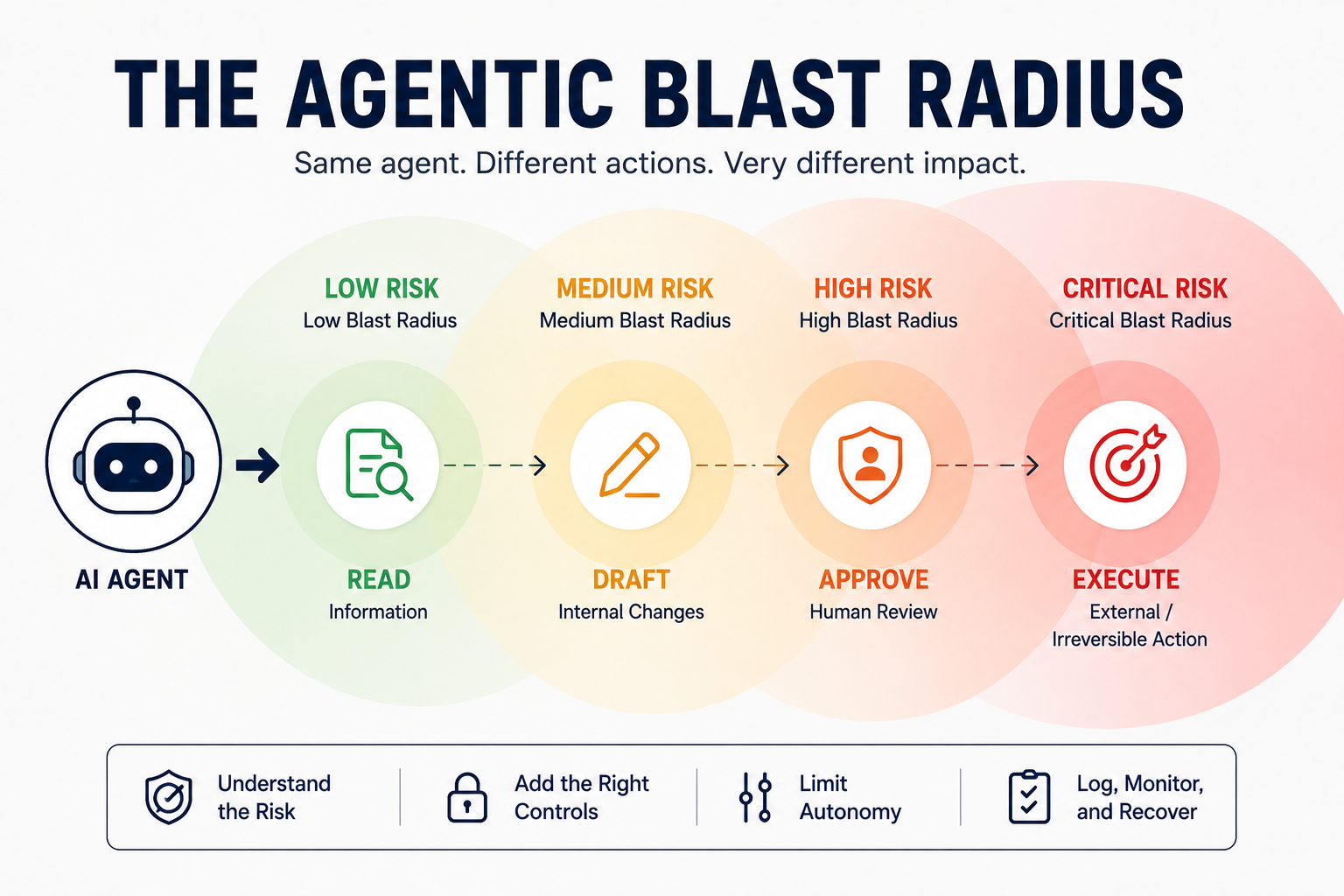
Every AI agent mistake does not carry the same risk. A wrong answer can confuse a user, but a wrong tool call can move money, change permissions, or break production. Before giving an agent more autonomy, ask one question: how much damage can one bad action cause?
A support agent gives the wrong answer.
Thanks for reading The Agentic Stack! Subscribe for free to receive new posts and support my work.
Annoying.
A billing agent issues the wrong refund.
Expensive.
A DevOps agent restarts the wrong service.
Incident.
A security agent changes the wrong permission.
Now you have a real problem.
These are all “AI agent mistakes.”
But they are not the same kind of mistake.
The first creates confusion. The second moves money. The third affects availability. The fourth changes access.
Same model class. Same agent architecture pattern. Very different blast radius.
That is the part many teams skip.
They ask:
Can the agent do the task?
They should also ask:
How much damage can one bad action cause?
That question changes everything.
It changes the tools the agent should get. It changes whether the action needs approval. It changes what should be logged. It changes whether rollback is required. It changes whether the agent should act, draft, escalate, or stop.
This is the Agentic Blast Radius.
It is the maximum damage an AI agent can cause when it makes one wrong decision, uses one wrong tool, trusts one wrong context, or follows one wrong instruction.
Most teams measure capability first.
Production teams measure blast radius first.
One extra tool can change the whole risk class
Imagine a billing assistant.
Version one can read invoices and explain charges.
Useful. Low-risk. If it gets something wrong, the user may be confused, but the system state does not change.
Version two can draft a refund request.
More useful. Still controlled. A human can review the draft before anything happens.
Version three can issue refunds directly.
Now the agent can move money.
That is not a small feature upgrade.
That is a new risk class.
The product may look almost the same. The demo may look almost the same. The prompt may barely change.
But the blast radius changed completely.
This is where teams get fooled.
They treat tool access as incremental.
Production treats it as a boundary.
Read invoice. Draft refund. Issue refund.
Those are three different systems.
They need different evals, permissions, approval gates, audit trails, rollback paths, and monitoring.
If your architecture does not change when the agent moves from reading to acting, the risk is hiding in plain sight.
The dangerous agent is not always the smartest one
People worry about highly autonomous agents.
That is fair.
But the more common risk is simpler: a narrow agent with one powerful tool.
A customer support agent with issue\refund. A sales agent with send\email. A workflow agent with update\crm. A DevOps agent with restart\service. A data agent with export\report. An internal assistant with change\permission.
None of these sound like science fiction.
That is why they are dangerous.
They feel practical. They save time. They fit real workflows. They are exactly the kind of agents companies want to ship.
But each one can change the world outside the chat window.
That is the line.
Once an agent can change state, the architecture needs to become more serious.
Not because the model is evil.
Because production systems do not care whether the mistake was made by a human, script, or AI agent.
The refund still happened. The email still went out. The record still changed. The service still restarted. The permission still opened.
Intent does not reduce blast radius.
Controls do.
Blast radius has four dimensions
You do not need a complicated model to start.
Ask four questions.
1. What can the agent touch?
Can it access public docs, internal docs, customer records, financial data, production systems, permissions, code, or external communication?
The more sensitive the surface, the larger the blast radius.
A wrong answer based on public docs is one thing.
A wrong action based on customer financial data is another.
2. What can the agent change?
Reading is risky.
Writing is riskier.
External actions are riskier still.
There is a big difference between:
“Here is the email I would send.”
and:
“Email sent.”
There is a big difference between:
“This account may qualify for a refund.”
and:
“Refund issued.”
The verb matters.
Read. Draft. Execute.
Each step increases blast radius.
3. How reversible is the action?
Some mistakes are easy to fix.
A draft can be deleted. A ticket tag can be changed. A CRM field may be corrected.
Other mistakes travel.
An email is read. A refund is processed. A permission is exploited. A production restart affects users. A bad file export leaves the system.
The harder it is to undo, the more control you need before the action happens.
Rollback is not a nice-to-have.
It is part of the risk model.
4. How far can the mistake spread?
Some errors stay local.
One user. One ticket. One draft. One internal note.
Others spread across customers, teams, systems, or workflows.
An agent that updates one support ticket has limited reach.
An agent that changes a customer segmentation rule may affect thousands of downstream emails.
An agent that modifies an access policy may affect every user in a workspace.
Blast radius is not only about the action.
It is about how far the consequences travel.
The mistake is giving every agent the same autonomy model
A low-blast-radius agent can be allowed to move fast.
Let it summarize. Let it classify. Let it draft. Let it retrieve. Let it recommend.
A high-blast-radius agent needs friction.
Approval. Policy checks. Rate limits. Audit trails. Rollback plans. Circuit breakers. Human escalation.
This is where a lot of agent design goes wrong.
Teams create one generic autonomy model:
The agent can use tools to complete the task.
That sounds elegant.
It is also too broad.
Autonomy should scale with blast radius.
For low-risk actions, autonomy can be high.
For high-risk actions, autonomy should degrade.
The same agent might be allowed to answer automatically, draft conditionally, and execute only after approval.
That is not a weaker agent.
That is a production-ready one.
The best agents know when to become less autonomous
Here is the pattern I like.
When risk is low, the agent acts.
When risk is medium, the agent drafts.
When risk is high, the agent asks.
When risk is unclear, the agent stops.
That simple ladder prevents a lot of damage.
A billing agent can explain a charge automatically. It can draft a refund recommendation. It can request approval for refund execution. It can stop if the policy is conflicting or the amount is above threshold.
A DevOps agent can summarize logs automatically. It can draft a remediation plan. It can request approval before restarting a service. It can stop if multiple systems are affected.
A sales agent can draft a follow-up automatically. It can ask before sending externally. It can stop if pricing, legal terms, or commitments are involved.
This is how agents become useful without becoming reckless.
The goal is not to remove autonomy.
The goal is to place autonomy where the blast radius is acceptable.
The question to ask before launch
Before shipping an agent, pick the highest-impact action it can take.
Then ask:
If this action is wrong, what happens next?
Not theoretically.
Walk it through.
Who is affected? What system changes? Can we undo it? How quickly would we know? Who gets alerted? What logs prove what happened? What approval should have existed? What should have stopped it?
If the team cannot answer those questions, the agent is not ready for that level of autonomy.
It may still be useful.
Just move it down the ladder.
Read instead of write. Draft instead of execute. Recommend instead of trigger. Escalate instead of guessing.
That is not slowing innovation.
That is reducing avoidable damage.
Thanks for reading The Agentic Stack! Subscribe for free to receive new posts and support my work.