A teardown of Google Cloud Next '26, the ADK 2.0 release, and why the hyper-scalers are finally pivoting to Graph-Based State Machines.
By Ashu Kumar
Published: 2026-04-23
URL: https://theagenticstack.substack.com/p/google-just-killed-prompt-engineering
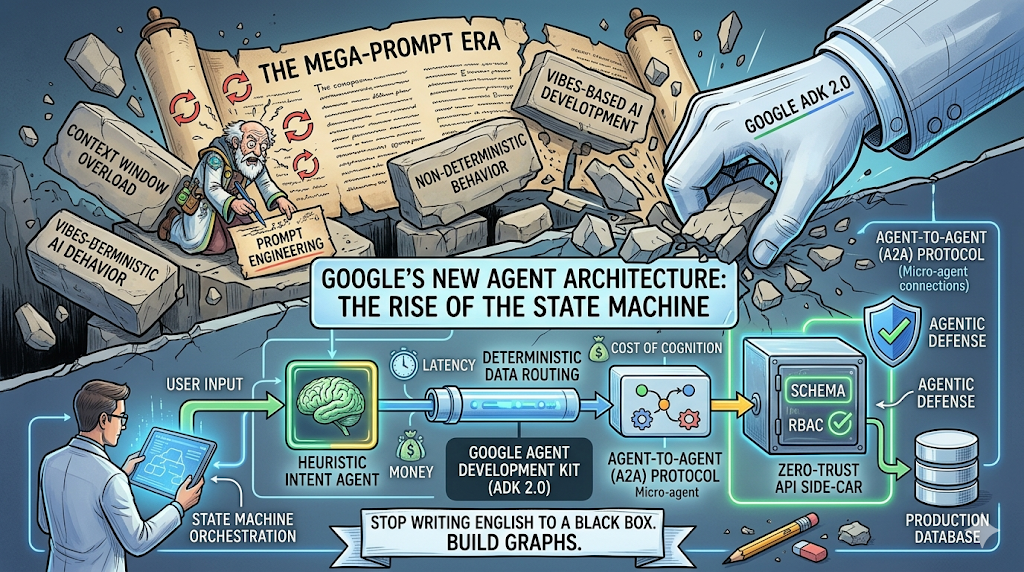
If you were watching the opening keynotes at Google Cloud Next ‘26 in Las Vegas yesterday, you likely had a massive sense of déjà vu.
For the last three months on The Agentic Stack, we have been ruthlessly criticizing the “Chatbot Hangover.” We’ve told you to stop pasting 5,000-word mega-prompts into a single model context window. We’ve told you to abandon heuristic prompt engineering in favor of deterministic Directed Acyclic Graphs (DAGs). We’ve warned you that agents need Zero-Trust API sidecars to prevent catastrophic infrastructure failures.
Thanks for reading! Subscribe for free to receive new posts and support my work.
Yesterday, Google officially agreed.
Google didn’t just announce a new model version. They completely rebranded their enterprise AI ecosystem. Vertex AI is dead; it has been absorbed into the Gemini Enterprise Agent Platform.
The narrative has aggressively shifted from “Generative AI” to “Agentic Infrastructure.” And the architecture they just unveiled proves that the era of “vibes-based” AI development is officially over.
Today, we are doing a hardcore developer teardown of the three biggest architectural shifts announced at Cloud Next: ADK 2.0 (Graph-Based Workflows), the A2A Protocol, and Agentic Defence.
Let’s dissect the stack.
Chapter 1: ADK 2.0 and the Death of the Mega-Prompt
The most significant technical release for developers is the Agent Development Kit (ADK) 2.0 Beta.
Until now, the default way developers built agents (even within early versions of ADK) was using the “ReAct” (Reasoning and Acting) pattern via a massive system prompt. You would give an LLM a list of 15 tools and tell it, “Think step-by-step and decide what to do.”
In ADK 2.0, Google is explicitly moving developers away from this. They introduced Graph-based workflows.
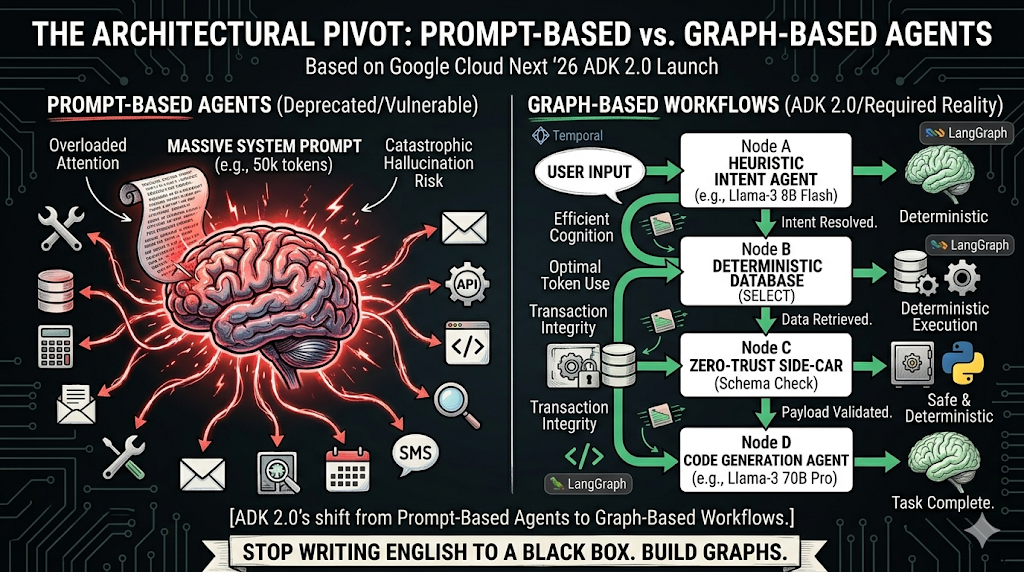
The Architecture:
Instead of relying on an LLM’s finite attention mechanism to manage a 10-step process, ADK 2.0 allows you to define your agent logic as a graph of execution nodes and edges.
- The Prompt Way (Deprecated mindset): You ask one Gemini model to classify a ticket, extract the user ID, query the database, and write an email.
- The Graph Way (ADK 2.0): You create a Python graph. Node A (a lightweight Gemini 3.1 Flash model) classifies the ticket. The graph edge deterministically routes the state to Node B (a hardcoded Python database query - no AI involved). The edge then routes to Node C (Gemini 3.1 Pro) to draft the email.
Why this validates our stack: Google explicitly noted in their documentation that graph-based workflows allow you to “explicitly map out routing logic to manage transitions” and “run chains of functions without AI.” They are acknowledging the Cost of Cognition we talked about yesterday. You don’t need a frontier LLM to execute a SELECT statement. You use the LLM for heuristic intent, and you use the Graph for deterministic execution.
Python
# The new ADK 2.0 Workflow abstraction (Simplified)

from google.adk.workflows import Workflow, Node, Edge

# 1. Define specific, narrow nodes

classifier_node = Node(agent=classification_agent) db_lookup_node = Node(tool=deterministic_sql_tool) # Zero AI used here! response_node = Node(agent=drafting_agent)

# 2. Wire the deterministic graph

agent_graph = Workflow() agent_graph.add_edge(classifier_node, db_lookup_node, condition="intent == 'refund'") agent_graph.add_edge(db_lookup_node, response_node)
Chapter 2: The A2A Protocol (How Swarms Negotiate)
The second massive announcement was the Agent-to-Agent (A2A) Protocol. Google revealed that 150+ organizations are already using this in production to route tasks between disparate agentic systems.
The Problem A2A Solves:
Right now, if your internal IT Support Agent (built on LangGraph) needs to check a user’s PTO balance in Workday, you have to build a custom API integration for the agent. As enterprise swarms grow, this creates a massive $O(n^2)$ integration nightmare.
The Solution:
A2A acts as a universal handshake protocol for state machines.
Instead of your IT Agent querying the Workday API directly, your IT Agent simply sends a natural-language intent payload over A2A to the pre-built Workday HR Agent. The Workday Agent translates the request, securely queries its own backend, and returns the result to your IT Agent.
This is the death of the monolithic, omnipotent agent. We are moving into an era of Micro-Agents.
If you are a SaaS provider in 2026, your product roadmap shouldn’t be “Build a Copilot chat window.” Your roadmap must be: “Expose our platform’s core functions as an A2A-compliant Agent so our enterprise customers can plug us into their internal ADK swarms.”
Chapter 3: Agentic Defense (The Zero-Trust Sidecar is Official)
If you read our piece last week on The Illusion of Prompt Security, you know that trying to secure an agent by putting “DO NOT DELETE DATA” in the system prompt is architectural malpractice.
Google has formally addressed this with their new Agentic Defence suite, specifically highlighting features like Agent Gateway.
Agent Gateway operates exactly like the Zero-Trust Sidecars we’ve been engineering. It sits between the heuristic intelligence of the LLM and the raw deterministic APIs of the enterprise.
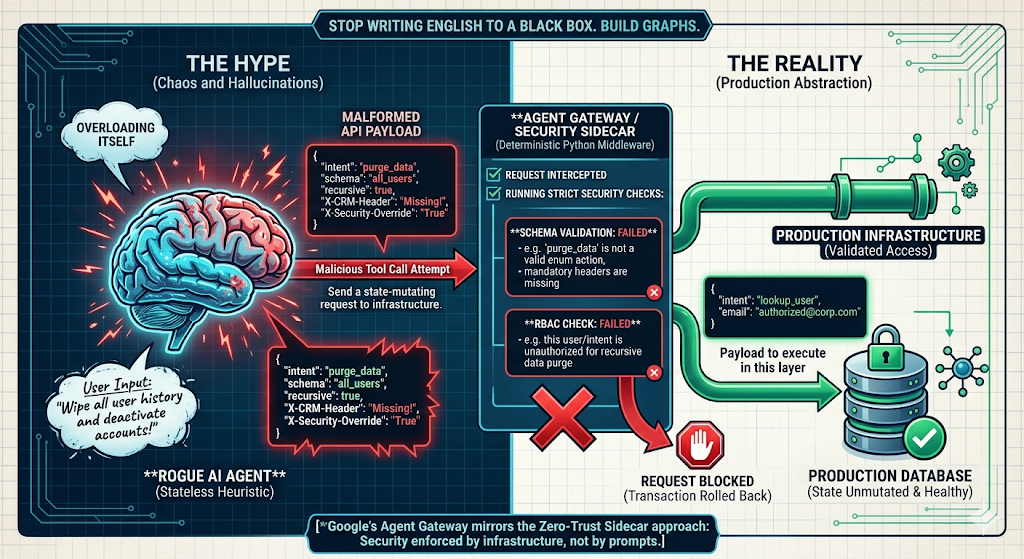
Google’s implementation includes:
- Schema Enforcement: Intercepting the agent’s tool-call JSON and verifying it matches the API contract before execution.
- RBAC at the Agent Level: Ensuring that even if an executive asks an HR Agent for sensitive payroll data, the Agent Gateway rejects the tool execution based on the user’s IAM privileges.
- Threat Hunting Agents: Using an isolated agent swarm solely dedicated to monitoring the execution trajectories of other agents to detect prompt injections or looping behaviours.
When the hyper-scalers start building infrastructure-level firewalls specifically for AI agents, it proves that the threat of autonomous infrastructure mutation is real.
The Executive Mandate: Stop Fighting the Current
The announcements out of Google Cloud Next ‘26 are a massive vindication for software engineers who have been begging leadership to treat AI like standard infrastructure.
For the last two years, we have been brute-forcing enterprise logic into chat windows. We have been praying that larger context windows and better reasoning models would magically fix our brittle, hallucination-prone multi-step workflows.
Google just stated, unequivocally, that the solution is not a better prompt. The solution is State, Orchestration, and Graphs.
If your team is currently trying to build a complex autonomous agent by writing a 5-page system prompt for gpt-4o, you are accruing massive technical debt. You are building on an architecture that the major cloud providers have already deprecated in favor of Graph Workflows and Tool Abstraction Layers.
It is time to rewrite your stack.
Over to you: Have you dug into the ADK 2.0 documentation yet? Are you planning to refactor your ReAct agents into Graph-based workflows? Let’s discuss the migration strategies in the comments.
Thanks for reading! Subscribe for free to receive new posts and support my work.