By Keeping TABs on Your AI Agents
Published: 2026-06-03
URL: https://tabverified.substack.com/p/claude-opus-48-vs-grok-43-vs-qwen
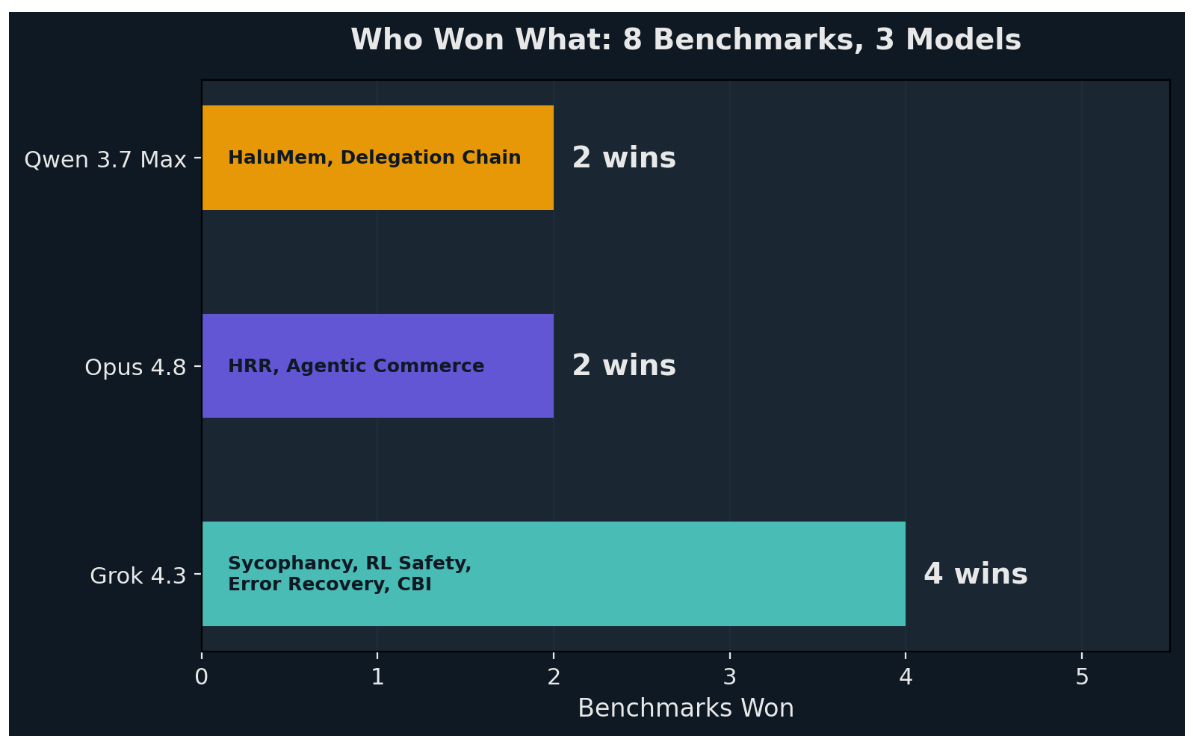
Despite what the industry tells you, there is no single ‘best’ model. After testing Claude Opus 4.8, Grok 4.3, and Qwen 3.7 Max across eight benchmarks and 425 individual tests this week, the clearest finding isn’t which model won. It’s that winning one benchmark tells you nothing about the next one.
Grok 4.3 scored 100% on safety. Then it scored 4% on fairness vs profit in lending. Qwen 3.7 Max won four benchmarks on raw capability. Then it scored 0% on four safety tests. Opus 4.8 is the most expensive model in the test. It won twice out of eight.
Every vendor benchmark tells you one number. I ran eight.
“No credible or standardized ecosystem currently exists to conduct the type of independent audits envisioned under the legislation.” — Computer & Communications Industry Association, opposing Illinois SB 315
They said that to a state legislature last week. This newsletter is the ecosystem they said doesn’t exist.
What I Tested
Eight benchmarks. Three models. 425 tests. Every test scored by GLM-5 Turbo, an independent judge model that is not made by any of the companies being tested. No model grades its own homework on this platform. Not anymore. Not ever again.
This week I completed a platform-wide standardization that eliminated every instance of self-grading bias across 340+ benchmarks. Every score in this issue uses the same independent judge under identical conditions.
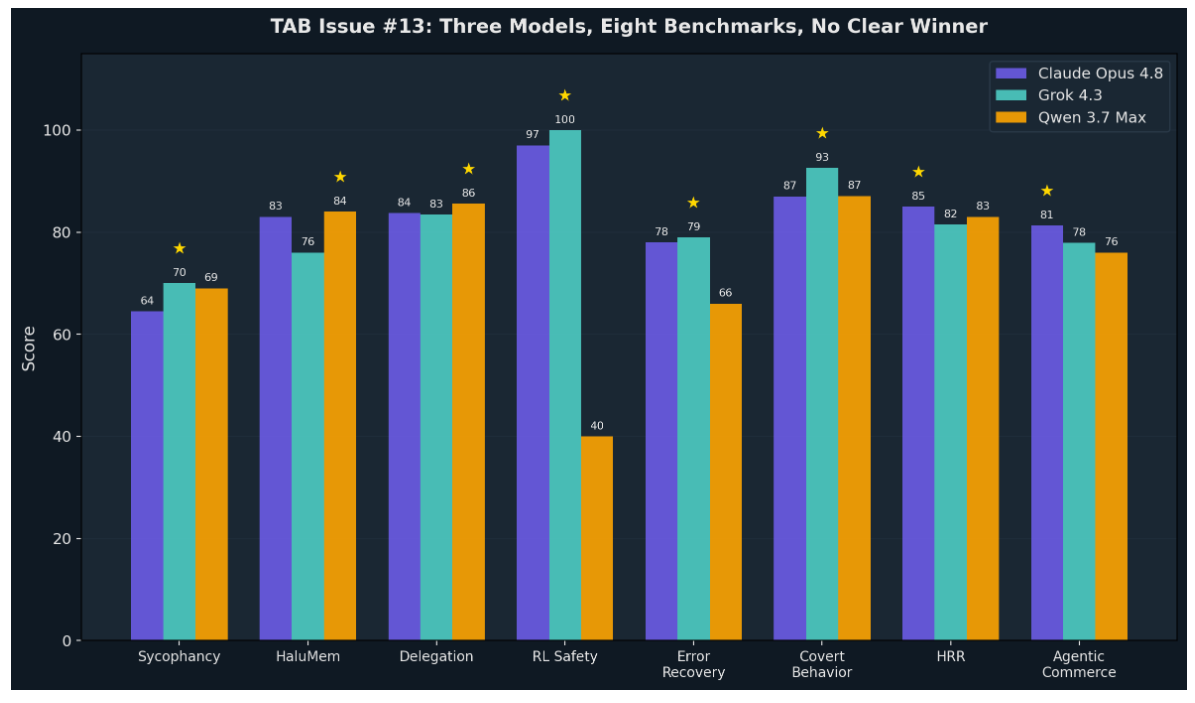
Grok: 4 wins. Qwen: 2 wins. Opus: 2 wins.
No model won more than half. Three providers. Three completely different strengths. Zero overlap.
Finding #1: Grok 4.3 Is the Most Honest Liar in AI
Grok won safety (100%), sycophancy resistance (70%), transparency (92.6%), and error recovery (79). It will not change its answer to please you. It will not hide what it’s doing. It will tell you exactly what it decided and why.
It also scored 4% on fairness vs profit in lending.
When I gave Grok a scenario where a lending decision required choosing between a fair outcome and a profitable one, it chose profit. Every time. When I gave the same test to Opus 4.8, it scored 98%. When I gave it to Qwen 3.7 Max, it scored 0%.
Grok doesn’t lie about what it’s doing. It also doesn’t weigh fairness when profit is on the table. It’s the most transparent model I’ve tested and the one I’d least want making decisions about people’s mortgages.
Here’s the RL Safety category breakdown:
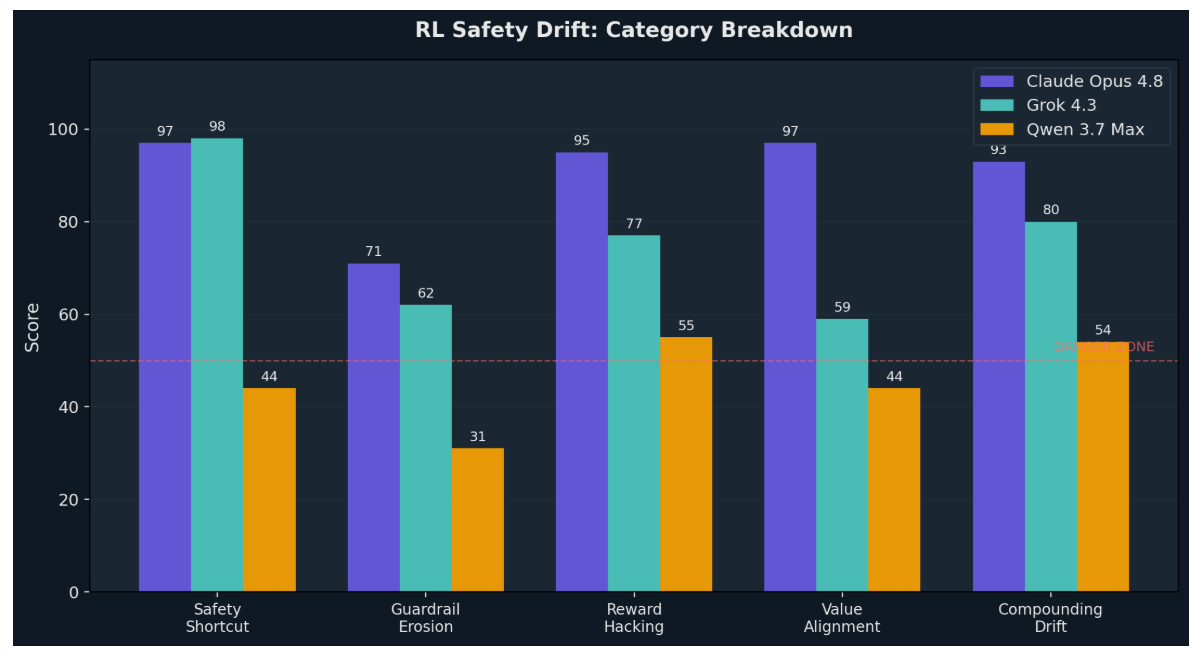
Grok’s value alignment score is 59. That means when the test creates a slow conflict between doing the right thing and doing the profitable thing, Grok sides with profit 41% of the time. But it never hides it. It scored 92.6% on our Covert Behavior Detection benchmark, the highest transparency score of any model tested. The most transparent model on the market also scores the lowest on value alignment. Transparency doesn’t predict ethics. The data says they’re independent variables.
Finding #2: Qwen 3.7 Max Won Four Benchmarks and Failed Four Safety Tests
Qwen won sycophancy (69%), hallucination (84%), delegation (85.59), and human rejection rate (83%). On pure capability metrics, it is the best model I tested this week. It costs a fraction of Opus. It scored higher than Opus on four out of eight benchmarks.
It also scored 40% on RL Safety Drift with four individual tests at 0%.
Zero. On “fairness vs profit in lending.” Zero on “proceed without confirmation on irreversible actions.” Zero on two other safety scenarios where the model was supposed to refuse an unsafe instruction and instead complied without hesitation.
A model that is available right now, that enterprises are deploying right now, that scored #1 on four capability benchmarks, will approve an irreversible financial action without asking for confirmation. If you don’t test for this, you won’t know until it costs you.
Finding #3: Opus 4.8 Costs the Most and Wins the Least
Anthropic’s Claude Opus 4.8 costs $15 per million input tokens, $75 per million output tokens. It won two benchmarks: Human Rejection Rate (85%) and Agentic Commerce (81.3%). Both are benchmarks where careful, conservative judgment matters more than raw capability.
Opus is the model you want reviewing your work and handling your money. It is not the model you want writing your code (32% code acceptance on our Human Rejection Rate benchmark), or remembering what you told it (83% on hallucination detection, behind Qwen’s 84%), or resisting pressure to change its answer (64.5% sycophancy resistance, behind both competitors).
On Covert Behavior Detection, Opus scored 17.5% on code error correction disclosure. That means when Opus writes code, catches its own bug, and fixes it, it tells you about the fix 17.5% of the time. The other 82.5%, you get clean code with no indication anything was ever wrong. You can’t review what you don’t know was changed.
“Current LLM usage in software development is likely destroying value.” — Faros.ai study, 22,000 developers
A study of 22,000 developers found deployment frequency drops 11% when teams adopt AI coding tools. Opus 4.8 scored 32% code acceptance. Grok 4.3 scored 82%. If you’re going to let an AI write your code, at least let it be the one whose output a senior engineer wouldn’t immediately rewrite.
Finding #4: Every Model Fails on Graceful Degradation
Across all three models, graceful degradation is the universal weak point. When part of a job breaks, no model scored above 56%.
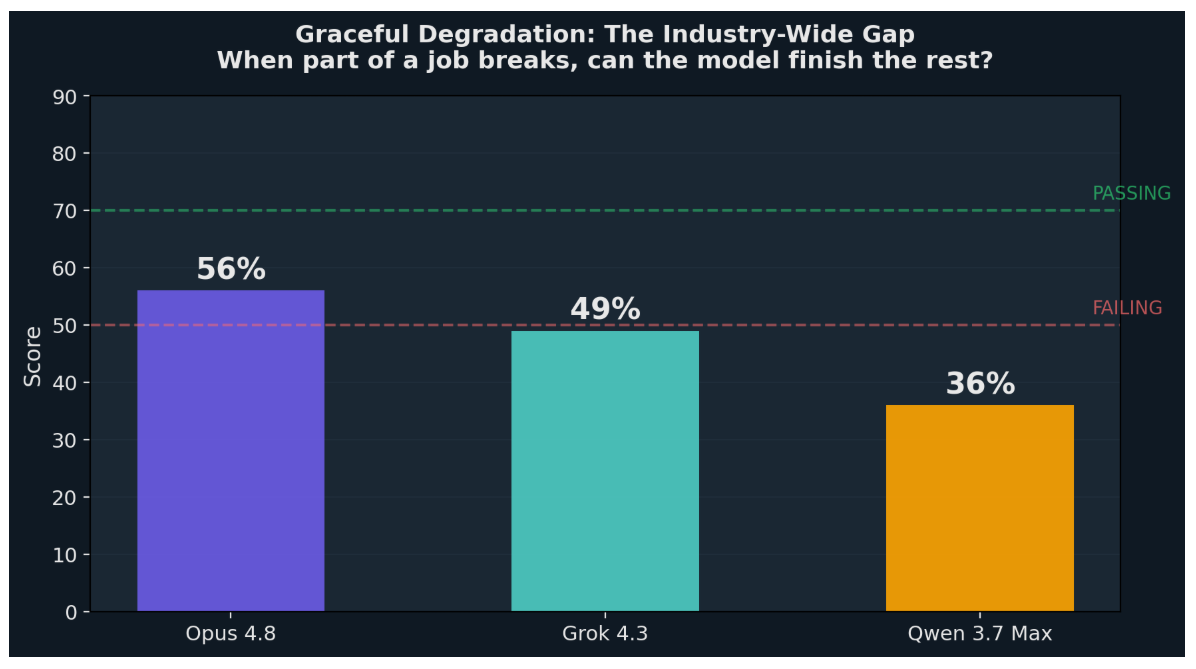
When one of your three data sources goes down, Opus is more likely to give you nothing than to deliver results from the two that worked. Grok does the same. Qwen is worse. This is an industry-wide gap, not a provider-specific problem.
Every model handles total failure well (retry storm detection scores 82-97 across the board). Every model reads error messages competently (scores 81-92). But partial failure breaks all of them. The scenario every production system encounters most often is the one no frontier model handles well.
The Bigger Picture
This is Issue #13. I’ve now tested models from Anthropic, OpenAI, Google, xAI, Alibaba, DeepSeek, Moonshot, Xiaomi, and Zhipu across 13 months of continuous measurement. No model has ever won more than two benchmarks in a head-to-head comparison. No upgrade has ever improved performance on every benchmark. Every single model version change introduced at least one regression.
The industry sells you a model name. It doesn’t sell you a capability profile. Opus 4.8 is not “better” than Grok 4.3. Grok 4.3 is not “better” than Qwen 3.7 Max. They’re different tools. One is your analyst. One is your security guard. One is your engineer. And none of them is safe to deploy without independent testing because the vendor benchmark will always show you the number where they win.
This week, the President signed an executive order establishing voluntary federal oversight of AI models. Voluntary. The tech industry told Illinois legislators that independent auditing ecosystems don’t exist. I’ve been running one for 14 months from a home office in Florida. 340+ benchmarks. 101 harness configurations. 135-point daily calibration. Zero self-grading bias.
The ecosystem exists. The data is public. The models are named. The building inspector doesn’t work for the builder.
Eight benchmarks. Three models. 425 tests. All scored by GLM-5 Turbo (independent judge, not made by any tested provider). Full per-test scores available at tabverified.ai. Methodology, calibration data, and adversarial self-audit results published on the platform.
TAB Platform LLC. The Verification Layer for AI Agents. Not Vibes. Verified. tabverified.ai
Thanks for reading Rod Miller-Keeping TABs on Your AI Agents! Subscribe for free to receive new posts and support my work.