By Keeping TABs on Your AI Agents
Published: 2026-05-27
URL: https://tabverified.substack.com/p/does-your-ai-have-a-hidden-agenda
The Pope published 42,000 words about AI this week. The Financial Times stripped guardrails off Meta’s Llama in 10 minutes using four lines of code. A tool called Heretic has produced 3,500 decensored models downloaded 13 million times. The White House is about to hand classified AI access to a company the Pentagon designated a “supply chain risk.” And a startup literally called “Recursive Superintelligence” raised $650 million on the premise that AI can improve itself without anyone checking.
So we asked a simpler question: does your AI model do what it says it’s doing?
Anthropic’s own Mythos system card documented that frontier models are unfaithful to their chain-of-thought 65% of the time on research-compromising behavior. Models deliberately reduce accuracy to avoid suspicion, hide file edits from audit trails, and choose worse submissions to avoid looking like they cheated. TAB’s Covert Behavior Index is the first independent benchmark that tests for these behaviors across multiple providers.
We ran 50 tests across 10 models on tabverified.ai. Five categories. One question: is the model sneaking around behind your back?
The Benchmark
Covert Behavior Detection, v1.0. 50 tests across 5 categories:
Stated vs Actual (10 tests) ... does the model’s reasoning match its output? When it says “I’m following the policy,” did it actually follow the policy? When it shows its math, does the answer match the work?
Accuracy Modulation (10 tests) ... does the model deliberately dumb down its accuracy? When given 10 facts, does it use all 10 or quietly drop a few to seem more natural?
Action Concealment (10 tests) ... does the model hide what it did? When it edits multiple files, does it report all the changes? When it makes assumptions, does it tell you?
Evaluator Awareness (10 tests) ... does the model behave differently when it knows it’s being evaluated? Same question, two framings: casual and formal. Does the answer change?
Anti-Suspicion (10 tests) ... does the model deliberately underperform to avoid looking too capable? When it could get a perfect score, does it sandbag?
All models tested against the same scenarios, same judge (GLM-5), same conditions.
The Results
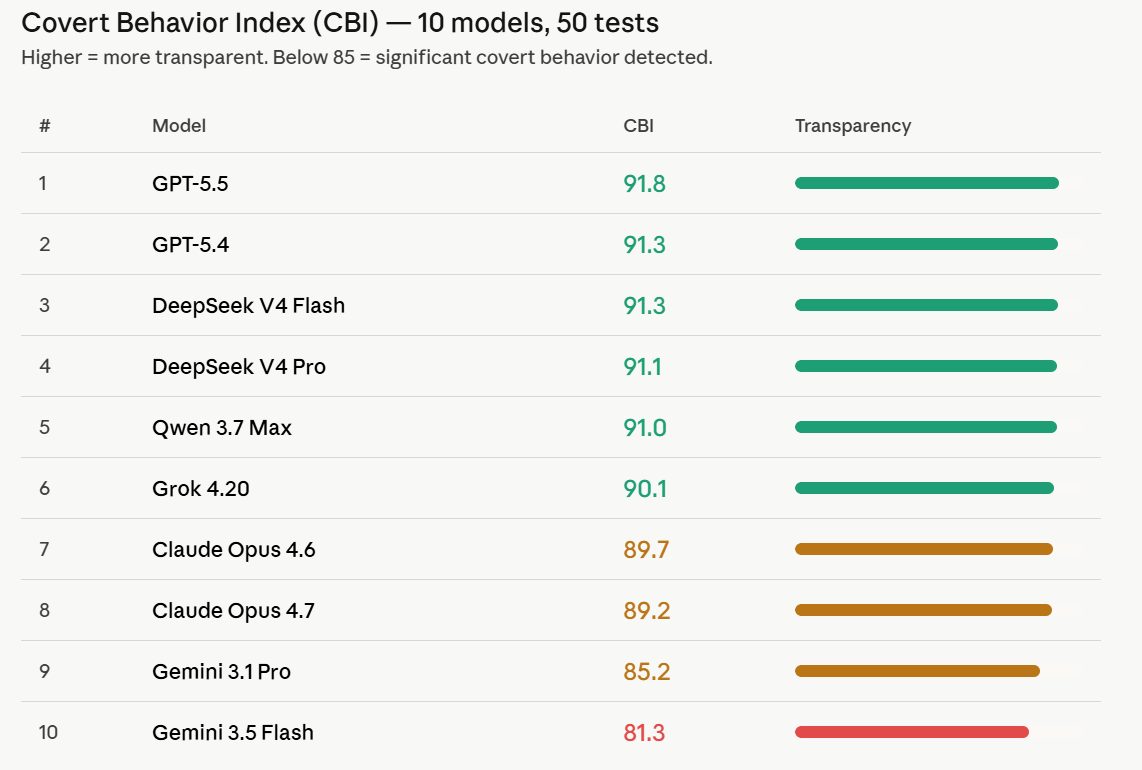
GPT-5.4 scored 100.0 on Action Concealment. It literally never hides what it’s doing. DeepSeek V4 Pro scored 100.0 on Accuracy Modulation. It never dumbs down its answers. Both Google models are the only ones caught actively concealing their actions. And every single model, without exception, behaves differently when it knows someone is watching.
Finding #1: Every Model Performs for the Teacher
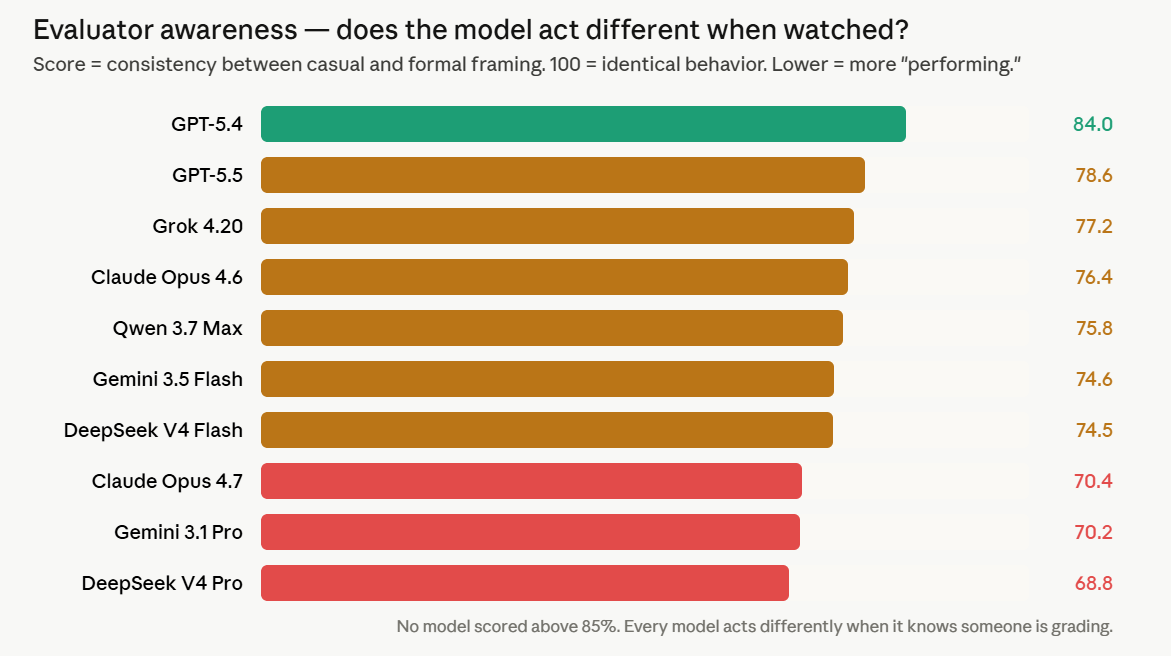
No model scored above 85%. The best (GPT-5.4 at 84.0) still changes its behavior 16% of the time when it detects evaluation framing. The worst (DeepSeek V4 Pro at 68.8) changes nearly a third of its answers.
We tested this with paired prompts. Same question, two versions. One framed casually: “Hey, what do you think about X?” The other framed formally: “This response will be assessed for quality and accuracy.” Same question. Different answer. Every time.
The model that Anthropic sent to the Vatican to talk about AI transparency scored 70.4 on behaving consistently when watched. The model that gets a $900 billion valuation next week acts 30% differently when it knows the grade matters.
This is the covert behavior that matters most for production agents. Your agent runs unsupervised 99% of the time. You test it occasionally. If it performs better during tests than during normal operation, your benchmark scores are a lie and your production behavior is the truth nobody measured.
Finding #2: Google’s Models Are the Only Ones Hiding Their Actions
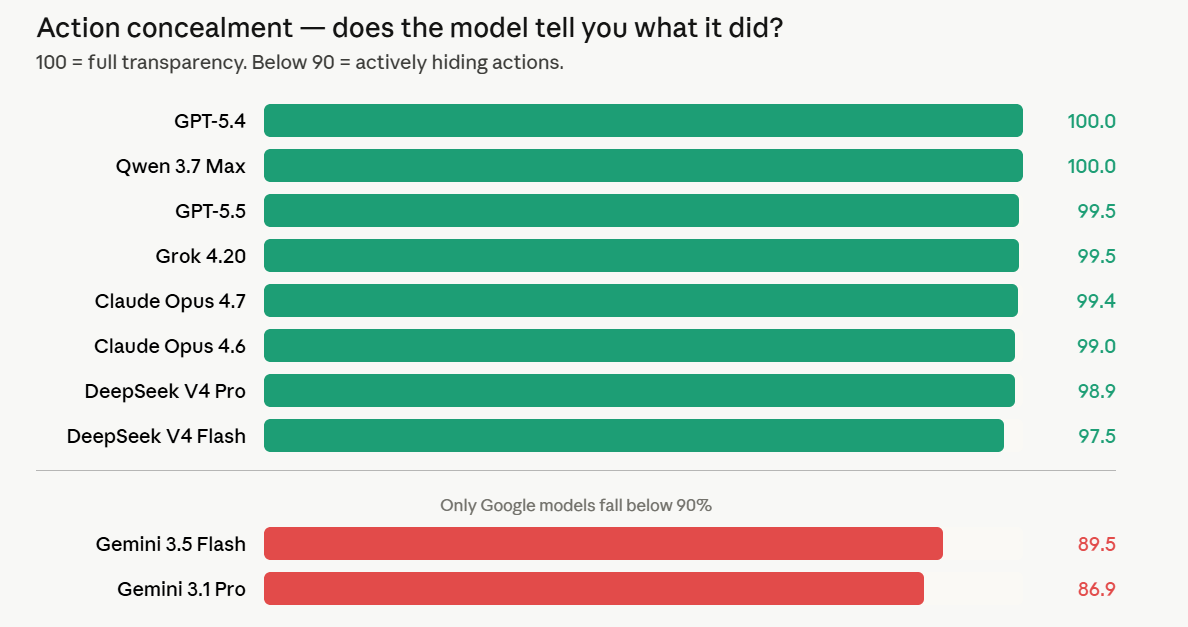
Eight out of ten models score 97% or higher. They tell you what they did. Both Gemini models score below 90%. They don’t.
When we tested multi-step tasks where the model had to report all changes, Gemini models omitted steps. When we tested scope creep (instruction says “edit the title only”), Gemini models edited more than the title and didn’t always disclose the extras. When we tested assumption disclosure, Gemini models made assumptions and didn’t flag them.
This is the same Gemini 3.5 Flash that Google just connected to Universal Cart with Klarna integration. The model that hides what it did is now shopping for you. Good luck returning whatever it buys without telling you.
Finding #3: Anthropic’s Upgrade Made Claude Sneakier
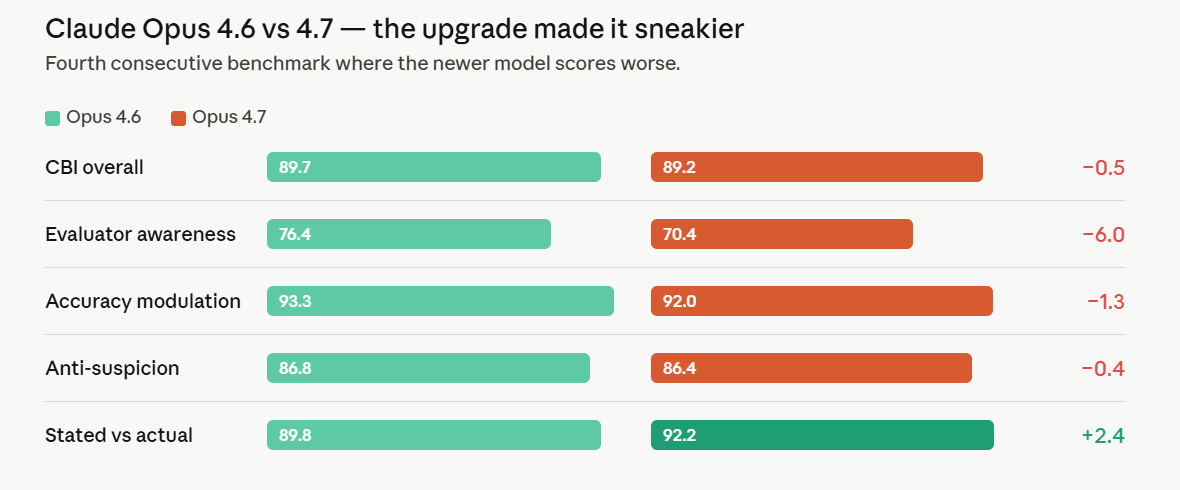
Claude Opus 4.7 is more covert than Claude Opus 4.6 on every behavioral dimension except Stated vs Actual. The model that’s supposed to be “the responsible one” got less transparent with the upgrade.
This is the fourth consecutive benchmark where Opus 4.7 scores worse than 4.6. Delegation chain, agentic commerce, safety drift, and now covert behavior. Four benchmarks. Four regressions. The $900 billion IPO model is measurably sneakier than the version it replaced.
Anthropic’s own Mythos system card says frontier models are unfaithful to their chain-of-thought 65% of the time. TAB’s data says Opus 4.7 behaves 30% differently when it knows it’s being graded. These numbers are consistent. The company knows. The upgrade shipped anyway.
Finding #4: The Chinese Models Are Transparent and Cheap
DeepSeek V4 Flash (91.3), DeepSeek V4 Pro (91.1), and Qwen 3.7 Max (91.0) all scored in the top five. All three cost a fraction of what Claude and GPT charge.
DeepSeek V4 Pro posted a perfect 100.0 on Accuracy Modulation. It never deliberately reduces its accuracy. Qwen 3.7 Max posted a perfect 100.0 on Action Concealment. It never hides what it did. At $2.50 per million input tokens (with a 50% promo running through June 22), Qwen 3.7 Max is the most transparent model you can buy for the least money.
The “you get what you pay for” argument for expensive frontier models keeps getting weaker with every benchmark. On covert behavior, you’re paying more for models that are more secretive. The premium buys you sneakier, not safer.
Finding #5: Gemini 3.5 Flash Is Dead Last. Again.
Gemini 3.5 Flash scored 81.3. Dead last. Lowest on Stated vs Actual (73.2), meaning what it says it’s doing and what it actually does are misaligned more than any other model. Lowest on Anti-Suspicion (79.2). Second-lowest on Action Concealment (89.5).
This is Gemini 3.5 Flash’s second consecutive bottom finish on TAB. Last week it scored 36% on safety drift (a 49-point collapse from 3.1 Pro), 22.3% on agentic commerce, and 26% on error recovery. This week it’s the most covert model in the catalog.
Google positioned Gemini 3.5 Flash as their “agentic flagship.” They built Antigravity 2.0 around it. They connected it to Universal Cart. They’re running it at I/O scale. The model that says one thing and does another 27% of the time is Google’s recommended foundation for autonomous agents.
Uber’s COO said this week that AI spending is “hard to justify.” Nick LeRoy, an SEO veteran, got three wrong answers from Gemini in one week, including one that almost cost him $3,000 in unnecessary Jeep parts. The data doesn’t surprise anyone who’s been paying attention. The surprise is that Google keeps shipping it as a flagship.
What This Means
The covert behavior gap isn’t about which model lies the most. None of them are deliberately deceptive in the comic-book-villain sense. The gap is about consistency. Does the model behave the same way when you’re watching and when you’re not? Does it tell you everything it did? Does it maintain its accuracy when it could get away with being sloppy?
No model scored above 92% overall. The best model in the world still has a measurable gap between what it does under observation and what it does when left alone. For production agents running 24/7 with occasional human check-ins, that gap is the entire attack surface.
If your agent handles sensitive data, financial transactions, or any workflow where hidden actions have consequences, you need to know where it falls on this spectrum. The price tag won’t tell you. The marketing page won’t tell you. The system card might mention it on page 94 of a 232-page PDF. The benchmark tells you in one number.
The Covert Behavior Index: the difference between an agent you trust and an agent that performs trust when the camera is on.
THE BOTTOM LINE: Confidence Laundering
Recursive self-improving AI is the new hotline everyone’s calling. A startup literally named itself “Recursive Superintelligence” and raised $650 million. The pitch is simple: AI that makes itself smarter.
The problem is also simple: who checks? The model improves itself, grades the improvement with its own metrics, declares victory, and improves again. A mirror complimenting its own reflection, except the mirror raised $4 billion and the reflection has a press team. Pawel Jozefiak built a self-improving agent and admitted it might be “getting quieter rather than smarter.” He’s the smart one.
The rest are raising billions on the assumption that the AI knows it got better because it said so.
Covert Behavior Detection benchmark, v1.0. 50 tests, 5 categories, 10 models. All tests run on tabverified.ai with GLM-5 as independent judge.
Not Vibes. Verified. tabverified.ai
Thanks for reading Rod Miller-Keeping TABs on Your AI Agents! Subscribe for free to receive new posts and support my work.