We ran agents in parallel on a real product. The code was not the constraint. The pipeline was.
By Sumant Thakur
Published: 2026-11-04
URL: https://sumantthakur.substack.com/p/your-ci-was-built-for-humans-agents
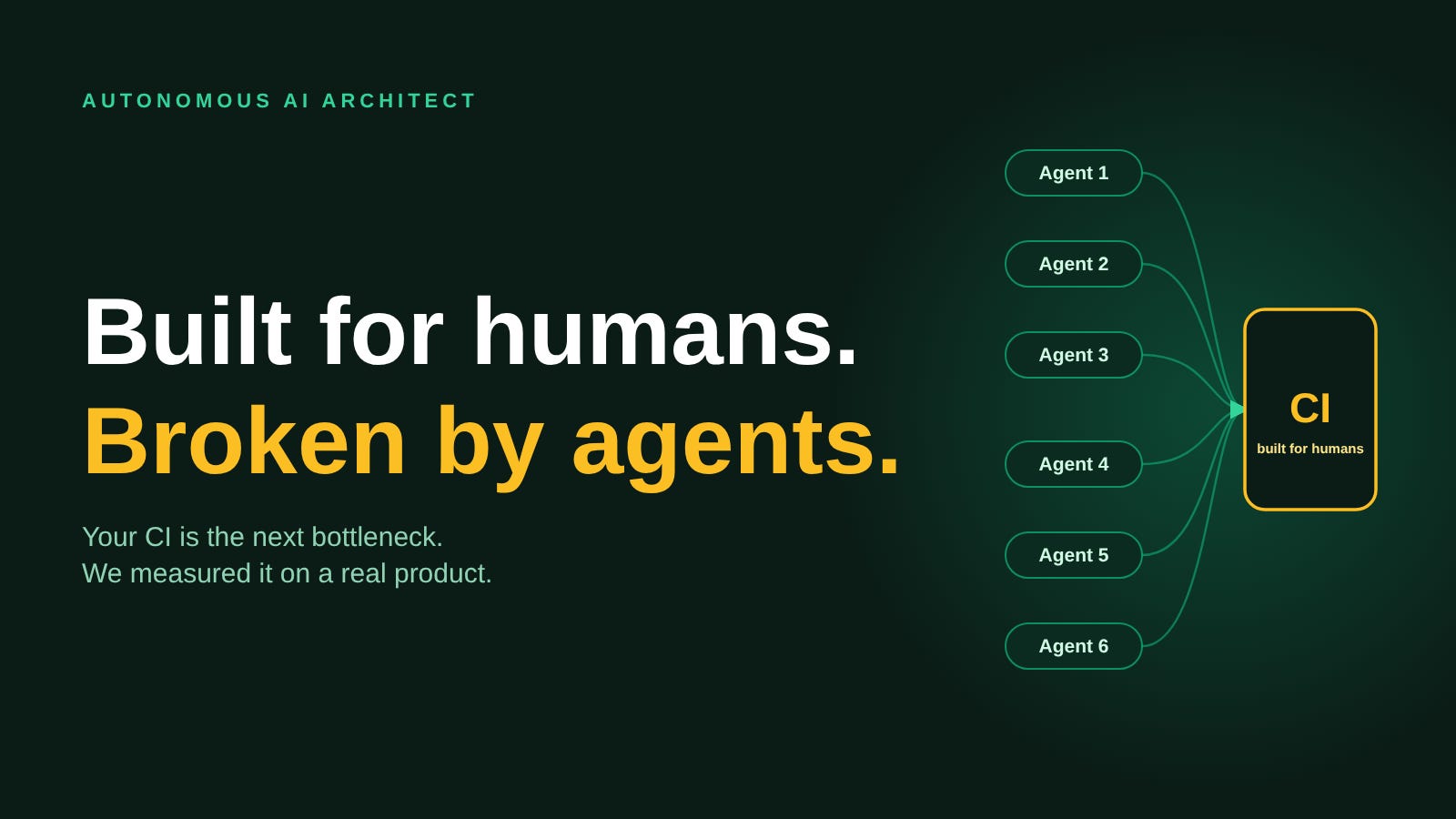
Agents made code cheap. Verifying it stayed expensive. Since mid-September we have built our agentic income tax portal with multiple agents working in parallel, and our CI workflow was triggered 649 times while we merged 156 pull requests. On our busiest day, 64 full runs executed across 19 branches. Producing code was not what slowed us down. Waiting on the pipeline was.
We are not the only team that hit this wall. Anthropic’s merges grew from about 2,500 a day in May to over 30,000 in September, and it built its own version control system. OpenAI says reliability for its monorepo at times fell below 90% under Codex, and it built a new Git backend. Both are the same problem we had, at a scale we will never reach.
This follows two earlier posts. In I Ran Multiple Coding Agents. The Code Was the Easy Part. I argued that parallel agents need isolated state and independent verification.
In Spotify, AWS and Warp Are Building the System Around Coding Agents I warned that parallel work would push the constraint toward review and integration. Here is what that looks like on a real product, in numbers.
Below: what slowed us down, what actually helped, the two levers any pipeline has, and how to audit your own.
Parallel agents make CI the shared bottleneck
A single CI run was never slow, so we looked in the wrong place for a while. The median run took 4.4 minutes. The cost came from volume: many branches, each pushing early and often, each push starting the full pipeline.
Here is what seven weeks of our own run history shows:
-
Volume: 649 triggers of our main verification workflow, 459 of which fully executed, with peaks of 53 to 64 full runs a day across 19 branches.
-
Total time: about 46 hours of pipeline time across the runs that actually executed.
-
Failures: 64 of 436 completed runs failed, about 15%, and each failure meant another run.
-
Long tail: the slowest tenth of runs took 9.6 minutes or more, and the longest took 54 minutes.
-
Re-runs: most pull requests needed one run, but one in ten needed four or more, and one needed 23.
Those are run times, not time spent waiting for a runner. The pattern was still clear: when several agents push at once, the pipeline becomes the one resource they all queue on.
Multiply it by a team and job slots become the limit
A full run is not one job. It fans out into 12, and about ten of them ask for a runner as soon as the first job finishes. On our busiest days, three or four full runs overlapped, which can ask for up to 40 job slots at once. GitHub-hosted runners cap concurrent jobs by plan: 20 on Free, 40 on Pro, 60 on Team and 500 on Enterprise.
To see what a team would face, I replayed our real days. Each developer is another copy of our repository’s activity placed on the same clock, and I took the median peak over 1,500 random draws.
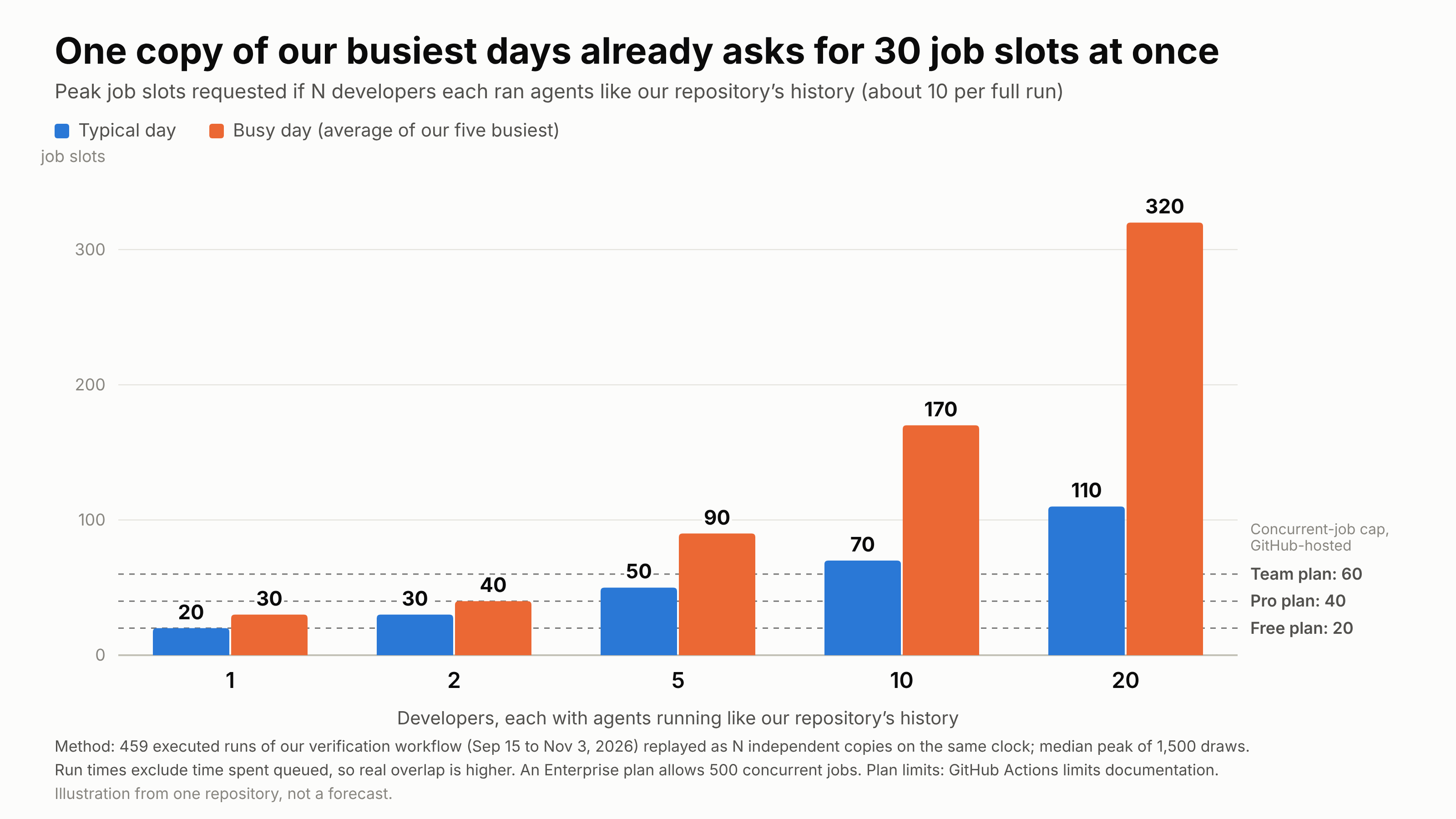
Busy day means the average of our five busiest days, at about 10 job slots per full run. One copy of our busiest days already asks for more slots than a Free plan allows. Five copies pass a Team plan’s 60. Twenty need about 320, which only an Enterprise plan covers.
This is an illustration from one repository, not a forecast. It assumes developers work independently, and our run times exclude time spent queued, so real overlap is higher. Which plan applies to your team decides when this starts to bite.
What runs, and when, mattered more than how fast
The biggest improvement came from deciding which pushes deserve a pipeline run at all, not from making any single run faster.
The change that helped most was moving work to draft pull requests. A push to a draft starts no jobs and allocates no runners. Full CI starts when the pull request is marked ready for review. In our history, 168 of 629 non-bot runs ended as one-second skips, which is mostly what draft pushes cost now.
Three smaller rules sit behind it:
-
Classify by changed paths. Documentation-only changes skip the heavy jobs. Anything unknown or shared runs in full, so the shortcut fails safe.
-
Split the pipeline into parallel jobs. Java unit and integration tests, UI, client, architecture checks and the scan worker run side by side, and one gate job decides the result.
-
Cancel superseded runs. When an agent pushes again, the older run on that branch is cancelled. That happened 25 times.
Agents push often. A pipeline that treats every push as a release candidate pays full price for work that is still changing.
Two levers: do less work, or run more at once
A shared pipeline has two ways to relieve pressure, and they fix different problems.
-
Reduce the work per change. Gate runs by draft state, classify by changed paths, split jobs and cancel superseded runs. This cuts cost and the number of runs competing for the same capacity. Most of our changes sit here.
-
Add parallel capacity. More or larger runners let more jobs execute at once. This fixes waiting rather than running, and it needs no change to how the team works. We built in a manual option to compare runner providers. The risk is that capacity can hide waste, such as repeated failures.
Which lever comes first depends on where the time goes. If runs wait for a runner, capacity helps. If runs repeat, fail or do work nobody needed, trimming helps. Teams running agents at volume will probably end up using both. The way to choose is to measure waiting and running separately, which is question four in the audit below.
Anthropic and OpenAI hit the same wall at a scale few teams will reach
Both labs found that code stopped being the bottleneck and the systems around it took over. Both fixed it by dropping a guarantee that was built for humans.
Anthropic (Redesigning source control at Anthropic):
-
Daily merges grew from about 2,500 in May to over 30,000 in September, with about 25 million CI checkouts a day.
-
At peak it ran several hundred internal Git mirrors, then built Scion, a version control system where the server does most of the work.
-
It says a merge queue with a global lock does not fit agent-scale merging, and relies on post-merge and pre-deploy testing instead.
OpenAI (Scaling Git at OpenAI):
-
Under Codex, reliability at times fell below 90%, with slow fetches and pushes and failed merges.
-
It built Pando, a new backend that keeps the Git protocol and client. Each branch is coordinated independently, and packfiles are reused across readers.
-
Median push latency fell by nearly 5x, and it now serves nearly a petabyte of Git data a day.
The interesting difference is what each kept. Anthropic replaced Git for its monorepo. OpenAI kept the interface and rebuilt what sits behind it. OpenAI gave up repository-wide consistency, and Anthropic gave up the global merge lock. Neither system is available to use, and both sets of numbers come from the companies themselves.
Our scale is a rounding error next to theirs. The pattern is the same: assumptions built for a human who commits a few times a day stop holding when agents do it all day.
The Key Takeaway
You do not need Scion or Pando. You need to find which human-scale assumption in your own pipeline breaks first. I call this the Human-Scale Assumptions Audit, and it is five questions:
-
What starts a run? Does every push trigger the full pipeline, including draft work and pushes that a newer push has already replaced?
-
Does every change pay for the full pipeline? Can documentation-only or isolated changes take a shorter path, with anything unknown falling back to the full one?
-
Is verification serial or parallel? One long job hides where time goes. Split jobs behind a single gate show it.
-
Is the limit waiting or running? Measure queue time separately from run time before you tune tests or buy capacity.
-
What does a repeated run cost? Track the failure rate and the re-runs per pull request. A pull request that needs many runs is telling you something about the work, not only about CI.
Start with question 4. Everything else depends on knowing whether your agents are waiting for a runner or for a test.
Plan your pipeline for the day your agents write faster than it can verify.
Related reading: The Future PR Is an Evidence Packet.
I publish one architecture framework a month and a short fix-it post every week. Subscribe free to get both.