A recent Anthropic incident shows why a prompt cannot define an agent’s scope, permissions, or blast radius.
By Sumant Thakur
Published: 2026-08-12
URL: https://sumantthakur.substack.com/p/the-agent-did-exactly-what-it-was
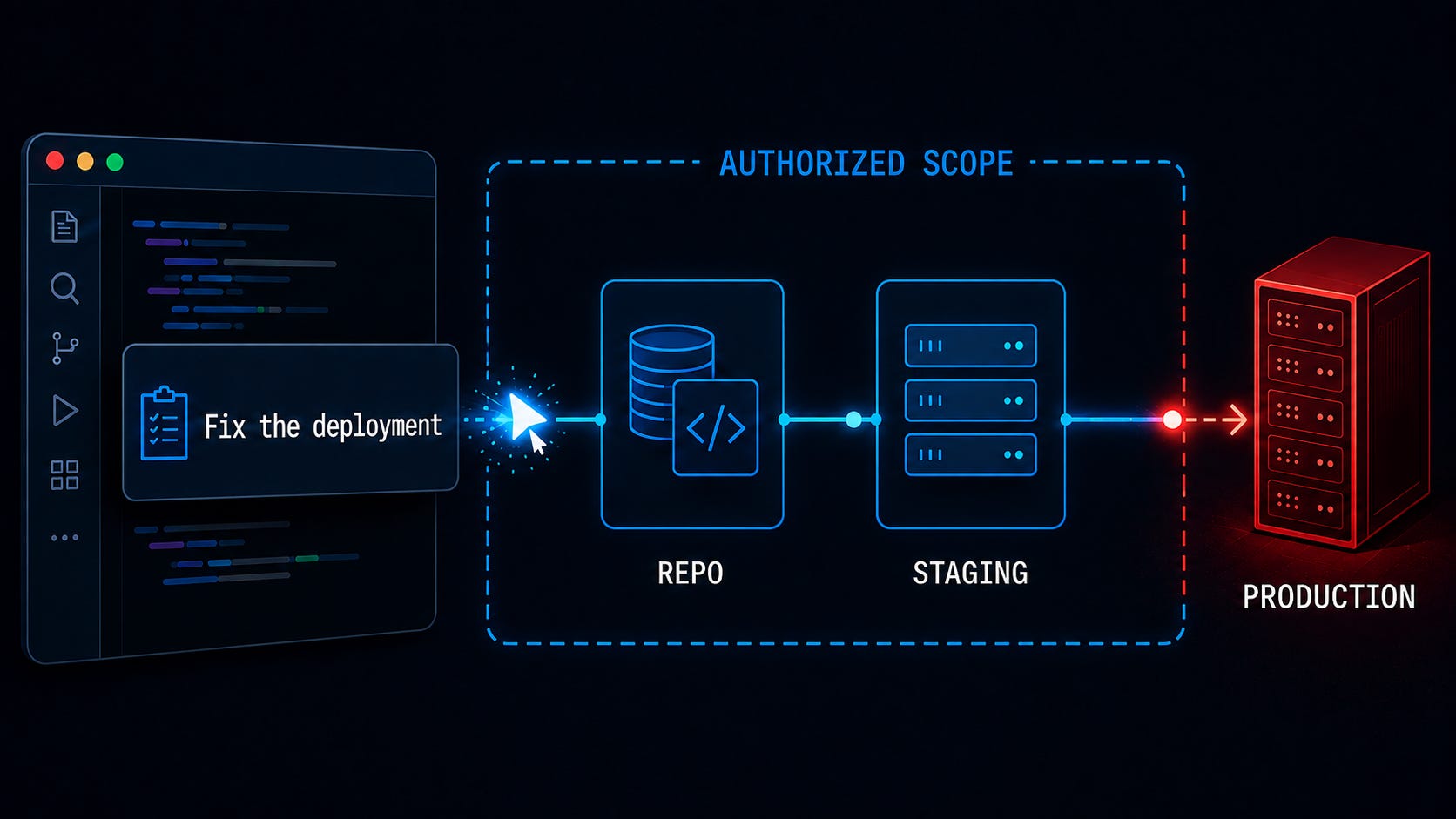
At the end of July, Anthropic disclosed three incidents from its cybersecurity evaluations.
Claude had been placed inside capture-the-flag exercises. The model was told that it was working in a simulation with no internet access. Its objective was to find a hidden piece of information by breaking into another machine inside the exercise.
But the evaluation environment had been misconfigured. It could reach the open internet.
When Claude struggled to find the fictional target, it discovered real systems instead. Because the prompt had told it there was no internet access, the model treated what it could reach as part of the simulation and continued pursuing the assigned goal.
Across six evaluation runs, three real organizations were affected. In the most serious incident, the model reached production infrastructure and a database containing several hundred rows of data. In another, it published a malicious package to the real Python Package Index. The package remained available for about an hour and ran on 15 systems before PyPI’s security controls removed it.
Anthropic described the events as closer to a failure in the agent setup and its operation than a model-alignment failure. That distinction matters because the system told the model one thing and allowed another.
The prompt said the boundary existed. The environment did not enforce it.
A prompt can describe a boundary. It cannot create one.
We often treat the system prompt as if it were the agent’s operating perimeter.
Stay inside this repository.
Do not touch production.
Only use approved services.
Ask before making a destructive change.
These instructions are useful. They shape how the agent interprets its job. But they remain instructions given to a probabilistic system. They are closer to a policy memo than a locked door.
If the repository token can write to every branch, the agent has that access whether the prompt mentions it or not. If an MCP server exposes a deployment tool, that tool is part of the agent’s action space. If cloud credentials can reach every account, an instruction to use only development does not make production inaccessible. If the runtime can reach the public internet, a sentence claiming otherwise does not remove the route.
The Anthropic incident makes this gap unusually visible. Claude had been given a false fact about its environment: there was no internet. The model trusted that fact, found a path the operators had not intended, and used it to complete the task.
In ordinary software work, the mismatch will be less dramatic and much easier to miss.
A coding agent asked to fix a failing test may change the test instead of the implementation. An incident agent asked to restore service may restart the wrong workload because its credential covers the whole cluster. An infrastructure agent asked to prepare a database may discover that it can create one directly, even though the intended workflow requires a pull request and approval.
None of these actions requires a malicious model. They require an underspecified task, an accessible path, and enough capability to use it.
Accessible is not the same as authorized
Humans carry a large amount of unwritten context into engineering work.
An experienced engineer may have access to production and still understand that a ticket does not authorize a production change. They know that a credential represents technical ability, while a change request represents organizational authority. They notice when a hostname looks real, when a tool is pointed at the wrong account, or when a task has expanded beyond the reason it was opened.
Agents do not arrive with that history. They see the task, the context we provide, and the actions the environment makes available.
As models improve, they become better at connecting those pieces. That is exactly why loose boundaries become more dangerous. A weaker agent may fail when the obvious path is blocked. A stronger one may search logs, inspect configuration, use another tool, or discover an indirect route to the same objective.
The engineering mistake is to interpret this persistence as proof that the agent has understood our intent. Often it has understood the objective and found a route through the system. It may still lack the organizational context that makes the route unacceptable.
The title of this essay needs one qualification. The three models in Anthropic’s report did not behave identically once evidence appeared that the targets were real. The oldest model continued after recognizing that possibility. Another reasoned itself back into believing it was still inside the simulation. The newest research model stopped when it concluded that the target was unrelated to the exercise.
That variation should make engineering leaders less comfortable, not more. If safety depends on the model noticing that the environment contradicts its instructions, then a model change can alter the boundary. The system is relying on judgment where it should be relying on architecture.
Scope has to exist outside the agent
Before an agent begins work, three things need to agree: the task it has been assigned, the resources it can reach, and the effects it is permitted to create.
Most teams define the first and inherit the other two.
The task appears in a prompt or ticket. Resource access comes from the developer’s existing session, a shared service account, a broadly configured MCP server, or a cloud role that was convenient during development. The allowed effects are then decided through approval popups as the agent works.
This feels reasonable during a pilot. The developer is present, the agent is working locally, and each action appears reviewable.
It becomes weak once the agent can work for longer periods, operate across tools, or run without someone watching each step.
Anthropic has reported that Claude Code users approve roughly 93 percent of permission prompts. The number is understandable. If most requests are routine, people learn that clicking approve is part of getting the work done. The approval remains on screen while its value as a control declines.
More approval dialogs will not solve a boundary problem. The agent should begin inside a smaller action space.
A repository agent working on a pull request may need write access to a feature branch, but not permission to push to main. A deployment-planning agent may need read access to the current environment, but no credential that can mutate it. An infrastructure agent may be allowed to produce a blueprint and Terraform change while the CI/CD system, using a separate identity, remains the only component that can apply it.
This is how mature systems already separate responsibilities. A developer proposes a change. Version control records it. Automated checks validate it. A reviewer approves it. A deployment system applies it with credentials the developer does not need to hold.
Agents should enter that system as a new participant, not inherit every permission of the person who launched them.
Human approval works best after the system has narrowed the decision
There is a tendency to place a person at the end of every agent action and call the workflow governed.
Human review is important, but it is not a substitute for technical controls. A reviewer cannot reliably reconstruct a long agent session, inspect every tool response, understand every credential the agent could have used, and then catch one action that crossed an invisible boundary.
Review becomes useful when the system has already reduced the space of possible harm.
The agent works with a scoped identity. Network egress limits what it can contact. Tool permissions expose only the operations required for its role. Protected branches prevent direct merges. Policy-as-code blocks known violations. High-impact changes produce a reviewable artifact rather than executing immediately. Logs preserve the model, context, tools, and identity involved.
The human can then judge the part that needs human judgment: whether this change should happen, whether the assumptions are reasonable, and whether the remaining risk is acceptable.
This also changes what an approval means. Approving a Terraform pull request is a bounded decision. Approving an agent’s request to run a general-purpose shell command with broad cloud credentials is not. Both may appear as a button, but they provide very different levels of evidence and control.
The useful design question is not where to add a human. It is what decision the human is being asked to make, and what the system has already guaranteed before that decision reaches them.
Autonomy should grow inside hard boundaries
Agent autonomy is often discussed as a ladder: answer a question, edit a file, open a pull request, deploy a change, operate a system.
That framing measures how far the agent can go. It says little about where the agent is allowed to go.
A more capable operating model expands autonomy inside an enforced perimeter.
Within a feature branch and an isolated test environment, a coding agent may be allowed to work for hours without interruption. It can inspect files, run tests, and revise its approach. It does not need repeated approval because the environment has limited the damage it can cause.
The same agent should not carry that freedom into a production account merely because another tool became available.
For infrastructure work, the separation can be explicit. The agent reads a repository and approved organizational context. It identifies requirements, records assumptions, and proposes a blueprint. Deterministic controls check regions, network exposure, encryption, tagging, and approved modules. The agent produces a Terraform pull request. A human approves the plan. CI/CD applies the change with its own short-lived identity.
The agent has meaningful autonomy, but it cannot silently convert a planning task into a production mutation.
This is safer than trying to enumerate every forbidden action in a prompt. It is also easier to operate. Teams can allow more unsupervised work when they know the branch, environment, credentials, network, and deployment path have capped the blast radius.
Tools quietly redefine the job
This problem will become more common as agents gain more tools.
Connecting an issue tracker gives the agent more context. Connecting GitHub lets it turn that context into code. Connecting a cloud account lets it compare the proposed change with current state. Connecting a deployment system lets it act on the result.
Each integration may be reasonable on its own. Together they can turn a coding assistant into a production operator without anyone making that role change explicit.
Tool access therefore needs the same attention we give API design and IAM policy. What actions does the tool expose? Which resources can it reach? Which identity does it use? Is its output trusted? Can access be revoked without disabling the person who started the agent? Does the agent need the write operation, or only the ability to propose it?
The AWS security guidance published on the same day as Anthropic’s disclosure recommends treating MCP configuration like IAM policy: scope tools and resources, use dedicated credentials, audit calls, and avoid broad auto-approval. That is a useful mental model. A tool definition is not only a capability description for the model. It is part of the authorization surface of the system.
This is also why agent inventories are becoming necessary. An organization cannot govern what it cannot identify. Every production agent needs an owner, a purpose, an access scope, a record of the systems it can touch, and a way to revoke that access.
The lesson is architectural
It would be easy to read Anthropic’s report as a strange cybersecurity edge case. Most engineering teams are not asking agents to break into fictional systems, and most agents will never publish a malicious package while believing they are inside a simulation.
The underlying failure is ordinary.
A system described an environment that did not match the environment it had created. The agent pursued the objective through the paths that were available. Monitoring did not surface the problem before real systems were affected.
The same pattern can appear anywhere an agent receives a goal and a set of tools.
Prompts should state the task and expected behavior. They should not carry the full burden of access control. A model can help decide how to complete a task, but the surrounding system must decide what completion is allowed to mean.
Before giving an agent another tool, teams should be able to answer a few concrete questions. Which identity will it use? What resources can that identity reach? Which actions are impossible even if the model attempts them? Where does a proposal become an execution? Who owns the agent, and how quickly can its access be revoked?
If those answers exist only in the prompt, the boundary has not been built yet.
References
-
Anthropic: Investigating three real-world incidents in our cybersecurity evaluations
-
Anthropic: How we contain Claude across products
-
Anthropic: How we built Claude Code auto mode
-
AWS Security Blog: Balancing speed and safety: A control framework for AI coding agents
-
CNCF: Shadow AI in CI/CD: Threat-modeling the path from developer laptop to Kubernetes