Coding agents can accelerate development, but platform engineering decides whether that speed becomes reliable delivery or technical debt.
By Sumant Thakur
Published: 2026-06-16
URL: https://sumantthakur.substack.com/p/why-coding-agents-need-platform-engineering
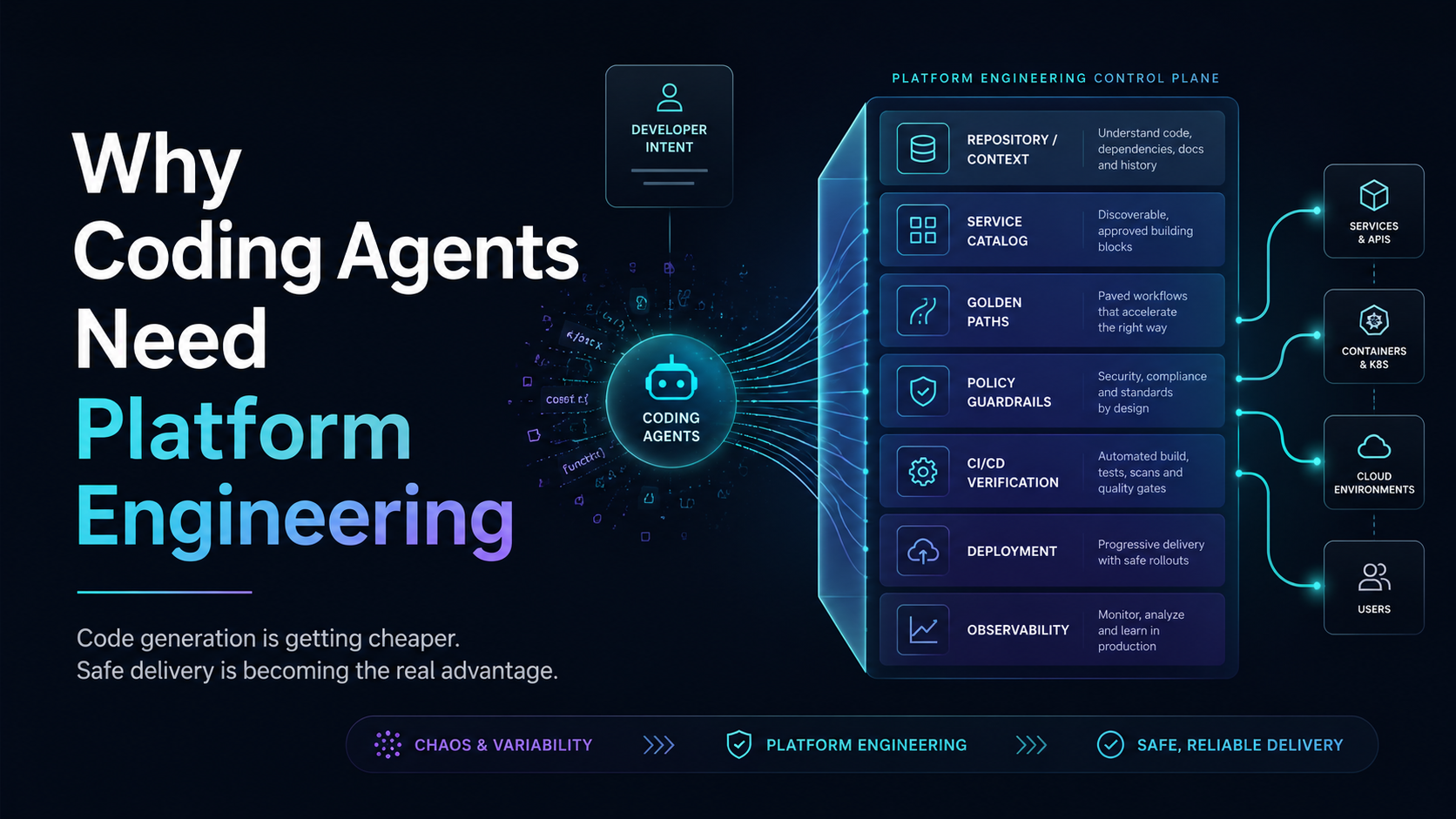
I’m building Flurit because I think the next big shift in software engineering is not just AI writing more code.
It is AI entering the delivery system.
That distinction matters.
A coding agent that can generate a pull request is useful. But a coding agent that understands the repo, follows the team’s standards, respects deployment boundaries, uses approved workflows, and produces changes that are easier to verify is much more valuable.
This is the gap I keep coming back to.
Most teams are experimenting with AI at the edge of the development workflow. They add a coding assistant to the IDE. They connect an agent to GitHub. They use it to write tests, explain code, refactor a function, or open a pull request.
That is a good start.
But it does not solve the deeper problem.
The real bottleneck in modern engineering is not only code generation. It is delivery trust. It is knowing whether a change is safe, aligned with the architecture, compliant with internal standards, observable in production, and easy to maintain after it ships.
That is the problem Flurit is being built around.
Flurit is focused on helping teams build more useful agentic workflows for software delivery — not just agents that create code, but workflows that connect coding agents with the platform context, guardrails, and verification layers they need to operate safely.
If you are a developer, DevOps engineer, platform engineer, or technical founder thinking about how AI agents should fit into real engineering systems, you can join the Flurit waitlist here:
Because this post is the core belief behind the product:
Coding agents will not reach their full potential in isolation. They need platform engineering.
The first wave of AI in software development was about assistance.
Autocomplete inside the IDE. A better search experience. A faster way to write boilerplate. A quick explanation of an unfamiliar function. Useful, but still limited. The developer remained fully in the driver’s seat, and AI mostly helped with the next line, the next function, or the next small task.
That phase already feels old.
We are now entering a different phase: delegated software work.
Coding agents are no longer just suggesting snippets. They can read a repository, understand an issue, create a branch, change multiple files, run tests, update documentation, and open a pull request. They can sit inside an IDE, a terminal, a GitHub workflow, or a cloud environment. They are starting to behave less like autocomplete and more like junior contributors with unusual speed, infinite patience, and very uneven judgment.
That shift changes the architecture question for engineering teams.
The question is no longer simply, “Can AI write code?”
It clearly can.
The better question is, “Can our engineering system safely accept work from AI?”
For many teams, the honest answer is not yet.
Code generation was never the whole problem
Software teams have spent years optimizing how code gets written. Better languages, better frameworks, better editors, better package managers, better CI/CD pipelines, better documentation, better cloud primitives. All of it helped.
But anyone who has worked inside a real engineering organization knows that writing code is only one part of shipping software.
The hard part is not always producing the change. The hard part is knowing whether the change belongs in the system.
Does it follow the architecture? Does it use the right internal library? Does it respect the deployment model? Does it create a security problem? Does it increase cloud cost? Does it break an API contract? Does it need a migration plan? Does it have the right tests? Can it be rolled back? Who owns it after it ships?
These are not questions a generic coding agent can answer well by default.
A coding agent can produce a pull request quickly. That is valuable. But speed at the pull request stage does not automatically translate into speed at the delivery stage. In fact, the opposite can happen. If the organization does not have strong engineering standards, fast feedback loops, good test coverage, clear ownership, and reliable deployment paths, AI-generated work can create more review pressure rather than less.
This is the uncomfortable part of the current AI moment in software engineering.
AI makes it easier to create work.
It does not automatically make the work safe, correct, maintainable, or production-ready.
That gap is where platform engineering becomes important.
AI exposes the quality of your engineering system
A lot of teams are experimenting with coding agents by adding them at the edge of the development workflow. They add an AI assistant inside the IDE. They connect an agent to GitHub. They let it comment on pull requests. They ask it to write tests, refactor code, or fix small bugs.
That is a reasonable place to start. But it also hides the deeper problem.
Most organizations do not suffer from a lack of code. They suffer from unclear paths to production.
The build process is different across teams. Service ownership is not obvious. Documentation is stale. Terraform modules are copied instead of reused. CI pipelines have grown organically. Security policies exist, but they are enforced late. Developers still ask around in Slack to figure out how something should be deployed. Senior engineers carry too much tribal knowledge in their heads.
Now add coding agents to that environment.
The agent may generate code faster than a human, but it is still operating inside the same messy system. If the correct pattern is buried in an old pull request, the agent may miss it. If there are three ways to deploy a service, the agent may pick the wrong one. If the documentation is outdated, the agent may confidently follow the outdated path. If ownership is unclear, the agent may open a technically plausible pull request that nobody feels responsible for maintaining.
This is why AI does not remove the need for architecture.
It raises the cost of bad architecture.
When humans work inside a messy system, they compensate through conversation, memory, intuition, and experience. That is slow, but it works up to a point. Coding agents do not have that same organizational intuition unless the system exposes it clearly.
If your engineering standards are implicit, agents will guess.
If your delivery paths are inconsistent, agents will multiply that inconsistency.
If your verification process depends too heavily on senior humans manually catching problems, agents will create more pressure on the exact people who are already overloaded.
This is the point many teams will learn the hard way: AI is an amplifier. It amplifies good systems, but it also amplifies weak ones.
Platform engineering gives agents a system to operate inside
Platform engineering is often described as the practice of building internal tools for developers. That definition is not wrong, but it is too small.
The better definition is this:
Platform engineering turns repeated engineering work into safe, self-service paths.
That matters because modern engineering teams are not just trying to move faster. They are trying to move faster without losing reliability, security, compliance, observability, or cost control. The platform exists to reduce cognitive load while increasing consistency.
A good platform tells developers how work should move through the system. It gives them approved templates, reusable infrastructure modules, deployment workflows, service catalogs, environment standards, observability defaults, security checks, and clear ownership models.
Now imagine coding agents inside that environment.
The agent is no longer guessing how to create a service. It uses the approved service template.
It is no longer inventing a deployment path. It follows the platform workflow.
It is no longer deciding how logs and metrics should be added. The platform provides the default instrumentation.
It is no longer guessing who should review the change. The service catalog knows the owner.
It is no longer free to make risky infrastructure changes without control. Policies and permissions define what it can touch and what requires human approval.
This is the right mental model:
The agent brings execution.
The platform brings context, standards, guardrails, and verification.
Without the platform, a coding agent is just another contributor with incomplete onboarding. With the platform, it can operate inside a system that already knows how software should be built, checked, shipped, and maintained.
The real architecture is the delivery control plane
When people talk about AI in software development, they often focus on the model. Which model writes better code? Which agent handles larger repositories? Which tool has better IDE integration? Which product can open a pull request?
Those questions matter, but they are not the whole story.
The more important question is what surrounds the agent.
A useful agentic delivery architecture needs a control plane. Not in the heavy, enterprise-buzzword sense. I mean a practical layer that connects developer intent, agent execution, internal context, workflow automation, policy enforcement, testing, deployment, and observability.
In a traditional workflow, a developer writes code and then pushes it through CI/CD. In an agentic workflow, the developer may define the intent, the agent may create the change, and the platform must decide how that change is evaluated.
That evaluation cannot be casual.
If the agent changes application code, the system should know which tests matter. If it changes infrastructure, the system should run policy checks and cost checks. If it touches authentication, payments, customer data, IAM permissions, database migrations, or production configuration, the workflow should automatically become stricter.
The platform should not treat every pull request as equal.
A CSS change, a dependency upgrade, a Terraform change, and a database migration do not carry the same risk. An agentic delivery system needs to understand that difference. It needs to route work through the right checks, the right reviewers, and the right approval gates.
This is where platform engineering becomes more than developer experience.
It becomes the safety layer for AI-assisted engineering.
Context is now infrastructure
One of the biggest mistakes teams will make with coding agents is assuming that repository access is enough.
It is not.
A repository tells the agent what the code currently looks like. It does not always explain why the system exists, which patterns are preferred, which ones are deprecated, what production incidents shaped the current architecture, which APIs are sensitive, which services are business-critical, or which tradeoffs the team has already made.
That context matters.
In the human world, this is why onboarding takes time. A senior engineer does not just know the syntax. They know the terrain. They know which service is fragile, which migration pattern caused pain last year, which team owns the billing flow, which deployment should never happen on a Friday evening, and which dashboard tells the truth when production is burning.
Agents need a version of that context.
This does not mean dumping every internal document into a vector database and hoping for the best. It means treating engineering context as part of the platform.
A service catalog should know who owns each service, where it runs, what it depends on, what SLOs matter, and how it is deployed. Architecture decision records should explain why important choices were made. Runbooks should be current enough to be useful. Internal libraries should be discoverable. Golden paths should be documented in a way that both humans and agents can follow.
When context is scattered, the agent guesses.
When context is structured, the agent can act with much better alignment.
This is why developer portals, service catalogs, repo-level instructions, internal documentation, and platform APIs become much more valuable in the agentic era. They are not just there to help humans find information faster. They become the operating context for automated contributors.
Golden paths beat better prompts
There is a lot of focus right now on prompting. Better prompts, better instructions, better agent rules, better system messages, better repo-level guidance.
All of that helps.
But prompts are not a substitute for platform architecture.
If every developer has to repeatedly explain your engineering standards to an agent, the organization has not created leverage. It has simply moved tribal knowledge into slightly better text boxes.
The more scalable answer is to encode common workflows into golden paths.
A new service should not start from a blank folder. It should start from an approved template.
A new API should not invent its own logging, authentication, metrics, and error-handling style. Those should come from standard patterns.
Infrastructure changes should not be copied from a random old project. They should use supported modules.
Deployments should not depend on each team’s custom pipeline unless there is a strong reason. They should flow through a paved delivery path with known checks and rollback behavior.
This matters even more with coding agents because agents reduce the friction of creating variation.
A human may hesitate before spinning up a new pattern. An agent will happily generate one if the instruction is ambiguous. Over time, that creates architecture drift. The organization ends up with more code, more patterns, more exceptions, and more things nobody fully understands.
Golden paths prevent that.
They give both humans and agents a default way to do the right thing.
That is the heart of platform engineering.
Not control for the sake of control. Not bureaucracy. Not forcing every team into the same shape.
The goal is to make the safe path the easy path.
Verification becomes the bottleneck
As code generation gets faster, verification becomes more important.
This is already happening. Developers can now create larger changes faster than before. That sounds good until reviewers are buried under pull requests they do not fully trust. If the team’s test suite is weak, CI is flaky, security scanning is inconsistent, and preview environments are hard to create, AI-generated work does not feel like acceleration. It feels like more uncertainty.
The winning teams will be the ones that make verification fast and reliable.
That means tests need to be meaningful. CI should be fast enough that developers and agents can use it as a feedback loop, not a slow ceremony. Security and policy checks should happen before production risk is introduced. Infrastructure changes should be validated automatically. Preview environments should be easy to create and destroy. Observability should be part of the default path, not something added later when production breaks.
This is one of the clearest places where platform engineering pays off.
A coding agent can create the change.
The platform has to prove the change is safe.
That proof cannot depend only on a senior engineer reading every line with perfect attention. Human review still matters, but it should be supported by automation. The reviewer should be looking at a structured, tested, policy-compliant change with clear evidence, not trying to manually reconstruct what the agent did and why.
In the agentic era, the pull request needs to become more than a diff.
It needs to become a package of evidence.
What changed? Why did it change? Which tests passed? Which policies were checked? Which services are affected? What is the risk level? Who owns the affected area? Is rollback straightforward? Are there migrations? Are there production implications?
If the platform can answer those questions automatically, coding agents become much easier to trust.
If it cannot, every agent-generated pull request becomes another investigation.
The platform team becomes the AI enablement team
This shift also changes the role of platform teams.
In many organizations, platform teams have been treated as internal infrastructure support. Developers need a pipeline, a database, a Kubernetes namespace, a secret, a dashboard, or a deployment fix, so they open a ticket. The platform team helps. The queue grows. Everyone complains about speed.
That model was already under pressure.
Coding agents will break it completely.
If agents increase the volume of changes moving through engineering systems, the answer cannot be more manual platform support. The answer has to be better self-service, better defaults, and better automation.
The platform team’s job becomes designing the system in which both humans and agents operate.
That means building the paved roads, defining the boundaries, maintaining the context layer, encoding policies, improving CI/CD, managing developer portals, standardizing observability, and making safe delivery easier than unsafe delivery.
This is a more strategic role than simply managing infrastructure.
The platform team becomes the bridge between AI speed and production reality.
It is the group that decides how much autonomy is safe, where approvals are required, which workflows can be automated, which risks must be surfaced, and how learning from incidents and reviews gets fed back into the system.
That is not just DevOps.
That is AI-era software architecture.
A simple example
Imagine a developer creates an issue that says: “Add rate limiting to the billing API.”
Without a strong platform, the coding agent reads the repository and makes its best attempt. It may find the right endpoint. It may add a rate limiter. It may write a test. It may even open a clean-looking pull request.
But there are many ways this can go wrong.
Maybe the company already has an approved internal rate-limiting library. Maybe the billing API has stricter reliability requirements than other services. Maybe the API gateway should handle the limit instead of the application code. Maybe the service is subject to compliance rules. Maybe the change needs a metric, a dashboard update, or a runbook entry. Maybe the agent does not know that a similar implementation caused an incident six months ago.
Now place the same task inside a platform-engineered system.
The agent can discover that the billing API is owned by the payments team. It can see that the service is classified as sensitive. It can find the approved rate-limiting pattern. It can use the standard library or gateway configuration. It can add the required metric. It can update the runbook. It can trigger the right tests and policy checks. It can tag the correct reviewers. It can include a useful summary in the pull request.
The human reviewer is still important. But now they are not reviewing a random AI-generated guess. They are reviewing a change that moved through a known system.
That is the difference.
Platform engineering does not make agents perfect.
It makes their work easier to inspect, constrain, and improve.
Start small, but start with the system
The mistake would be to think that a company needs a perfect internal developer platform before it can use coding agents.
That is not realistic.
A better approach is to take one repeated workflow and make it agent-ready.
For example, start with dependency upgrades, test generation, documentation updates, small bug fixes, or service template creation. Pick something that happens often, creates friction, and has a clear definition of done.
Then build the platform support around that workflow.
Define the expected inputs. Make the relevant context discoverable. Create or improve the golden path. Add the required checks. Clarify ownership. Standardize the pull request format. Decide where human approval is needed. Capture feedback when the agent gets something wrong.
This is how teams should think about adoption.
Not “How do we let AI do everything?”
But “Which workflow can we make safe enough for AI-assisted execution?”
That framing is healthier.
It avoids both extremes. It does not reject AI out of fear, and it does not hand production systems to agents out of excitement. It treats AI adoption as an architecture problem.
That is the right level of seriousness.
The companies that win will not just have better agents
Most companies will have access to similar AI tools.
They will use the same major models. They will install the same IDE extensions. They will experiment with the same coding agents. They will connect AI to GitHub, Slack, Jira, terminals, and cloud sandboxes.
The tool itself will not be the durable advantage.
The durable advantage will be the engineering system around the tool.
A company with strong platform engineering can convert AI-generated work into reliable delivery. A company with weak platform engineering will convert AI-generated work into larger review queues, inconsistent patterns, hidden technical debt, and fragile deployments.
That is why this moment is bigger than coding assistants.
AI is making code cheaper to produce.
Platform engineering makes code safer to ship.
And shipping is where value is created.
Final thought
Coding agents do not eliminate the need for platform engineering.
They make it unavoidable.
The faster software work can be generated, the more important it becomes to define how that work enters the system, how it is checked, how it is secured, how it is deployed, and how it is maintained after release.
Speed by itself is not the goal.
Trustworthy speed is the goal.
That is the real promise of coding agents when they are paired with platform engineering. Developers can focus more on intent, product thinking, architecture, and judgment. Agents can help with execution. Platforms can provide the structure that turns that execution into production-ready change.
Without that structure, AI just creates chaos faster.
With it, coding agents become part of a better software delivery system.
And that is where the real opportunity is.
Thanks for reading Autonomous AI Architect! Subscribe for free to receive new posts and support my work.