When agents write the code, review has to verify intent, context, tests, ownership, and delivery risk, not just the changed lines.
By Sumant Thakur
Published: 2026-06-11
URL: https://sumantthakur.substack.com/p/the-future-pr-is-an-evidence-packet
If an AI system can author most of the code that gets merged, then the bottleneck has already moved.
It is no longer only about whether the agent can write code.
Thanks for reading Autonomous AI Architect! Subscribe for free to receive new posts and support my work.
It is whether the team can trust, review, and safely merge the change fast enough.
That is the part I think we are underestimating.
Anthropic recently said that, as of May 2026, more than 80% of the code merged into Anthropic’s codebase was authored by Claude. It also said the typical engineer was merging around 8× as much code per day as in 2024. That is a remarkable signal, even if we treat it as internal company data rather than a universal benchmark.
But the important part is not the exact percentage.
The important part is the direction.
If coding agents can produce more code, more fixes, more refactors, more experiments, and more implementation attempts, then software teams need a different review layer.
Because the old code review model was built for a slower world.
A human wrote the code. Another human reviewed the diff. They asked questions. They checked the tests. They approved or requested changes.
That workflow assumes the reviewer can understand the change mostly by reading the diff and asking the author for missing context.
Agentic coding breaks that assumption.
The diff is still important.
But the diff is no longer enough.
The old review model assumes a human path
Code review has never been only about syntax.
A good reviewer is not just reading changed lines. They are trying to understand intent.
Why was this change made? What problem is it solving? What trade-offs were considered? What did the author already try? What could break because of this? Who owns the affected area? Is this ready to merge?
When the author is human, some of that context is implicit. The reviewer assumes there was a path behind the diff. The author read the surrounding code, understood the requirement, tried an approach, adjusted after failures, ran tests, and can explain what happened.
That assumption is weaker with agent-authored code.
The agent may have generated the final patch after several failed attempts. It may have inspected only part of the repository. It may have followed the issue too literally. It may have passed one test while missing a broader architectural constraint. It may have made a locally correct change that does not fit the team’s ownership model or deployment path.
The code may look fine.
The path that produced it may still be unclear.
That is where review changes.
With human-written code, the reviewer often reviews the output and reconstructs the reasoning through conversation.
With agent-written code, the reviewer needs the reasoning trail as part of the artifact.
Not because humans should distrust every agent-generated change.
Because trust does not scale through vibes.
Trust scales through evidence.
The PR is becoming a different object
A pull request used to be a diff with a description.
In agentic development, a pull request needs to become more than that.
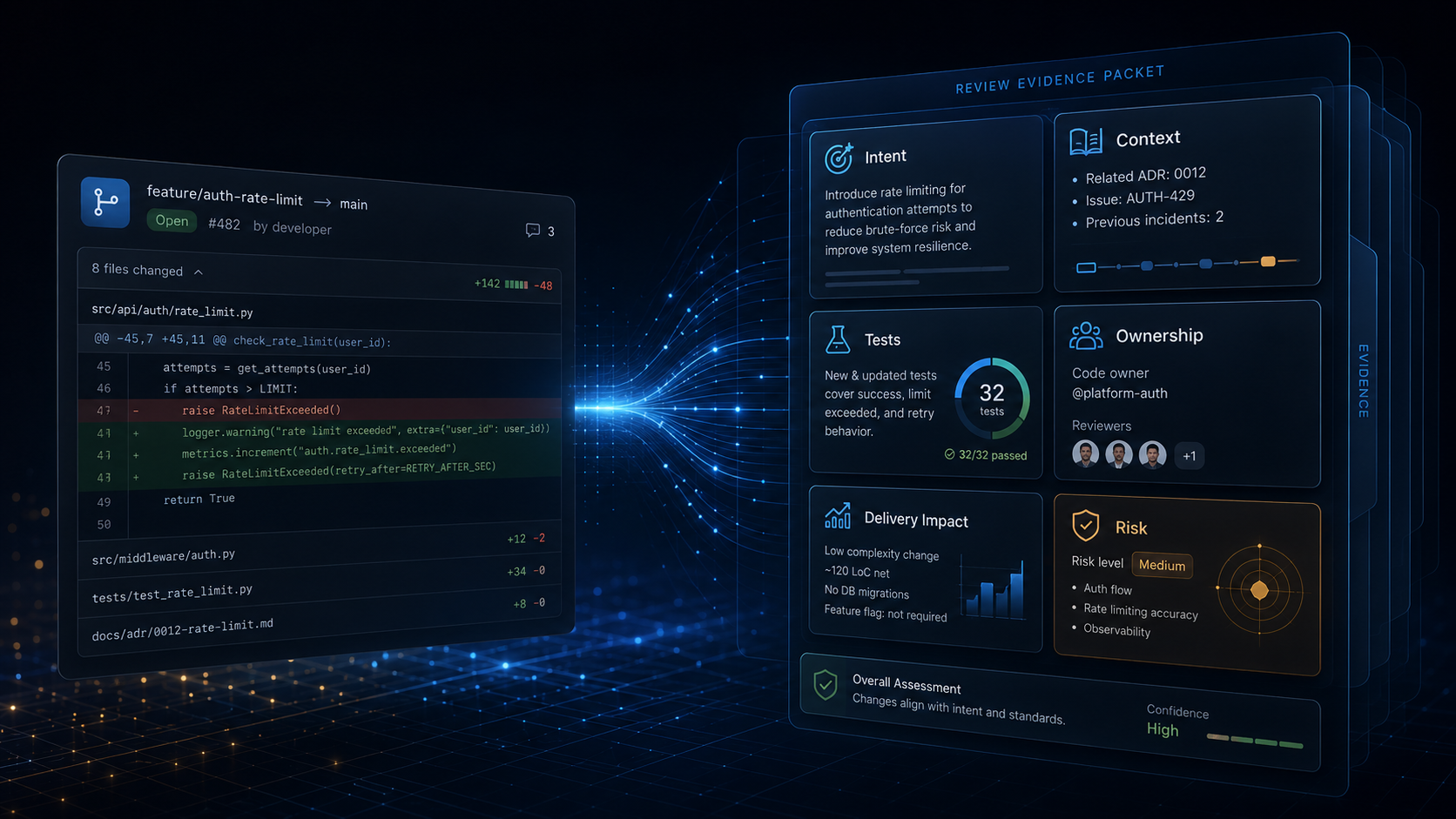
It needs to become an evidence packet.
That does not mean dumping every log, token, prompt, and failed command into the PR. That would make review worse, not better.
An evidence packet is the opposite of a log dump.
It is the structured context a human reviewer needs to make a faster and better decision.
It should tell the reviewer what the agent was asked to do, what context it inspected, what assumptions it made, what it changed, what it validated, what failed before the final version, and what still needs human judgment.
This is the difference between:
“Here is the diff.”
and:
“Here is the change, the intent behind it, the evidence supporting it, and the remaining risk.”
That distinction matters because AI-generated code changes the review burden.
The reviewer is no longer only checking whether the code compiles or follows style.
The reviewer is checking whether the agent understood the task, touched the right surface area, avoided the wrong shortcuts, validated the right behavior, and stayed inside the expected boundaries.
A future PR may still show a diff first.
But the merge decision will increasingly depend on the evidence around the diff.
This is already visible in review behavior
Early research is starting to show that AI-assisted review does not simply remove human review work.
It changes the shape of it.
One recent study, Human-AI Synergy in Agentic Code Review, found that human reviewers exchanged 11.8% more review rounds when reviewing AI-generated code than human-written code. It also found that suggestions made by AI agents were adopted at a much lower rate than suggestions made by human reviewers: 16.6% compared with 56.5%. More than half of unadopted AI suggestions were either incorrect or handled through alternative fixes by developers.
That is an important signal.
The issue is not simply that AI code is bad.
The issue is review confidence.
If a reviewer has to spend more time figuring out whether the agent understood the context, then the productivity gain moves downstream. The code was produced faster, but the team still pays the cost during review.
Another paper, Understanding Dominant Themes in Reviewing Agentic AI-authored Code, analyzed thousands of review comments on agent-authored PRs and found that beyond functional correctness and logical changes, reviewers frequently focused on documentation gaps, refactoring needs, styling and formatting issues, testing, and security concerns.
That also makes sense.
Agentic coding does not only create code.
It creates review questions.
And if the review layer does not evolve, those questions pile up on human reviewers.
The developer role is moving toward merge confidence
GitHub’s recent Copilot app announcement is interesting for this reason.
The headline is that GitHub is building an agent-native desktop experience. But the deeper signal is that developer workflows are moving toward supervising agent-produced workstreams. Agents can be assigned tasks, work across repositories, generate changes, analyze context, and execute actions.
That changes the developer’s center of gravity.
The developer is not only writing every line.
The developer is increasingly deciding which agent-produced change is ready to trust.
That sounds subtle, but it is a big workflow shift.
The old bottleneck was creating the change.
The new bottleneck is merge confidence.
Can I understand what this agent did? Can I verify that it did the right thing? Can I see what failed before this version? Can I trust the tests it ran? Can I see what parts of the system are affected? Can I safely merge this without becoming the human rubber stamp for a machine-generated diff?
That is the real pressure.
The review layer has to answer those questions without forcing the human to replay the entire agent session in their head.
A summary is not enough
One tempting answer is to make agents write better PR descriptions.
That helps.
But a PR description is not an evidence packet.
A description can say:
I fixed the authentication issue and added tests.
Evidence should show what issue was fixed, which files were inspected, which tests were added, which tests were run, what failed earlier, what changed after failure, and what confidence the system has in the final result.
A summary tells the reviewer what the agent claims.
Evidence helps the reviewer verify the claim.
This is the same distinction that is becoming important across agentic systems.
Summaries are useful for communication.
Receipts are needed for trust.
When the author is an agent, reviewers need fewer polished explanations and more useful evidence.
Not more text.
Better structure.
Review must expand beyond the diff
This becomes even more important when agent-generated code touches infrastructure, CI/CD, configuration, deployment logic, or cloud resources.
A diff can show that a Terraform file changed.
It may not show whether the cost changed meaningfully.
A diff can show that a deployment config was updated.
It may not show which environment will be affected.
A diff can show that a GitHub Actions workflow was modified.
It may not show whether the new pipeline changes release behavior.
A diff can show that a secret reference was renamed.
It may not show whether the runtime environment actually has the new secret.
This is where DevOps and platform engineering become central to agentic coding.
Agent-generated code is not only a source-code problem.
It is a delivery-system problem.
When agents change code that affects runtime behavior, review has to include operational evidence: tests, policy checks, deployment impact, rollback readiness, ownership, observability, and sometimes cost.
The reviewer should not have to infer all of that manually from a patch.
If agents are going to generate the change, the system around the agent should generate the review evidence.
That is the trade.
More automation in generation requires more structure in verification.
The future review layer will be evidence-first
I think the review layer around agentic coding will evolve in three directions.
First, PRs will include more structured context about intent. Not long essays, but clear records of what the agent was asked to do and what scope it operated within.
Second, validation traces will matter more. Reviewers will want to know what tests ran, what failed, what was retried, and what remained unverified.
Third, operational impact will become part of code review by default for certain changes. If the change affects infra, CI/CD, secrets, deployment behavior, cost, or production state, the review packet should surface that before merge.
This is not about replacing reviewers.
It is about making reviewers stronger.
The human reviewer should spend less time reconstructing the agent’s path and more time exercising judgment.
That is where human review still matters most.
Judgment. Ownership. Taste. Architectural fit. Risk acceptance. Business context.
Agents can generate changes.
They can even help gather evidence.
But humans still need to decide whether the change belongs in the system.
The wrong future is review theater
There is a bad version of this future.
Agents generate code.
Agents generate PR descriptions.
Agents generate test summaries.
Agents generate review comments.
Humans skim the page, see green checks, and approve.
That is not review.
That is review theater.
The problem with review theater is that everything looks responsible from the outside. There is a PR. There is a summary. There are checks. There are comments. There is an approval.
But the human never really saw the evidence that mattered.
This is the trap teams need to avoid.
The goal is not to make agent-authored PRs look more human.
The goal is to make them more verifiable.
A good review layer should not hide the agent’s uncertainty. It should surface it.
It should say where the agent had strong evidence, where it made assumptions, where validation is incomplete, and where human judgment is required.
That is what makes review useful.
The future PR is an evidence packet
This is the mental model I keep coming back to.
The future PR is not just a diff.
It is an evidence packet.
The diff shows what changed.
The evidence packet shows why the change should be trusted.
For human-written code, we often got that evidence through conversation, team context, and author judgment.
For agent-written code, we need to make more of it explicit.
Not because agents are uniquely untrustworthy.
Because agents can produce changes faster than humans can casually inspect them.
When production systems are involved, speed without evidence becomes risk.
That is the bottleneck.
Not code generation.
Merge confidence.
Closing thought
The next phase of AI software engineering will not be decided only by which model writes the best code.
It will be decided by which teams build the best review layer around generated change.
The diff will still matter.
But the diff will not be enough.
Review needs intent. Review needs context. Review needs validation. Review needs ownership. Review needs operational evidence.
As agents write more code, the human reviewer should not become a slower parser of machine-generated diffs.
The reviewer should become the decision-maker over a better evidence packet.
That is how agentic coding becomes production software.
Not by generating more code.
By making generated change easier to trust.
P.S. This is one of the directions shaping how we are thinking about Flurit AI. DevOps agents should not only generate infrastructure artifacts. They should preserve the evidence needed to review, approve, and safely move from application intent to infrastructure change.
If that sounds relevant to your team, you can join the early-access waitlist here: [Join the Flurit waitlist]
Thanks for reading Autonomous AI Architect! Subscribe for free to receive new posts and support my work.