Why the real problem is no longer prompting, but runtime, state, routing, and failure control.
By Sumant Thakur
Published: 2026-04-07
URL: https://sumantthakur.substack.com/p/agents-are-becoming-distributed-systems
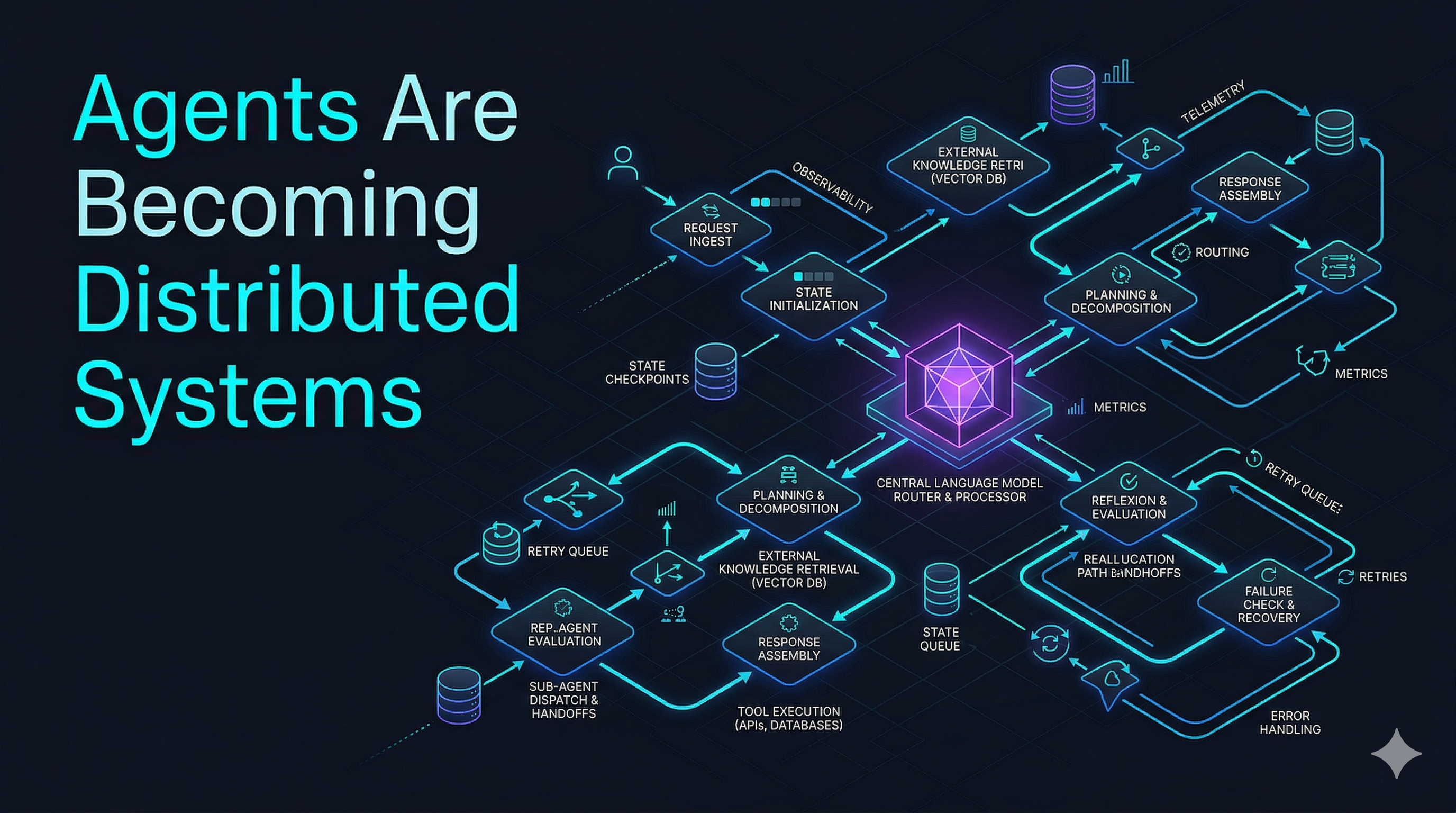
We are not really building agents yet.
We are building unreliable distributed systems with a language model in the middle.
That sounds harsh, but the moment an agent has to do more than one step, the truth becomes obvious. This is no longer about prompts. It is about state, routing, retries, failure modes, handoffs, and control flow.
In other words, it is a system.
And systems do not care how elegant the prompt was.
The demo model breaks fast
The first version of the mental model is always simple:
prompt in, tool call out, answer back.
That works for demos. It works for screenshots. It works when everything succeeds on the first try.
It does not work in production.
In production, the system has to remember what it already did. It has to wait on external systems. It has to recover after failure. It has to choose between branches. It has to hand work off. It has to stop at the right time. It has to leave a trace behind so we can understand what happened.
At that point, we are not building assistants anymore.
We are building runtime infrastructure.
State is not optional
This is where things get real.
Without state, the system forgets too much. With bad state, it remembers the wrong things. With too much state, it becomes noisy, slow, and hard to trust.
So the real question is not “does the agent remember?”
The question is:
What should persist? What should expire? What should survive across runs? What should be scoped to a single task? What should be checkpointed? What should be discarded?
That is not a secondary concern. That is the core of the system.
If state is wrong, everything becomes unpredictable.
The system repeats itself. It acts on stale context. It takes the wrong branch. It becomes brittle in ways that are hard to explain.
And at that point, prompt tuning does not help.
Routing is the real control problem
As soon as there is more than one step, routing becomes the central problem.
Should the same agent continue? Should another agent take over? Should the workflow branch? Should the system ask for approval? Should it gather more context before acting? Should it fail closed or keep going?
These are not model questions.
These are control questions.
And control questions determine whether the system works or fails.
A workflow with poor routing will break even if every individual model call looks correct in isolation. That is why thinking in terms of “agent capability” is not enough.
The real question is:
What path does work take through the system?
That is the architecture.
Reliability is the real engineering work
In production, everything around the agent is unreliable.
Tools fail. APIs time out. Context changes. State drifts. External systems move underneath the workflow. A decision that was valid earlier may no longer be valid now.
So the system needs:
Retries with logic Checkpoints Idempotency Clear termination rules Recovery paths Fallback behavior Rollback support
This is not optional.
This is backend engineering.
The only difference is that control flow is now partially driven by reasoning, which makes the system more flexible and more fragile at the same time.
Debugging is where systems break
This is where most systems fail silently.
When something goes wrong, the real question is:
What happened?
If there is no trace, no checkpoint, no state history, and no replay, then there is no answer.
And without an answer, there is no way to fix the system.
A real agent system must make it possible to reconstruct:
- what it saw
- what it inferred
- what it decided
- what it handed off
- what it retried
- what it skipped
- what branch it took
- what changed during execution
Without that, we are not operating software.
We are observing behavior.
Multi-agent is not the answer
Adding more agents is not a solution by default.
Sometimes it helps. Sometimes it introduces clarity. But often it increases:
- coordination overhead
- state transitions
- failure modes
- cost
- debugging complexity
The real question is not “how many agents?”
The real question is:
What control topology does this system need?
A single agent with strong state? A router? A handoff model? A verifier? A human approval layer? A workflow engine?
That is the design decision that matters.
What this means for how we build
If agents are becoming distributed systems, then the stack must reflect that.
We need:
- explicit state management
- durable execution
- structured routing
- controlled handoffs
- checkpoints and replay
- approval gates
- traceability
- policy enforcement
- rollback paths
This is not a prompt layer.
This is a runtime.
The shift that is coming
Right now, most attention is still on the model layer.
That will change.
The systems that succeed will not be the ones with the most impressive demos. They will be the ones that can move work safely through the runtime, preserve state, recover from failure, and remain observable enough to be trusted.
That is where real software lives.
That is where trust lives.
That is where infrastructure lives.
Agents are not just prompts anymore.
They are systems with memory, branches, failures, and control flow.
In other words, they are becoming distributed systems.
And once that becomes clear, the focus shifts.
From demos to systems
From prompts to runtime
From intelligence to reliability
Flurit is what I’m building to make agentic DevOps safe by design where identity, policy, and execution boundaries are first-class, not afterthoughts.